

Every year, people from Macau make at least 30,000 trips to Taiwan for work or business. So where do they go once they get here? A stroll around Taipei's Little Macau provides the answer.
"Business is pretty good in Taiwan. When I heard from relatives that the local antiques market looked promising for the next ten years, I applied to the authorities and moved here from Macau." So says Mrs. Chen, a stallholder at the weekend jade market-also known as "Little Macau"-in Taipei's Kuanghua Bazaar.
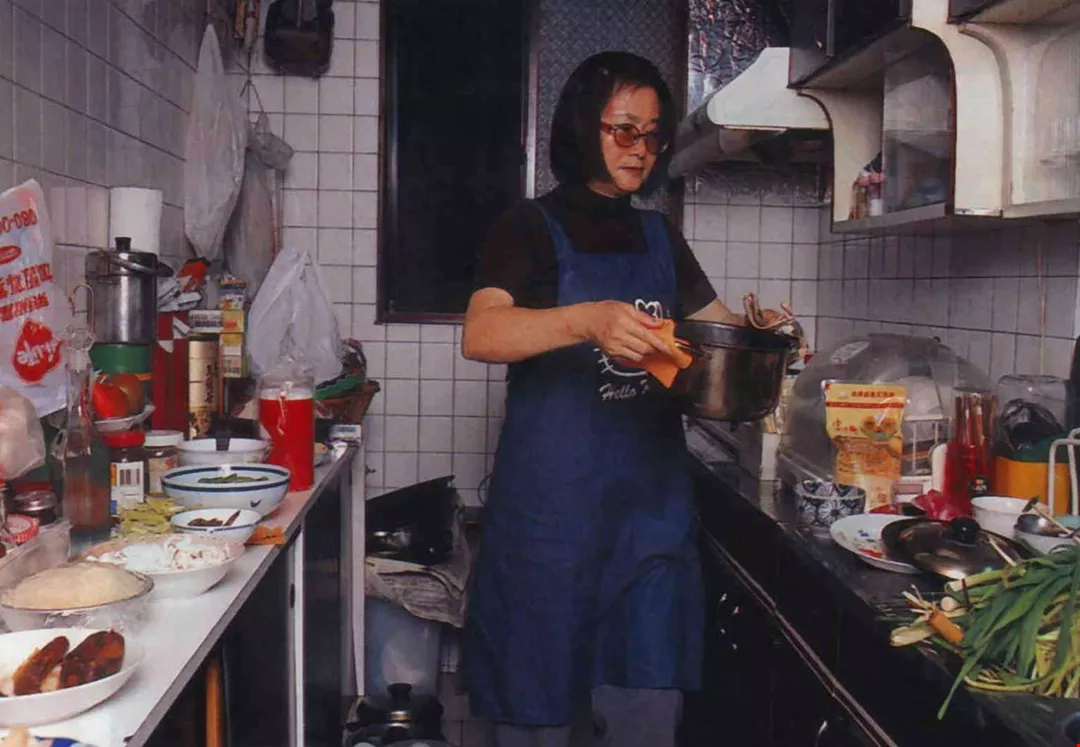
Though Ku Yue's kitchen is small, she has the skill to conquer its limitations and produce more than ten dishes for the holiday dinner.
"Leap-frogging" to Taiwan
Taipei's Little Macau actually covers two locations. The first is the triangular area bounded by Pateh Rd, Civil Boulevard and the Hsinsheng North Rd. overpass, next to Kuanghua bazaar, where a jade market springs up at weekends and on public holidays. A few years ago when business was booming, there were one to two hundred stalls here, and "90% of them were run by people from Macau," says Lin Han-chang, owner of an antiquarian bookstore. The other location is in the vicinity of Huayin Street behind Taipei train station, where there's a market every afternoon. "Antiques are sold at both locations," says Lin, "but the pieces sold at Kuanghua bazaar are higher-grade and more authentic."
Most of those who come to Taiwan from Macau are ethnic Fujianese, from the Barrier-Gate area at Macau's northern end. They tend to speak Mandarin with a heavy Cantonese accent, but when chatting together in the market they use Minnan (Southern Fujianese), or Putian, another native dialect. Says Lin Han-chang: "People of Putian ancestry usually sell jade, while those from Quanzhou sell antiques." But the divisions are not always so precise.
It's hard to say exactly when and how Little Macau began to take shape, but the Macau stallholders have been congregating in Taipei for at least ten years now. Although the market took shape naturally, several external factors also played a part.
First was the fact that up until 1994, when the Overseas Chinese Students Household Registration Law was passed in Taiwan, students from Hong Kong and Macau were allowed to settle here. Another important factor was the Macau government's liberal policy regarding immigration from the mainland during the 1980s, and especially following June 4, 1989, when special allowance was made for 50,000 new arrivals. As Mr. Yang, a regular at the weekend jade market explains, after several years these immigrants-the great majority of whom were Fujianese-were able to obtain Overseas Chinese Cards through Taiwan's representative office in Macau, and thus, one by one, they "leap-frogged" across to Taiwan.
The most important factor was market supply and demand. "Demand for antiques is very strong in Taiwan," says Lin Han-chang, who often chats with the Macau stallholders. Once the mainland opened up there were ample sources of antiques supply, and in the early days the export of artifacts from China was not tightly regulated. People in Macau spotted the market potential, and working as individual merchants they began bringing a steady flow of goods to Taiwan.
Antique exchanges
Many of the people who have moved from Macau to Taipei have their own unique stories. Some first fled to Macau during the Cultural Revolution, and others went there in search of a better life, moving in with relatives and leaving behind their homes in the remote mountain regions of Fujian. Later they came to Taiwan to work, established residency, and obtained a Taiwan identity card. One of them, Mr. Lin, who specializes in top-grade "Hetian" jade and originates from the town of Jinjiang on the mainland, says "Taiwan is my home." Lin has lived in Taiwan for more than ten years, his children are in school here and he has bought an apartment too. Every two weeks he travels back to the mainland in search of merchandise. "I go to Guangzhou, Beijing, Henan, Shandong, and anywhere that I can find good items," he says. "And I usually enter through Macau." In fact, there are many like Mr. Lin, who live in Taiwan but also have homes in Macau and on the mainland.
Some of them are really loaded up with travel documents, what with a Portuguese ID, Macau Residents Permit and ROC passport, all ready for use depending on where they are. One woman, who sells dZi beads and jade ornaments from her stall in the market, says mysteriously that she has "many different identities." Most of these people from Macau live in areas like Luchou, Tucheng and Sanchung, parts of Taipei County where housing is relatively affordable.
Lin Han-chang says that the later arrivals, who haven't yet bought homes here, tend to lodge in the Ziyun Hotel, next to Hsinsheng North Road overpass and upstairs from the jade market. They run their stalls here at the weekend, and spend the rest of the time traveling around Taiwan to sell their wares.
Mr. Yang says that Taiwan's market for mainland artifacts has been booming for the last few years, and they are usually shipped to Taiwan by the container-load, passing through Hong Kong on the way. "Sometimes when the container truck gets here, the wooden crates inside haven't been touched," says Yang, "which is to say that customs haven't inspected them at all." Some of the Macau dealers have their goods delivered straight to the Ziyun Hotel, though those hailing from Putian tend to use the Tainan Hotel in Chang'an West Road. Yang, who frequently visits the hotels to inspect incoming wares, says that they are "filled with antiques of every description."
Lin Han-chang points out that Little Macau may not be very large, but it's where the majority of Taipei's antique dealers get their wares. Lin himself does a circuit of all the stalls every weekend, and has picked up some interesting articles this way.
Little Macau adds variety to Taipei, and the antique dealers from Macau who gather there provide Taiwan's many connoisseurs of old artifacts with a great opportunity for interaction and education. So how about it? Take a stroll down to Taipei's Little Macau one of these days, and see what treasures you can pick up!

@List.jpg?w=522&h=410&mode=crop&format=webp&quality=80)
@List.jpg?w=522&h=410&mode=crop&format=webp&quality=80)


