Lukang: Old Streets Bring Forth New Art
Sam Ju / photos Chuang Kung-ju / tr. by Scott Williams
June 2014


An old saying runs, “Tainan, Lukang, then Mengjia.” It’s a reference to the past prosperity of the harbor towns of Tainan, Lukang (in Changhua County) and Mengjia (now Taipei’s Wanhua District), and their importance to Taiwan’s history and development.
Lukang will celebrate the 230th anniversary of its founding in 2014. Designated a trading port by the Qing imperial court in 1784, Lukang was an important part of Taiwan’s development.
Originally established as a harbor, Lukang expanded over the years, moving inland street by street and block by block. Its first major thoroughfare, constructed during the Qing Dynasty and still in use today, was built atop an elevated foundation. It is now known as Zhongshan Road.
In the Qing era, Lukang was famous for its “three absences”—its lack of sky, earth, and women—because visitors never seemed to see any of them. The “absent sky” was a reference to Zhongshan Road, where businesses determined to operate year-round covered the street with canopies. The stores’ willingness to pay for the canopies, which had the side effect of obstructing pedestrians’ view of the sky, strongly suggests that business was good in those days.
The “absent earth” was a comment on the town’s brick-paved roads, which hid loose earth from view. The “absent women” had to do with Lukang’s adherence to the custom of foot binding, which made it difficult for the town’s women to get out and about.
Nowadays, Lukang could be more accurately described as a town of “three plenties” for its abundance of historic sites, snacks, and artisans.
As old as Lukang is, it still has a few new tricks up its sleeves. One of them, the Osmanthus Alley Artists Village, is a great place to begin a stroll around town.
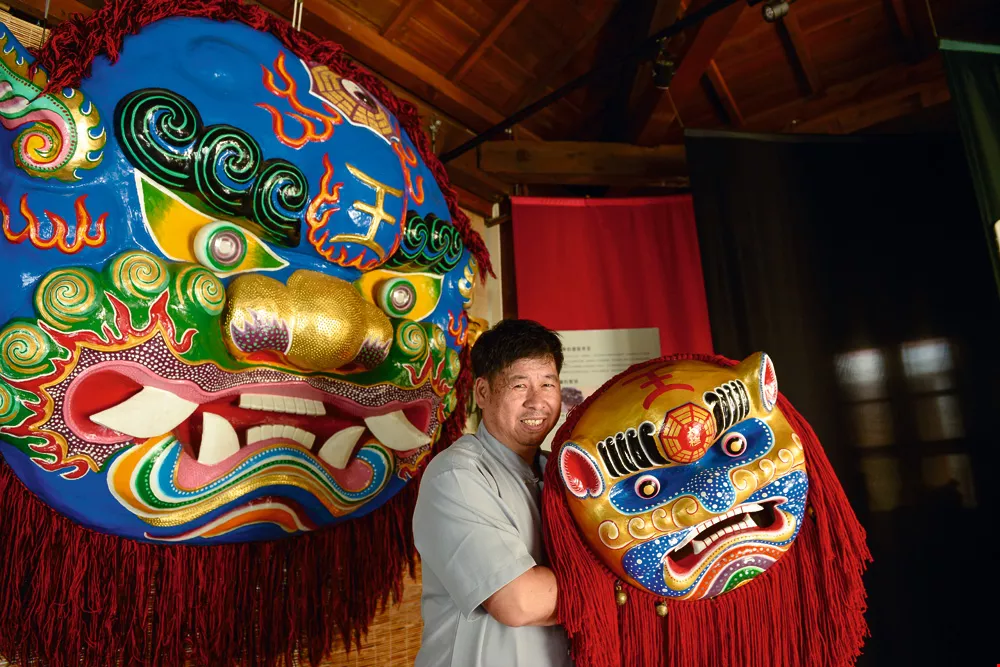
Shi Junxiong, the owner of the Shi Studio in Lukang’s Osmanthus Alley Artists Village, has Taiwan’s largest and most comprehensive collection of lion heads.
A handicrafts hub
During the period of Japanese rule, the Japanese raised low-lying land near the river and built dormitories on it. After Taiwan’s return to Chinese rule, the new government provided the dorms to civil servants and educators. Over the years, residents aged and passed away, causing the area’s population to decline. The government then negotiated the relocation of the remaining residents, and designated the area for revitalization and reuse. Following the renovation of the old Japanese residences, the area was named the Osmanthus Alley Artists Village.
The heart of the “village” is a broad street flanked by old Japanese dorms. Since 2010, the government has permitted artisans and artists to apply to live in the houses, and eight currently reside there.
The arrangement makes neighbors of artists and artisans. Those in residence work in a variety of fields, mixing the trendy with Lukang’s own “classic” vibe. The include a photographer, an oil painter, a flautist, an illustrator, a quilter, and a calligrapher.
Fifty-four-year-old Shi Junxiong, a sculptor of lion heads, is a particularly prominent village resident.
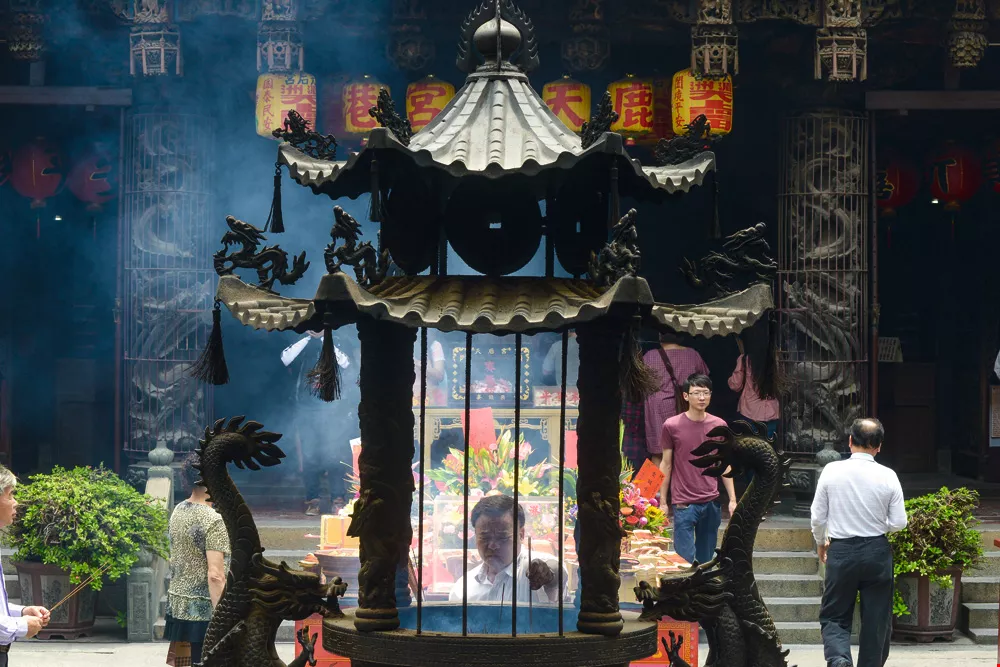
Lukang’s Mazu Temple is the town’s most iconic historic site.
The Shi Studio
“This place is full of ferocious beasts. Some children are afraid to come inside,” jokes Shi. The “Shi” in his studio’s name is a homophone for his surname and for “lion.”
Lion dancers use lion-head sculptures during their performances. Over the last 35 years, Shi has collected thousands of them, both large and small, and has become Taiwan’s grandmaster of lion heads.
Lukang isn’t the only place in Taiwan where lion heads are made, but individuals interested in seeing Taiwan’s most comprehensive collection would do well to seek out Shi.
The heads come in a variety of styles that vary with region and application. For example, martial arts clubs each have their own traditional lion head customs and styles. When hired to create lion heads for various martial arts clubs, Shi took the opportunity to compile the lion-head “genealogies” of each region of the Chinese-speaking world.
For example, lion heads from mainland China are generally made in the Beijing, Guangdong, or Fujian style. Taiwanese lion heads tend to be variants on the Fujian style, and are predominantly blue and green in color.
Lion heads also vary from region to region within Taiwan. Shi says that the lion heads used in the north are known as “northern open-mouths” for their moveable mouths. Those used by Hakka communities are called “Hakka open-mouths.” Those used in the central and southern parts of the island are generally “closed-mouth lions.”
“There are also differences between those in central Taiwan and the south,” explains Shi. “Central Taiwanese lion heads have a bulging forehead; south of Tainan, the flatter look of the ‘Song Jiang’ style head is more prevalent.”
Many visitors to the Shi Studio are startled to find a lion head with a pig’s nose in his collection. Laughing, Shi explains that an Aboriginal client once ordered a lion head with “Aboriginal characteristics,” but never provided a model to work from. After racking his brains, Shi suggested making a head with the nose of a wild boar—an animal often used by Aborigines for offerings—and the expression of a lion. The client agreed, and Shi created the odd-looking piece.
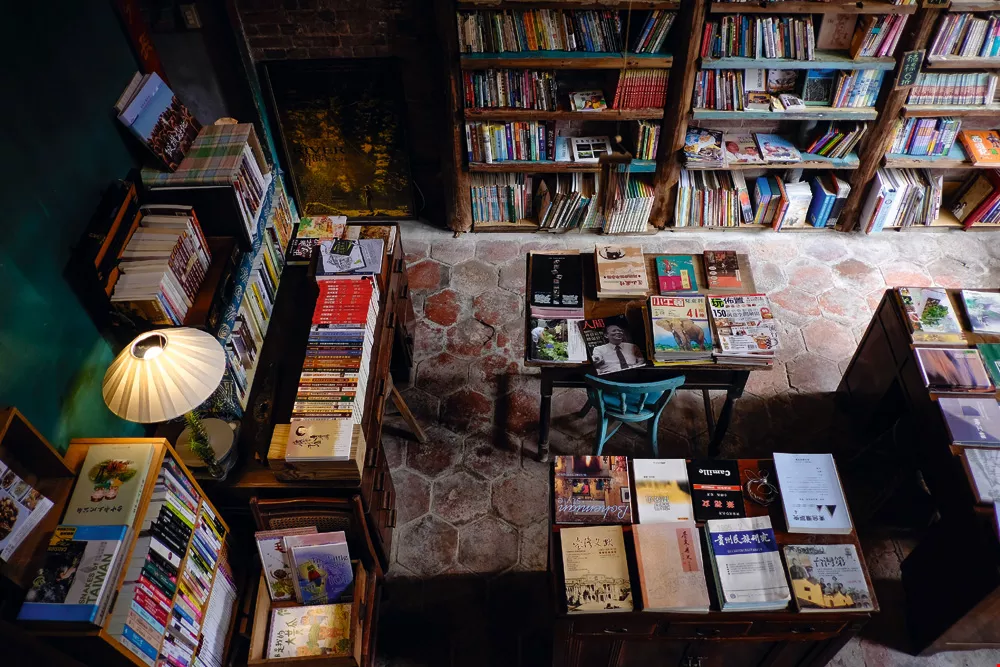
Surprises await around every corner in Lukang. Lately, teashops and second-hand bookstores, both old-fashioned and modern, have been popping up all over town.
Lukang’s must-see temples
Fans of Luo Ta-yu’s “Lukang, Little Town” who visit Lukang always drop by the Mazu Temple mentioned in the song as well as the brick-paved streets of the Old Town.
“I guarantee that when people come to Lukang to see the historic buildings, they won’t get lost if they stick to the brick-paved roads,” says Chen Shixian, sharing an insider’s tip. Chen, the owner of a Lukang bookstore, has published a dozen-odd guides to the town’s historic sites and studies of its history and culture.
Lukang’s Longshan Temple was founded in 1653, when Taiwan was ruled by Ming loyalist Zheng Chenggong following the collapse of the Ming Dynasty in mainland China. Rebuilt at its present location in 1786, it is the town’s only National Historic Site, and is, along with the Mazu Temple, one of only two local destinations on Chen’s must-see list. The two temples are located at either end of Zhongshan Road and connected by the brick-paved Nine Turns Lane, which makes it easy for tourists to stroll among the town’s historic sites.
Each of Lukang’s temples and historic sites has its own unique characteristics. For example, Chen suggests that visitors to the Mazu Temple (a county-level historic site) take note of the wood and stone sculptures as well as the paintings, which he regards as the finest in Lukang’s temples. He further suggests that those dropping by the Longshan Temple take in the oldest and best preserved bagua-shaped caisson ceiling in Taiwan, located above the temple’s stage, and notes that the temple’s original layout is also very well preserved.
Notable sites along Nine Turns Lane include Remembrance Hall and its deep courtyard; the Shiyi Building, where local literati used to gather; and the Narrow Gate, which marked the limits of gangster influence. All are worth a look.
Visitors with an interest in local pastries should also be sure to visit the Yu Jen Jai Bakery, the originator of Lukang’s famous phoenix-eye cakes. Built in 1877, the bakery is located on Minzu Road.
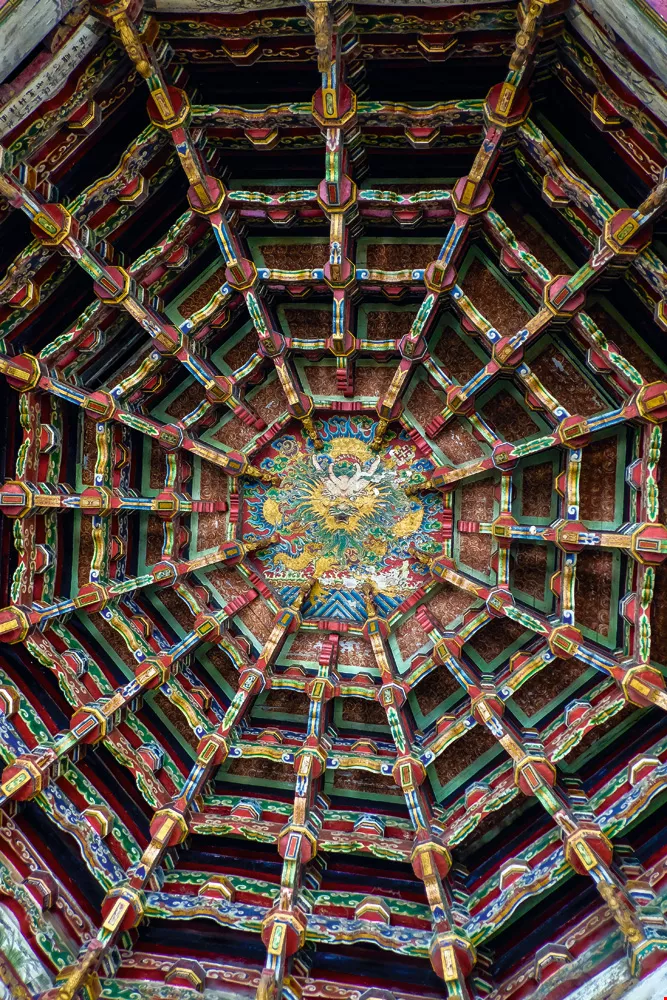
The bagua caisson ceiling above the stage at Lukang’s Longshan Temple is the oldest in Taiwan.
Traditional pastries
Many of Taiwan’s small towns and villages have developed signature pastries that add to their local charm. Examples include taro pastries from Dajia, “navel” cakes from Miaoli, and Sunny Hills-brand pineapple cakes from Nantou, an enormously popular gift item.
Lukang’s main bakeries are Yu Jen Jai, Jeng Sing Jen, and Jeng Yu Jen. All three shops were established more than 100 years ago and all have links to Zheng Chui, a master baker brought to Taiwan from Quanzhou.
Lee Meng-jiun, an associate professor with the General Education Center at Chienkuo Technology University, explains that the family that founded Yu Jen Jai originally ran a fabric store, but then brought the 16-year-old Zheng Chui to Taiwan to help them develop a pastry business. In later years, Zheng went on to found the Jeng Sing Jen and Jeng Yu Jen shops.
Arriving in Taiwan with a book full of snack recipes and baking tricks, the skillful Zheng soon developed phoenix-eye cakes. His gold-medal performance in a Japan-wide baking competition during the period of Japanese colonial rule won renown for Lukang pastries. His cakes, which are named for their upward-tilting phoenix-eye shape, have been a Lukang trademark ever since.
Lukang’s bakers also have their own take on “ox-tongue” cookies. Unlike the thin, crispy Yilan version of the cookies, Lukang’s are thick, with a soft, flaking mouthfeel, and are filled with strawberries, taro, or other flavorings.
With the national rise of the fine foods industry, Lukang’s bakers now find themselves competing not just with baked goods from other cities and counties, but with all kinds of food products. Lee suggests that if Lukang’s bakers can tie their products more closely to the town’s history and culture, Lukang’s baked goods will become even more popular with visitors.
These many attractions make venerable Lukang a fascinating place to visit.
@List.jpg?w=522&h=410&mode=crop&format=webp&quality=80)

@List.jpg?w=522&h=410&mode=crop&format=webp&quality=80)


@List.jpg?w=522&h=410&mode=crop&format=webp&quality=80)

@List.jpg?w=522&h=410&mode=crop&format=webp&quality=80)
