
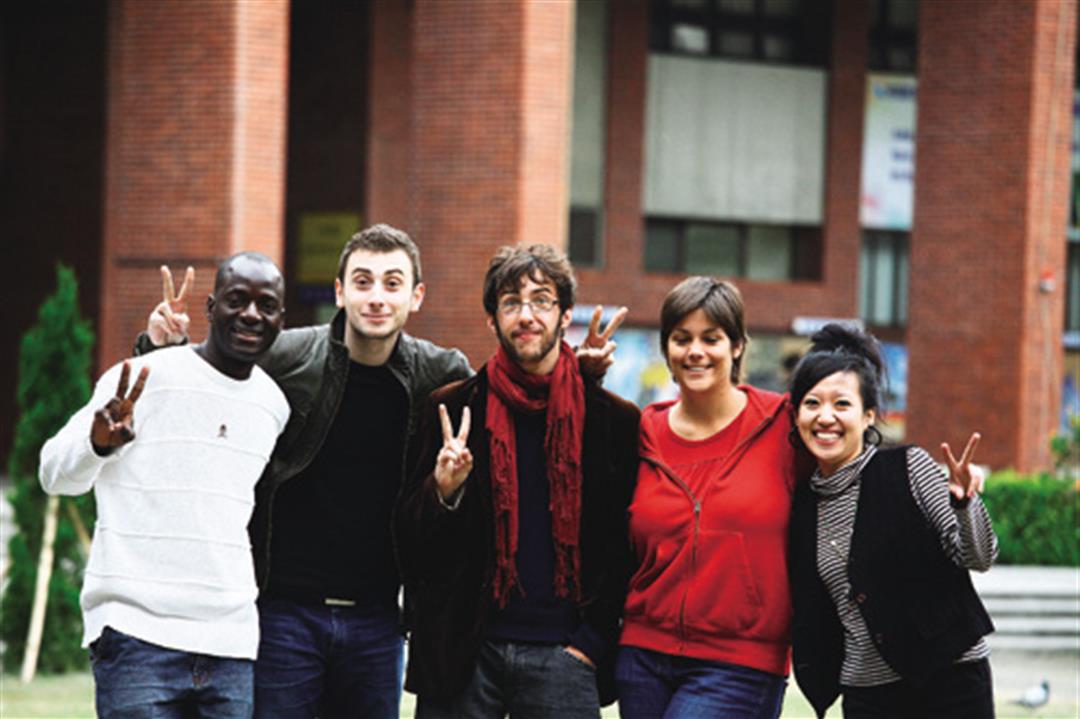
Life at Taiwan's universities has quietly been undergoing a transformation! Stroll through a campus and everywhere you turn you'll see students with blond hair and blue eyes or coffee-colored skin and kinky hair. In the classrooms, English-language curriculum has been proliferating, both in general curriculum courses and advanced courses for majors only. Take a seat in the cafeteria and exchange students at the next table may well be speaking Mandarin in the accent of some inland mainland-Chinese province. Growing numbers of Vietnamese, Indonesians and Koreans are enrolled in master's and doctoral programs....
According to the Ministry of Education, the number of foreigners enrolled as undergraduate or graduate students at Taiwan's universities has grown 20-30% per annum over the last three years. In 2009 a total of 7764 foreign students, hailing from more than 110 nations, were scattered at more than 100 universities throughout Taiwan. Why have these foreign students come? What do they study in Taiwan? And how are they changing life at Taiwan's campuses-both in quantity and in quality?
At the steps to the main gate of Ming Chuan University on Zhongshan North Road in Taipei, you see foreign students here and there, coming and going. You may even meet the gaze of their big eyes. At Ming Chuan's International College building, which stands at the foot of a hill, flags of various nations flutter. When the bell rings at the end of class, students of varying ethnicities-black, white, red, and yellow-pour in and pour out. You can hear English, French, Japanese and all manner of languages beyond this reporter's ability to identify.
Cut to National Sun Yat-sen University on the banks of Xizi Bay in southern Taiwan. A class in "Taiwan Government and Politics" is meeting. More than a dozen foreign students are scattered in every corner of the room as the professor, speaking English, leads a discussion on issues of ethnic identity in Taiwan. A French student expresses doubts about the quality of a survey conducted by National Chengchi University's Institute of International Relations. He argues that the question "Do you identify yourself as Taiwanese, Chinese, or both?" isn't precise enough, because it ignores the difference between cultural and political identification.
In reality scenes such as these have been playing out at universities throughout Taiwan for more than three years. According to the Ministry of Education, there are over 20 university campuses in Taiwan with over 100 foreign students. National Chengchi University, National Taiwan University and National Cheng Kung University have over 500 foreign students each. When you add overseas Chinese students, short-term exchange students, foreigners in Chinese language programs, mainland Chinese students and so forth, the sight of foreign students in classrooms, campus clubs and dormitories has become commonplace.
The earliest waves of foreign students came as a result of government policies encouraging them. Beginning in 2004 the government began issuing "Taiwan Scholarships" to attract talented foreign students to study in Taiwan. The Ministry of Foreign Affairs targeted these scholarships at students from nations with diplomatic relations with the ROC. Meanwhile, the National Science Council, Ministry of Education and Ministry of Economic Affairs-and even the Mongolian and Tibetan Affairs Commission-offered other scholarships mainly to students from nations without diplomatic relations with the ROC. The full-ride scholarships were as long as five years for those earning bachelor's degrees (for one year of a language course and four years of college) and three years for those earning master's or doctoral degrees. About 400 of these scholarships were granted each year, and an additional 300 scholarships were granted for those enrolling in Chinese-language programs. With the large amounts of funding and active efforts by government agencies, "study in Taiwan" gradually began to take on traction with students abroad, and the number of foreigners pursuing their educations here began rapidly to rise.

At the international colleges at Ming Chuan and I-Shou Universities, the students use English for all four years of instruction. Foreign nationals are thus able to jump right in and take advanced level courses and engage in intellectual exploration. These schools thus also create complete English-language environments for local students. The photo shows students and faculty in the mass communications department at Ming Chuan.
Meanwhile, under the Ministry of Education's policy of "internationalizing universities," from 2005 various private and national universities as well as technical colleges began offering "university scholarships" to attract foreign students, via subsidies from the government supplemented by additional funds provided by the institutions themselves.
For instance, at Ming Chuan University, in addition to a 20-50% reduction in tuition and other fees for foreign students, depending on a student's grades, scholarships range from NT$7000-20,000 per semester. At Tamkang University, it's NT$40,000 (tuition at private universities is about NT$40-50,000 per semester). Some institutions established by corporate groups offer even better deals: The Far Eastern Group's Yuan Ze University not only covers tuition and room and board, but it also provides an allowance of NT$6000-10,000 per month for living expenses.
Apart from the incentive provided by scholarships, the rapid economic rise of East Asia has created an ardent demand for skilled manpower among companies and industries throughout the region, and the magnetic pull of the mainland China market has made Chinese-language programs hot. Furthermore, Taiwan has many advantages in terms of its economy, technology and higher education, and it's also a place abundantly imbued with the "inside stuff" of Chinese culture. Consequently, it's attracted quite a few students from Southeast Asia.
According to the Ministry of Education, Southeast Asians constituted more than 60% of all foreign students in Taiwan in 2009. For those pursuing bachelor's or master's degrees, the top three countries of origin were Vietnam, Malaysia, and Indonesia. In doctoral programs, students from India and Vietnam took the top two spots.
"Many people are under the impression that most of these students only thought of studying in Taiwan after learning about the scholarships, but that's a misconception," say Ministry of Education officials, who estimate that when you take the more than 7000 foreign students and subtract the 1400 that have Taiwan Scholarships and the 2-3000 awarded scholarships by individual universities, the resulting figure shows that more than 40% of all these foreign students are completely paying their own way.
"I like to travel and wanted to get a master's degree abroad, and tuition in Taiwan is one-third of what it is in France," notes Fabien Laventureux, a French student working toward his GMBA at National Sun Yat-Sen University. "So I came here!" Chia Chee Pin, who earned a two-year associate's degree in mass communication in his native Malaysia, worked for a year, and then felt that a higher degree would be a good insurance policy in poor economic times, so he applied to enter a joint degree program from I-Shou University in Kaohsiung and New Era College in Malaysia. After he gets his bachelor's, he plans on working toward a master's.
Zhou Shuyin, a third-generation Chinese Fijian, wants to master Mandarin. She had worked on the mainland for half a year, but didn't like the conservative and closed-minded atmosphere there. Consequently, she decided to pay her own way to finish her university education in Taiwan.

A studio used by students in the mass communications program at Ming Chuan University. With regard to their experiences at Taiwan universities, foreign students tell Taiwan Panorama they're most satisfied with campus facilities, the rich holdings of the libraries, and the friendly atmosphere.
When foreigners come to Taiwan, what do they want to study? And do they want their instruction to be in Chinese or English?
Currently, apart from a very few institutions that require their foreign students to have a mastery of Chinese, most universities actively try to accommodate foreign students' needs by teaching courses in English. Among these, Taipei's Ming Chuan and Kaohsiung's I-Shou have gone so far as creating international colleges where English is the language of instruction in all four years. In other universities you find the foreign students scattered among various departments, with special courses or sections specially designated for instruction in English.
Yet, in a non-English-speaking nation like Taiwan, an English-language curriculum in universities may make things convenient for foreign students, but it poses enormous challenges for many of the instructors.
Chen Shu-heng, dean of international cooperation at National Chengchi University (NCCU), explains that establishing programs with English-language instruction is a major endeavor that's going to require long-term effort. Among all of Taiwan's universities, NCCU pushed internationalization first. In the last decade, it has offered more than 500 classes in English, but that number has still not been enough to meet demand among foreign students.
"The main problem is finding willing instructors," says Chen. Many members of its faculty earned degrees in the United States and Europe. But reading English is one thing; using English to teach class and respond to students' questions is quite another. Instructors have to spend large amounts of time to prepare lessons. When facing the varied backgrounds of foreign students, the constant mental adjustments that are demanded may end up feeling overwhelming. And the use of English constantly puts limits on the quality of instruction. For the instructors, it's never going to be as easy to speak precisely or cite examples in English as it is in Chinese. And when neither the teachers nor the students completely understand each other, the problem of words not being able to convey exact meaning can become very frustrating.
That's why of the six departments at NCCU that originally offered curriculums in English four (including diplomacy and journalism) encountered a dearth of willing and able instructors and consequently couldn't offer enough required courses in English. Currently, only the departments of business administration and economics have been able to find enough instructors willing to teach in English, however reluctantly.
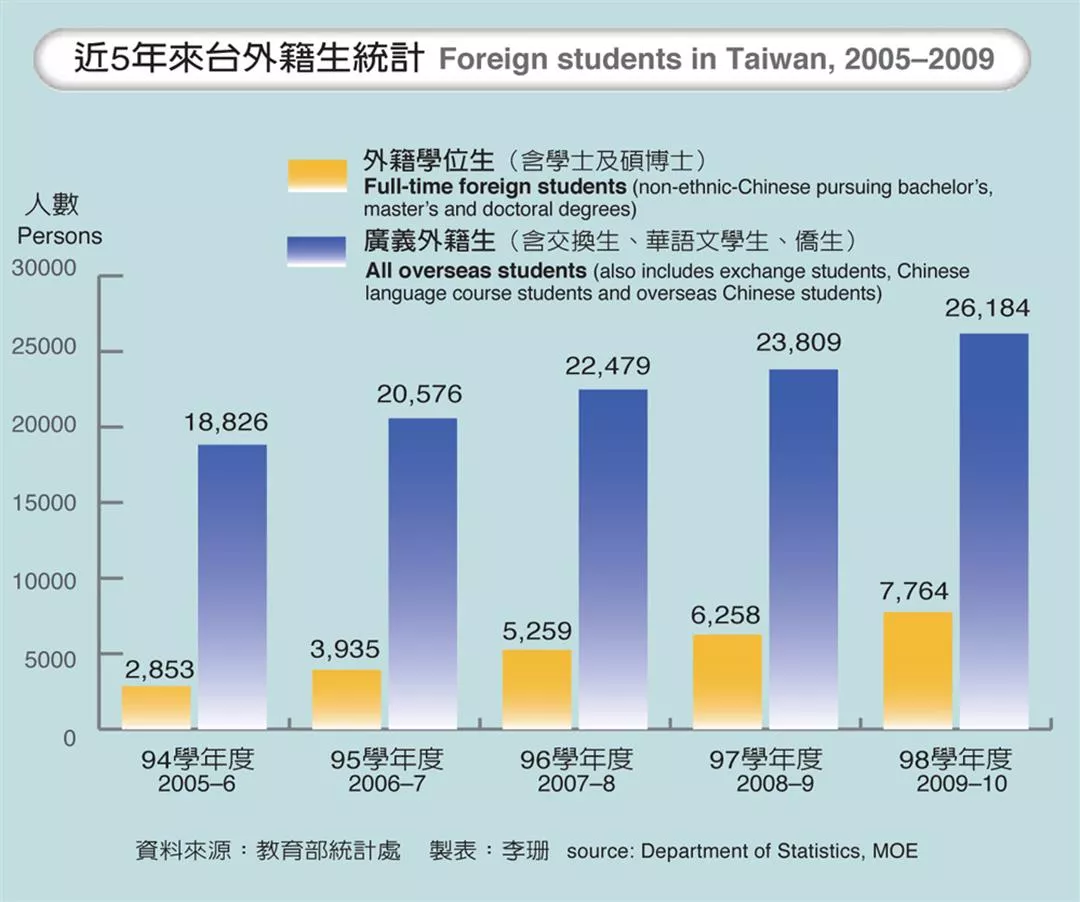
Foreign students in Taiwan, 2005-2009
Reflecting the bottleneck posed by a shortage of Taiwanese instructors that can teach in English, the International College of I-Shou University took a new approach: In September of 2009 it introduced three new departments: international business administration, international finance, and international tourism. I-Shou hired instructors from Europe, the United States and various Asian nations to teach not only the general curriculum courses but also advanced courses for majors.
"My goal is to get students to feel that coming to attend university in Taiwan is better than going to America, Britain or Australia, but it's only one-fifth the cost of studying in America!" says H. Ruhi Yaman, the dean of I-Shou's International College, who came to I-Shou from Victoria University in Australia. In an era when Asia is rising, Taiwan has excellent conditions to attract Westerners wanting to enter China. Based on his own experience of teaching in various nations in Asia and Europe for a more than a decade all told, Yaman says I-Shou's environment meets top international standards, and it has excellent foreign instructors. He firmly believes that I-Shou can be turned into one of Asia's top universities.
Yaman explains that in an era of global operations, if you want to cultivate international business leaders, language is the first hurdle to clear. Unfortunately, he has noticed that most of those Taiwanese who return from study abroad do not have particularly outstanding English. Consequently, I-Shou specially emphasizes language training, providing various kinds of media so that students can immerse themselves in an English-language environment. For instance, the college requires first-year students to live on campus, and the foreign instructors take turns visiting the dorms as tutors. If the students have any questions, they can take advantage of those opportunities. And all classes are recorded and available for viewing on the university's website, so students can review classroom lectures and discussions at their convenience.

Students at Ming Chuan University's International College hail from many different nations. The diversity can't help but broaden one's outlook and connections. From left to right: Jamali Jack, Tenga Taua, and Joagni Pare.
Behind the choice between English or Chinese instruction stands the issue of how international a university wants to become.
Business administration and finance typically feature the largest number of advanced courses taught in English, followed by engineering and applied technology, and then the humanities and the arts.
By encouraging foreigners coming to Taiwan to enroll in international business, trade and other "global mainstream academic departments," most universities are taking the approach of "welcoming the world into Taiwan." There are relatively few social-science or humanities programs open to foreigners, however, that "take Taiwan out to the world" by focusing on life in Taiwan.
Jamali Jack, who hails from St. Vincent in the Caribbean, was awarded a five-year Taiwan Scholarship in 2007. In St. Vincent he earned an associate's degree and worked for many years in the advertising industry. He first studied advertising at NCCU, but after taking many classes there taught in Chinese that he couldn't follow, he decided to transfer to Ming Chuan, which is less prestigious but has an international college. He feels that the biggest benefit of the move has been overcoming the language barrier, directly moving into more advanced courses, and interacting with students of many nations at the college, thereby expanding his horizons and making connections.
Likewise, Joagni Pare, a good friend of Jack's who hails from Burkina Faso, is studying international business administration. He also believes that, apart from the advanced knowledge he's learned, the biggest benefit of enrolling at Ming Chuan has been the contact with people of so many different backgrounds. It's truly one of the keys of international commerce, but at university you usually don't have an opportunity to gain that kind of "real-life wisdom." Because foreign students from many different nations are gathered together here, they naturally undergo a baptism of multiculturalism.

In 2009 there were 7,764 foreign students enrolled in undergraduate, master's or doctoral programs at universities in Taiwan. With plans to raise the limit on enrollment of foreigners (which is now set at 10%), that total is expected to rise. The photo shows part of the I-Shou University campus in Kaohsiung.
Generally speaking, foreign students rarely participate in school activities-either because of language issues or because they feel that they are mere visitors who don't really belong. But they thus lose out on a great opportunity to immerse themselves into Taiwanese society. Reflecting this, National Chengchi University, which has been pursuing internationalization for 10 years already, established the NCCU International Association in 2009 with the hope of building bridges of friendship between these foreign students and Taiwan society.
Wilfried Relwende Sawadogo, who hails from Burkina Faso and is the association's president, says the club has three goals: First, members want it to serve as a bridge of communication between foreign students and Taiwanese teachers. Consequently, they welcome the participation of Taiwan students and faculty. Secondly, they want to work to integrate various resources for foreign students, including those held by foreign students, Taiwan students and various organizations and educational institutions. Thirdly, they hope to build bridges between the university and the local community.
Concrete steps they have taken include publishing a bilingual bulletin-NCCU United-so as to let faculty and students at the university, as well as people in the outside world, understand related developments. They have also established a student support group, which aims to help foreign students adjust to local food, clothes, living arrangements, transportation, and culture. If Taiwan students have the need, they happily share their resources and provide aid. They also put on various workshops, lectures and seminars. Because university funding is limited, they've gone off-campus to seek support from businesses, or have worked with other organizations as co-sponsors.
"One of the greatest things I've gotten out of coming to Taiwan is helping to establish this group!" says the association's vice president Dale Albanese, an American. In the United States he majored in English with international studies. More than three years ago, because he was interested in Asia, he applied for a Fulbright scholarship to come to Taiwan, where he first taught for a year in an elementary school in Yilan before spending some time to focus on studying Chinese. He then won a Taiwan Scholarship from the Ministry of Education and entered a master's program in Taiwan studies at NCCU's Graduate Institute of Development. Albanese believes that he was fated to come to Taiwan. He's very satisfied with the educational environment here, and participating in the international students' association has provided out-of-the-classroom learning opportunities. It's been a source of great satisfaction.
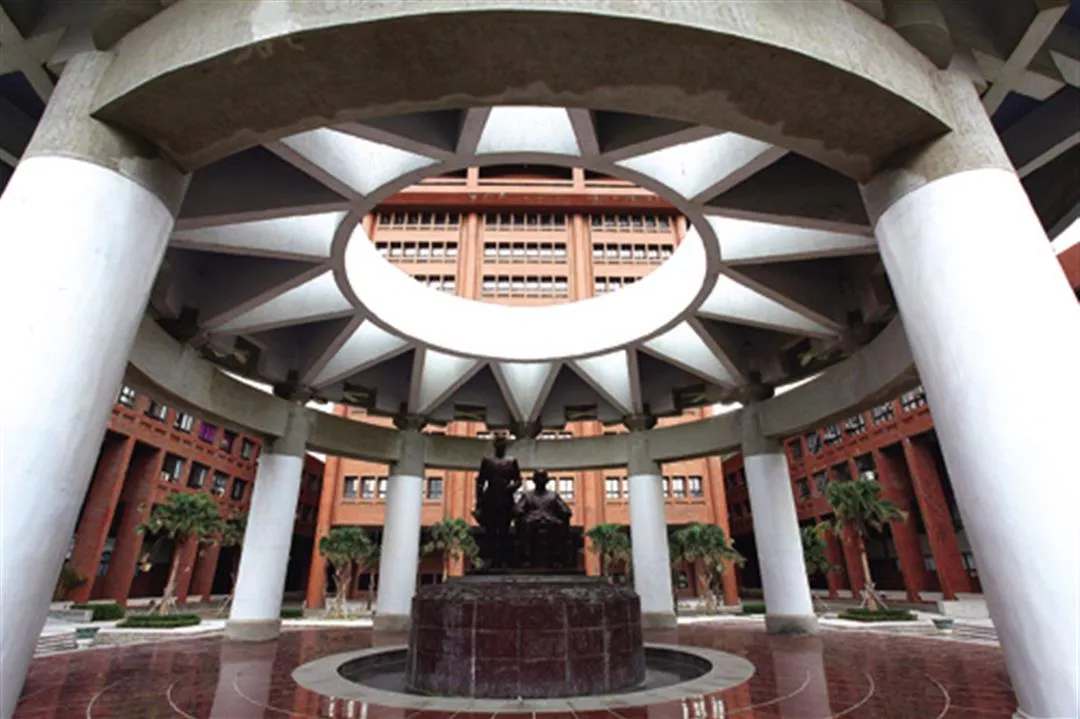
Taiwan's unique history, modern experience, and Chinese cultural traditions are its greatest assets for creating an international curriculum. The photo shows statues of Sun Yat-Sen and Chiang Kai-shek at National Sun Yat-Sen Univeristy.
This reporter visited five universities in northern and southern Taiwan, and interviewed about 50 foreign students. Although some students have complaints, generally speaking most are positive about higher education in Taiwan. They are happy with the well-equipped campuses and well-stocked libraries. For instance, foreign students at I-Shou praise the photographic equipment and studios. And students at NCCU, Tamkang and Sun Yat-sen laud the holdings of their libraries and the excellent and varied academic lectures-all of which greatly benefit graduate students.
What's more, the schools show great concern for the foreign students. They've developed "buddy systems," matching foreign students with locals. They've met them at the airport, helped them find places to live, provided advisers, and generally demonstrated a welcoming vibe-all efforts at getting these students who are so far from their homes to feel comfortable.
"A low student-faculty ratio" and "friendly and open-minded professors" are other strong points that many students mention.
"Accounting is a pretty hard subject, and in Taiwan I'm not afraid of asking my instructors questions. And the instructors are very patient when they explain things to me," says Helene Konkobo, who is enrolled in a program at Tamkang that is taught in English.
Of course, another big benefit of coming to study in Taiwan is that it can greatly increase one's Chinese abilities and one's understanding of Chinese culture.
"There were a lot of Chinese businessmen in my hometown, but I felt that they were an altogether different race of people, and I never felt that I wanted to chat with them," says Tenga Taua from the island nation of Kiribati. Now she feels none of that sense of separation. Walking the streets here, she interacts with the locals left and right.
Unique Taiwan/Asian experienceGenerally speaking, most foreign students have a positive impression of education in Taiwan when it comes to the facilities, the educational resources, the language, the friendliness of teachers and so forth. But when it comes to the core focus of academia-stimulating innovation and advancing academic knowledge-the praise is more muted. In the face of global competition in education, one can't help but worry: What unique advantages does Taiwan have?
"Our strong suit ought to be in the realm of the humanities and social sciences. We should establish a unique Taiwan experience-or perhaps we can more broadly call it 'the modern Chinese experience,'" argues Christopher Chang, director of the Chinese Language Center at NCCU, who has been among those guiding NCCU's internationalization for many years. When setting their policy directions, both the government and universities ought to bear in mind that internationalization doesn't equal the spread of English, and an international country isn't one with an English-language curriculum. Rather, internationalization should mean developing curriculum about every area in the world, including curriculums that demonstrate Chinese cultural values and Taiwan's experience at modernization.
"For instance, Taiwan's graduate institutes of Taiwan literature and departments of Chinese, business and political science," Chang says, "rather than establishing standard economics and behavioral science classes that one can study anywhere, ought to think about developing curriculum that has special cultural or regional emphasis, so that interested foreigners will feel that they 'absolutely have to go to Taiwan.'"
"At the end of the day, the Chinese language is an important medium for getting foreigners to understand Taiwan and Chinese culture," says Frank Ying, dean of international affairs at National Sun Yat-Sen University. Both Chang and Ying believe that if government policy doesn't set Chinese-language requirements for its foreign students, then it will be very hard for campuses to become truly international. Ying cites the example of Yu Kwang-chung, a "campus treasure of National Sun Yat-Sen University": He has enormous literary and scholarly accomplishments, but if humanities students can't understand Chinese, how can they enter the realm of Yu's poetry? How will they gain a feel for the master's literary models?
New selling point: Taiwan studiesTaiwan's "cultural strength" is clear to those who come to Taiwan to earn master's and doctorates in programs with Chinese-language instruction.
Nurni W. Wuryandari, a doctoral candidate in Chinese at Tamkang, taught Chinese at the University of Indonesia (the nation's top campus) for 20 years. With the encouragement of the Indonesian government, she applied for a three-year Taiwan Scholarship to study here. Because the Chinese programs at National Taiwan University and NCCU emphasize difficult classical Chinese, she decided to take a more practical direction and enroll at Tamkang.
She's been in Taiwan for more than two years now and feels she particularly benefitted from her "literary sociology" and "comprehensive research into Chinese history and literature" classes. She has a lot of respect for the professors at Tamkang. She says her own Chinese has plenty of room for improvement, but that she is sparing no effort as the first Indonesian to pursue a doctorate in Chinese in Taiwan. Not only has her Chinese writing ability made great strides, but she believes that she will be able to expand the horizons of the Chinese studies community in Indonesia when she returns.
Frank Ying says that history and literature aren't the only areas where a Chinese-language curriculum can benefit foreign students. In social sciences and business administration, Taiwan offers unique Chinese points of view and experiences. He has taken students from third-world countries on tours of Taiwan's major science parks, and seen their eyes widen. Likewise, he's taken students from Belgium and Austria on tours of China Shipping, visits that have also broadened their horizons. If they can be better integrated into a curriculum, the many stages of Taiwan's economic development experience are all potential academic "strong suits."
Relying on higher education to push internationalization both offers a way forward for the education sector and helps the nation make friends and expand its influence. The number of foreign students is on the rise, and they're making their mark in every corner of Taiwan. Nevertheless, in comparison with Hong Kong and Singapore, Taiwan has taken its first steps late. If we want to enjoy a reputation as a great place to study, we need to work harder. But in the process of welcoming and befriending foreigners, can we also ruminate on our own identity and values? That's the still greater challenge!


@List.jpg?w=522&h=410&mode=crop&format=webp&quality=80)
