NTUST College of Design: Creativity is Everything
Lin Hsin-ching / photos Jimmy Lin / tr. by Chris Nelson
July 2010


Hailed as the Oscar of the design world, Germany's International Forum (iF), one of the world's big four product design award institutions, recently announced that 10 universities in Taiwan have ranked within the top 100 design institutions internationally in the past three years. The National Taiwan University of Science and Technology (NTUST) numbers among the top five names with 160 points, clinching the number-four spot and beating out world-famous institutions such as Germany's Hochschule fur Gestaltung Schwabisch Gmund (140 points), the UK's Royal College of Art (100 points), and the USA's Chicago Art Institute (20 points). Even as the people of Taiwan savor this glory, they might wonder: "How did they do it?"
The secret is the learning environment at NTUST's College of Design, which encourages creativity from the top down, complemented by highly qualified instructors, a top-notch student body, and a culture that encourages mutual help. These naturally merge to form outstanding academic achievements, with unlimited potential for sparking creativity.
"I'm Hong Yijun, creative director of Jingua Design. The main thrust of this proposal is to promote the YOPO brand of household appliances: namely, coffee makers and toasters. The motto of the YOPO brand is 'Your Style, Your Life': that is, a lifestyle of quality, substance and dynamism. Our target demographic is white-collar workers and opinion leaders who like innovative things and who have money to spare."
Expounding fluidly at the lectern, Hong notes that YOPO consumers have a discriminating eye, and are not driven away by premium prices when looking at products. So in his narrative he promotes the products' high intrinsic value, which is the only way to motivate this group of consumers.
"Here we draw upon the splendid imagery of birds singing at daybreak. We harmonize the avian form with vivid blue and red hues in our product design, boasting both a delightful appearance as well as added texture. When the consumer pours a cup of rich, fragrant coffee from the bird's beak, or lifts piping-hot toast from the wings of the toaster, it's the beginning of a beautiful day."
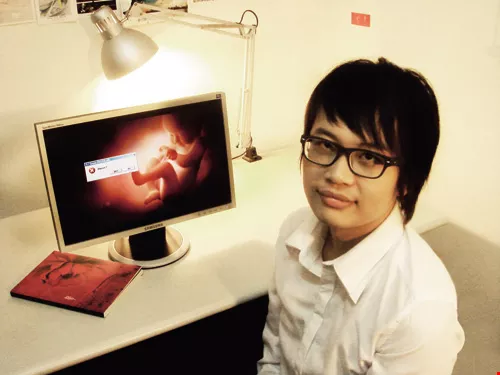
Prize-winning work by NTUST students. From left to right: Liu Hsiang-ling's solar-powered silicon gel phone, Lai Zhongping and Ye Minghong's eating utensils designed not to touch surfaces, and Xiao Shengwen's 3D computer animation Love_Child, using fetal imagery.
After listening to this product report aimed at target consumers, questions may arise in our minds: when did this inventive company, Jingua Design, appear on the scene?
It turns out that this professional-looking presentation is just a final project for the junior-year Design Practice class offered by the university's Department of Industrial and Commercial Design. Besides Jingua Design, students in this class also created the mock companies Xing Design, a household furniture company, and Xidianzi Design, a designer of lamps for display at IKEA.
After dividing into design teams of six or seven, the students had to name their companies, design business cards and logos, plan websites, set the companies' basic operating strategy, and choose managers for their creative, accounting, sales and PR departments. Then they had to do detailed market surveys of their mock customer bases and design products for their target demographics, while also devising market strategies. On top of this, they had to work on details like pricing, contracts, payroll and performance evaluation. Finally, they had to build models of their products according to the group's ideas while strictly adhering to industry specifications, and then give their presentations in front of the entire class.
"A professional designer not only needs to keep a product's form and function in mind, but also has to consider production costs and whether the product fits with market trends and customer needs," explains Associate Professor Cheng Jin-dean, who teaches Design Practice at NTUST and also has 20 years of industry experience. The purpose of his course is for students to gain a realistic working knowledge of today's design industry before leaving academia, so they can hit the ground running in the job market and in entrepreneurship.
"No matter how superb one's creativity is, it's only successful if it passes the test of the workplace and the rules of the market," says Cheng.
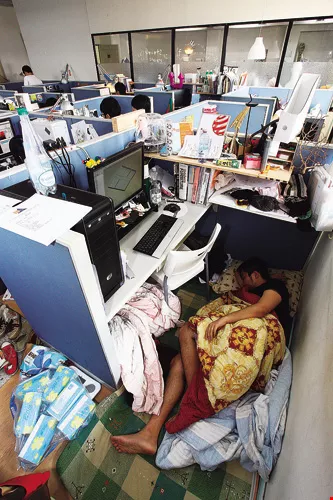
Though College of Design students may joke that they're on a costly, injurious road with no and the sense of achievement they derive from it give them great satisfaction, prodding them to continue. Pictured here is a student sleeping on the research room floor.
Taming unrestrained creative thinking by minding product feasibility and market practicalities is an integral feature of NTUST's College of Design.
The College of Design, founded in 1998, currently comprises two departments-the Department of Architecture and the Department of Industrial and Commercial Design. It is one of the few design institutions in Taiwan with a full spectrum of programs from the undergraduate through the doctoral level.
NTUST president Chen Shi-shuenn notes that the school used to be called National Taiwan Institute of Technology, and was the top industrial and technical institute in Taiwan. In the early 1990s, the school decided to add a design program in order to acquire the diverse curriculum required of a full university, while also preparing for the post-industrial era. In 1991, the school began offering master's level classes in architecture and design, hiring qualified professors and accumulating teaching experience. In 1997, the school was officially designated a university, and the next year the College of Design was formed.
NTUST's Department of Industrial and Commercial Design has a history of less than 20 years in this field, far behind the industrial design departments of National Cheng Kung University and Tatung Institute of Technology, which were both founded in 1973. And it also lags behind the corresponding departments of private schools such as Tunghai University, Dayeh University, Huafan University, National Yunlin University of Science and Technology, Shihchien University and Ming Chuan University, all founded in the 80s and early 90s.
But as in the fable The Tortoise and the Hare, NTUST's Johnny-come-lately design department has yielded brilliant results in the last several years, with its students securing 72 top international awards between 2003 and 2009.
The world's big four design awards-Germany's iF and red dot, the United States' IDEA and Japan's G-Mark-are all honors frequently won by NTUST students. So far this year, four NTUST students have been picked from nearly 5,000 entrants around the world, winning the iF lebens(t)raume and concept awards. Last year, five NTUST students won red dot awards.
And because industrial and commercial design often requires computer aid, many NTUST students develop exceptional skills in computer animation. Last year, graduate student Xiao Shengwen used fetal imagery in his 3D computer animation Love_Child, which was nominated from more than 700 entries in the ACM SIGGRAPH Computer Animation Festival. It was the first time that a student from Taiwan had had an entry nominated for this award.
These days, the university's Department of Industrial and Commercial Design is the first choice for local students wishing to work in design. This year the bar for admission was raised to 68 points on the General Scholastic Ability Test. Two students who earned 73 points even gave up their aspirations to study law at National Taiwan University in favor of attending NTUST, such is the popularity of this program.
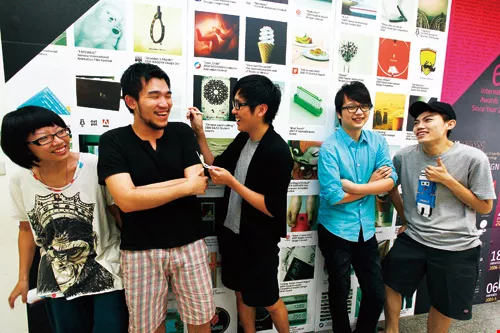
Within NTUST's College of Design is a display wall set aside to showcase the students' award-winning works. From left to right are Chen Bohe (Gigabyte Innovation Award winner), Lai Zhongping and Ye Minghong (iF Design Award winners), Xiao Shengwen (ACM SIGGRAPH Award nominee), and Huan Xianxun (iF Design Award winner).
For NTUST's College of Design to rise from nothing to excellence in one short decade seems an impressive feat. But it's actually the combined result of inherent advantages and hard work.
First, the college, located in the vibrant Gongguan district near National Taiwan University, is one of a very few national design institutes in the Taipei metropolitan area, enabling it to benefit from the latest information in the design field and easily forge project partnerships with business. In addition, with the school's strong background in engineering, it provides design students with the support of abundant knowledge, technical skills and management expertise. As such, the "soft skill" of free-thinking design is backed by the "hard skill" of manufacturing, so students won't stray from reality during the creative process.
Such naturally advantageous conditions mean that NTUST is able to attract the cream of the crop of students interested in design. Yet this is only the first factor in the school's rise to prominence, not the key.
Professor Chen Lin-lin, dean of the College of Design, says that in recent years many schools have sought to learn their secrets to success. "But there really aren't any," she says, throwing up her hands. "We spent a lot of time engaging qualified and hard-working instructors, and gradually modified our student recruitment strategy, screening for students most suitable for growth in the field of design."
According to Chen's assessment, it's not hard for other departments to hire suitable instructors. But it's different for design departments, because in academic circles, design is a relatively new field. It was only as late as 2000 that schools in Europe and North America began conferring doctoral degrees in design. "There are very few instructors in the world, much less in Taiwan, with design skills, practical experience and doctorates who meet the criteria for teaching at a national university."
"We would rather go without than employ unqualified professors," says Chen regarding the university's hiring principle. The College of Design spent a great deal of time seeking instructors who meet these three conditions, but the final consideration beyond academic record is still ability. For instance, Associate Professor Cheng has just an MFA degree, but was hired on the strength of his superb teaching reviews.
"Professor Cheng once worked for the renowned American firm Frog Design, and also served as product design manager for Sampo Corporation. He even opened a design firm. He is adept at teaching, too. Before the submission deadlines for international competitions, students vie with each other for the chance to discuss their ideas with him. He's in greater demand than a famous doctor!" describes Chen.
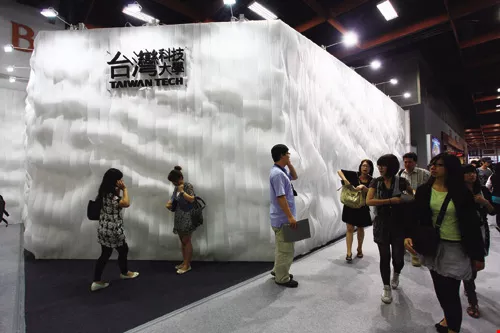
(left) NTUST's booth is a focus of popular attention at the New Generation Design Show, a graduation exhibition jointly organized by design schools around Taiwan.
Once the school has hired qualified experts for its teaching positions, it goes to great lengths to help them maintain their passion and energy for creativity.
Unlike instructors in other fields, in which there is a "publish or perish" imperative for promotion, the College of Design allows for prize-winning work to take the place of the publication requirement. This enables instructors to devote themselves wholly to creativity, and gives them the greatest incentive and pressure to win awards.
University president Chen Shi-shuenn, the instigator of this alternative criterion for career advancement, admits it was not an easy task to implement the system amid the university's conservative academic tradition. He spent a long time before he managed to convince the institution's old-school powers-that-be to agree to it.
"Design instructors need to concentrate on creating. What kind of creativity is stimulated by forcing them to spend five to 10 years doing painstaking researching only to produce dull, formulaic papers?" remarks Chen, who believes that encouraging instructor advancement through producing prizewinning work can motivate them to keep pace with the latest domestic and international design trends, thereby inspiring the students to create and compete in contests. Much more could be accomplished this way.
The College of Design carries out an equally accommodating student recruitment strategy, with its greatest change manifest in its graduate program. Professor Chen Lin-lin notes that the original entrance exam required written essays in subjects such as design principles, design history, chromatics, and human factor engineering. "But later we found that the nature of the exam pushed students to attend buxiban classes in order to cram for them, and students with exceptional design skills weren't necessarily able to do well on these tests."
To overcome this problem, the school started dispensing with the written subject exams seven or eight years ago, instead looking at students' portfolios and undergraduate grade records, and instituting skills tests (such as last year's test themed "human-powered devices," in which students were to come up with human-powered lamps and radios). These are accompanied by an oral exam given by a panel of examiners to gauge students' on-the-spot reactions and thinking.
This consistent encouragement of creative thinking is also reflected in the schooling. For instance, graduate students can follow the flexible paradigm used for instructor career advancement by choosing between creative work or writing a traditional thesis as a requirement for graduation. As for undergraduates, there's a system encouraging beneficial student interaction.
According to Professor Chen Lin-lin, there are six vocational high school graduates in the College of Design for every four ordinary high school graduates. One trait of vocational students is their strong technical skills, but their research skills are not quite up to snuff. Students from academic high schools are the opposite.
"Design doesn't require just technical know-how; it also involves complex applications such as understanding consumer psychology. By allowing students from different backgrounds to work together in the same classroom, they are able to learn from each other. This often evokes even more astounding creativity," says Professor Chen.
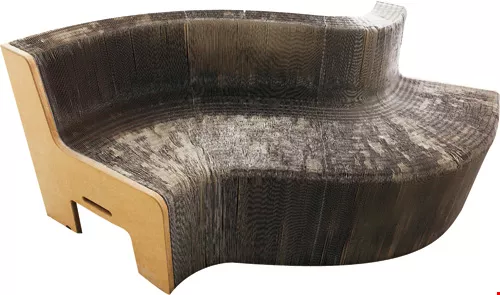
FlexibleLove, an accordion-like, expandable chair, was created by Chiu Chishen, who graduated four years ago from NTUST in industrial design. Hailing from suburban Miaoli, Chiu by chance passed by an adhesive tape factory not far from his home, where he saw stacks of honeycomb cardboard. Inspired, he created a chair out of folded cardboard. When stretched, the chair can seat up to 16 football players; when compressed, it's a two-person love seat. The versatile, environmentally friendly design became a hit in Western countries like France and Spain. The chair currently sells at the renowned luxury goods outlet Nordic with a suggested retail price of NT$12,650-NT$23,150.
Walking into the College of Design building, the casual observer will see students sporting the simple garb of ordinary college kids, not dressing the way one might imagine those doing creative work would dress. Upon entering the fourth-floor research rooms, however, you can clearly sense the creative energy of this group of students.
In these rooms, festooned with sketches, models and international journals, the lights blaze 24 hours a day. Shuttling around here, you have to be careful not to step on students sleeping on the floor, because they may have been working on some creative project without sleep or rest for many days, brainstorming on some international design competition entry.
"The ambition that NTUST students have for taking part in international competitions is truly spirited. It's not forced by the professors; rather, it's the product of students' mutual encouragement. The research rooms are packed with people before the entry deadline for any competition. When you see other students giving their all thinking and creating, sometimes submitting a dozen or so entries, you'll naturally push yourself to stay caught up," says graduate student Liu Hsiang-ling, who snatched the 2009 iF and red dot awards for the silica gel "sticky cell phone" that sticks to car windows.
A graduate in Industrial Design from Huafan University, she admits that she had submitted her work over and over while in college, but had never won anything.
"Maybe it was because I worked alone then. But at NTUST, with a group of like-minded classmates working with you and critiquing each other's work, we can keep each other's spirits up when things go wrong," she says.
Liu gives an example. For her silica-gel cell phone, her primary intent was to design an environmentally friendly phone that could be stuck to a car window, solving the problem of not knowing where to put the phone in a car. To conform to the green energy trend, she had planned to include a solar panel on the phone, but this would have increased the phone's thickness by several millimeters. Later, her classmates helped her by finding the latest "printed solar cell" technology, in which a thin layer of material is added to the cell phone for instant recharging, allowing the phone to be only eight millimeters thick, thereby preserving her original design. This solved her conundrum.
At this stage, the College of Design's emphasis on creativity and competition has become a prominent feature of the program. But does this push to produce good work and to compete cause unwarranted pressure, and do the regulations of the competitions place bounds on student creativity?
Regarding these questions, associate professors Sung Tung-jung and Cheng Jin-dean, both of whom teach product design, hold that competing in contests may put pressure on students, but whether or not they win a prize, their academic performance does not suffer. Both professors agree that it's because, whether or not a student wins an award, there is an element of luck involved, and even good entries can be rejected.
From another perspective, industrial and commercial designs are not pure artforms; they have always been subject to budget constraints, clients' aesthetic sense, market tastes and so forth. Competitions allow students to become used to "exercising maximal creativity within a limited framework." Furthermore, competing in domestic and international contests alongside the world's best designers is the best training for boosting students' skills and international vision.
"Such hard-to-come-by experience can't be traded for all the money in the world," says Cheng.
A flexible yet up-to-standard administrative model, a cooperative and active learning environment and a solid system of prerequisites ensure outstanding outcomes. Superb performance by NTUST College of Design students and faculty in international competitions is perhaps an inevitable result!
Top ten universities in Taiwan in terms of winning the iF Design Award
| Chaoyang University of TechnologyGlobal ranking | Points | School name |
| 4 | 160 | National Taiwan University of Science and Technology |
| 12 | 120 | Shih Chien University |
| 16 | 80 | National Taipei University of Technology |
| 28 | 60 | National Cheng Kung University |
| 28 | 60 | National Chiao Tung University |
| 41 | 40 | Ming Chi University of Technology |
| 41 | 40 | National Kaohsiung Normal University |
| 41 | 40 | National Yunlin University of Science and Technology |
| 41 | 40 | Shu-Te University |
| 57 | 20 | Chaoyang University of Technology |
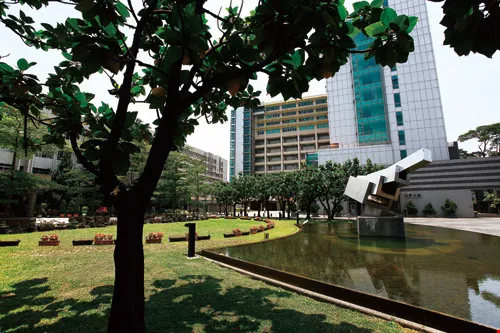
Located in Taipei's Gongguan area, NTUST's College of Design enjoys excellent geographical advantages, with ready access to the latest industry information and opportunities to form cooperative projects with business.

The NTUST College of Design places emphasis on practical creativity. Shown here is a final presentation in Design Practice class. The Jingua Design team is introducing toasters and coffee makers designed with bird imagery.

Industrial design graduate Qiu Qinmao's work Plant Planet, an indoor plant container that absorbs solar energy.
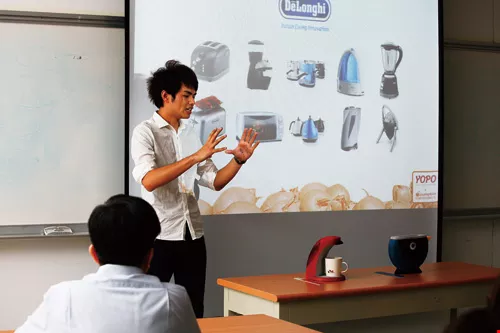
The NTUST College of Design places emphasis on practical creativity. Shown here is a final presentation in Design Practice class. The Jingua Design team is introducing toasters and coffee makers designed with bird imagery.
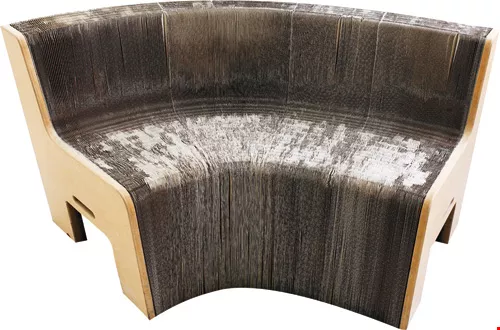
FlexibleLove, an accordion-like, expandable chair, was created by Chiu Chishen, who graduated four years ago from NTUST in industrial design. Hailing from suburban Miaoli, Chiu by chance passed by an adhesive tape factory not far from his home, where he saw stacks of honeycomb cardboard. Inspired, he created a chair out of folded cardboard. When stretched, the chair can seat up to 16 football players; when compressed, it's a two-person love seat. The versatile, environmentally friendly design became a hit in Western countries like France and Spain. The chair currently sells at the renowned luxury goods outlet Nordic with a suggested retail price of NT$12,650-NT$23,150.
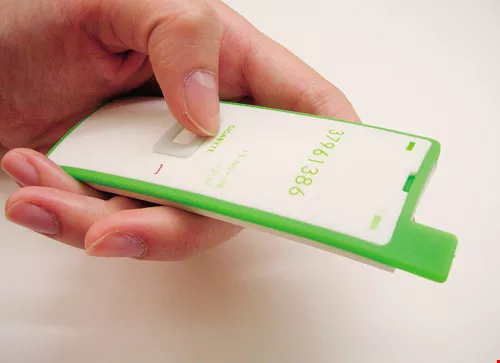
Prize-winning work by NTUST students. From left to right: Liu Hsiang-ling's solar-powered silicon gel phone, Lai Zhongping and Ye Minghong's eating utensils designed not to touch surfaces, and Xiao Shengwen's 3D computer animation Love_Child, using fetal imagery.
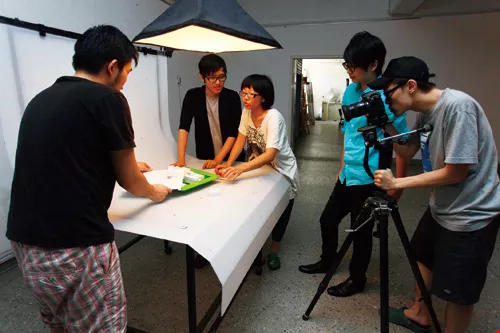
The College of Design boasts a professional photography studio where students can compose attractive photos to promote their work.
@List.jpg?w=522&h=410&mode=crop&format=webp&quality=80)

@List.jpg?w=522&h=410&mode=crop&format=webp&quality=80)


@List.jpg?w=522&h=410&mode=crop&format=webp&quality=80)

@List.jpg?w=522&h=410&mode=crop&format=webp&quality=80)
