Some 2.7 million visitors come every year to the little town of Yeliu to see the weird coastal rock formations that have won it the top spot on the list of Taiwan’s top ten natural landscapes. But the Queen’s Head mushroom rock for which Yeliu is best known continues to weather, and the neck upon which the head rests is growing perilously thin.
Experts say the Queen’s Head could break off at any time, and any earthquake that jolts the area at a seismic intensity of level three or higher could do the trick.
Yeliu Cape, located in New Taipei City’s Wanli District, is about three kilometers long and 200 meters wide—indeed, just 50 meters at its narrowest point. At high tide, the lowest part of the cape is often submerged. Legend has it that Spanish sailors passing by in the 17th century were so spooked by the jagged coastline and dangerous currents that they named it Punto Diablos (“Devils Cape”).

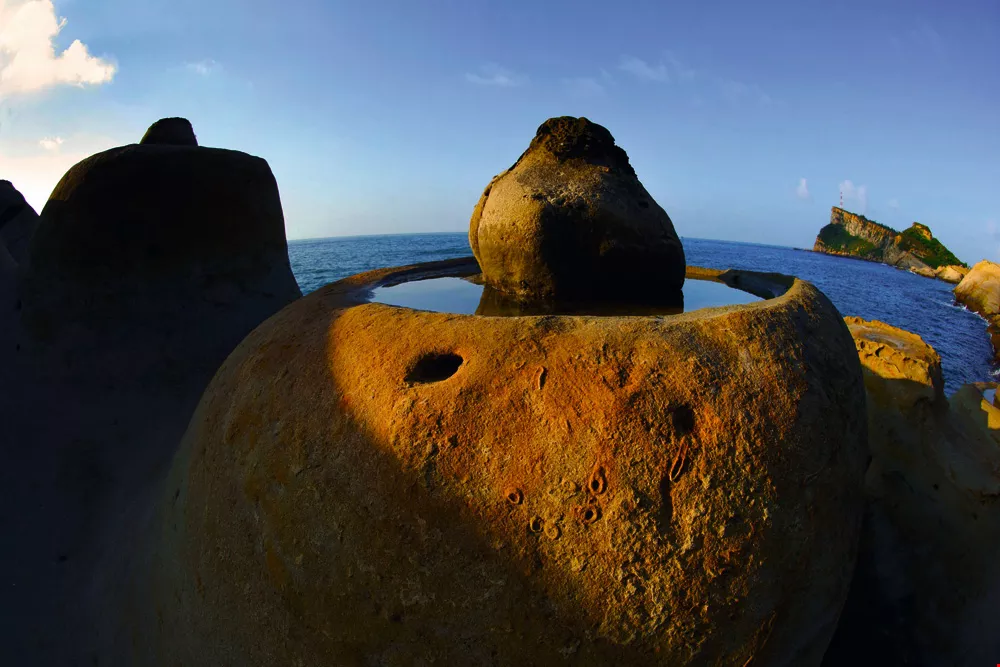
The calcareous concretion nodule that sits atop a candlestick rock is extremely hard. The softer surrounding sandstone gets eroded more quickly by the seawater, leaving the nodule up top looking rather like the flame atop a candlestick. There are very few geological features of this sort anywhere in the world.
Yeliu Cape is part of the Daliao formation, which dates to the Miocene epoch of the Tertiary period, and is composed primarily of inclined sedimentary rock. The strata here were laid down about 22 million years ago, then rose from the ocean floor around 6 million years ago through a process of mountain building.
The rock in Yeliu consists of three different strata. Water and wind erosion act upon the first stratum to create what is called mushroom rock, comprising a roughly two-meter-thick top layer of calcareous sandstone over a layer of tan sandstone. The second stratum, composed of irregularly shaped nodules and tan sandstone, erodes into “ginger rock.” And the last stratum yields “candlestick rock,” which features extremely hard lumps that have become embedded in sandstone through a process known as concretion. In this process, mineral cement percolates through the spaces between the sediment grains until it eventually collects in one spot and hardens. The concretion tends to be harder and more resistant to weathering than the host stratum, thus allowing erosion over time to sculpt odd-shaped rocks such as those found at Yeliu.
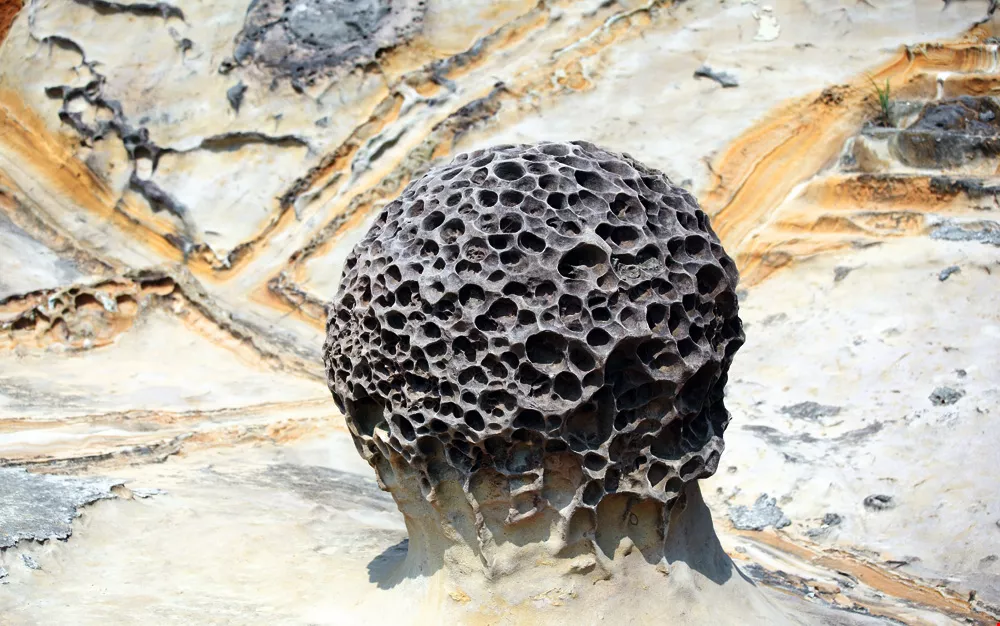
One will note during a stroll on Yeliu Cape how the sea waves have eaten away at the rock in patterns determined by the jointing of the rock, leaving smoothly surfaced orthogonal shapes. These are known in Chinese as tofu rock because the sharply cloven rock faces call to mind freshly cut blocks of tofu. Taiwan’s cold, damp northeasterly monsoon winds also work on rock of uneven hardness to carve out all sorts of weirdly shaped mushroom rocks. In the meantime, the hollow spots left behind by mollusks and crabs are also embellished through the erosive action of seawater, temperature, and wind to form honeycomb rock.

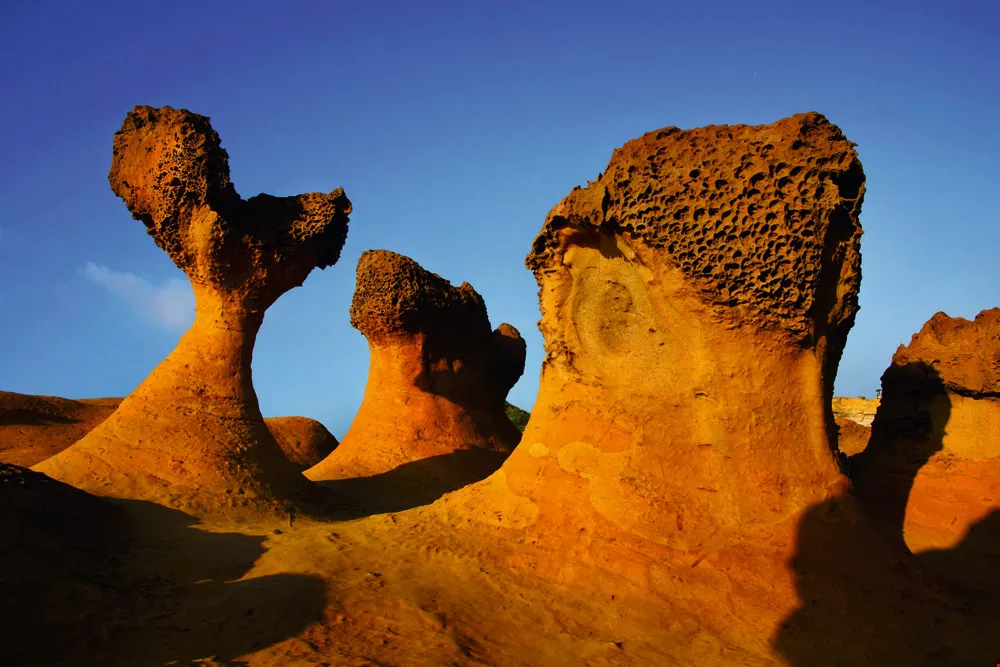
The top layer of a mushroom rock is composed of calcareous sandstone, which is harder than the layer below. Erosion leaves the top layer bigger around than the underlying stone, and results in something resembling a mushroom.
Within this odd collection of fantastic shapes, the most famous rock of all is the Queen’s Head. A classic example of a mushroom rock, the Queen’s Head was once indeed shaped just like a mushroom, but then a few chunks fell from the top part in 1962–63 when it fractured along the jointing, leaving behind a rock that resembles the famous bust of Queen Nefertiti. Hence the name, and the rock’s subsequent popularity.
The neck of a mushroom rock starts out thick, then becomes thinner and thinner as weathering progresses, until at last it breaks. At an estimated age of about 4,000 years, the Queen’s Head is nearing the end of her days.
Yehliu Geopark general manager Yang Ching-chien points out that the neck of the Queen’s Head 20 years ago measured 220 centimeters in circumference, but it’s now down to just 123 cm. Even without any damage by humans, the circumference will shrink by 2 cm per year.
Experts believe the head could break off at any moment over the next ten years. “A tremor of level-three seismic intensity in the local area could bring it down today,” says Yang.

The forces of erosion act upon rocks of differing hardness to carve out the pock-marked oddities known as honeycomb rock.
If the world-renowned Queen’s Head were to disappear, tourism in Yeliu would take a hit, so experts are hard at work in search of a way to extend her life.
People have suggested various ways to preserve the Queen’s Head indefinitely—propping it up with a support structure, coating its surface, or enclosing it in something protective, for example—but all the suggestions would be ugly.
The North Coast and Guanyinshan National Scenic Area Administration a few years ago hired a multidisciplinary team of leading experts from National Taiwan University to tackle the problem. They eventually found that it would be possible to use nanotechnology to “freeze” the Queen’s Head. Suddenly, there was hope.
The NTU research team, explains Yang, has discovered that a specially formulated nanotech reinforcement compound could be used to fill in the pores and cracks in the rock, thus strengthening it and making it resistant to weathering. However, the nanotech compound currently available has side effects, and could make the Queen’s Head look unnatural. If the compound were applied in its current formulation, moisture would no longer seep into the rock. The surface would become smooth, and the coloring and grain would be affected.
Yang explains that the research team is now working to resolve the problem, and expects to come up with a solution next year. It will be the first time that nanotechnology has ever been put to this sort of use anywhere. Before any action is taken, however, the authorities will hold a national vote to let the people decide whether they actually want the Queen’s Head to be artificially preserved.
Perhaps the Queen’s Head’s fame has been excessive, overshadowing the larger significance of Yeliu as a living classroom where we can learn about the earth and how it changes. But in any case, it is certainly deserving of its designation as the top landscape in Taiwan.
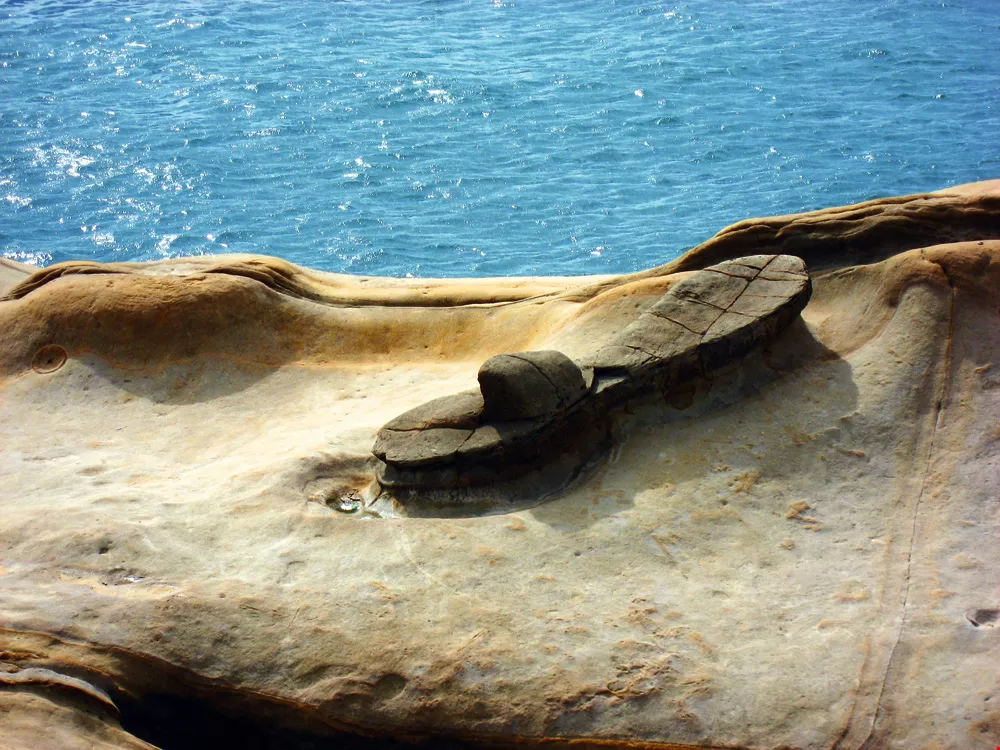
The Fairy’s Shoe shown here falls in the category of ginger rock, composed of sandstone with hard calcareous concretions embedded in it. The seawater has washed away the softer sandstone to reveal what looks strikingly similar to a shoe, and the natural jointing in the rock adds a convincing decorative touch!