Popping Up at Chinese New Year’s:The Dadong Arts Library
Su Shih-ya / photos Su Shih-ya / tr. by Jonathan Barnard
April 2014


As promoters of reading culture, libraries, if managed creatively, can also become forces to bolster community solidarity and societal exchange.
Famous for its innovations, Kaohsiung’s Dadong Arts Library beat out stiff competition to win the Ministry of Education’s Innovation Award.
As its name implies, the library’s collection focuses on art books, with some 150,000 volumes in all. Another unique feature of the library is its collection of children’s pop-up books. When you open the books, castles and dragons and even Harry Potter magically leap out from the page.
When the Dadong Arts Library opened during Chinese New Year’s vacation—the most important holiday for Chinese around the world—it received more than 20,000 visitors in six days. That’s a new record for a public library in Taiwan. The branch really pulled out all the stops, providing fabulous personal viewing areas for people to watch videos and bringing the building’s architects back to answer visitors’ questions about its design. Many members of the community came back day after day.
The Dadong Arts Library is located in the Fengshan District of Kaohsiung, next to the Dadong Elementary School. The two institutions create an interesting visual mix.
Established in the Japanese era, the school has one of the most illustrious histories in the Kaohsiung area. But with declining numbers of local children, it was turned into a special “mini” elementary school with a focus on the arts. The downsizing freed up 4.3 hectares for a new cultural and arts center. Part of that complex, the Dadong Library helps to blur the line between a school and its community.
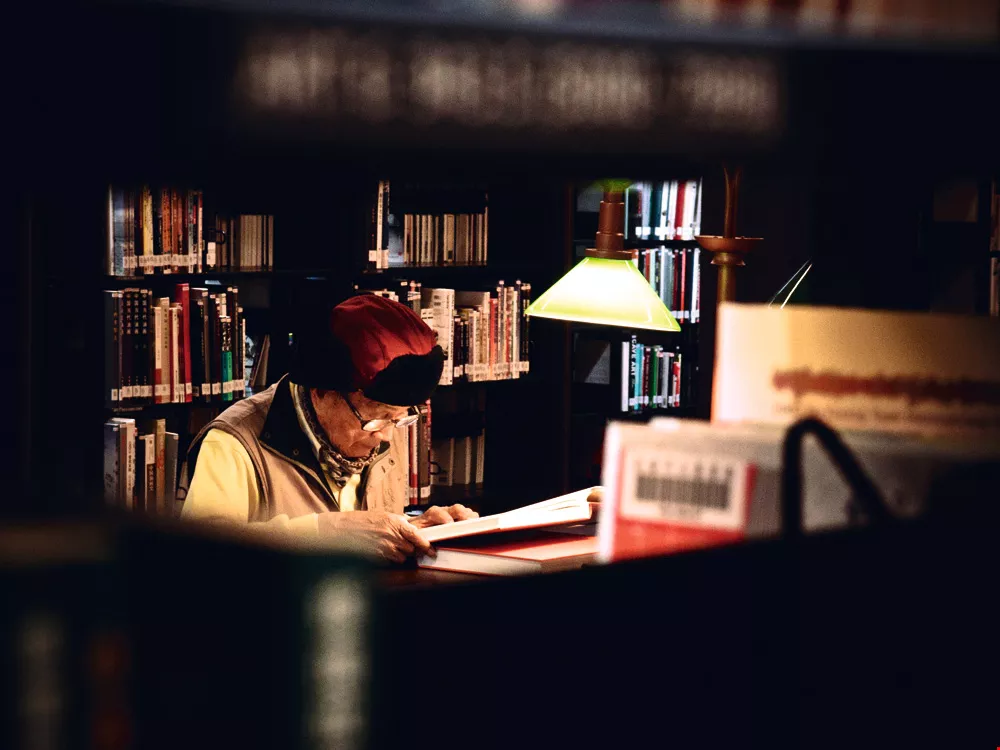
This old gentleman shows up at the Dadong Library every day to read quietly by the soft light of the reading lamps.
Early one spring morning, the southern Taiwan sun shines on traffic-filled streets. The rush hour crowds are hurrying to punch in at work. Meanwhile, locals have gathered outside the Dadong Arts Library, waiting for its doors to open.
One of those waiting is a senior named Mr. Su. Almost every day without fail, no matter how blustery or rainy the weather, and even during typhoons, he makes his way to the library, both to read and to work. In 2013, to celebrate its anniversary, the library held a photography competition. Mr. Su quite naturally became one of the leading subjects of the photographs submitted by competitors.
Apart from the seniors, the library is also full of intimate scenes of parents and children reading together. Because Dadong is the nation’s first library devoted to art, it has many lively and beautiful books on its shelves, which attract people’s notice. The specially designed spaces of the children’s reading area and its pop-up books cause children and parents to linger. The library holds nearly 40,000 art books and illustrated books in Chinese and Western languages. That’s more than in any other library in Kaohsiung. Many of these expensive books were crafted by hand abroad, with prices running to the tens of thousands of NT dollars.
Pop-up books are volumes with moveable elements in their page spreads or paper art that unfolds as pages are turned. These books have 800 years of history. At first pop-ups were used for calculating tools or for visual aids in instruction manuals aimed at adults. It wasn’t until the Industrial Revolution of the 18th century that pop-up books began to be marketed to children. Now most pop-up books are for children.
The library holds pop-up versions of well-known children’s books in their original languages, such as Beauty and the Beast, Aesop’s Fables, Alice in Wonderland, and Peter Rabbit. These are among its most commonly borrowed books. A Mrs. Lin, who lives in the neighborhood, often brings in her small grandchild, who delights in these pop-up books. Even though Mrs. Lin doesn’t understand English, she tells the stories with cues from the illustrations.
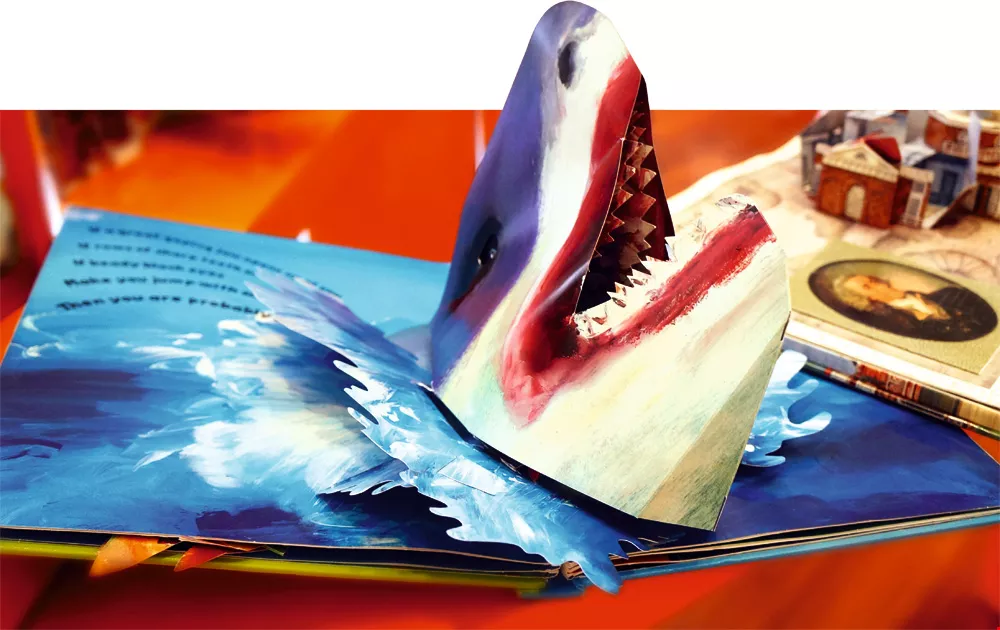
Open the book, and a shark leaps out from the pages! Pop-up books are full of suprises.
In the reading area on the third floor, elegant Hans Wegner elbow chairs await readers to fill them. The brass and green-glass reading lamps here are variations on the classic reading lamps found in the Boston Public Library, the first of their type used in any American library and much loved by the library’s users. The designer of Dadong’s reading rooms studied the Boston Library carefully. Installed on the reading tables, the lamps, with their green glass, impart a nostalgic atmosphere. Cast downward onto the pages of books, their light is soft.
Xu Ruihong, who once served as the executive director of Taiwan News, says, “I used to hear a lot about how the Boston Public Library was so elegant and captivating, but I never had a chance to visit it. Now, the atmosphere I imagined it having has been recreated right here in the Dadong Arts Library. We may not have the rest of the Boston Public Library, but we’ve got those classic green lamps to accompany your reading.”
A Ms. You, who works in art and design, excitedly says, “The Dadong Arts Library has all manner of foreign design books, which are a fantastic source of inspiration.” She used to have to purchase books through foreign Internet booksellers. They were very expensive, and she couldn’t look at a book before she ordered it. When she received books, she sometimes discovered that they weren’t suited to her needs. Now she can just go to the library and borrow them.
With its focus on the arts, the library has become an important resource for artists of all kinds. Yet most wonderfully, its grandeur hasn’t pushed the community away. Instead, the library has become an intimate friend of the common folk!

@List.jpg?w=522&h=410&mode=crop&format=webp&quality=80)

@List.jpg?w=522&h=410&mode=crop&format=webp&quality=80)


