Morotai Island: Emerging from Isolation
Liu Yingfeng / photos Jimmy Lin / tr. by Scott Williams
January 2014


Indonesia’s Morotai is an emerald isle located just three hours by air from Taiwan. Still largely undeveloped, it is a tranquil place seemingly consisting of little but blue skies and rugged coastline.
Just over a year ago, the Taiwanese and Indonesian governments joined hands to forge the island’s future. They plan to use the previously isolated island’s abundant natural resources to provide it with a sustainable future.
Passing through Ternate, the spice capital of Indonesia’s North Maluku Province, we hop aboard a motorboat bound for Morotai, the nation’s northernmost island. In the distance, we can just make out a simple harbor dotted with docked sampans.
With the November arrival of the monsoons, heavy rains lash the 2,400 square kilometer island. As evening approaches, a cool breeze begins to blow. Smoke spirals up from a nearby cooking fire, and children play in front of wooden bungalows.
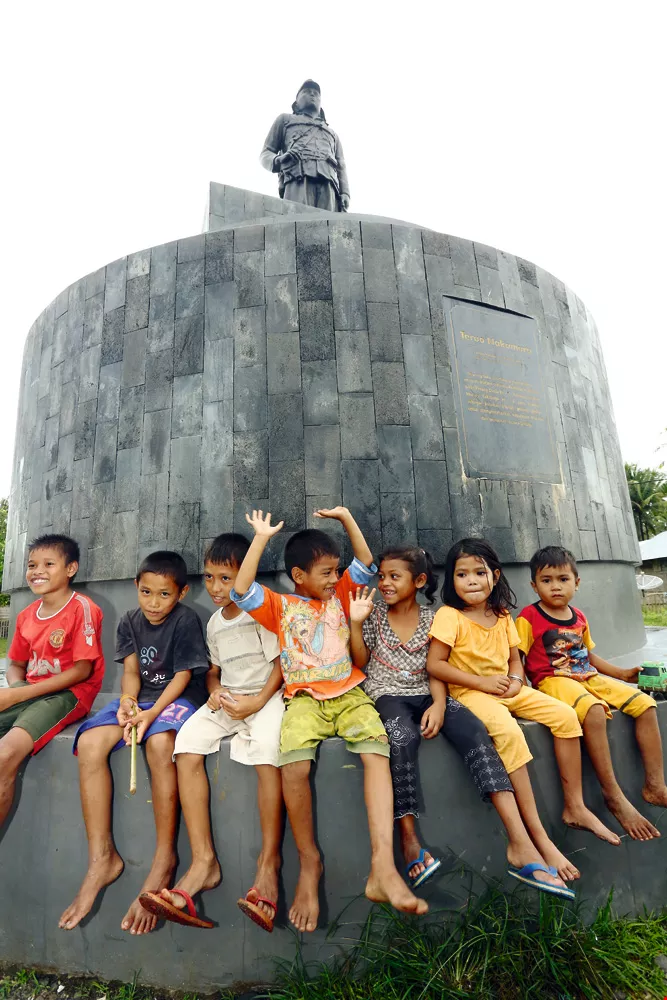
Morotai Island, located at the northern edge of the Indonesian archipelago, was home to Li Guanghui, a Robinson Crusoe-like Amis tribesman from Taiwan, for more than 30 years. The local government even commissioned a bronze statue to commemorate Li’s story.
Night comes on quickly, and with it the coastal reefs and palm forests disappear into inky blackness. Lanterns come alive inside the bungalows, powered by the new 60-megawatt solar power plant that provides electricity for the island’s 60,000-plus residents.
The sounds of karaoke waft from the small beachside resort that opened last year. Then there’s a pop, followed by the humming of a backup generator coming to life. Power outages are simply a part of life here on Morotai, which will be especially quiet tonight.
Morotai rises from the ocean far from the hustle and bustle of Jakarta. With only one scheduled flight to the island every day, it remains relatively isolated. But as tranquil as the island is today, it was of great strategic importance 60-odd years ago.
Though only one-fifteenth the size of Taiwan, Morotai’s location midway between Indonesia and the Philippines made it a strategically important battlefield for US and Japanese forces during World War II. The Japanese military built two airstrips here, and General Douglas MacArthur later used it as a base during his island-hopping campaign. MacArthur even visited in person after the Allies established a beachhead on Morotai in 1944, deeming the island crucial to the Allies’ victory in the Pacific theater.
Stories about the events of World War II still circulate on the island today. Islanders say that General MacArthur bathed at Air Kaca, a cavern on the western side of Morotai, shortly after arriving on the island. Some also say that the cavern was created when MacArthur ordered Allied troops to dig a channel under cover of darkness to enable them to slip ashore in secret.
The island even has a war-era link to Taiwan. An Amis from Taitung named Li Guanghui who had been drafted by the Japanese and sent to fight in the South Pacific ended up stationed here during the war. When the fighting turned fierce, Li took refuge deep in the forest and ended up losing contact with the Japanese military.
He remained “lost” until a young villager reported meeting him in 1974, precipitating Li’s first trip back to Taiwan in 31 years. During the intervening years, Li had married a local and lived like the shipwrecked Robinson Crusoe, far from the affairs of the outside world.
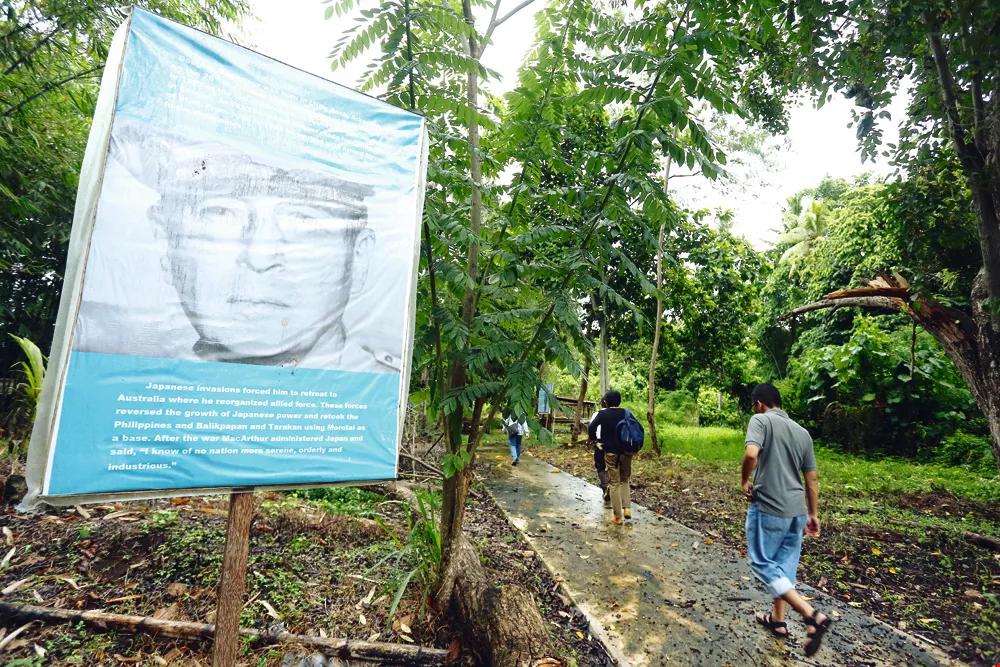
Morotai is home to a number of historic sites dating to World War II. Among them is the Air Kaca cavern, where General MacArthur is reputed to have bathed after coming ashore.
Nowadays, the island is being reinvigorated by the Taiwanese–Indonesian joint development program.
Taiwan and Indonesia signed a memorandum on the joint development of Morotai in December 2012 following two years of discussions. Taiwan then placed its side of the development mission in the hands of the International Cooperation and Development Fund (ICDF) in October 2013.
A veteran of several trips to Morotai, ICDF secretary-general Tao Wen-lung says that when you consider how far Indonesia’s territory stretches from east to west, developing Morotai makes both strategic and economic sense.
Morotai’s most valuable agricultural products are its cloves, cardamom, and Borneo kauri (Agathis dammara), a coniferous timber tree. Tao says that the agricultural techniques currently in use on the island limit its harvests, but suggests that the current environmental push to reduce food miles offers opportunities for developing local agriculture in a manner in keeping with local customs.
The island’s scenic highlights include mangrove forests that extend into its interior and beautiful coral reefs in pristine coastal waters. Tao believes that Morotai’s natural environment, history and culture give it fantastic potential for tourism.
He adds that Taiwan and Indonesia are well aware of the global problem of overdevelopment, and have therefore agreed to make ecological sustainability a core principle of their development efforts. In the future, the ICDF will evaluate the environment’s tolerance for any business that seeks to set up shop on the island. The hope is that they can keep Morotai from being as overrun by international tourists as Bali.
Importing agricultural know howBecause the Morotai development plan represents Taiwan’s first attempt at managing an overseas development program in conjunction with another country, the ICDF has modified earlier agricultural mission practices by placing a manager with negotiating capabilities in the country. In fact, ICDF sent project manager Wu Jiungfeng to Jakarta in November 2013 to begin preparations.
Agriculture is another issue. Morotai suffers from a lack of water resources that severely limits the number of places in which crops can be cultivated. The islanders do grow some eggplant and bitter melon, but the yields and quality of the vegetables are poor, leaving them dependent on produce from Manado, the capital of North Sulawesi Province.
Once the ICDF establishes itself on the island in early 2014, its first priority will be helping locals become more self-sufficient by improving local farming practices and introducing less water-intensive crops such as upland rice and quick-maturing vegetable varieties.
Wu says that the Indonesian government’s 2011–2015 comprehensive regional plan names fishing and tourism as key areas of development for Morotai. ICDF’s second priority will therefore be to bring in two technical specialists to help locals improve their Chinese and English language skills, and their service skills.
Jababeka, a development company that has worked on Java’s outlying islands, is handling implementation on the Indonesian side of the project. Company chairman S.D. Darmono says that Morotai is only three hours by air from Taiwan, and argues that if the island develops a tourism industry, its coastal scenery is sure to draw Taiwanese tourists. Island spices, coral reefs, and World War II have all helped shape Morotai. After years in hibernation, this speck of an island at the northern edge of the Indonesian archipelago is ready to reemerge and seek its place in the world.

@List.jpg?w=522&h=410&mode=crop&format=webp&quality=80)
@List.jpg?w=522&h=410&mode=crop&format=webp&quality=80)


