Ye Ye Ye: Three Generations of Temple Sculpture
Kuo Li-chuan / photos Cheng Heng-lung / tr. by Scott Williams
March 2012


Deeply historically and culturally rooted, Taiwanese temple architecture is distinguished in part by the jiannian (“cut and paste”) sculpture that adorns its roof ridges. The sculptures, which depict dragons, beasts, characters from fables and parables, and legendary immortals, are truly magnificent.
The craft has been passed down through the generations in Tainan, home to Taiwan’s densest collection of temples and to the Ye family, renowned jiannian artisans. The craft itself brightens and brings color to otherwise solemn temple culture by transforming pottery shards and bits of broken flower vases into vibrant sculptures.
Jiannian originated in the Chaozhou area of Guangdong Province some 400 years ago. Chaozhou has produced ceramics since ancient times, and its masons long used discarded pottery shards to decorate their structures. The craft, known there as jianhua (“cut flowers”), later made its way to Taiwan with Chinese immigrants.
Similar to mosaic, jiannian is the practice of cutting pottery shards to shape and embedding them into roughly formed plaster to create decorative images.
The technique owes much to painting. Using steel wire as “bones” and plaster as “flesh,” artisans shape figures of humans, birds, beasts, and flowers. They then use pincers to clip bits of glass or colored ceramics. Embedded in the plaster “flesh,” these become the skin. Completed sculptures are mounted atop the roof ridges and under the eaves of Taiwanese temples.
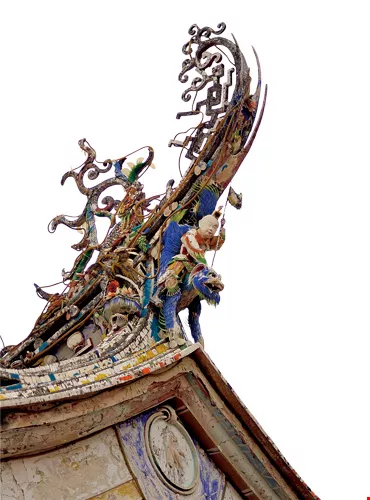
Qilin Taizi, a jiannian sculpture on the roof ridge of the gate area of Tianhou Temple at Qihou, Kaohsiung, is ornate and finely made.
The Ye family of Tainan’s Anping District are among the most renowned practitioners of this traditional handicraft. Family patriarch Ye Zong (1893–1971) studied under Hong Hua, a native Taiwanese craft master and Anping resident who originally learned from masters in Chaozhou.
Ye Zong established the family business. His son Ye Jinlu took it over and eventually passed the torch to the family’s third generation: Ye Mingji.
Now aged 81, Ye Jinlu learned the trade from his father after graduating from elementary school. “It was very hard work,” he recalls. Though his father had numerous apprentices, he was strictest with the young Jinlu, shouting at him if his work didn’t come up to standard and keeping him home in the evenings to practice his painting while the other apprentices were off attending glove puppetry shows or Taiwanese Opera.
“My father thought that learning to paint was crucial to learning our art, and was determined that I learn to paint well.” Ye Zong’s stringent demands together with his own native talent and hard work ultimately turned Jinlu into an accomplished painter.
In 1952, Ye Jinlu and his father restored the Ciji Temple in Xuejia Township, Tainan County. Awed by the work Ye Wang and He Jinlong—masters of the previous generation—had done on the temple’s beams, the younger Ye applied himself with still greater diligence to the study of his craft, honing his skills for five more years before finally producing work with which he was satisfied.
In 1961, he and his father took on a jiannian project at Tainan’s Wanhuang Temple, competing “head to head” with another jiannian team. The temple assigned half of the project to them and the other half to another master, separating the teams from one another with plastic sheeting. When the Yes’ work was judged to be superior, the temple staff draped them in red silk, paraded them through the streets in a ceremonial vehicle, and sent them home in great honor.
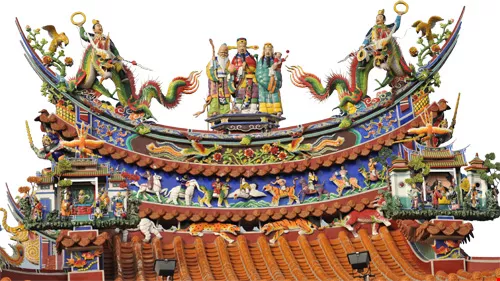
The brilliant Shuang Long Hu Cai Zi Shou on the roof ridge of Tainan’s Bao’an Temple is a jiannian sculpture composed of elements of varying sizes, including beasts, people, and immortals.
Later, Ye Zong and Ye Jinlu became so renowned for their craft that even the gods “acknowledged” them.
When Mingsheng Temple was being constructed in Bitan, New Taipei City, in early 1960, temple staff asked the team building the temple to recommend a jiannian artisan and received a list of more than 100 names. After seven days of praying for guidance, temple staff cast divination blocks and chose Ye Jinlu after his name received nine “yeses,” more than any other jiannian craftsman.
At the outset, Ye refused. When his father was active in the field, he had three opportunities to take on projects in Taipei, but each time Taipei craftsmen deliberately pushed down the price until Ye Zong had to decline. “In those days, craftsmen in the north boxed out those from the south. If my father, who was so well known in the field, couldn’t take projects in the north, how could I?” Exasperated by his repeated refusals, temple staff told him: “You’ve been chosen by the gods. Cast the blocks yourself and ask them!” Heading home after that visit, Jinlu carried an NT$100,000 deposit for the project in his pocket.
When Taiwan’s economy took flight in the 1970s, there was a flurry of temple renovation. Many older buildings were rebuilt with reinforced concrete and the work of older masters was replaced. Fengshan’s Longshan Temple, a national historic site, is one of the few temples where you can still see restoration work down by Ye Jinlu and his father (Ye Zong restored it in 1958, and Jinlu in 1987).
The four-clawed green dragon of the left-hand interior wall combines stucco, jiannian, and painting techniques. The long, thin body bursts through the clouds with impressive force. The waters surging beneath it form dancing whitecaps where a smaller green dragon swims, looking up in awe at the larger dragon in the clouds.
Koji pottery figures of the immortals Lady He and Iron-Crutch Li adorn opposite ends of the right-hand wall under the eaves. Beautiful Lady He glances back while leaning against a door. Iron-Crutch Li’s right hand strokes his belly as he gazes skyward and laughs as if utterly untroubled by the grotesqueness and lameness of his physical form.
The work on both walls is a testament to the skill and artistry of the masters of earlier generations.
Ye Jinlu says that jiannian and koji pottery are different crafts utilizing different materials and techniques. In the old days, craftsmen such as Hong Hua and Ye Zong were masters of both, capable of sculpting clay and crafting koji figures. That’s why you see both jiannian and koji techniques together in the older temples.
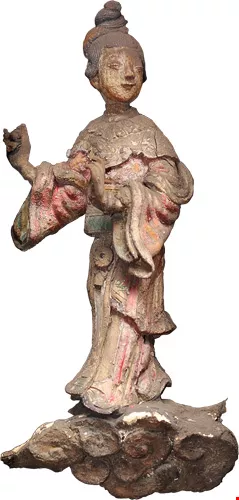
Each generation of the Ye family has its own style. Shown on this page are a Ye Zong koji sculpture of a woman from the distant past, and a Ye Jinlu piece that combines koji and jiannian techniques.
Though jiannian originated in mainland China, the Cultural Revolution effectively eliminated it there. As a result, the mainland has had to turn to Taiwanese artisans for help on its jiannian projects.
In 1993, Ye Jinlu met the secretary of the provincial party committee at a banquet he attended in Hunan’s Shimen County. When the secretary learned that Ye was a jiannian artisan, he mentioned that the area had two historic buildings in need of restoration and asked him to take on the project, for which the budget was RMB50 million. Not knowing whether he could trust the people involved, Ye declined.
In 1998, Ye Jinlu learned that the jiannian sculptures he had created for Tainan’s Jian’an Temple when he was 42 had been damaged by years of exposure to incense smoke and were to be removed. After buying them for a few hundred thousand NT dollars, he cleaned, repaired, and individually framed each piece. Restored to their former vibrant glory and removed from their temple context, the pieces were transformed into works of pure art. The Tainan Municipal Cultural Center invited him to exhibit them in 2000 to let the public see this traditional handicraft up close.
A jiannian artisan for 60 years, Ye Jinlu is a national treasure who has been involved with the restoration of more than 300 temples and won numerous awards, including the 14th Global Chinese Culture and Arts Award in 2007.
Ye has three sons and two daughters. Though his eldest son originally studied with him, Ye was more focused on his more artistically talented third son, Mingji.
Now 49, Ye Mingji has been immersed in jiannian since childhood and used to work for his father during summer holidays. But when he finished high school, he was uninterested in taking on the family trade. After completing his military service, he instead became an engineering manager in the construction industry. That changed 16 years ago, when the call of familial affection drew him home again.
“When I came back, I had to start as an apprentice,” says Mingji. Jiannian requires hard manual labor: working in the sun, climbing ladders, cutting pottery shards and colored glass to measure, then sticking them onto a variety of forms.... Nonetheless, after honing his skills for a few years, he came to appreciate the craft’s cultural value and developed a sense of mission.
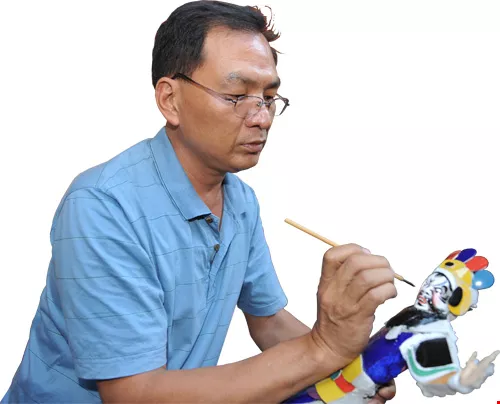
Carrying on the family trade, Ye Mingji is completely focused on his work, particularly when creating small pieces, which are especially challenging to produce.
Because Ye Mingji entered the field in his 30s—quite late for a traditional craft that stresses hands-on experience—and given that both his father and grandfather were well known craftsmen, it was only natural that his work would be closely scrutinized. Determined to excel, like his father before him he spent his spare time practicing his brushwork.
The acclaim he won from fellow artisans and academics for his restoration of the jiannian at Tainan’s historic Zonggan Temple silenced the doubters and earned him a reputation in his own right. In 2010, he worked on the restoration of the historic Tianhou Temple in Kaohsiung’s Qishan District. Though the jiannan works Hiring of Worthies on the Wei River beneath the eaves of the left arcade by the temple’s triple-gated entryway and Three Visits to the Thatched Cottage beneath the eaves of the right were badly faded and there was little information about their original appearance, his skilled work succeeded in restoring their vibrancy and splendor.
Feeling it a shame that the time-, labor-, and thought-intensive jiannian craft was limited to temples, Ye Mingji cast about for a means to elevate it into the realm of art while also bringing it to ordinary people. To that end, he and his father established the Tailang Arts and Crafts Workshop in 1998, and began working together on jiannian pieces for art collectors. One of these, a piece called Dragon Looking Skyward on which Mingji worked for six months, was the first Taiwanese jiannian to manage full three-dimensionality in a small piece.
“The smaller you make jiannian, the more attention you have to pay to details like curvature and turns. The difficulty increases as the size shrinks, and three-dimensionality just makes it harder still.”
Ye Mingji’s groundbreaking work introduced the general public to the beauty of jiannian. His 2003 invitation to exhibit in Brisbane, Australia, brought still greater exposure to the art form by introducing it to the global stage.
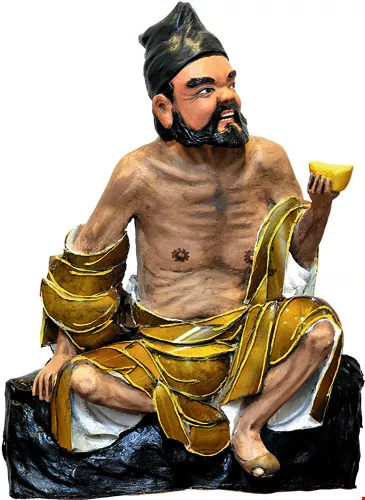
Each generation of the Ye family has its own style. Shown on this page are a Ye Zong koji sculpture of a woman from the distant past, and a Ye Jinlu piece that combines koji and jiannian techniques.


