Peng Chin-yong’s United Nations of Tomatoes
Chang Chiung-fang / photos Jimmy Lin / tr. by Phil Newell
March 2014


What an amazing assortment of tomatoes you will find at the Chin Yong DIY Recreational Farm in Guanxi Township, Hsinchu County! Some are shaped like kiwifruit, some like lemons; others resemble light bulbs, and still others sweet peppers. The collage of colors—red, orange, yellow, green—never fails to delight and dazzle visitors. Just looking at them puts one in a happy, energized state of mind.
Peng Chin-yong, who in 1995 was given the Shennong Award as one of the nation’s top ten farmers and who in 2004 was named one of the ten most outstanding business managers in Taiwan, Hong Kong and mainland China, has been growing tomatoes for 21 years. He has taken his operations from the “primary sector” of the economy (agriculture) into the “tertiary sector” (services, specifically tourism). Peng’s “United Nations of Tomatoes”—so named because he grows varieties from all over the world—is a case study of the miracles that can be accomplished with a low-toxin small farm.
The Chin Yong DIY Recreational Farm is divided into three zones, with a cultivated area totaling five hectares.
In terms of production volume, sweet peppers rank at the top of the crops, with the farm’s 6000 bell pepper plants producing about 36 metric tons per year. But there is no question that tomatoes—of which the 50,000 tomato plants produce about 20 tons annually—are his marquee product. These two items are complemented by other fruits and vegetables including strawberries, sweet corn, and cucumbers.
Yet despite these production levels, supply still can’t keep up with demand.
“When I first started out, I only knew about growing tomatoes; I didn’t know anything about selling them. I was always taken advantage of in the wholesale market—it was really pathetic. But now, using the tourist farm model, consumers come directly to me. I don’t have to lay out any money for packaging, transport, or commissions—the buyers even pick the tomatoes themselves!” Peng explains happily. “Also, the price is unaffected by fluctuations in the open market, which is a win-win situation for myself and my customers.”
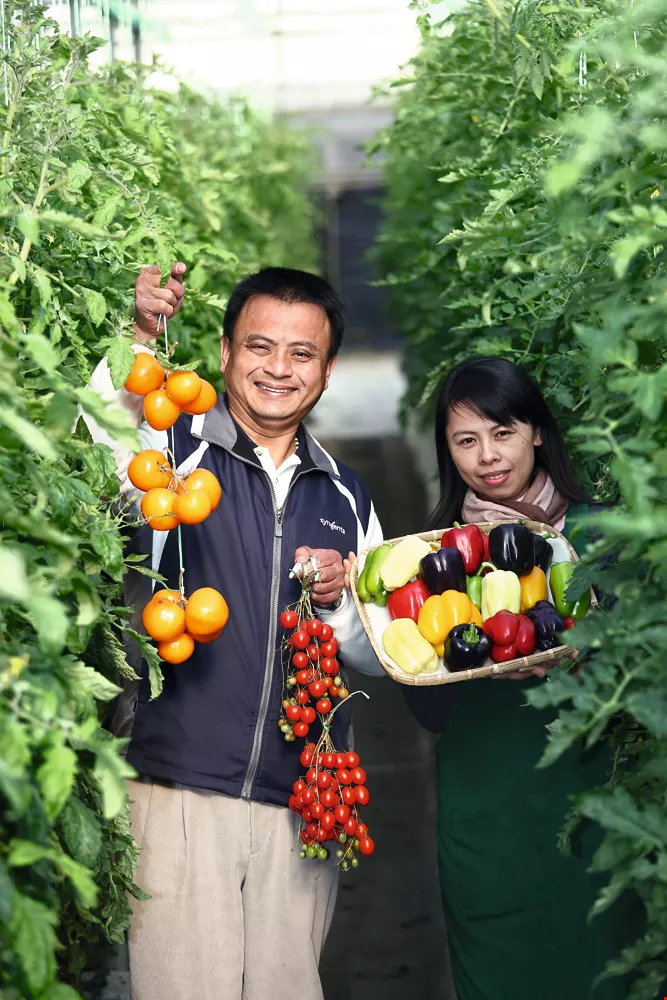
Sweet? Sour? Lycopene, anthocyanidin, folic acid? Visitors to the Peng Chin-yong DIY Recreational Farm can pick and choose from a wide variety of bell peppers and tomatoes to get whatever they want most.
Basket case
The success of the Chin Yong Farm is built on two key elements: quality and marketing.
In order to learn how to grow the best possible tomatoes, as well as how to deal with issues like soil quality, disease, pests, and climate change, Peng Chin-yong went all the way to the Netherlands to see how they did things there.
He relates that the soil in Taiwan is seriously acidified and compacted, and deficient in the microorganisms needed for the growth of fruits and vegetables. Moreover, you can’t cultivate plants of the Solanaceae family (which includes tomatoes, eggplant, and bell peppers) on the same plot of land two years in a row, because residual root-nodule bacteria in the soil will cause the crops to rapidly die. (Anti-microbial pesticides are ineffective in these cases.)
Peng therefore imported the Dutch method of growing tomato vines in baskets elevated off the ground. For his growth medium, he buys peat soil from the European Union and mixes in coconut fibers from Southeast Asia. And he completely replaces his old soil each year.
Greenhouse cultivation is another important factor in his success. Peng explains that the acidity of rainwater is already quite high (a pH of between three and four, with seven being neutral and one being highly corrosive), which can have a devastating effect on plant life. Take for example chili peppers. Their main defense against disease is that they have a natural waxy coating. But when this protective surface is damaged by acid rain, once the sun comes back out the plants are highly vulnerable to black spot disease. Unless immediately sprayed with appropriate agrichemicals, they will yield nothing.
Tomatoes, meanwhile, face a number of threats, including powdery mildew and anthracnose as well as an insect known as “tobacco cutworm” (which feeds on the leaves and stems). Not only can greenhouse cultivation reduce the risk of insect damage to below 5%, the harvest season can be extended to nine months long. (Typically, farmers can pick tomatoes for only one or two months, after which they have to cut their vines out and replant.) The trick is that Peng’s vines can be laid flat, so that they can continue to grow upwards in an L shape. However, the longer the growing season, the higher the chances of disease. If disease does become a serious problem, Peng must spray his tomatoes with low-toxicity chemicals.
Peng says that although this means the tomatoes don’t come out entirely toxin-free, every test they have done shows they meet the GAP quality standards set by the Council of Agriculture. “If we do have to use some kind of pesticide,” says Peng, “we always ban picking in that area for a week to ensure the tomatoes are safe for human consumption.”
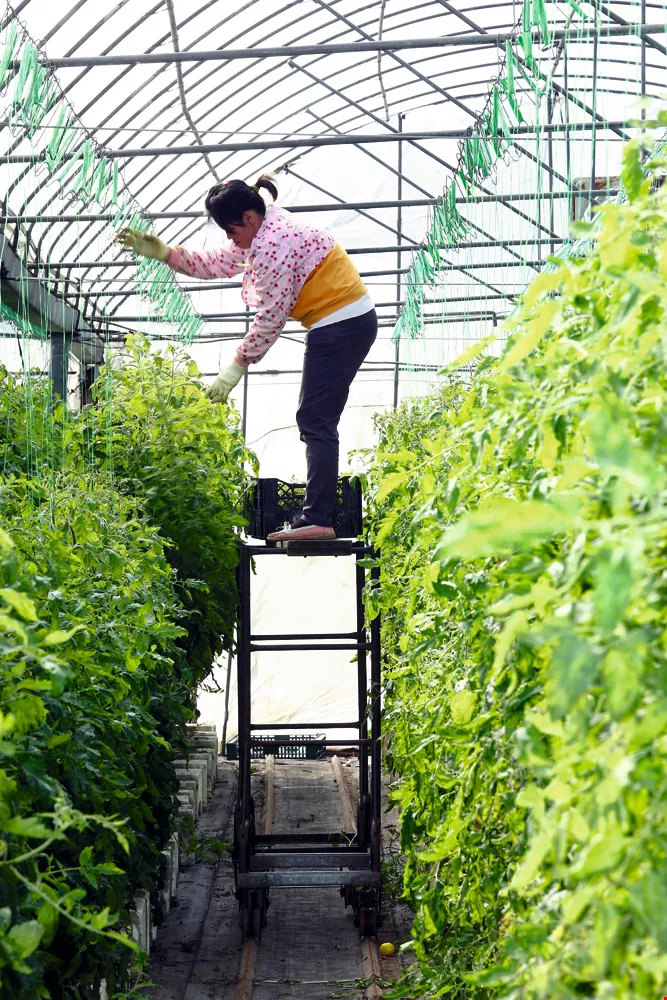
Agriculture in Taiwan faces problems with acid rain as well as acidification and compacting of the soil. Peng Chin-yong addresses these by growing his tomatoes in baskets filled with imported soil and placed in greenhouses. When the vines grow too high, he can place them on the ground so that they continue growing upward, extending harvesting to nine months long.
It’s the marketing
“You reap what you sow.” Nice sentiment, but every farmer knows that no matter how hard you work, it’s all for naught if you don’t get a good price for your crop.
Peng, who has been growing tomatoes for 21 years, says that he used to sell his tomatoes the way most farmers still do, through produce markets and supermarkets. “Produce markets only want large tomatoes, and they don’t accept any B-grade ones. Supermarkets only want tomatoes of about 120 grams—not too big and not too small. The smaller tomatoes get sold to schools for student lunches.”
But the market mechanism means that when production rises, prices fall. Although prices rise when production is low, by definition you haven’t got as much produce to sell! It’s hard to make much money under these conditions.
After pursuing primary agriculture for six years, Peng began to think about operating a tourist farm where he could sell his own produce directly to consumers. As visitor numbers have increased from 100–200 per day at the beginning to 3000–5000 per day today, the percentage of tomatoes that Peng sells through wholesale fruit and vegetable markets has conversely fallen from 80–90% all the way to zero.
These days Peng has to meet and greet so many visitors it’s scary. On weekends and holidays, he can get as many as 50–60 tour buses per day.
To make visits more fruitful, Peng has designed a half-day itinerary for visitors. Besides picking their own produce, visitors can enjoy DIY activities for making mashu (sticky-rice sweets) and Hakka leicha (a traditional drink with tealeaves, sesame, and peanut powder). This allows everyone to stay occupied with different things rather than having them all crowd into the greenhouses at the same time.
Tomato history
Since taking the recreational farm route, Peng has discovered that visitors by no means share uniform tastes when it comes to tomatoes. Some prefer sweet, some like sour, some like crispy, others prefer soft. Pregnant women should eat tomatoes high in folic acid, while people with diabetes have to stick with those low in sugar. To cater to different cravings, Peng has over the years introduced more and more types of tomatoes from other lands, and today he cultivates 42 such varieties.
Each variety of tomato has its own nuances. For example, Taiwan’s own “Black Beauty” tomatoes have thin skins with fine (rather than coarse) pulp; they are also noteworthy because they turn darker in color when air temperatures are lower. The red-orange T-bone tomato from the Netherlands, on the other hand, is crisp and sweet, while the European yellow pear tomato is high in vitamin C.
Golden tomatoes have a special place in the collective memory in Taiwan, having enjoyed a highly unexpected 15 minutes of fame back in 1999.
In general, golden tomatoes are beautifully shaped, but not sweet, so they are not very much coveted by consumers, with the exception of diabetics. But this general rule was shattered in Taiwan by the marketing effects of television, which turned golden tomatoes into a “miracle food.”
At the time Gala Television aired a program about Peng’s farm, and while being interviewed he mentioned having imported sugar-free golden tomatoes for diabetics, which by then he had been cultivating for three years, though without much market response. The media, always looking for an angle, began blathering about “miracle weight-loss sugar-free tomatoes.” At the behest of the media, Peng provided ten people with one catty (0.6 kilos) per day of golden tomatoes for seven straight days, and they ended up losing three to five kilos each. When these people went on TV to testify about their experiences, they turned golden tomatoes into an overnight sensation. For a time they were selling for NT$1000 per catty in Taipei wholesale markets.
However, it wasn’t long before trading companies, dollar signs shining in their eyes, started importing large volumes of small yellow tomatoes. Unfortunately, the imports were in fact a completely different variety. The market rejected them, and prices collapsed.
Likin’ the lycopene
Peng not only understands all about cultivating tomatoes, he knows all about how to get the most effectiveness and nutrition out of them. He states that you get the most impact in terms of weight loss if you eat some tomato before meals. But people with sensitive stomachs should wait until after meals.
Among the more than 40 varieties of tomatoes Peng grows, the most popular is the Momotaro breed from Japan. It has a pleasing texture, the surface is as shiny and red as an apple, and it has the highest content of lycopene, which has antioxidant properties.
There is also a trick to getting the most lycopene out of a tomato when you eat it. Peng says that you should eat the skin and the flesh together, because the place with the highest concentration of lycopene is the thin white membrane between the skin and the flesh. If you crush tomatoes to make juice or sauce, don’t filter out the pulp, or you will lose all the nutritional value.
You also get better absorption of lycopene if you heat the tomatoes. Peng relates that the optimum cooking temperature is 60–80°C. Adding oil also helps, because lycopene dissolves in the oil and therefore is easier for the intestinal villi to absorb.
A colorful life
Having gone from a small farmer whose daily bread depended on the weather and the forces of the open market to an entrepreneur operating a business with annual revenues of NT$20 million, Peng Chin-yong says: “The agricultural sector has to integrate production with ecological sustainability and cultural content—appealing to people’s desire to stay in touch with a simpler, more natural rural lifestyle. Farmers who want to make money would do better to use the part of their body from the neck up rather than the neck down.”
“Tomatoes are really a colorful part of nature, and they can make life more colorful,” says Peng, “Isn’t that a good thing?” A business in the tourism industry must offer its customers fun, touch their hearts in some way, and whet their appetites so that they have a sense of anticipation toward the product and will go out of their way to find it. Over the long term, to satisfy these desires you have to constantly innovate and come up with novel ideas. For his own future, Peng plans to add more varieties and develop various processed tomato products.
Having gotten the knack of marketing, the life of farmer Peng Chin-yong has gone from black-and-white to vibrant color.

@List.jpg?w=522&h=410&mode=crop&format=webp&quality=80)


