The Twists of Destiny A Special Exhibition of Historical Materials on Macau at the National Palace Museum
Jackie Chen / tr. by Phil Newell
January 2000
Macau was the last colony in Asia, and also was one of the first places in Asia to come under the control of Europeans. When and how did it become a Portuguese colony? Interestingly, you won't find the answer to this question in the recently completed ceremonies marking the return of Macau to Chinese rule. But you will find clear explanations, using treaties, maps, illustrations, and other historical documentation, at the Special Exhibition of Historical Materials on Macau currently under way at the National Palace Museum in Taipei.
How did Macau become a colony?
In 1553, during the Ming dynasty, after a Portuguese "tribute ship" was blown aground, the Portuguese captain asked to lease a nearby fishing village to dry out the goods. A local maritime official acceded to the request. In 1614, after the Portuguese had assisted the Ming court in defeating pirates, Viceroy Zhang Ming-gang secured the emperor's consent to allow Portuguese to settle permanently in Macau. As Chen Chien-jen, currently head of the ROC Ministry of Foreign Affairs, which is a main sponsor of the exhibit, points out: That local officials in the 16th and 17th centuries were able to decide on their own to allow use of national territory in response to Portuguese requests shows, from a modern point of view, that Chinese ideas of national territory were ill-defined at that time.
In fact, imperial China only requested that the emperor be obeyed; otherwise it didn't matter what territory was used by whom. Also, before the 19th-century, the idea that "under Heaven, there is no land that is not the emperor's," was still prevalent in China. The idea of national territory as embodied in modern international law is something that only came about as a result of imperialism "knocking at the gate" in China.

Tsai Chin-lung, a teacher in the "New Year Foods" lecture series laid on by the Taipei City Farmers' Association, makes New Year dishes which not only look and taste good, but are healthy too.
Dual rule
For the first 300 years that Portuguese lived in Macau, they did so as tenants, while professing obedience to the Ming and Qing emperors. As Wu Zhiliang, director of the Macau Foundation, says, the Portuguese ran Macau under a "dual rule" situation. "In fact, people now talk of the Portuguese invading' China, but before the late Qing dynasty, this was not at all the situation," he says. It was only in 1887 that Macau formally, by treaty, came under Portuguese sovereignty, with the "Sino-Portuguese Treaty of Commerce and Friendship," which is more commonly called the "Sino-Portuguese Treaty of Peking."
This important document was originally kept in the Imperial Zongli Yamen (which handled foreign affairs). After the establishment of the Republic of China, it was transferred to the Foreign Ministry. Just like the Nanking Treaty which decided the fate of Hong Kong, this Sino-Portuguese treaty has been kept in the ministry all these years.
Portuguese refusal to continue the lease arrangement with the Qing dynasty was connected with the Opium War and the British seizure of Hong Kong in 1842. At that time the Portuguese in Macau felt threatened by Britain, and in 1843 submitted a list of demands to the Chinese: halting of rent payments for Macau, expansion of Macau's boundaries, elimination of the need for Portuguese to apply for licenses for construction buildings, reduction of taxes on Portuguese goods, and access to five new ports for trading. Eventually the Qing agreed to the demand for access to the five ports, but refused to terminate the lease payments. So the Portuguese simply refused to pay the rent, and moreover began to expand their area of control, even "sub-letting" part of Macau to the British.
It was only with the signing of the Sino-Portuguese Treaty of Peking in 1887 that the Qing court formally accepted permanent Portuguese control of Macau. In return, the Portuguese promised not to cede the colony to any third country.
Unfortunately, thereafter on several occasions the Portuguese continued to expand their area of control in Macau. The exhibits at the National Palace Museum include vital documents from that period, including the Chinese, Portuguese, and French versions of a series of unequal treaties as well as maps showing evidence of Portuguese transgressions.
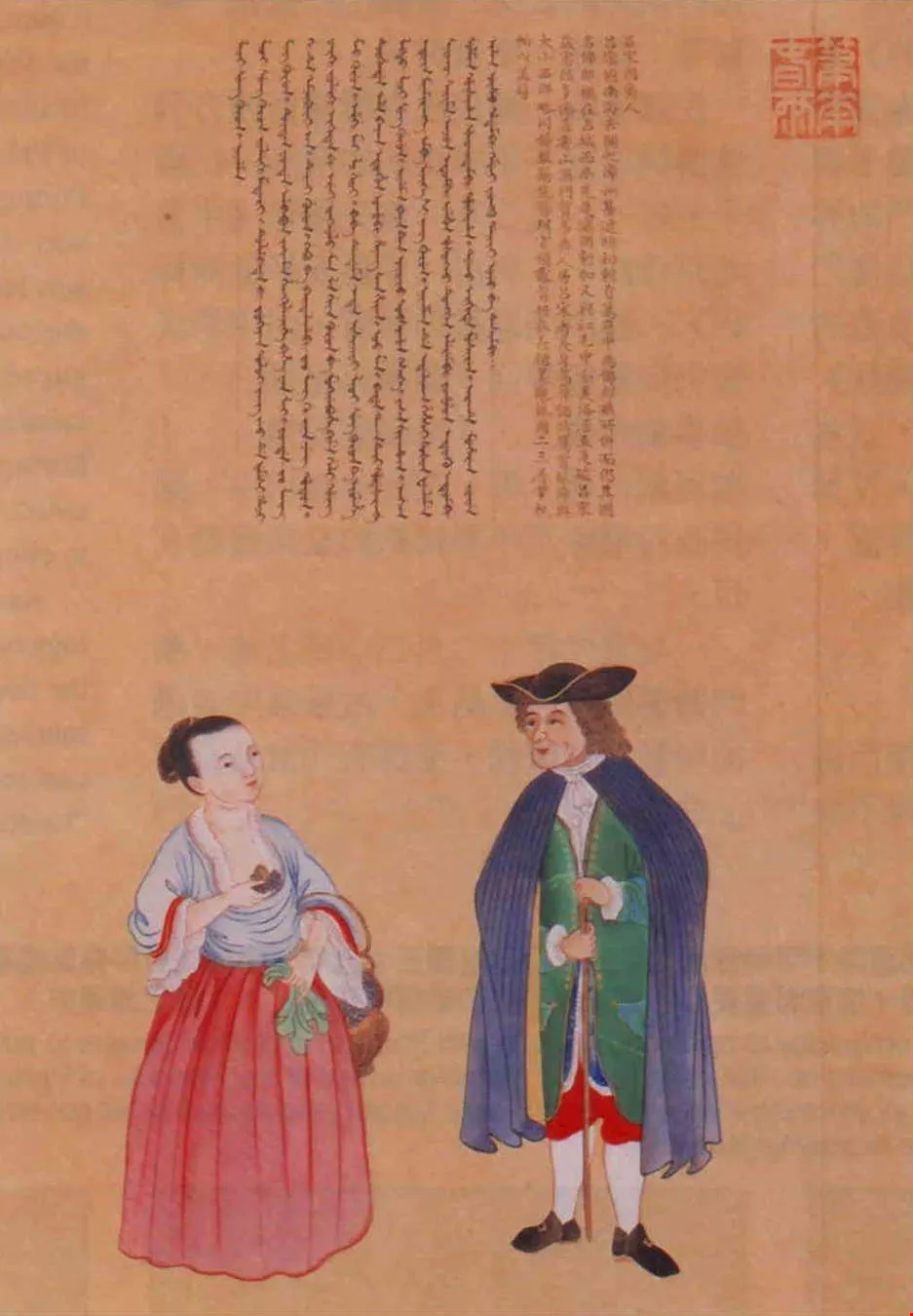
A depiction of "Portuguese people" from Foreign Envoy with Tribute Bearers by Xie Sui of the Qing dynasty. The text describes Portuguese men as "long in body, with prominent noses and mouths like an owl," and says women "tie up their hair, wear hairpins, have square necklines and exposed waists, wear short blouses and long skirts with two or three hoops underneath, and often carry a shawl with which they cover their heads." (courtesy of the National Palace Museum)
Unequal treaties
From the first Portuguese ventures into the Orient 400 years ago, Macau was a place where Chinese and European cultures have mixed. Naturally there were conflicts between cultural, moral, judicial, and commercial systems and customs. The exhibit includes Qing dynasty documents procured by Luo Chia-lun, a well-known figure of the Republican era in China, on a trip to Europe. These include things such as an order by the Portuguese procurator promising to enforce the ban on opium trading in Macau; the names and dates of entry and exit through Macau of the few permitted "quota ships"; details of the lives of European residents, such as a list of their servants; documents from the customs office of Macau Chinese officials; and shipping stamps.
After the founding of the Republic of China, the ROC opened negotiations with the Western powers to abolish the unequal treaties. In 1928, the Sino-Portuguese Treaty of Peking was terminated, and a new Sino-Portuguese Treaty of Amity and Commerce was signed. Although the Macau problem was left unresolved, the ROC reclaimed numerous governing rights from the Portuguese, including powers over customs, coastal trade, and riverine transport; also, Portuguese consular jurisdiction was terminated. The exhibit shows how the ROC tried to eliminate the unequal treaties.
As of December 20, 1999, the era of Portuguese Macau is over. From a walk through the documents and other materials that have marked this Sino-Portuguese journey, you can see that there have indeed been many "twists of destiny."


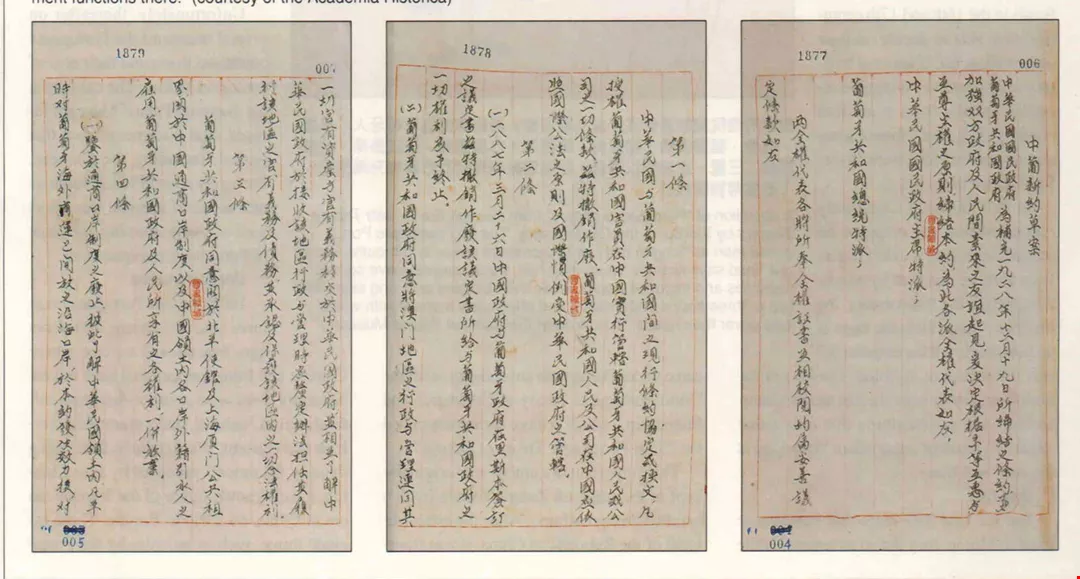
After its establishment, the ROC moved quickly to open negotiations with Portugal and other powers to terminate the unequal treaties. The photo shows a Sino-Portuguese agreement of 1936 which says: "The government of the Republic of Portugal agrees to turn over to the government of the Republic of China all administration and control of the Macau area as well as all government-owned property and government functions there." (courtesy of the Academia Historica)