Every year during the tuna season of March to June, waters between Taiwan and Japan lose their tranquility. This year, more than ten fishing boats have already been stopped or chased by Japanese patrol boats in waters of overlapping or contested ownership.
The problem traces back to the 1994 United Nations Convention on the Law of the Sea, which set a country's exclusive economic zone as extending 200 nautical miles off its shores. That meant that some nations' zones would overlap. In the case of Taiwan and Japan, Japan's claim to the disputed Tiaoyutai Islands puts all of Taiwan in Japan's 200-nautical-mile zone, and parts of the Japanese Ryukyu Islands are in Taiwan's. The dispute over the Tiaoyutai Islands makes it difficult for the two sides even to reach a consensus over a provisional line of enforcement. Traditional Taiwanese fishing areas in the East China Sea, the Tiaoyutais, and the Japanese Yaeyama Islands are all subjects of controversy.
Though international law provides the right to maritime economic activity including fishing, the areas in dispute are open waters and not territorial seas, which are within 12 nautical miles. The harassment of fishermen by Japanese patrol boats within Taiwan's economic zone must meet a stern response.
In the past, the CGA used the provisional line announced by the Ministry of the Interior as the boundary of its fishery protection zone. Many traditional fishing grounds of Taiwanese fishermen fall outside this area, however, so the CGA has expanded the protected area to the entirety of Taiwan's exclusive economic zone save any foreign territorial seas within it. That has brought waters around the Pratas and Spratly Islands into the area, as well as waters around the offshore Chunxiao natural gas fields in the East China Sea.
The CGA plans to begin daily patrols with a 500-ton ship, and move in any time a Taiwanese fishing boat is pursued or detained by a Japanese patrol boat in order to protect their safety and fishing rights.
When the first incidents happened, the CGA found itself accused of being powerless to protect fishermen, so it made its case with numbers. According to Japan's Fisheries Agency, since 2000, South Korean fishing boats were detained the most times by Japanese patrol boats, at 102 instances. Chinese boats were second at 38 instances, and Taiwan third, with only 11 boats stopped. Therefore, the CGA maintained, Taiwanese fishermen were not being singled out for abuse by the Japanese due to Taiwan's zoning predicament.
Following calls from some fishermen for the Ministry of National Defense to use the military to protect fishing boats, on June 21 defense minister Lee Jye and legislative speaker Wang Jin-pyng led members of the Legislative Yuan's National Defense Committee on an excursion on a naval frigate to protect Taiwan's fisheries and assert ROC sovereignty over the Tiaoyutai Isands.
Premier Frank Hsieh instructed appropriate agencies to construct channels for multilateral negotiations in the hopes that a peaceful resolution can be found. In the interests of safety, the administration stressed that the government by no means encourages fishermen to take matters into their own hands. In addition to already having issued a letter of protest to the Japanese authorities, the ROC government has expressed through diplomatic channels its willingness to resume negotiations, and the Japanese have agreed to begin talks in late July.
To stop infringement on fishermen's rights, the government needs to form a long-term, consistent policy and enforce that policy. Before the problem is solved, Taiwan should continue to maintain its claim on the Tiaoyutais and request that the Japanese keep to the status quo. At the same time, negotiations with Japan need to be brought to higher levels of government so an agreement can be signed concerning fishing rights. The government and the people working hand in hand will uphold the nation's dignity and rights.
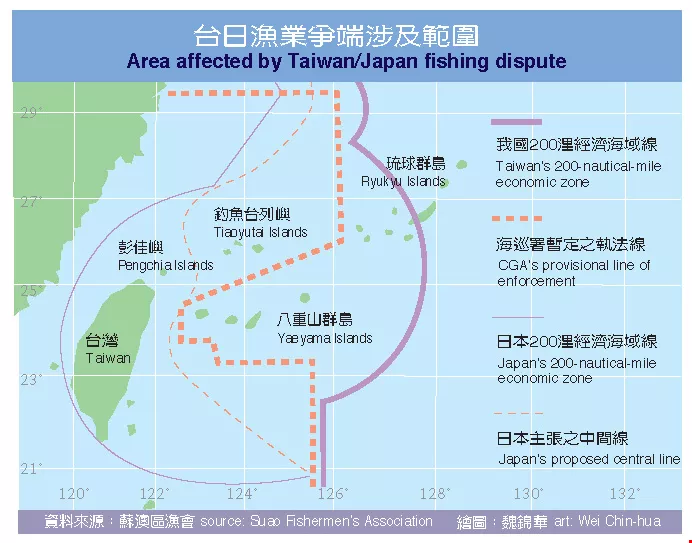
Area affected by Taiwan/Japan fishing dispute
source: Suao Fishermen's Association
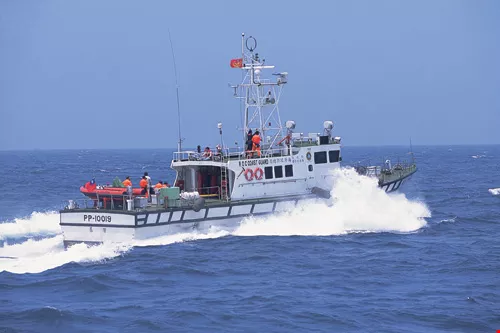
The CGA's determination to protect fishing rights has won the approval of fishermen.




@List.jpg?w=522&h=410&mode=crop&format=webp&quality=80)


