

Football's enormously popular quadrennial World Cup provides the film and television industry with the chance to introduce the latest-and-greatest audiovisual technology to audiences around the world.
When Japan and South Korea jointly hosted the 2002 World Cup, the event kick-started the stampede for flat-panel televisions. The 2006 World Cup in Germany triggered an explosion in high-definition television across Europe. This year's World Cup in South Africa introduced something even more revolutionary: live 3D broadcasts of matches.
At 2 a.m. on 12 July 2010, when most of Taipei was dreaming, hundreds of excited young people filled the Cinemark Cinema at Living Mall. The majority were wearing casual clothing, sports jerseys, and sneakers. Some waved glow sticks. Others had painted their faces in the colors of national flags.
But why on earth were people decked out for a sporting event sitting in a movie theater? They were there to watch the World Cup final. Though very few Taiwanese football fans were able to attend the match in South Africa in person, they could watch it live in 3D from the comfort of a seat in a luxurious air-conditioned movie theater, engrossed as Spain's La Roja vied with the Netherlands' Orange Eleven for the title.

Elta TV, which broadcast the first 3D World Cup to local viewers, currently has three channels: sports, stage and screen, and variety. The network is one of very few in Taiwan able to broadcast entirely in Full HD.
Where viewers of traditional 2D broadcasts of sporting events follow the action by staring at a small screen, the 3D World Cup broadcast allowed audiences to feel as if they were at the stadium themselves, right in amongst the players. Every time two players from opposite teams leapt after a ball, flinging themselves through the air and grimacing, someone in the audience would shout out, "Ouch! That hurt!" The action was just that vivid.
The sponsors also arranged halftime games and cheering contests to further viewers' sense of "surrogate participation," increasing their excitement and sense of being present at the match.
The live World Cup broadcast in 3D was truly revolutionary, both in the sports world and in the film and television industry. In an effort to avoid technical glitches (and engage in some mutually beneficial marketing), FIFA turned to Sony, an industry leader, for the 3D cameras and broadcasting equipment used for the 2010 World Cup. Sony installed nearly NT$1 billion worth of equipment at five South African stadiums, and offered live 3D feeds for 25 of the 64 matches.
Recognizing that 3D televisions are not yet in wide use (their global penetration rate is just 3-5%), organizers arranged to feed the inaugural 3D World Cup broadcast to cinemas that already had all the basic equipment. For their part, the cinema operators were happy to have the extra ticket revenues that the 3D content generated.
In the Americas, a total of more than 700 cinemas screened the live broadcasts. In Europe, some 400 cinemas across 19 nations, including France, Germany, Italy and Spain, participated in the simulcasts. In Asia, only Japan, Korea, Hong Kong and Taiwan offered audiences the chance to see the matches in 3D. Korea was the most enthusiastic, with nearly 52 cinemas offering the broadcasts. In Taiwan, only two cinemas-Taipei's Cinemark and Kaohsiung's Oscar-screened the broadcasts.
Television broadcasters are just beginning to move into 3D, and took advantage of this broadcast to test the waters. In the US, sports broadcaster ESPN simulcast the opening of the World Cup on June 11 on the world's first 3D channel, ESPN 3D, raising the curtain on the "3D in the home" market. (The channel broadcasts exclusively in North America. It also airs erratically, broadcasting only when a 3D feed of a match is available.)
Other stations, such as Spain's Sogecable, Japan's Sky Perfect TV, and Korea's SBS offer live or recorded 3D broadcasts only of certain select matches. Naturally, viewers wishing to enjoy these 3D sporting events in their homes must have their own 3D televisions or projection equipment.

(facing page) Viewers in the cinema auditorium demonstrated a palpable excitement no less than that of those attending the match in person. Organizers helped keep things lively at halftime with games and cheering contests. (bottom right) The lucky couple in the photo just won a World Cup souvenir for correctly answering a question.
Taiwan was just as caught up in the recent fever for the World Cup and 3D as anyone else. Elta TV, which is carried on Chunghwa Telecom's MOD system, was the only local broadcaster to acquire the television rights to the 3D World Cup.
Established in 2008, Elta currently broadcasts three channels: sports, stage and screen, and variety. It is one of Taiwan's few "Full HD" networks (i.e. all its programming is high-definition 1920 x 1080-resolution programming). By broadcasting the 3D World Cup, Elta further solidified its image as a network on the cutting edge of display technology.
Peter Cheng, Elta's vice president, notes that the 3D World Cup was difficult to broadcast. Though 3D imaging has been around for more than 100 years, the World Cup marked the first attempt to air 3D live. Everything about it, from shooting the match to sending the feed to broadcasting the match, was hard.
"Live broadcasts differ from 3D films in significant ways," he explains. "When making a film, you can retake a bad shot. And if you can't reshoot it, you can use computers to fix it in post-production. The live broadcast was simulcast around the world. There was just no way to fix any mistakes."
Cheng says that to capture the excitement in the stadium, Sony's team installed seven 3D rigs, each consisting of a pair of high-definition cameras, in each of the stadiums-one rig by each goal, one covering the area between the midfield line and the goal on each side, one in the upper reaches of the stands, and two in the corners.
With this setup, the Sony team could take aerial shots, close-ups, and overviews, as well as cover the goals, ensuring it wouldn't miss any of the action. And when the team replayed the action in slow motion, they had multiple camera angles to work with.
Even so, you can't script a match and when you're working with a 7,140-square-meter football pitch, you never know from one second to the next where the ball is going to be. With this in mind, the team set their cameras' projection plane at the edge of the pitch for the World Cup.
This setup meant that whether the action was at the near or far edge of the pitch, virtually all of the images had a negative parallax. This prevented rapid switching between negative and positive parallax images, something that can make viewers dizzy and nauseous.
In the normal course of events, a 90-minute match will see a couple of breathtaking goals. The team shot the matches in such a way that goal shots were among the few positive parallax images, and the suddenness of the switch helped heighten viewer excitement.
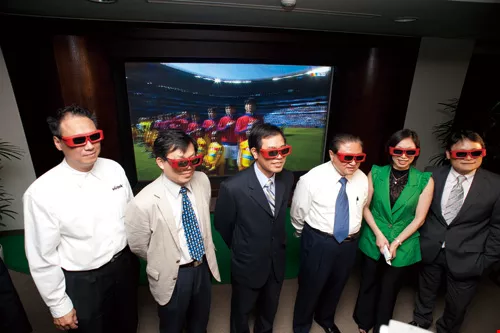
Elta TV, which broadcast the first 3D World Cup to local viewers, currently has three channels: sports, stage and screen, and variety. The network is one of very few in Taiwan able to broadcast entirely in Full HD.
It wasn't just shooting the matches that was hard; transmitting and broadcasting them was also challenging.
Cheng explains that the current generation of 3D cinemas in Taiwan generally utilize either XPAN 3D (an active-shutter system), Real 3D (a polarization system), or Dolby 3D (an improved version of the traditional color-filtration system).
There's also IMAX, which has become popular in recent years. Developed by Canada's IMAX Corporation, IMAX was originally a film projection system utilizing a giant screen that allowed the projection of larger, higher-resolution images than traditional film. To distinguish its 3D system from this earlier widescreen 2D format, the company calls it IMAX 3D. Like Real 3D, IMAX 3D utilizes a polarization system that requires viewers to wear polarized glasses.
Chen says that while all of these projection systems rely on presenting different images to the right and left eyes, their projection formats differ. When screening a typical 3D film, cinemas simply project the copy of the film the producer has prepared specifically for them. But a live 3D simulcast just doesn't work that way.
Given that Sony's team could only transmit a single feed to theaters around the world and that the currently available bandwidth was likely to be insufficient (broadcasting separate image streams for each eye requires twice the bandwidth), the team utilized a "3D in 2D" transmission method to minimize the likelihood of transmission failures. This method combines the left- and right-eye streams into a single "side-by-side" signal, compressing them into a 2D HD (1920 x 1080) image. This feed was then transmitted over the satellites without increasing bandwidth requirements. The cinemas receiving the feed had only to run the signal through their projection system's 3D encoder to convert the 2D feed into the 3D images that their viewers enjoyed.
"The biggest disadvantage to this approach is that when you compress the left- and right-eye streams into a single HD image, you lose half the horizontal resolution, which falls from 1920 to 960," says Cheng. "When the two streams are reconverted and overlaid, the sharpness of the image is noticeably less than that of 2D HD. But this is the best technique available right now."
This technological limitation is the reason that Elta TV waited until it had arranged to work with leading local corporations-Delta Electronics for 3D projectors, Chunghwa Telecom for transmission, and ITRI for 3D encoding equipment-before it began carrying the World Cup broadcasts, by which time only four matches remained.
These "history-making" broadcasts cost upwards of NT$10 million for just the rental of auditoriums and equipment, and the payment of wages for the screenings in Taipei and Kaohsiung. That amount doesn't include the undisclosed cost of licensing the broadcast rights from FIFA. Fortunately, viewers came out in droves, with nearly 4,000 football fans turning up to cheer on teams. Whether in Taipei, where the broadcasts were entirely free of charge, or Kaohsiung, where some venues charged NT$700 for tickets, the broadcasts were packed.

(facing page) Viewers in the cinema auditorium demonstrated a palpable excitement no less than that of those attending the match in person. Organizers helped keep things lively at halftime with games and cheering contests. (bottom right) The lucky couple in the photo just won a World Cup souvenir for correctly answering a question.
Where 3D cinema offers an expensive-but-enjoyable group experience, the 3D television market is still in the early stages of its development. (It is forecast to have a 10% market share in 2012, and the possibility of a 20% market share by 2015.) Cheng believes that 3D cinemas will continue to play a crucial transitional role in the interim. Sporting events and live performances, neither of which need a script to be exciting, could provide crucial programming content during this period.
"This year's 3D World Cup generated tremendous enthusiasm and ticket sales," says Cheng. "In the future, important sporting events, including this year's Major League Baseball playoffs and NBA Finals, will employ the same live-broadcast model. If we can get everything in place, we can overcome any difficulties and attract Taiwanese sports fans to the broadcasts."
If industry forecasts are accurate, 3D sporting events may well become regular programming, much to the delight of the world's sports fans. But if we want to get 3D into the home and further the audiovisual revolution, we can't rely on sporting events alone. Hardware and software makers must work together to develop the richer and more diverse content that will persuade consumers to go out and buy these new products.
@List.jpg?w=522&h=410&mode=crop&format=webp&quality=80)

@List.jpg?w=522&h=410&mode=crop&format=webp&quality=80)


@List.jpg?w=522&h=410&mode=crop&format=webp&quality=80)

@List.jpg?w=522&h=410&mode=crop&format=webp&quality=80)
