World Expo Highlights Crown Jewel: The Chinese Pavilion
Lin Hsin-ching / tr. by Jonathan Barnard
June 2010


On May 1, the most expensive World Expo in history, eight years in the making, finally opened in Shanghai. Although there were a few snafus during the previews and opening, there was no denying that this was a remarkable gathering the likes of which might never be seen again.
Tremendous sums were spent on the pavilions: The Saudi Arabian Pavilion, a "Silk Road treasure ship," cost about RMB1 billion (NT$4.8 billion). The Japanese Pavilion, a "purple silkworm island" that combines technology and environmental consciousness in interesting ways, ran to about RMB900 million. The Spanish Pavilion, constructed to resemble a large Spanish basket, cost 55 million, and the German Pavilion, with its "city in balance" theme, cost 50 million. Even bankrupt Iceland spent US$2 million to create its ice-cube-like pavilion. No wonder Southern Weekend, one of mainland China's most important media outlets, used the phrase "come hell or high water" to describe nations' ardent determination to attend Expo 2010 even in the midst of the financial crisis.
Precisely because Expo 2010 is unprecedented for its scale, character and the designs of its pavilions, Taiwan Panorama visited some of its most celebrated pavilions-including those of China, Spain, Japan and Korea-with the aim of serving as our readers' advance scouts. In the pages that follow, let us lead you on a tour!
When wandering through the World Expo site, which covers 5.28 square kilometers, whether you're to the west or east of the Huangpu-or even, for that matter, on the shuttles crossing the river-you are almost always in sight of the central Chinese Pavilion, which, at a height of 69 meters, is about three times as tall as most pavilions and bright red in color.
In 2007 the Shanghai World Expo Coordination Bureau announced an open competition to design the pavilion. From 344 entries, it ended up choosing the submission by He Jingtang, dean of the architecture school at South China University of Technology in Guangdong Province. Finding inspiration in traditional Chinese four-legged ceremonial vessels, he employed a modern steel structure to create a multilayered style similar to the dougong (bucket arch) system of brackets, which supported the elaborate upturned eaves in traditional Chinese ceremonial and palace architecture. From afar, the Chinese Pavilion looks like a classical red mandarin's hat, and up close it looks like a traditional Chinese vessel for measuring grain. It's very striking.
The red color scheme, which was chosen to put a "Chinese Red" face on the pavilion, is also one of its most arresting visual elements. From among 100 different shades of red, colorists and traditional craftsmen inspected the reds at the Palace Museum in Beijing and picked seven, including light red, vermillion, bright red and magenta. They then applied these shades to the pavilion and its metal panels at varying heights and in consideration of how light would reflect.
He Jingtang has explained that he picked red to be China's face to the world because it represents jubilation, wealth, and sumptuousness, and because it possesses a "Chinese flavor." The tall and brightly colored Chinese pavilion and the 31 local (provincial and municipal) pavilions that encircle it suggest a king surrounded by his entourage, and they announce magnanimously (or domineeringly, depending on one's perspective): "Here is the eastern crown, flourishing China, a place where granaries are full and people prosper."
Apart from its eye-catching exterior, the Chinese pavilion is also fully "green" architecture. It looks like a stack of layers broad at the top and narrow at the bottom that is supported by four "legs," and this design allows for natural ventilation under its central structure, providing welcome sun in winter and cooling shade in summer. When the summer sun rises high, the sun's rays are blocked from hitting the area underneath where crowds are waiting.
What's more, the roof of the Chinese Pavilion has a water collection system, as well as solar panels that are sufficient to supply all the electricity needed to power the pavilion's lights. At the ends of what appear to be exposed beams on all four sides of the pavilion are openwork grates with seal-style Chinese script marking the points of the compass. Apart from providing visual interest, these grates also provide ventilation, bringing air into the building through the hollow beams. It's a design element that demonstrates great craftsmanship.
(facing page, bottom) China is much criticized for its carbon emissions. The "low-carbon city" skillfully and creatively turns carbon emissions into installation art, thus reminding people to pay attention to the connections between carbon emissions, greenhouse gases and global warming.
It was no easy feat to produce exhibition content for the China Pavilion that would match its breathtaking exterior. YAOX Edutainment, a firm from Taiwan, ended up winning a tough competition to create that content. The firm became "general contractor for exhibition design and construction" and its executive creative director Crayon Yao also assumed the title of "creative director" for the pavilion.
The core theme of the Chinese Pavilion is "Chinese wisdom in urban development." After various discussions with experts, Yao and his group decided to go in the direction of explaining the process of "300 million peasants migrating to the cities." "The Chinese Pavilion exhibition could be described as beginning with the lines of people waiting outside," Yao explains. Because the Chinese Pavilion is the focal point of the World Expo, long lines are unavoidable. In order to reduce some of the public's impatience and frustration, he specially designed the elevators to be like "train cars." On both sides of the elevator are screens with images that continually change-from fields, to single-story homes to high rises. However tired of waiting or stressed from the madding crowds, visitors suddenly get a sense of being like those masses of people on the move during the Chinese New Year's holiday, either going home to their rural hometowns or returning to their lives in the big city. In this manner, the frustrations of the wait are turned into an interesting experience!
Via the crowded "train car," you ascend to the highest-level exhibition hall at a height of 49 meters, where you are welcomed by a multimedia sound-and-light show: "City Hung Upside Down." On 15 screens hung from the ceiling, visitors can see scenes of people busily going about their work in 15 Chinese cities at the same time. The complex work gives visitors a sense of the urban noise, alienation and pressures that face peasants who come to the city to work, as well as a sense of how the cities represent fresh and abundant opportunities to these newcomers.
Next there's a theater with screens on three sides (21 meters long by eight meters high) as well as a 24-meter diameter domed screen above. The screens show Spring Story, an eight-minute short by Lu Chuan, a famous mainland director. The film documents the story of great masses of peasants moving from remote rural villages to the cities, working on various infrastructure projects, and falling in love-their new lives and what they left behind.
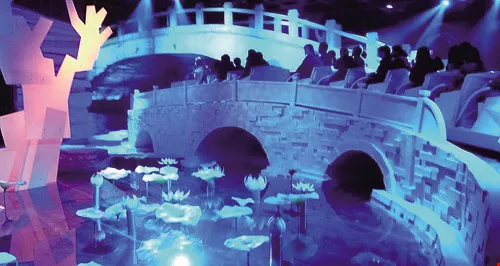
The much-praised domed theater of the Chinese Pavilion and its "dark ride," which shuttles visitors back in time to understand the wisdom of traditional Chinese architectural design, were built under the creative direction of Crayon Yao from YAOX Edutainment, a design firm in Taiwan.
Whereas Spring Story gives an account of the current urban situation, for the future development plans for cities, the exhibition has instead elected to refer to the experience of older generations. Yao, who has studied Chinese history in great depth, brings out the scroll painting Along the River During the Qingming Festival to be representative of the ancients' urban wisdom.
Yao points out that Along the River During the Qingming Festival depicts Bianliang (now Kaifeng), when it was China's capital during the Northern Song Dynasty. And the Northern Song Dynasty represents the height of Chinese material development and civilization, with a society that was closer to modern capitalism than that of any other dynasty. Consequently, in the painting we see merchants tending their wares along shop-lined streets, and workers unloading cargo. There is even a Persian Zoroastrian temple and Jewish synagogue. These show that the Chinese have an ancient tradition of respect for ethnic and cultural diversity. "From this experience we can draw wisdom today."
Consequently, this exhibition area, which is called "River of Wisdom," uses multimedia and projection technology to project Along the River During the Qingming Festival along a wall six meters high and 100 meters long. The painting's carts, boats, horses, clerks, scholars, and canal workers are all brought to life in a lively manner. There are also boatmen pulling their boats across the river, and camel caravans hurriedly pressing their way through the city. It abounds with interest.
One then descends to the second exhibition area, where the Chinese Pavilion features a "dark ride" like the kind often found in amusement parks (and in some places called a "ghost ride").
Yao explains that a dark ride is something akin to an "indoor roller coaster," which is combined with constructed scenery and projected images in an enclosed space. This is the first time a dark ride has been tried at a Chinese Pavilion (previously, the Chinese pavilions at World Expos have tended to be rather staid affairs). Here guests get into cars that are shaped like small boats, and then they are whisked through Suzhou, visiting its gardens, arched bridges, wooden buildings, and dougong bracketed eaves, gaining wisdom from traditional Chinese urban architecture.
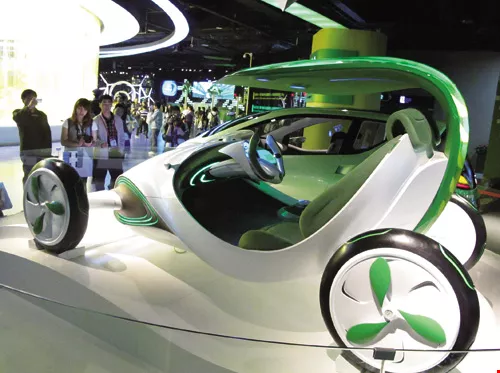
Going down another level one reaches a "low-carbon city." Exhibited here are mainly the fruits of research into green architecture and environmental technology by the Chinese government and industry in recent years. They include what's come out of efforts to promote wind energy, algal water-purification technology, low-carbon vehicles and so forth.
Since the Chinese Pavilion is the "face" of Expo 2010, much thought went into considering every detail of its exterior and interior. Great efforts were taken to be innovative, and it is expected to receive more visitors than any other pavilion.
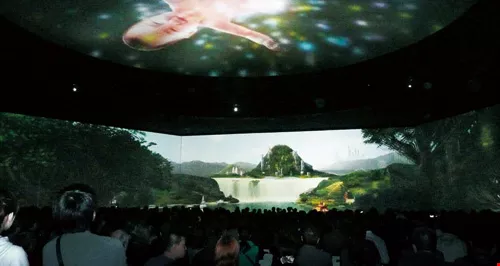
The much-praised domed theater of the Chinese Pavilion and its "dark ride," which shuttles visitors back in time to understand the wisdom of traditional Chinese architectural design, were built under the creative direction of Crayon Yao from YAOX Edutainment, a design firm in Taiwan.
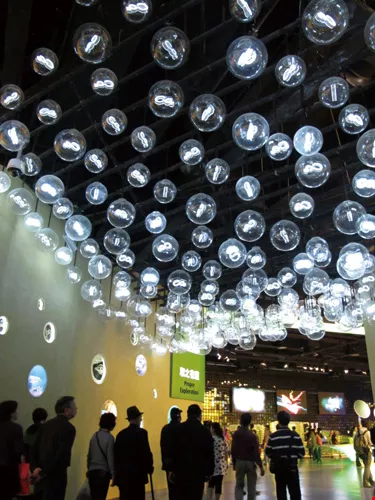
(facing page, bottom) China is much criticized for its carbon emissions. The "low-carbon city" skillfully and creatively turns carbon emissions into installation art, thus reminding people to pay attention to the connections between carbon emissions, greenhouse gases and global warming.
@List.jpg?w=522&h=410&mode=crop&format=webp&quality=80)

@List.jpg?w=522&h=410&mode=crop&format=webp&quality=80)


@List.jpg?w=522&h=410&mode=crop&format=webp&quality=80)

@List.jpg?w=522&h=410&mode=crop&format=webp&quality=80)
