Yuanli: From Rushwork to Organic Farming
Sam Ju / photos Chuang Kung-ju / tr. by Jonathan Barnard
June 2014


When you mention Miaoli County, most people think of the flowering tung trees of Sanyi, but few know that Taiwan’s best rush for weaving is grown in Miaoli’s small coastal town of Yuanli.
The Taokas plains Aborigines, who were Yuanli’s original inhabitants, long wove rush mats. With the arrival of ethnic Han Chinese, the fields of Yuanli were given over to rice paddies. Its abundant harvests earned the town the moniker “Miaoli’s granary.”
Since the 1970s, the rush weaving culture in Yuanli has virtually disappeared, but a form of organic farming that combines raising ducks with cultivating rice has grown up in its place. This small coastal town has changed a lot.
Yuanli’s rush is fragrant and pliable, and it naturally wicks away moisture. These qualities make it an excellent raw material for woven goods. During the Japanese colonial era items woven from rush in Taiwan constituted the island’s third largest category of exports. Exports of rush hats to Japan alone reached 15,000 per year at their peak.
Yet the rise of plastics and the mechanization of industry completely destroyed the rush weaving industry in Yuanli more than 30 years ago. Plantings of rush, which used to be common in people’s backyards, also disappeared.
After the 921 earthquake of 1999, Yuanli’s Shanjiao Community Development Association made an inventory of its cultural resources connected to rush weaving and decided that it was essential to reshine a spotlight on this beautiful craft.
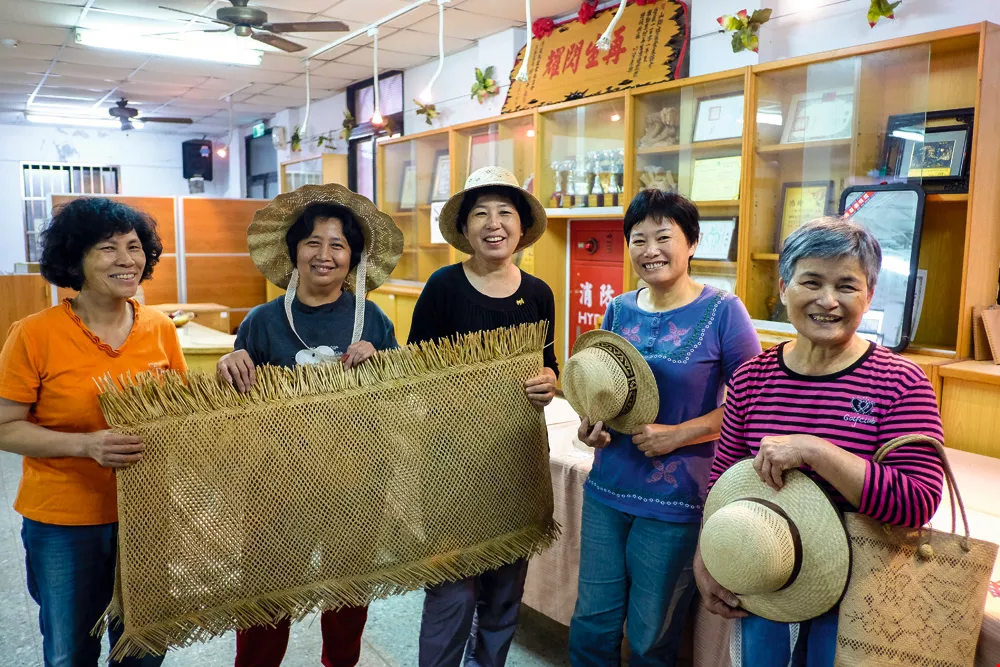
Yuanli’s rush weaving culture and techniques, the pride of the town’s women, acquired quite a reputation in Japan during the era of Japanese colonial rule. New design elements are now being added to make goods woven from rush more popular with younger consumers.
Prized by the Japanese
Without rush, there can be no rushwork. “Long gone, rush returned on the bodies of crabs!” says a smiling Yeh Wen-hui, the association’s president.
It 2003, when the campaign to revive the rush weaving industry was launched, Yeh went looking for plantings of Yuanli’s distinctive rush. It was then that a friend of Yeh’s who owned a trading company told him that mainland Chinese suppliers of crabs used plastic ropes to restrain them, but restaurants in Taiwan worried that the plastic would emit toxins after being cooked, so crab dealers switched to using rope woven from plants. Yeh made inquiries and discovered that the raw material for the rope was in fact rush grown in Yuanli.
This kind of rush is three sided (and thus known as “three-cornered grass” locally). Currently, it can be found in such places as Tainan, Changhua and Yilan. Yet its quality and uses vary from place to place.
Yeh explains that the suppleness and absorbency of Yuanli’s rush is two to three times higher than the rush grown elsewhere. What’s more, its odor repels dust mites and fleas. It is thus highly suited for weaving, and in the Japanese era, household items woven from Yuanli rush, including rush mats, pillows and inserts for shoes, were quite popular.
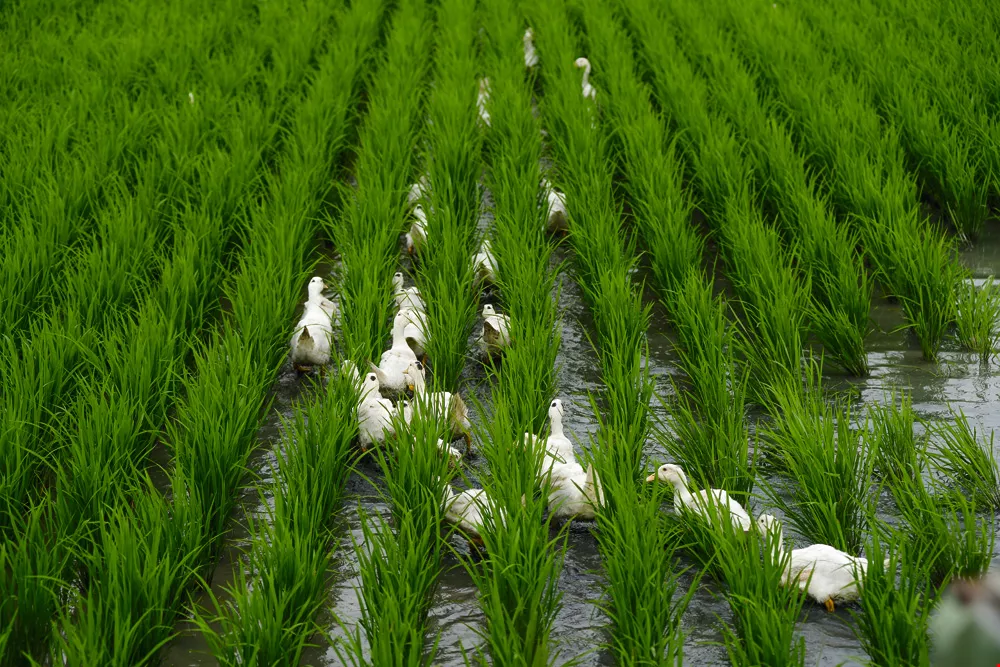
Promoting organic agriculture, Yuanli’s Shangguan Community has been putting ducks in rice paddies for pest control.
Pliant, durable and fashionable
Forty-odd years ago, rush weaving was one of Yuanli’s star industries, with piecework weaving of rush mats or hats taking place in almost every living room. In any given household most women were involved in the industry to some degree or another.
Later, as Taiwan’s economy took off, many local girls started leaving the town to work in factories once they were full grown, and rush weaving went into a decline. Recently, those women have hit their 50s and 60s and are retiring. Yeh has invited them to return to the community and pass along the legacy of rush weaving. They were all excited to reignite their memories of weaving with their mothers.
The charm of Yuanli’s rushwork is found in the weaving techniques. Yeh explains that most bamboo and textile weaving makes use of a simple warp and weft that is easy to mechanize. But Yuanli rush weaving has a “double-layered weave” that is much tighter and denser. The resulting products are strong, without losing suppleness, and they can be used for several decades.
In order to give this traditional craft a modern twist, the Shanjiao Community Development Association holds classes to teach weaving techniques. It invites university design instructors to come in and provide guidance on how to create new products. For the Muji Award International Design Competition in Japan, the association entered five items made in Yuanli. One of these was awarded a bronze prize. It caused the Japanese consumers and its design community to once again pay attention to Yuanli’s rushwork.
“The techniques had never been lost,” Yeh emphasizes.
In addition to its rush weaving, Yuanli is also known for the Shangguan Community, the largest organic farming village in Taiwan.
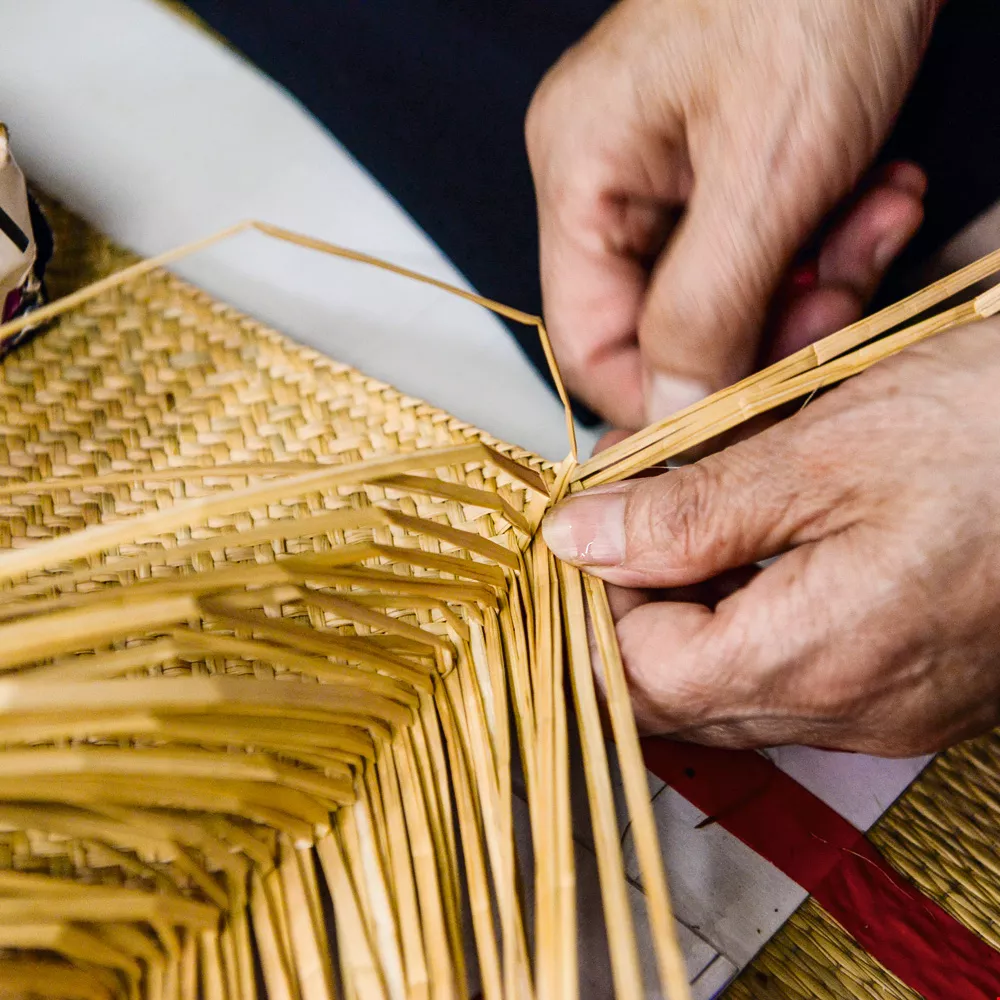
Pliant, durable and fragrant, the rush grown around Yuanli is well suited to making woven goods.
Adding ducks to rice paddies
Shangguan comprises 200 farming families, cultivating 330 hectares of water paddies. Among these are 125 hectares certified as organic. Most of these are planted with Taigeng No. 9 rice, one of Taiwan’s best varieties.
Apart from not spraying pesticides or herbicides, the community uses ducks to control insects, establishing a symbiotic relationship between the rice paddies and the fowl. It’s a special feature of the organic practices employed at Shangguan.
“Agriculture is our calling card,” says Li Qingxiang, secretary-general of the Shangguan Community Development Association. Yet, with most of its members at least approaching 65 (and plenty in their 80s), giving a facelift to the community’s brand isn’t easy.
Fortunately, young people like Ke Bizhen and Ke Xiongneng, who were born in the 1970s and have returned home to farm, are bringing back new knowledge and ideas to share with the older farmers. In the process, they are helping to give a new look to the old community.
A few years ago, with the growing popularity of small-scale, “authentic” travel, the association began to consider how best to let visitors experience the charms of the community.
Interestingly, there aren’t any scheduled activities for tourists here. When association farmers are out in the fields, the association’s staffers bring the tourists to check out and experience what the farmers are up to, “whether they’re transplanting seedlings or harvesting,” says Ke Bizhen. “Since you’re here to experience farming, we might as well just let you experience what we’re actually doing.”
When it comes to meals, too, the travelers eat whatever the farmers do, such as taro, Hakka pickled vegetables, or dried daikon radish. They are dishes that may not be so common at a restaurant in the city.
For recreation, you can ride a bicycle on the wide, safe concrete paths at the edges of the fields, enjoying the breezes and the views of odd-looking Mt. Huoyan, with its bare slopes.
After you’ve gotten enough sun and are sufficiently tired, go back inside and experience the association’s specially prepared “puffed rice duckies.”
Last year a rubber duck by the Dutch conceptual artist Florentijn Hofman came to Taiwan with much fanfare for visits to Kaohsiung, Taoyuan and Keelung. The association jumped aboard the bandwagon, creating wooden molds in the shape of a duckling, so that tourists can make their own “puffed rice duckies.” Though inspired by Hofman’s rubber ducks, the image symbolizes the Shangguan Community, with its ducks foraging for insects in its rice paddies.
Buying puffed rice cakes from street stalls on the way home from school has long been a rite of passage for Taiwan’s children. If you pay a visit to Shangguan, you might as well try these duckies made from delicious Taigeng No. 9 organic rice. When the association’s workers heat white or brown rice in pressure cookers, the grains crackle and pop as they burst open inside the cooker.
Next it’s time for some DIY tourism: Stuff the hot and pliable puffed rice into a duck mold before coloring it with turmeric. Give it some time to cool, and then turn the mold upside down. Voilà! Out pops a little puffed rice ducky.
Many children that grow up in the city have long dreamed about visiting an agricultural village. All they know of life on a farm is what they’ve been told or learned from their textbooks. Yet with this DIY tourism, they can experience farming for themselves.
“Coming here is a way to share life and to share values,” says Ke Xiongneng, describing the true meaning of a trip to the Shangguan Community.
Miaoli is often described as a county of mountain towns. In fact, there is a great variety of natural scenery and cultural activities among its settlements. They are places of boundless potential, where abundant handicrafts, culinary diversity, and culture far surpass what outsiders might imagine. If you visit the lowland town of Yuanli, it will break your preconceived notions about Miaoli.
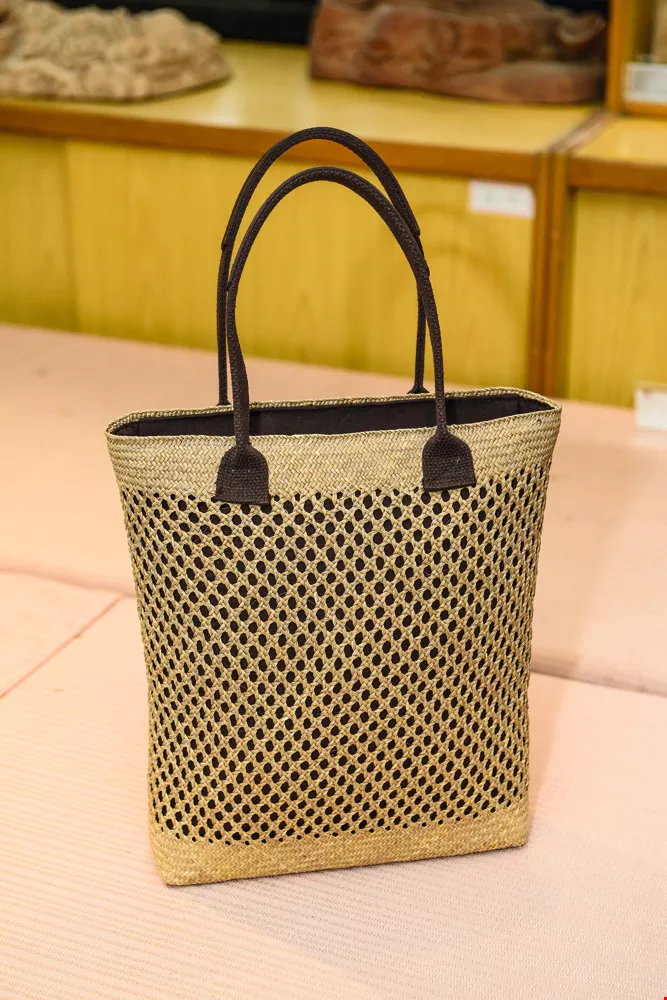
A rush bag woven in Yuanli has become a bestseller in Japan.

@List.jpg?w=522&h=410&mode=crop&format=webp&quality=80)

@List.jpg?w=522&h=410&mode=crop&format=webp&quality=80)


