Economy of Scales-Aquaculture Goes High Tech
Chen Hsin-yi / photos Chuang Kung-ju / tr. by Jonathan Barnard
January 2011


Women who are lovers of beauty- shouldn't be strangers to collagen. A key component of skin, tendons, and ligaments, collagen promotes the healing of wounds and the restoration of tissue. Collagen that is extracted from animals and plants is widely used in medicines, food products, beauty products, and postoperative topical ointments.
In Japan, where the cuisine puts an emphasis on seafood and where there is a flourishing beauty products industry, firms began to extract collagen from marine life more than a decade ago.
Here in Taiwan the Council of Agriculture's Fisheries Research Institute began investigating techniques to extract collagen from the scales of tilapia in 2004. Yet it was efforts among private producers at the grassroots that led to the successful mass production and marketing of fish collagen.
In both Tainan County, the center of Taiwan's milkfish industry, and Yunlin County, where the tilapia industry's economic chain is most complete, fish scales have been turned into big money makers. These achievements were built on a foundation of work aimed at upgrading the aquaculture industry, so they also bear witness to that industry's future prospects.
In 2007, a made-in-Taiwan facial mask hit the market, retailing for NT$220. It was said to fight wrinkles, whiten and restore the skin, and moisturize, all at the same time. Its "secret weapon" was a layer of nanoscale collagen. Even more mi-ra-cu-lously, the collagen peptide used for the product-its key active ingredient-was extracted from the scales of milkfish.
According to Fisheries Research Institute studies, though good for the skin, the collagen extracted from cattle, pigs and chickens could potentially contain pathogens that are dangerous for man and beast alike, such as mad cow disease, bird flu and so forth. There will always be concerns about the potential transmission of infectious diseases. But people and livestock are not susceptible to fish viruses. Consequently, fish collagen is well suited for use in beauty and health products.
Shin-hui Bio-tech, the developer of that facial mask, is located in Tai-nan County's Sin-ying Industrial Park. The company's products include beauty serums and facial creams, as well as supplement tablets. The milkfish scales from which its products' key ingredient is extracted come from Bei-men Township, where the Chia-ton Company's milkfish processing plant stands amid a scattered multitude of fishponds.
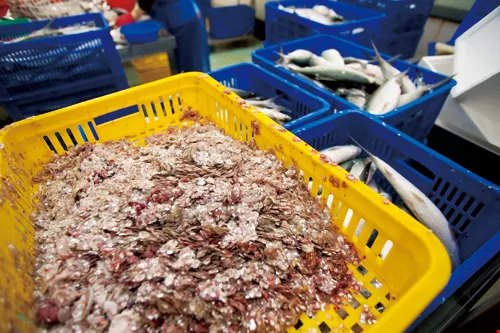
Raven Chen, Chiaton's second-generation owner, notes that their fish scales used to be discarded or ground up for fertilizer. It was purely by accident that he found a new business opportunity for using the scales three years ago. He was chatting with a former classmate, "who had an uncle who was looking for fish scales, hoping to research and develop collagen extraction." Chen hadn't yet taken the reins at the family business, but he thought to himself: "We have loads of fish scales, and they're processed at a low temperature, maintaining their freshness and quality!" Today, the Chiaton plant, which has HACCP international certification, can sell its fish scales for the tidy sum of NT$20-some per kilo. Those sales serve the additional purpose of reducing its waste-processing costs.
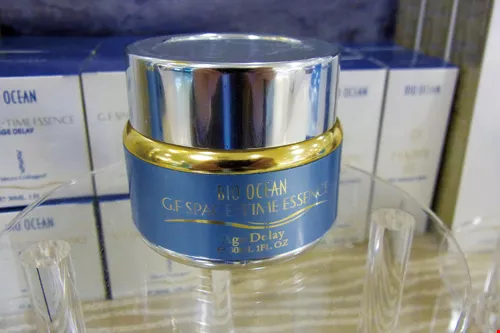
Cosmetics is a high-profit industry. Although the future looks bright for products like fish collagen, there are still technical and marketing challenges to overcome.
That "uncle" was Qiu Yang-hao, general manager of Shin-hui Bio-tech. Now 62 years old, Qiu hails from Yan-shui in Tai-nan County and was a civil servant for more 35 years. He entered biotech five years ago-and his involvement, like Chen's, can be chalked up to serendipity.
Eight years ago, Qiu was head of cultural affairs for Yun-lin County. He was planning to work one more year until he could retire with a pension. A chance conversation with agricultural expert Hong Jing, a member of an advisory committee to the Council of Agriculture, would change his life. They discussed the challenges of agricultural transformation facing Taiwan after joining the WTO. Without hesitation, Qiu decided to return to his hometown and work with local fish farmers toward upgrading the locale's aquaculture industry.
Qiu says he felt confident that his ability to bring together resources, which he had gained over the course of his career, in conjunction with the technical skills he learned majoring in chemistry at National Kao-hsiung Normal University, would enable him to make a contribution. What's more, his family had three fishponds of their own.
Unfortunately, not long after he embarked on his new career path, Taiwan faced a ban on exports of tilapia to the European Union when inspectors discovered traces of drugs in the tissue of fish imported from Taiwan. Consequently, tilapia fell from NT$23 per catty (600 grams) to half that. And because tilapia producers in Tainan County were less organized than producers elsewhere, they suffered more under the pressure of lower prices.
Realizing that efforts to organize local producers were urgently necessary, Qiu convinced a feed-industry businessman to use his connections to organize an aquaculture cooperative. Qiu threw himself into planning, and in 2005 the Nanying Aquaculture Cooperative was born.
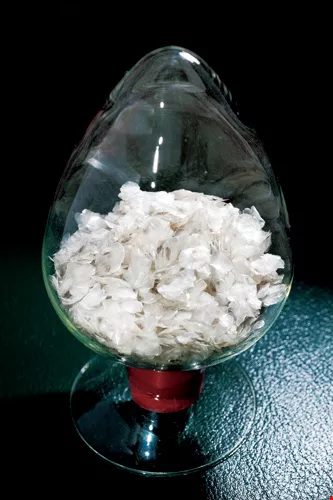
In recent years Taiwan aquaculture has taken strong strides toward upgrading, even making inroads in the high-value-added realm of biotechnology. The collagen extracted from discarded fish scales is used in cosmetics.
With the co-op leveraging the power of solidarity, the price of fish stabilized. Once Nanying was on a sure footing, Qiu passed along his executive duties and turned his attention to biotech. The person behind his second career shift was Wang Dong-qing, a chemical engineer who worked for the co-op as a food consultant.
Wang, who is 70, hails from Tai-nan. He previously had worked as the research director for Vedan, a major food company. When he and Qiu were at Nanying, they developed an interest in fish collagen and threw themselves into researching it. Referencing over 200 Japanese academic papers and continually experimenting in the lab, they came up with their own sequence of processes for extraction.
Generally speaking, fish scales are about 50% collagen. To extract it, an organic solvent (such as acet-one) is traditionally employed to remove fat, and acid hydrolysis to remove ash. Filtering then yields raw collagen. But this complicated process takes a long time and poses safety concerns.
In contrast, Shin-hui's extraction employs enzyme hydrolysis, which is said to maintain the structural integrity and bioactive qualities of the collagen while posing no risks for end product users.
"The know-how described in Japanese academic papers was highly abstruse, but in fact there was little real difference between in the processes and theories used by various researchers," explains Qiu. To master the crucial enzyme hydrolysis process, in which the enzyme formulation affects the outcome of molecular cutting, he and Wang spent three days and nights holed up in the lab, their eyes fixed on petri dishes, as they determined the proper enzymes and quantities to use.

Cosmetics is a high-profit industry. Although the future looks bright for products like fish collagen, there are still technical and marketing challenges to overcome.
They moved from tilapia to milkfish both because milkfish production comprises the shark's share of Tainan County's aquaculture business, and also, even more importantly, because less antibiotic is used in raising milkfish. Unlike the monocultures typical of tilapia farming, milkfish can be raised in an ecology that includes fish, shrimp and algae. That greater biodiversity naturally creates more stable water quality. "Today milkfish collagen can be fairly described as the safest form of extracted collagen," says Qiu with great satisfaction.
It took more than a year of experimentation before they were finally able to extract nanoscale collagen molecules from milkfish scales. According to tests carried out at the National Pingtung University of Science and Technology, their extracted collagen had a purity of 96.62%, compared to 95% purity in collagen produced by the Fisheries Research Institute. What's more their collagen has an average molecular mass of 1000 Daltons, compared to the 3000 Da that is typical. The lower the molecular mass, the better the take-up rate in the human body. But as for how they went about extracting collagen "with a lower molecular mass than ever before," Qiu is closed lipped. "That's classified," he says.
The next step was to form a company to carry out mass production. Lacking funds needed to purchase equipment from overseas, Qiu at least had the good fortune of being able to draw needed personnel from within his own family. He convinced his nephew Sunny Tseng, who had an MBA from Strayer University in the United States, to return home and help out. In his early thirties, Tseng jokes that he "was loath to see a family elder being so busy at such an advanced an age." Con-se-quently, he somewhat reluctantly left a seven-figure-NT-dollar salary at an IC design manufacturer to come home and help out.
With the power of the group behind it, Shin-hui Bio-tech has been producing two tons of collagen peptide a month. Although Shinhui markets under its own brand, it also supplies raw material to other dom-estic beauty product manu-fac-tu-rers-sales that are the firm's main source of revenue. Qiu hopes to hire qualified staff to research even more highly competitive biomedical products (such as artificial skin).
As someone who is concerned about development of the aquaculture industry and has helped to plan the vertical integration of Tainan County's milkfish industry-from cultivation and feed supply, to processing, sales, and product development-Qiu realizes that another key link is needed: a contractual arrangement to get fish farmers to employ organic methods, whereby both the environment and fish farmers' interests can be protected, and end products can attain an even higher value.
Qiu Yanghao (left) and his cousin raised money to establish their own family biotech firm. Their aim, now accomplished, was to work with the milkfish industry in Tainan County to produce top-quality collagen.
A similar transformation in aquaculture has happened in Yun-lin -County's hardscrabble Kouhu Township. One difference is that Kouhu is using tilapia scales for its raw material. The key figure behind Kouhu's transformation is Wang Yi-feng, a mere kid at 30.
The eldest son of a family involved in aquaculture for three generations, Wang began helping out at his family's fishponds and processing plant when he was just a youngster. As a senior in high school, he was already sitting with his elders at the conference table, discussing how the tilapia industry ought to deal with rise of competition from mainland China (as other Taiwanese producers brought their technical knowledge there) and market contraction. Wang recommended upgrading their tilapia processing plant in order to raise product value.
Kouhu Fisheries, a cooperative of more than 40 tilapia producers headed by the Wangs, formally began operations in 1997. In 2002 its processing plants obtained international HACCP certification, and then its products obtained the domestic CAS (certified agricultural standards) label. Via active networking, Kouhu's membership has risen to more than 200. Accounting for about one quarter of Taiwan's tilapia producers, the co-op's members are found throughout Yun-lin, Chiayi and Tai-nan counties. Their fishponds occupy more than 2300 hectares of land.
Since 2005, when Wang took over the reins of the family business shortly after graduating from Dayeh Univeristy with a major in food technology, his main work has been lever-aging high quality to expand into the international market, and also considering "how to make best use of every part of the fish."
Wang explains that the highest value products taken from a tilapia processing plant are two chunks per fish used for sashimi, as well as the jaw of the fish. Other valuable portions include the belly, which is barbequed, and the skin, which is roasted. These products all allow for orderly expansion of production lines. Only the use of the scales has required hit-or-miss experimenting in order to move forward.
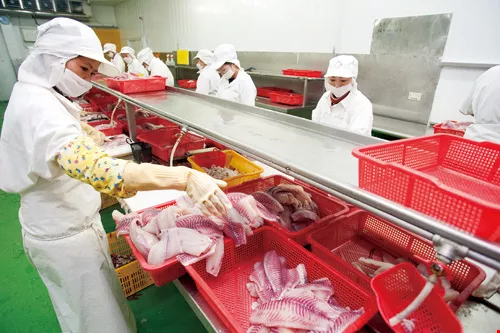
A native son of a fish-farming village, Wang Yi-feng has put his family's tilapia processing plant at the center of an effort to upgrade the local aquaculture industry. His Kouhu Fisheries cooperative has built channels to foreign markets and made new advances in biotech based on fish scales.
In the past Wang observed that fish scales used to be regarded as a nuisance at Kouhu: When workers would cut up fish, the scales, if not immediately washed off, would get stuck to the workers' skin, needing to be pried off. It wasn't until someone from the Fisheries Research Institute told them about collagen that they realized that fish scales actually had some developable value.
Through an introduction, Wang first approached the Research and Development Foundation at National Chung Kung University, but NCKU never succeeded in raising the quality and purity of the extracted collagen.
When Kouhu's R&D efforts were stuck, Emuco, a Japanese food products company, approached the co-op. It turned out that chairman of Emuco had started researching collagen extraction technologies a decade earlier. He had heard about Kouhu's hard work and found its efforts moving. Eventually the two parties agreed to a technological cooperation. A condition was that the Japanese company's technology had to be kept confidential and that Kouhu could only sell to Emuco, not outside parties.
Under that subcontracting agreement, Kouhu earned NT$100 million in profits in a year, extracting collagen from more than 200 tons of fish scales, which was shipped to Japan for use in beauty products.
Early in 2009, Wang obtained the permission of Emuco to use 5% of the collagen Kouhu was producing to develop its own line of beauty products. These earned Wang a Shen-nong Award in 2009. The judges cited three reasons: "for upgrading the aquaculture industry," "for developing access to international markets," and "for developing new biotech products." Afterwards, orders for the product really took off.
Now known as the "prince of tilapia," Wang is thankful that his family elders threw their support behind these efforts, particularly the transformation that took place more than a decade ago. When others were going en masse to the mainland, looking for quick profits, the family firms in Kouhu Co-op took a risk on investing some NT$10 million to upgrade their processing plant. The modern processing plant is at the core of the business today, and it has helped pull along related industries, such as the breeding of fish fry, the supply of fish feed, product development and other links in a strong economic chain.
Wang's elders are extremely proud of him for providing new employment opportunities in Kouhu and for stemming the loss of its young people.
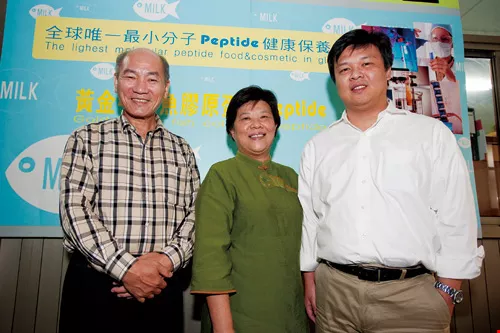
Qiu Yanghao (left) and his cousin raised money to establish their own family biotech firm. Their aim, now accomplished, was to work with the milkfish industry in Tainan County to produce top-quality collagen.
In recent years, biotech cosmetics products-whether ointments, facial masks or capsules-have provided a welcome opportunity to upgrade the aquaculture industry. But are collagen-based cosmetics really as miraculous as advertised?
Some Japanese cosmetics experts are skeptical. Even with a low molecular mass, fish collagen is completely different from human collagen. The claims that collagen in cosmetics can whiten or restore skin are nonsense, they say. At best it can work like a topical moisturizer.
And Chen Jing-chuan, founder of the Aquaculture Service Center of National Pingtung University of Science and Technology and currently vice president of academic affairs at Meiho University, says that the key to producing high-quality collagen lies in preserving its molecular structure and bioactive properties; simply pursuing the lowest possible molecular mass is of no great benefit.
Moreover, the industry is facing some serious problems. Firms that have been unwilling to divulge and explain their extraction technology have had trouble gaining customer trust. And small firms have found it hard to build marketing channels. Whether traditional aquaculture companies can really enter the high-tech realm of biotechnology remains to be seen.
But on the sunny side, Taiwan has a lot of talent in the field of aquaculture. Its successes in turning fish scales into gold cannot simply be rung up to dumb luck. There's good reason to be confident that future breakthroughs will add to the "fish-scale miracle.
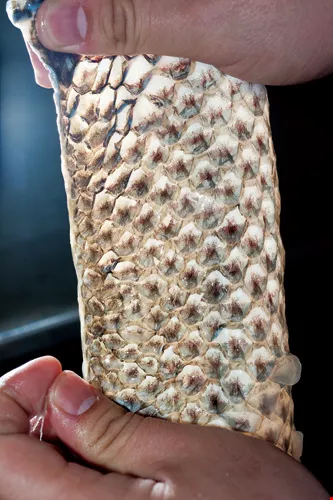
Traditionally regarded as having little if any value, fish scales have been turned into raw material for cosmetics and fish skins have been used to create breathable insoles.
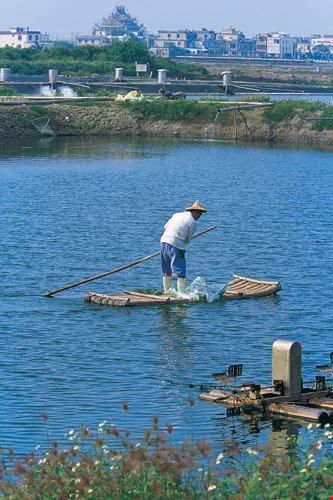
In recent years Taiwan aquaculture has taken strong strides toward upgrading, even making inroads in the high-value-added realm of biotechnology. The collagen extracted from discarded fish scales is used in cosmetics.
@List.jpg?w=522&h=410&mode=crop&format=webp&quality=80)

@List.jpg?w=522&h=410&mode=crop&format=webp&quality=80)


@List.jpg?w=522&h=410&mode=crop&format=webp&quality=80)

@List.jpg?w=522&h=410&mode=crop&format=webp&quality=80)
