Lai Ching-te's Tainan Dreams
interview by Coral Lee / photos Jimmy Lin / tr. by Phil Newell
March 2011


A doctor by profession who earned wide attention for his achievements in three terms as a member of the Legislative Yuan, Lai Ching-te (William Lai) has just been elected as the first mayor of the new special municipality of Tai-nan City. What is he planning to do to make the best use of the resources possessed by what were formerly Tai-nan City and Tai-nan County in order to lead the economy of Greater- Tai-nan forward at the lowest cost? A summary of his interview with Taiwan Panorama follows:
Q: You have said that your vision for -Greater Tai-nan is as "a city suitable for dreams." What are you preparing to do?
A: My objective is to utilize the unique characteristics of -Greater Tainan to become a strongly competitive city internationally, so that young people can see hope, middle-aged people will see their dreams become reality, and older people will find contentment.
Besides being a "cultural capital" and a "tourism playground," -Greater Tai-nan will also be a "sustainable city." Tai-nan is rich in ecological resources, including three national parks and scenic areas, as well as international-class wetlands and lagoons. But Tai-nan also has 14 industrial parks, including the Southern Taiwan Science Park and the Tai-nan Technology Industrial Park in the city's An-nan District.
There are two fundamental tasks: The first is water management. There are more than ten districts in Tai-nan that have flooding when it rains heavily, and lack water when it doesn't, yet -Greater Tai-nan has more reservoirs than anywhere else. We need a wholly new approach to water resource management and flood prevention, and to this end I have invited the former head of the Water Resources Agency of the Ministry of Economic Affairs, Chen Shen-xian, to chair the city's commission for disaster relief and flood control. The second fundamental task is to push forward the six new types of industries we have identified as having growth potential, in order to create jobs.
Q: How can the cultural and historic resources of Greater Tai-nan be structured into an engine to drive local development?
A: In terms of culture, the former Tai-nan County and Tai-nan City have some things in common, but also some differences. Therefore, culture should move in the direction of pluralized development, not of being structured.
Tai-nan City and Tai-nan County share similar histories, both being places pioneered by soldiers of Zheng Cheng-gong back in the 17th century, and today one-third of the residents of the city area moved there from the county, so the two share similar cultures of daily life and religious beliefs. The main difference is that the city has many historic monuments, especially ones built by the government or the gentry, whereas the culture in Tai-nan County has been produced by ordinary farming people and by the forces of nature. Both are very valuable.
Ya-su-nari Ka-wa-bata, who won the Nobel Prize for literature, has said, "Kyoto is my hometown, and it is also the hometown of all Japanese." We hope that in the future we can say, "Tai-nan is the hometown of Tainan people, and also the hometown of all Taiwanese." I plan to establish a systematic program of courses and research to provide a platform for persons interested in Taiwanese culture, history, and arts. This will be the foundation for developing the city's cultural life. My hope is that everyone will feel a deeper sense of attachment and identification with Taiwan because of a sense of pride in the history of Tainan.
As for forming "cultural and creative industries," let's look for example at the embroidery shops along Min-quan Road. These need to incorporate creative new ideas, such as embroidery designs that would make suitable gifts for a baby's one-month birthday, or a design of "The Eight Immortals Offer Congratulations on Your Birthday" for elderly people. The works could also be given a contemporary feel, perhaps by including things that are familiar symbols of Tai-nan, like local fruits, the black-faced spoonbill, lotus flowers, and so on. This could revitalize business.
In addition, I want to make films of the stories of Tai-nan. For example, we could make a film about Yo-ichi Hatta, who was the heart and soul of the construction of the Wu-shan-tou Reservoir and the Jia-nan Plain irrigation works back in the Japanese occupation era. From there we could tie in the Guan-zi-ling hot springs, Tai-nan's famous danzi noodles, and so on. Japanese who see the film will feel a very strong desire to come here and visit. I have made preliminary contact with the director Ang Lee and he says he is willing to help out.
Q: Tainan is Taiwan's largest supplier of staple foods, especially rice. What are your plans for agriculture?
A: The biggest problem facing agriculture in Taiwan is that the farmers are getting old. We will take an inventory of the success stories of Tai-nan's agriculture and aquaculture industries, such as milk-fish, orchids, or dragon fruit, and set up a program of classes or lectures to spread the word about these successes to attract young people back to rural areas. At the same time we will begin by helping young would-be farmers find fallow land they can use. The city government will also establish a fund and commission the Agricultural Bank of Taiwan to act as guarantor for start-up loans to farmers, in order to solve their financial difficulties.
In terms of what we can do through the older generation of farmers, we hope they will help persuade the younger generation to move back to rural areas. For this to happen, it is necessary to help them understand precisely what kind of capital is needed to go into farming, and when they can begin to make money-that's the only way they'll be willing to come back.
Finally, we need to upgrade marketing of agroproducts. For example, we could take the orchid industry to the next level by founding an international orchid auction center, or even go directly to the Netherlands and sell at auctions there. My dream is that one day Tai-nan orchids will provide a living to as many people as Dutch tulips do now.
Further, in order to ensure that the vast farmland of southern Taiwan does not get taken over for other uses, we will work with our neighbors, Yun-lin and -Chiayi counties, to promote the idea of a "Yun-lin-Chia-yi-Tai-nan Special Agricultural Zone." My aim is to get a special act passed by the legislature to protect this area, so that it will serve as a national-level breadbasket.
Q: You seem to have thought a lot about medical tourism. Does Tai-nan have the right assets for this?
A: Of course tourists can be attracted by religious and historic sites and events, but medical tourism is also a growing trend. In particular, for people from countries where winter is very cold, the sunshine of southern Taiwan has great therapeutic value.
Right now Tainan has two major medical centers, National Cheng Kung University Hospital and Chi-mei Medical Center, as well as Tai-nan Hospital (run by the Department of Health) and Sin-lau Hospital. So the quality of medical care here is high. But what really sets Tainan apart is that medical care is also inexpensive, and the climate is really great and very sunny. You could come to Tainan for a couple of weeks for, say, a comprehensive physical examination, to treat rheumatism, or to recover from a heart attack. You will find yourself quickly restored to health, and if you have time you can even do some sightseeing and have some fun!
Tainan will also attract visitors as a "solar-powered city." Mo-tech Industries, a company in the Southern Taiwan Science Park, already in 2005 ranked fifth in the world in the value of production, and third in the world in volume of production of solar cells. I hope that in the future solar panels can be installed on the roofs of government buildings and private houses in Tai-nan, creating an image of a progressive and environmentally conscious city.
The Statute for Renewable Energy Development, which passed last year, requires the government to promote renewable energy. Right now Tai-power charges NT$3 for each kilowatt-hour, but producers of renewable energy can sell it to Tai-power for NT$12 per kilowatt-hour. The differential is enough to attract businesses to buy solar panels and rent rooftops to install them on. In fact there are already companies renting the roofs of government buildings in Tainan.
To sum up, I have a two-handed strategy to build up -Greater Tai-nan as a cultural capital and solar-powered city. With one arm I want to reach back and bring the culture of the past into the present, and with the other reach forward and bring the technologies of tomorrow into everyday life today. In the future the citizens of Tai-nan City will live amidst a duality of elegant culture and high technology.
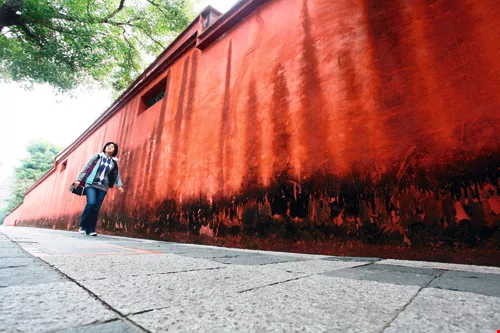
The marks of time are all over the red walls and old trees of the Confucius Temple in Tainan, and indeed can be found all over the streets and venerable shops of the city.


@List.JPG?w=522&h=410&mode=crop&format=webp&quality=80)


