Organic Stores: Selling Health and Good Feeling
Chen Hsin-yi / photos Chuang Kung-ju / tr. by Chris Nelson
September 2012


Whether or not you’re a regular customer, you’ve surely noticed that organic specialty stores are becoming almost as ubiquitous as convenience stores in Taiwan’s cities and towns. At the same time, the business world has been investing in existing organic store brands, inspiring many stores to change their appearances by adding a sense of style.
The organic foods market is expanding yearly both in Taiwan and abroad, linked to growing popular awareness of food safety and environmental stewardship, and driven by the desire for healthy living.
So, how does one turn organics into good business?
This new generation of organic stores—tidy, brightly lit, well stocked and offering cordial service—sells more than just organic produce, health foods and environmentally friendly products. Some also provide ready-made meals, host seminars, book clubs and cooking classes, and even have nutritionists on staff to give advice. Their commonality lies in their pursuit of health, vitality, peace of mind, and a better environment.
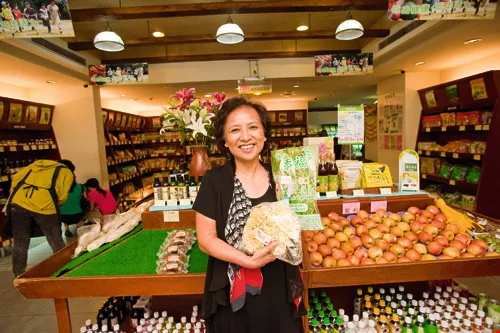
Leezen president Lee Miao-ling calls her company a “social enterprise,” aiming to benefit producers, sellers and consumers alike.
Why are Taiwan’s organic stores growing so vigorously? And what are the motives of the entrepreneurs?
In Taiwan, modern organic farming found its start in the 1990s. In the early stages, it was a movement formed by civic organizations and farmers concerned about the environment. They cared about agricultural production, and stressed harmonious living as well as ecological balance. Nevertheless, the idea of “organics” had not yet matured at that time; lower yields and greater reliance on farm-to-market delivery and direct sales made it a hard business to run.
In the mid-1990s, some interested parties started opening organic specialty stores. A study by the Organic Trade Association shows that by 2004, there were around 1,000 organic and health food stores in Taiwan, making it the fastest developing Asian country, next to Japan, in this respect.
Dong Guochang, marketing management lecturer at Ling Tung University, notes that organic stores are run by several different kinds of people. Some are run by doctors, who apply their medical expertise to build customers’ trust. Others are run by religious leaders, who make use of their spiritual appeal to call upon volunteers to join in on the operations, creating a special kind of business strategy. Still others are run by organic health gurus and survivors of grave illnesses, who call upon their personal experience to gain people’s trust, gladly sharing the results of their organic lifestyles. Finally, there are the enthusiasts, who seek competitive advantage through marketing savvy and enhanced services.
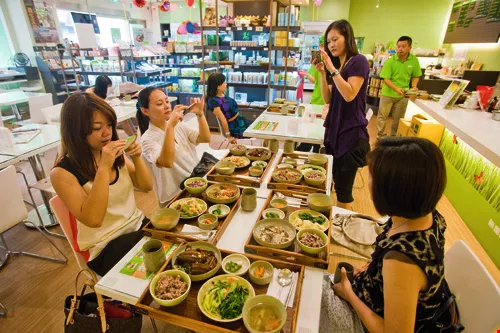
Yogi House International is one of the few organic stores that offer prepared meals. Upon seeing the scrumptious spread on the table, onlookers snap photos with their cell phones.
Leezen Co., founded in 1998 on a spirit of altruism, is the epitome of a religious-based organic store.
Leezen sprang from the same source as Tse-Xin Organic Agricultural Foundation (TOAF): both were inspired by Dharma Master Richang (1929–2004). It’s said that the master came into contact with organic farming while preaching in the United States, and recognized it as a good alternative to conventional farming’s long-standing harmful practice of pesticide use. One time, when a disciple was thinking of donating land to build a holy site, Master Richang suggested using this land for organic farming in order to save the lives of animals, and encourage others to learn from the example and spread the word. Gradually, the number of his followers increased, some eager to farm, others going overseas to learn more, and still others in charge of training volunteers. TOAF was founded in 1997, followed by Leezen the next year.
TOAF CEO Su Muh-rong remembers that it wasn’t easy to promote organics at first. Mainly, the farmers’ land hadn’t been properly maintained, the skill base was inadequate, the growing process was labor intensive and time consuming, and sales and yields were poor. But they were finally able to get on their feet thanks to the joint efforts of TOAF and Leezen volunteers as well as the support of sales.
Over several years of hard work, the organic produce sold by Leezen increased in quality and quantity, and with TOAF as a backer they drew in more cooperation with farmers. Consumers identified with Leezen’s simplicity and honesty, and sales began showing significant annual growth.
From the very start, Leezen has developed processed foods and household products using organic ingredients as raw materials to meet the varied needs of consumers. For instance, organic paddy rice is a mainstay among organic foods in Taiwan, and organic rice fields contribute a lot to ecological balance. But the lower price of conventionally farmed rice is a barrier to sales. To promote organics and support farmers, Leezen has dealt with food companies to develop rice-based processed goods including breads, buns, rice crackers, and hot cereals.
Leezen has grown from three outlets (one each in northern, central and southern Taiwan) into a robust company with 87 retail stores, more than 1,000 products, and capital of over NT$100 million. Leezen’s president Lee Miao-ling says that the company is run according to a social enterprise model: “Everything is done from the heart, with producers, sellers and consumers forming a living community that believes in and helps each other. This has brought success.”
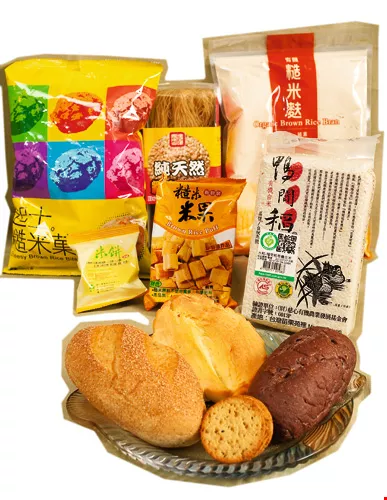
Leezen has developed many “low-fat, low-salt, natural” rice products using organic rice as a primary ingredient, to give consumers healthier eating choices.
Yogi House International has over 70 regular chain and franchise stores. It was founded in 1999 by Wang Kangyu, who was in the pharmaceuticals business and has become an organic health guru.
Wang, who now serves behind the scenes as education director, graduated in pharmacy from Taipei Medical University. During his career in pharmaceuticals, he began suffering health problems in middle age, and went on an organic food diet. With a foundation in pharmacy and often traveling abroad, he was especially fond of the science of healthcare regimens found in different countries, such as vegetable juice fasting and macrobiotic diets. He sought out the requisite products, developed meals, and translated the recipes into Chinese to share with consumers.
Unlike Yogi House International, which has followed a theoretical path from the start and enjoyed the investment of a captain of industry, Earthlife, founded in 1994, was originally a small-cap business selling natural eco-friendly products, and was not very famous. Then in 2006, a biotech firm bought it for NT$200 million, and in five years it grew from 16 to nearly 100 regular chain and franchise stores. The driving force behind the scenes is chairman and marketing wiz Spencer Lin.
Lin takes pride in the fact that the raw materials of 80% of the company’s 1,500 products are locally grown, toxin-free organic produce, with prices ranging from NT$35 vegetable packages to healthcare products costing thousands of NT dollars, hoping to do something for the development of organic farming.
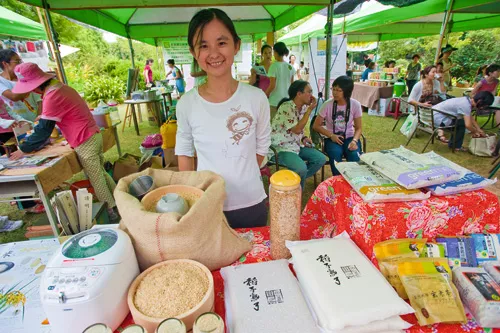
Taichung Hope Market is a great place for small organic farmers to sell their produce.
According to Huang Chang-ju, professor of applied economics at National Ilan University, we know from overseas experience that the key to success in the organics industry is the establishment of a fair certification system and an organic certification mark, to win customer trust.
The earliest pioneer organic stores saw a lack of government regulations regarding organics, so they had to verify product quality themselves. At that time, many fake organic products were touted as genuine, dealing a serious blow to consumer confidence. Then the Agricultural Production and Certification Act was passed in 2007, and two years later a certification and marking system was officially enacted. This was a boon to the development of the organics industry.
According to the Council of Agriculture, 5,015 hectares of farmland were certified for organic farming by the end of 2011, the chief crops being paddy rice and vegetables, followed by fruit and tea. Altogether there were 2,300 certified organic farms, 15% growth for the year. Good prospects indeed!
With these systems in place, organics chains saw a new wave of growth. The Taiwan Chain Store Almanac 2012 shows that the top five organic specialty stores are Santa Cruz, Earthlife, Leezen, Yogi House International, and Cotton Land. All but Leezen have been bought by or merged with major corporations.
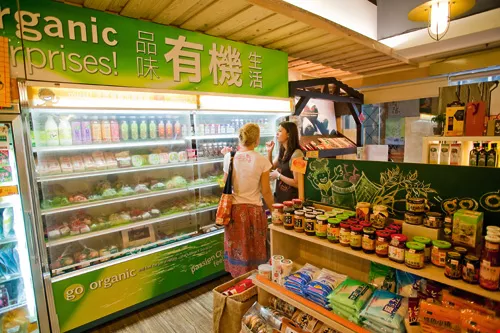
In addition to organic produce, Earthlife’s flagship store in Taichung sells a variety of health foods to maintain a profit.
But when big companies buy organic product chains, this elicits many doubts about the proportion of organic products in these stores.
A study published in Common Health magazine in August 2012 shows that in the average organic specialty store, fresh produce makes up 20% of sales, healthcare products 15% to 20%, infused beverages 25%, and other products (dry goods, processed goods, utensils and so forth) 30%, and that organic products account for an average of 20% to 30% of overall sales. “The idea that organic stores sell nothing but organic products is just wishful thinking on the part of consumers,” the study says. In addition, Common Health states that though organic stores do contribute to the spread of the organic concept, sales clerks often oversell health foods, misleading consumers by overestimating their effects.
In response, scholars say that this is understandable if they wish to survive. Dong Guochang says that fresh produce makes up the mainstay of organic products in these stores; thus, because of low unit prices, small profits and short shelf lives, they have to be careful not to stock too much of it: “Independent and chain store operators need to make up for these shortcomings in other ways in order to survive,” he says.
Huang Chang-ju notes that the proportion of fresh produce in organic stores overseas averages about 20% to 30% as well: “A heavy concentration on fruit and vegetables is a particular feature of the organics movement in Taiwan, and that very overemphasis has led to disappointment in organic stores.” According to Huang’s analysis, Taiwan’s organic framework is currently lacking in two vital respects. The first is that organic livestock products have long been given the cold shoulder by agricultural administration authorities, leaving consumers with limited opportunities to buy them: “Livestock should be returned to traditional integrated farming methods [in which livestock and crops are raised together], which would be beneficial both environmentally [e.g. through the use of manure as organic fertilizer] and in terms of animal welfare. But the Council of Agriculture remains overly concerned with maximizing factory-style production efficiency. Thus, organic livestock products aren’t available to consumers.”
The second, considering the long-term development of the organics industry, is that the government should make efforts to foster the local organic processing industry, such as high-demand processed bean products or the increasingly popular floral and herbal teas, to sustain and increase the value of the organic products, “and not let imported processed goods monopolize the scene,” says Huang.
Are organics too pricey?Another misconception is that organic vegetables are too expensive.
In 1999, Huang found in her research that the prices of Taiwan-grown organic vegetables were on the high side, over twice as much as for ordinary vegetables, while the price difference in European countries was between 1.2 and two times. She believes the chief reasons for the higher sales prices were that organic farming developed later in Taiwan, production technologies and marketing had not yet matured, and yields were unstable.
But today the state of affairs has changed for the better. Currently, the sales price for organic vegetables in specialty stores is between NT$35 and NT$45 per 250-gram pack, making a reasonable profit for farmers and sales channels while remaining within an acceptable price range for consumers. Huang says that current organic vegetable prices are more stable than for ordinary produce, because the costs of conventional farming, which relies on chemical fertilizers, have risen over the years, plus there have been advances in domestic organic growing techniques. Moreover, some organic produce is grown in greenhouses, and prices aren’t as susceptible to increases stemming from typhoons and other natural disasters.
It’s worth noting that organic sales channels in Taiwan have quietly reached into supermarkets and hypermarkets. These major channels enjoy an economic advantage due to scale, offering high quality and great variety at low prices, to the consternation of specialty stores.
In June, PX Mart signed a deal with an organic farm and began selling organic vegetables in 400 of its outlets all over Taiwan at NT$29 per package, with sales growing from 40,000 to 70,000 packages a week since the launch date.
Anticipating growth“Supermarket sales of organic produce are good for the organics industry. It’s like when farmers’ markets opened up everywhere, giving more people the chance to know about organics,” says Huang. In Europe, whose organics industry developed over half a century, the sales channels evolved from direct sales by farms, to specialty stores, and then to supermarkets. The diversity of channels also drives the continued growth of the organics-consuming population.
“Organic stores don’t need to worry about competition from supermarkets, and independent stores don’t need to struggle against chains, because organic stores have always offered friendly and attentive service, stressing humanity and long-term relations: these draw in loyal customers from the community,” says Huang.
Dong Guochang points out that organic stores appear to be prospering, but in fact “Most of them rely on the enthusiasm and manpower of friends and relatives: people like them, but the products don’t sell well.” The reason why corporate businesses have invested in organics chains is that they’re taking a long-term view. They’re currently in the investment stage, relying on their ample financial resources and alliances to reduce operating costs and risk.
Li Meiyun, director emeritus of the Taiwan Organic Farm Educational Resources Society, believes that people should cherish the food safety and environmental value behind the prices, and gradually go back to the basics in their lifestyles. They just shouldn’t rely on health foods whose efficacy is over-exaggerated.
At the most fundamental level, organic specialty stores are friendly, highly innovative social enterprises, giving us the chance to protect our health and save the planet through our purchases, and to encourage the growth of high quality stores.

@List.jpg?w=522&h=410&mode=crop&format=webp&quality=80)

@List.jpg?w=522&h=410&mode=crop&format=webp&quality=80)


