Vietnam Investment Reinvigorating Taiwanese Businesses
Chang Chiung-fang / photos Hsueh Chi-kuang / tr. by Scott Williams
November 2001


While the rest of the world is strug-gling with the global economic downturn, Vietnam is predicting 7.1% economic growth this year, and major firms are flocking there in droves. Formosa Plastics is considering investing US$10 million in the construction of a chemical-fiber production complex in Vietnam. New Century wants to invest in a cement factory in northern Vietnam. . . . Yet the Taiwanese media continues to inundate the public with stories on investment in China. As a result, few people seem to be aware of the opportunities available in Southeast Asia, or of the fertile ground that Vietnam offers to Taiwanese businesses.
Sinorama would like to take this opportunity, in the tenth year of the ROC government's "Go South" investment policy, to introduce our readers to a few of the many Taiwanese businesses operating in Vietnam. Capitalizing on the opportunities available in Vietnam-once home to the "Paris of the Orient"-these entrepreneurs are creating a slew of new "Tai-nam Miracles."
In introducing the government's "Go South" investment policy in 1990, former economic affairs minister P.K. Chiang noted: "The heart of the world's economy is gradually shifting to Asia. Moreover, the fastest growing economies in Asia are those of China, the members of ASEAN, and, in the future, Vietnam."
Since China opened itself up to foreign investment in the 1990s, Taiwanese investment in Malaysia, the Philippines, Thailand and Indonesia has been falling. Vietnam has been the only exception to this downtrend in Taiwanese investment in Southeast Asia. And it is a glaring exception-Taiwanese investment in Vietnam has been growing as quickly as Taiwanese investment in China.
David Wu, head of Taiwan's Economic and Trade Office in Vietnam, says that Vietnam's representative office in Taiwan has received 27,000 applications for six-month, multiple-entry visas to Vietnam. Wu estimates that there are now about 20,000 to 30,000 Taiwanese business people in Vietnam, and more than 1,000 Taiwanese companies. He points out that these businesses not only make a significant contribution to Vietnam's job market by employing approximately 600,000 people, but also to the country's industrial development.
According to the Vietnamese government, as of last year, Taiwanese businesses had invested a total of US$5.3 billion in Vietnam, an amount second only to the US$6.7 billion invested by Singaporean firms. However, Wu notes that many Taiwanese business people make their investments via a third country. Unofficial estimates of Taiwanese investment that include these indirect investments run from US$8-10 billion, making Taiwan the largest investor in Vietnam.
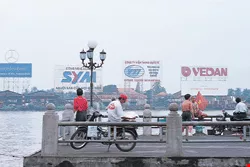
Local residents of revitalizing Ho Chi Minh City gaze across the Saigon River at the large advertising hoardings on the other side, including one from Taiwan's Vedan Company.
The Paris of the Orient
It's hard to imagine that only 40 years ago, Saigon was known as "the Paris of the Orient." But 30 years of war left Vietnam utterly devastated. Then, for ten years following its reunification in 1975, the country isolated itself from the rest of the world.
When the Vietnamese government chose to begin pursuing policies aimed at reviving the economy in 1986, the situation took a turn for the better. In 1987, the government began to allow foreign investment in the country, and in 1996 approved a new legal framework for such investment, in an effort to attract more foreign capital. In March of 1991, Taiwan set up representative offices in Hanoi and Ho Chi Minh City. In September of that same year, P.K. Chiang, who was then vice minister of economic affairs, led a trade mission to Vietnam.
In fact, a report by Shiu Wentang of the Academia Sinica's Institute of Modern History shows that Taiwan has been the largest foreign investor in Vietnam since 1991, whether measured in terms of number of items, number of projects, or total capital.
In September of 1997, a "Taipei School" was established in Ho Chi Minh City to better serve the needs of the Taiwanese business people in Vietnam. The school's current enrollment of 277 students, 90% of whom are children of Taiwanese business people, makes it the largest of the six Taipei Schools in Southeast Asia.
But things weren't always easy for Taiwanese entrepreneurs in Vietnam. Before the Asian financial crisis, the Vietnamese government was not at all enthusiastic about investment by foreign small and medium enterprises (SME), preferring investment by major corporations instead. However, the regional financial crisis demonstrated to the Vietnamese that major corporations were not always sound corporations. Moreover, it highlighted the resiliency of Taiwan's SMEs. Now the Vietnamese welcome investment by firms of all sizes.
The Vietnamese government's reconsideration of its approach to foreign investors has led to other changes, as well. For example, the Ho Chi Minh City government can now approve foreign investments involving less than US$10 million without the involvement of the central government. This same prerogative has also been extended to all of Vietnam's provincial governments for investment proposals involving less than US$5 million. In addition, having seen the constant human resource conflicts that resulted from joint ventures between Taiwanese capital and Vietnamese private or public enterprises, the government now allows foreign ventures to wholly own their local affiliates.
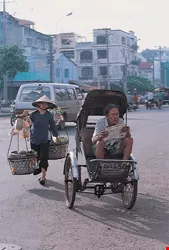
After a long war and years of isolation, Vietnam is now actively courting foreign investors. Ho Chi Minh City, Vietnam's largest city, is now home to the country's greatest concentration of Taiwanese businesspeople.
A business paradise
Vedan and the Pou Chen Corporation were the first two major Taiwanese firms to set up shop in Vietnam under the old policy favoring large corporations.
Vedan built a monosodium glutamate (MSG) production facility in Vietnam which is now the largest producer of MSG in Southeast Asia. The company says it chose Vietnam for two reasons: the availability of raw materials and the strength of local demand.
Vedan's president, Joel Wang, explains that the main ingredients of MSG-molasses and starch-are not readily available in Taiwan. Vedan thus felt that if it was to remain competitive, it had to seek out a new production site overseas. In 1989, Vedan evaluated every country in Southeast Asia as a potential location, and eventually signed a memorandum of understanding indicating that it planned to locate its new plant in the as-yet-unbuilt Pudong area of Shanghai. However, after a final review Vedan chose Vietnam instead.
Wang says that Vietnam consumes a tremendous amount of MSG, essentially putting a large market right at the plant's doorstep. MSG is also said to be one of the essential rations of the Vietnamese army because soldiers can use it to flavor their food while on guerilla missions, and to stanch a bleeding wound. But Vietnam not only possesses strong domestic demand, it is also located right in the middle of the ten ASEAN nations, putting Vedan's plant within easy reach of a 400-million-person market. Vietnam also provides convenient access to European markets.
Vietnam was a good match for Vedan for other reasons, as well. First, the country has abundant supplies of the molasses and starch used to make MSG. In addition, Vietnam's lifestyle, customs and Confucian-influenced society are similar to Taiwan's. Wang says, "The Vietnamese are very much like Taiwanese. They celebrate the Mid-Autumn Festival and the Lunar New Year, and they venerate their ancestors on the first and 15th of every month of the lunar calendar." Wang concludes, "Given the country's access to global markets, its abundant supplies of raw materials, its cultural similarity to Taiwan and its geographic advantages, Vietnam is an outstanding place for us to be invested."
Vedan received its business license in 1991, and has invested a total of US$387 million in Vietnam over the last several years. The company's 129-hectare Vietnamese production complex includes all the facilities one would expect to see in a small industrial park. The site is home not only to Southeast Asia's largest MSG production facility, but also to an electrical cogeneration plant that generates enough electricity to allow Vedan to resell surplus power to the national power grid. Vedan also produces lysine, glucose syrup and more than 30 kinds of modified starches at the complex, which last year generated revenues of more than US$160 million.
To facilitate the shipment of raw materials and finished goods, Vedan also operates its own pier in the Phuoc Thai harbor. The company has even worked out an arrangement whereby customs workers check the company's goods on the pier itself. While Phuoc Thai harbor is currently only able to admit ships with a displacement of 5,000-6,000 tons, Vedan is eyeing an expansion. Wang says that future dredging could allow vessels of up to 12,000 tons displacement to make port calls.
Making an investment the size of the Vedan production complex can be very complicated. Wang says that before getting its plans approved, the company had to contact nine government ministries, including the Ministry of Commerce, the Ministry of Transport and Communication, the Ministry of Energy, the Ministry of Heavy Industry, the Ministry of Light Industry, the Ministry of Agriculture and Rural Development, the Ministry of Planning and Investment, the Ministry of Science, Technology and the Environment, the Ministry of Culture and Information, and the Ministry of Foreign Affairs. Wang says, "We didn't take any chances. We did exactly what they told us to do."
Vedan currently runs three shifts at the complex, which employs 50 Taiwanese foremen and about 1,600 local workers. To meet the needs of those workers, a company kitchen serves up six meals a day. Vedan provides the meals free of charge, and also offers employees free housing and free transportation to locations within a one-hour drive.
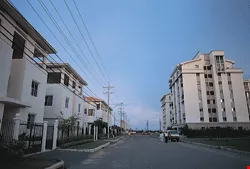
(opposite page) A joint venture between Central Trading and Development and a Ho Chi Minh City-owned company is leading development on the massive Saigon South New City Center project. With a number of residential buildings and recreational facilities already complete, the project is beginning to take shape and receiving accolades from local residents.
Taiwan's king of tea
Foreign firms have also come to Vietnam to manufacture shoes. Taiwanese and Korean firms dominate the industry. The Pou Chen Group is currently the largest of the Taiwanese shoe manufacturers with facilities in Vietnam. The group operates two affiliates in the country-Pou Chen Vietnam (PCV) and Pou Yuen Vietnam (PYV)-and has factories in Binh Chanh and Bia Hoa Provinces. To date, the group's Vietnam investments total US$330 million-nearly as much as Vedan's.
Shoemaking is a labor-intensive business. PCV and PYV together employ about 30,000 workers, more than any other Taiwanese ventures in the country. And according to Shih Hsiao-ping, a special assistant to the chairman, that figure will skyrocket to 80,000 when PYV completes an ongoing factory expansion.
Shih Hsiao-ping says that before Pou Chen came to Vietnam in 1994, it had already established overseas production bases in China (1989), Indonesia (1992) and the US. The group chose to invest in Vietnam for two reasons: to meet its clients' needs and to distribute risk.
But labor-intensive export processing isn't Vietnam's only business; agriculture is also an area of great promise. In fact, Vietnam is the world's second largest exporter of coffee and rice, and Lam Dong Province in southern Vietnam is home to ten Taiwanese tea growers.
The New North South Tea Corporation is the largest of Vietnam's estimated more than 1,000 tea producers. Johnson Wu, the company's managing director, was born in Vietnam of Chinese parents. His family lived in Cambodia for 15 years, but moved to Taiwan when Cambodia became embroiled in its civil war. Wu jokes that he was "tricked" into going back to Vietnam to grow tea 13 years ago.
Wu says, "I was the first person to come here from Taiwan to grow tea, but I was the last one to actually get started." Wu explains that he got started growing tea here when a Vietnamese friend invited him to come have a look at some tea fields. At the outset, the two of them partnered with a state-owned enterprise (SOE). Wu's friend left the venture after just one year, leaving Wu partnered with the SOE. The company operated a 100-hectare tea farm, and generated fat profits in its early years. Wu later imported tea plants from Taiwan, planning to begin to harvest leaves three to four years after they were planted. Unfortunately, the SOE dissolved their partnership, forcing Wu to start again from scratch.
Wu acquired 100 hectares of overgrown hillside for about NT$6 million, then cleared the land, built a road, and brought in power lines himself. In late 1997 he put in his first crop, and now his whole hillside is a brilliant green. Wu's farm produces a number of varieties of tea, including black tea, green tea, Japanese sencha, and several types of Taiwanese oolong.
Management of New North South Tea is completely computerized, with detailed charts showing when to plant, how many plants to place in each row, and when to apply pesticides and fertilizers. The farm also employs techniques which are beyond the capabilities of most Vietnamese tea farms, such as organic composting and the use of an elevated sprinkler system to apply pesticides.
Vietnam's favorable climate allows growers to harvest leaves of consistent quality six times a year. This compares favorably to Taiwan, where growers get only four harvests a year and must contend with bitter and astringent summer leaves. On average, New North South Tea exports more than 1,000 tons of tea leaves every year, and Taiwan is its main market. The steady growth of Wu's business has left him no time for vacations, but he doesn't seem to mind. In fact, he headed to Shanghai last month to prepare for the opening of a sales office there.
Chien Wen-hsien, who owns the Chao-ming Tea Company, takes quite a different approach to his business. Chien runs a small operation and handles virtually everything, from labor to management, himself. It is an approach that helps him keep costs down and profits high. Chien has been working his 13-hectare farm in Vietnam for seven or eight years now, and sells all of his tea back to Taiwan. Chien says that he shipped about 40,000 pounds of tea to Taiwan last year, and he estimates that his shipments will rise to about 50,000 pounds this year. For his part, Johnson Wu smiles when Chien's name comes up, remarking that his small-scale approach is truly the way to make a fortune without anyone knowing.
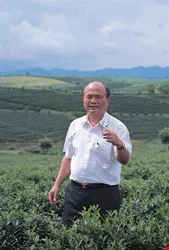
Johnson Wu, Managing Director of the New North South Tea Corporation, says, "I was the first person to come here from Taiwan to grow tea, but I was the last to get started too." Wu's earlier bitter experience with investing in Vietnam has now turned sweet.
Phu My Hung building a new Vietnam
Central Trading and Development (CT&D) is yet another venture striving to develop Vietnam's virgin markets.
CT&D was founded in 1989, then spent two years searching for an overseas market in which to invest. Since deciding on Vietnam, the company has poured some US$650 million into the country.
According to Alpha Chen, international marketing director at CT&D, the company chose Vietnam for its high-quality, low-cost workforce, for its location in the heart of Southeast Asia, and for the three million Vietnamese expatriates who bring new skills and more than US$1 billion back to the country every year. CT&D also owns 70% of the Phu My Hung Corporation (PMHC). Established in 1992, PMHC is a major real estate developer in Ho Chi Minh City. PMHC's projects include the Tan Thuan Export Processing Zone, the Hiep Phuoc Power Plant and the Saigon South New City Center.
PMHC's 300-hectare Tan Thuan EPZ was Vietnam's first export processing zone. Some 152 companies have established offices in the EPZ since it opened, 40% of them Taiwanese and another 40% Japanese. While the Vietnamese government has given the Tan Thuan EPZ strong backing and recognition, it is not the EPZ's only advocate. In fact, in 1999 Tan Thuan was ranked the number one EPZ and industrial park in the Asia-Pacific region by the British magazine Corporate Location.
Also built by PMHC, the Hiep Phuoc Power Plant accounts for 22% of southern Vietnam's power generation capacity. The Hiep Phuoc Power Company sells electricity from the plant to both the Tan Thuan EPZ and to the Vietnamese national power grid, generating monthly revenues in excess of US$10 million.
Finally, PMHC's massive South Saigon New City Center development (SSNCC) includes a convention center, office and residential buildings, a business center, hotels, a club, a hospital, schools, and athletic facilities that include a golf course. According to Central Trading and Development, the objective of the project is to turn South Saigon into "the most beautiful place in Southeast Asia."
Interestingly, Alpha Chen reports that land development and construction were not originally CT&D's primary businesses. But in its efforts to survive the Asian financial crisis, the company began presales of a new residential development in 1998. Fortunately for CT&D, the local economy was growing at the time, but Vietnamese were reluctant to keep their money in the bank. As a result, sales were strong. One project launched in May 2000 was even fully subscribed within a month of being offered to the public.
Saigon South is also home to Saigon South International School, Ho Chi Minh City Japanese School, Saigon South People's Founded School (Vietnam's first private school), and the Korean School. In addition, the three-year-old Taipei School relocated to the New City Center in September of last year. Alpha Chen says that the decision to develop Saigon South focused on the tremendous potential represented by projections showing Ho Chi Minh City's population growing from its current seven million to ten million over the next ten years.
Virgin territory
Research by the Academia Sinica's Shiu Wentang shows that Taiwanese investors in Vietnam recoup investments very quickly, usually becoming profitable in three to five years.
Nonetheless, not every investment is a success story. For example, the Jin-Wen Group acquired a large piece of property in central Ho Chi Minh City which is now overgrown with weeds. Another Taiwanese firm rented a plot of land the size of Taipei County and set people to work planting bananas on it. The company then built a row of buildings along the Saigon River with the intention of selling them. However, the company ran into financial difficulties and ultimately pulled out of Vietnam entirely.
While both Vietnam and China are communist countries, Hsu notes that Vietnam is less expensive in terms of both labor and land costs. More importantly, Taiwanese firms in Vietnam have the same status under the law as other foreign firms. Taiwan and Vietnam also signed an investor protection agreement in 1993. Taiwanese firms have quite a different situation in China. Although the PRC promulgated an investment protection act for its "Taiwanese compatriots" in 1994, the law treats Taiwanese businesses as domestic firms. As a result, when there are disputes, Taiwanese firms are not necessarily protected under the law. Moreover, given China's strategy of using business to manipulate governments, Taiwanese investors could face fallout in the event of political wrangling.
On the other hand, investors in Vietnam do have to contend with several difficult issues, one of which is labor law.
The Vietnamese government is very protective of its workers, and the country's labor law reflects this attitude by placing a number of restrictions on management. For example, the law requires an eight-hour workday and a 48-hour workweek, and limits annual overtime to 200 hours. It also grants female employees four months of maternity leave (down from six months) and gives them one hour each workday to nurse their child when they return to work.
In one case at a Taiwanese firm, workers struck and sued the company for abusing its employees when a floor manager disciplined workers by making them run around a track.
Vietnam's labor law also prevents companies from firing workers unless they fail to show up for work for seven days, or harm the company in some manner. Faced with the downturn in the global economy, a Japanese computer firm recently wanted to lay off 500 of its Vietnamese workers, but had to find them new jobs before the government would let it do so.
Labor disputes occur occasionally, often brought on by foreign investors' approach to management or problems involving overtime work. Businesses in Vietnam must also contend with a lack of trained local management. Vedan president Joel Wang says that while the company's Vietnamese workers have picked up technical skills quickly, Vedan has had more difficulty teaching management techniques. The unwillingness of Vietnamese to take orders from other Vietnamese is also an issue.
In addition to considering how to make the best use of Vietnam's natural advantages, Taiwanese businesses must also reflect on how they plan to negotiate the potential pitfalls and difficulties associated with investing in Vietnam if they are to generate earnings.
@List.jpg?w=522&h=410&mode=crop&format=webp&quality=80)

@List.jpg?w=522&h=410&mode=crop&format=webp&quality=80)


@List.jpg?w=522&h=410&mode=crop&format=webp&quality=80)

@List.jpg?w=522&h=410&mode=crop&format=webp&quality=80)
