Hospitals Grapple with Nurse Shortage
Chang Chiung-fang / photos Chin Hung-hao / tr. by Jonathan Barnard
July 2012


The International Nurses Day celebration in Taiwan was unusual this year, as nurses—those angels in white who selflessly offer their assistance to the sick—took to the street. Answering a call from the Taiwan Radical Nurses Union, a group of 200–300 protesters, including nurses, their family members and friends, demonstrated in front of the Department of Health on May 12. Carrying signs such as “I’m overworked and have a terrible schedule,” they pressed the DOH to look squarely at the plight of nurses.
Devoting their lives to helping others, nurses are answering a sacred call. Yet when a deteriorating work environment pushes nurses to leave the profession in droves, nurses aren’t the only ones hurt. So too are the general public, who rely on nurses for care.
The white angels are tired! Nursing reform needs to happen now!
In recent months a series of incidents has brought attention to the troubles of nurses: There were several cases of emergency-room nurses in central and southern Taiwan attempting or committing suicide, and there were stories of nurses who were forced to work while hooked up to IVs themselves.
These extreme incidents of nurses spilling their own blood, sweat and tears have captured attention, both from the medical institutions that wield power by hiring nurses or setting policies, and from members of the general public who enjoy the fruits of the National Health Insurance system.
“There is a Chinese expression that you ‘burn yourself to illuminate others.’ But once you’ve burned out, what good are you to others?” asks Huang Lian-hua, director of nursing at National Taiwan University Hospital (NTUH).
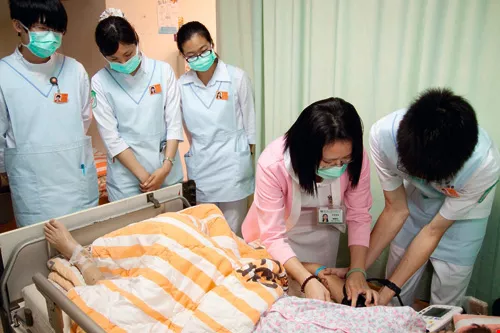
The busy, taxing, and stressful work of nursing often shocks newcomers to the profession. More than half of nursing graduates leave the profession within a year.
The shortage of nurses has many interconnected causes.
There are 231,217 certified nurses in Taiwan, but only 136,379 are currently employed. That’s not even 60%.
What happened to that lost 40% (about 100,000 individuals)?
Lu Meei-shiow, president of the National Union of Nurses’ Associations (NUNA), points out at that in recent years many nurses have been leaving the profession to work as flight attendants or pursue careers in fields such as cosmetic medicine, insurance, or health product marketing.
In March of this year NUNA released the results of a survey on nursing resources throughout Taiwan. As many as 90% of hospitals couldn’t recruit sufficient numbers of nurses. On average, 7.2% of nursing positions were vacant. It is estimated that more than 7000 additional nurses would be needed to close the gap.
Many may be surprised to learn that, with the shortage of doctors, advance practice registered nurses (APRNs) and other senior nurses are taking on more and more of the work formerly handled by resident physicians. That shift of duties has only compounded the overloading of nurses.
Lu notes that doctors can’t be replaced, but experienced nurses acting much like resident interns can help out. So long as doctors write out prescriptions, nurses can fill them. And when surgeons are in the operating room, APRNs can sub for them on their rounds, keeping abreast of patients’ medical situations.
Currently, 2914 nurses have passed the exams to become APRNs, and there are another 3000-plus senior nurses who haven’t yet obtained APRN certification yet are nevertheless doing some of the work of hospital resident physicians. That brings the total to more than 6000 nurses taking on some of the work that doctors would normally handle.
What’s more, the total number of nurses also includes nurse clinicians, who focus on follow-up patient care and aren’t necessarily performing typical nursing duties. At NTUH, notes Huang, when you add the nurses who are on maternity or other kinds of leave, you lose another 10% of practicing nurses.
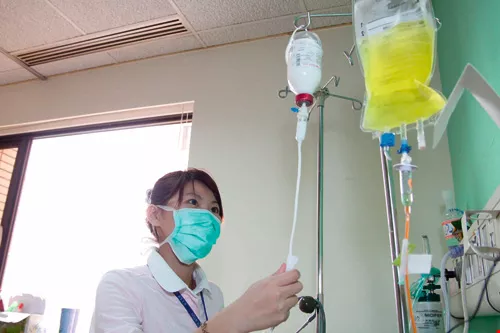
By profession, nurses devote themselves to helping other people, but the long hours and low pay are driving away those who are unwilling to endlessly sacrifice themselves. Society needs to squarely confront the shortage of nurses.
The impact of “hidden losses” among senior nurses is far reaching. Not only does it create openings that need to be filled; it also exacerbates the low retention of newcomers to the field of nursing.
“The nursing ranks are fractured, with senior nurses missing,” says Lu. Newcomers need mentors, but now they have to be mentored by nurses with only two or three years of experience—“mentors” who aren’t fully trained themselves. When these nurses have to guide newcomers, they become overburdened and the newcomers lack adequate guidance. It makes adapting to the profession difficult.
According to NUNA, as many as 58% of new nurses leave the profession within a year.
“With low rates of retention, hospitals have to continually train new hires. That makes it hard on everyone.” NTUH’s Huang notes that seven years ago NTUH was losing more than 24% of its nursing hires during their first year. With added supervision and with senior nurses providing one-on-one mentoring, the figure fell to 16.6% just a few years later.
“The hospital environment is complex,” says Liang Xiumei, a member of the Taiwan Radical Nurses Union. “You’ve got to deal with doctors, patients, patients’ families and colleagues. It’s not easy.” When she first started working at a hospital 20 years ago, she cared for one patient the first week and then two the second week, gradually getting a feel for the job before increasing her load. But now working conditions have tightened, and in the first week on the job you’ll have 10 patients. A senior nurse will keep an eye on you, but she will have her own work to do as well. It’s a situation that can’t help but foster agitation and frustration, as both parties feel a great deal of pressure.
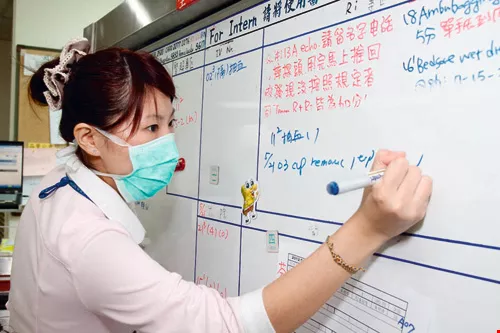
The busy, taxing, and stressful work of nursing often shocks newcomers to the profession. More than half of nursing graduates leave the profession within a year.
One nurse performing her internship wrote in a letter to a newspaper that she was working extra hours every day in order to record what patients had eaten, how many times they had gone to the bathroom, how much water they had drunk and so forth. But when she got off work, she herself had no idea how much she had eaten and how many times she had gone to the bathroom. The working conditions led to stomach aches, urinary tract infections and other health problems as she became ill herself.
The DOH has long prescribed a ratio of one nurse to between eight and 11 patients on day shifts. To comply with that ratio, hospitals have taken nurses off night and late-night shifts, thus increasing workloads on those shifts.
Surveys have revealed that nurses typically care for five to 13 patients on day shifts, six to 18 on night shifts, and seven to 20 on late-night shifts.
These workloads stand in stark contrast to those of nurses in nations such as the United States and Australia, where nurses typically care for four or five patients on day shifts, four to six on the night shift, and eight to 10 on the late-night shift.
In 2011 the Taiwan Healthcare Reform Foundation opened a hotline to report on poor working conditions in hospitals, prompting many nurses to vent their true sentiments. One of nurses’ biggest gripes is that they can’t take advantage of their accumulated vacation time because of hospitals’ practice of “buying back” vacation days.
Liang Xiumei notes that nurse-patient ratios may at first appear to be in conformance with mandates, but nurses have no way to use their days off. Hence, apart from looking at nurse-patient ratios, there needs to be an additional focus on the reasonableness of shift scheduling.
However unpleasant it may be for those working night shifts, the three-shift system at hospitals is unavoidable. But when nurses are forced to work both day and night shifts, they can’t get adequate rest and their internal clocks get out of whack. It’s very hard on them.
When nurses are overworked, it affects not only their own health, but also the quality of the hospital care they provide and the rights of patients.
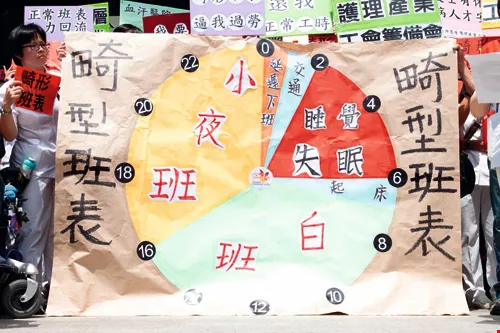
If you’re ill yourself, how can you serve the sick? On International Nurses Day (Florence Nightingale’s birthday), some of Taiwan’s “white-clad angels” took to the streets in protest. Onerous shift schedules were forcing nurses to work both day and night, messing up their internal clocks and giving them no time to recharge their batteries.
A 2002 study by the University of Pennsylvania revealed that it is safest for a nurse to be caring for four patients. At five patients, the likelihood of patient death increases by 7%. At six patients, it increases by 14%, and at eight, by 31%.
A 2009 research study in Taiwan showed that for every additional nurse hired per 100 beds, the likelihood of patient death decreases by 17.77%, the rate of infection by 16.69%, and the incidence of circulatory shock by 12.1%. The number of patients who suffer falls decreases by 10.83%, and unintentional tube dislodgement decreases by 9.98%. From these figures, one can see how hiring additional nurses has the potential to actually reduce medical costs.
The profession’s high “wear and tear” results in nurses’ careers lasting only six to seven years on average. That represents a huge waste of resources when you consider the cost of nursing education.
To figure out how to retain nurses, you’ve got to put yourself in their shoes. Huang Lian-hua says that in order to retain senior-level nurses, NTUH started implementing a system in 2000 whereby nurses over age 50 don’t have to perform late-night shifts.
What is more, to encourage younger nurses to take night shifts, the hospital has increased the supplement given to nurses who take more than 15 night shifts a month from NT$300 for the early night shift and NT$500 for the late night shift to NT$500 and NT$700 respectively. “Only by taking steps to reduce mandatory night shifts can we retain nurses with children.”
In the case of hospitals that lack the means to put in place incentives like NTUH’s, many make ample use of low-salaried nursing graduates performing their internships or the free labor of nursing students.
Liang Xiumei points out that nursing students need eight to 10 months of hospital experience. During that period, they not only receive no salaries but they also have to pay a “practicum” fee to the hospital. But these students constitute an important source of caregiver personnel for these hospitals. Liang cites statistics from the psychiatric ward at a hospital: there are typically only two full-fledged nurses on duty during all shifts—day, night and late night—per 100 beds of chronic sufferers. The rest of the nursing workload is carried out by students from two nursing schools. Each school sends six to eight students, so that there a dozen or more in total. These students can help out with the interaction between nurses and patients and relieve some of the patients’ boredom, thus reducing their violent tendencies.
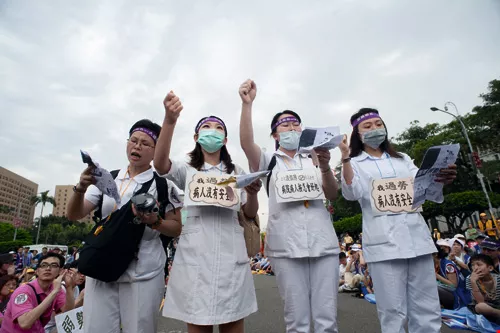
If you’re ill yourself, how can you serve the sick? On International Nurses Day (Florence Nightingale’s birthday), some of Taiwan’s “white-clad angels” took to the streets in protest. Onerous shift schedules were forcing nurses to work both day and night, messing up their internal clocks and giving them no time to recharge their batteries.
A question demanding more research: Are hospitals or the National Health Insurance system to blame for nurses being burdened with low pay and high-pressure working conditions?
Taiwan Healthcare Reform Foundation researcher Chang Ya-ting points out that NHI expenditures are growing by 3% a year, and profits for services provided by medical personnel at medical centers have rebounded from –0.4% in 2005 to 3–4% in 2008–2009. Yet the share spent on salaries is falling.
Lu Meei-shiow, NUNA’s president, notes that the NHI system currently budgets about NT$300 billion for Western medicine. NT$20 billion of that is paid for nursing fees related to in-patient care. But hospitals and other medical providers are reimbursed for nurses at an average of only NT$17,500 per month, far lower than the actual salary of most nurses. Consequently, hospitals have realized that “the more nurses they hire, the more they bleed money.”
Hence NUNA is lobbying for sufficient nursing reimbursements for the “second generation” of NHI, which will go into effect next year. “When funding increases, that doesn’t necessarily mean that nurses’ salaries will likewise increase, but it will remove any excuse for hospitals to delay salary hikes any longer,” says Lu.
In order to retain nurses, and to attract more graduates to actually enter the profession, one hospital after another has come up with plans to raise nurses’ salaries.
To attract more nurses, NTUH has added NT$3,100 to contract nurses’ monthly pay, offering NT$46,000 to new nurses and thus shrinking the salary gap to NT$10,000 between its contract nurses and tenured nurses with benefits.
Recently Huang Lian-hua discovered that nurses at NTUH had salaries NT$3,100 lower than those of other medical workers in its employ with similar levels of education. Consequently, she lobbied the president of the hospital to raise their salaries. “By offering competitive salaries, we found that recruiting went well this year, as we hired 318 nursing program graduates.”
On the eve of International Nurses Day, Changhua’s Show Chwan Memorial Hospital also announced that it was raising salaries by 20%, bringing the average nurse’s salary there to NT$45,000. As soon as the news broke, applications poured in, so that the hospital was immediately able to fill its shortfall.
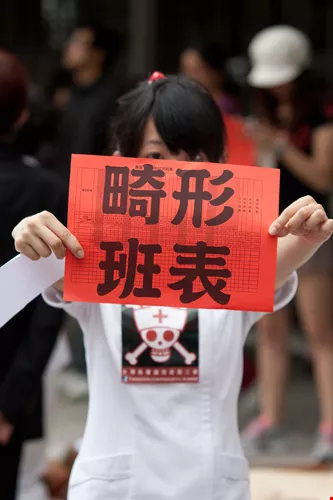
If you’re ill yourself, how can you serve the sick? On International Nurses Day (Florence Nightingale’s birthday), some of Taiwan’s “white-clad angels” took to the streets in protest. Onerous shift schedules were forcing nurses to work both day and night, messing up their internal clocks and giving them no time to recharge their batteries.
Apart from adequately rewarding nurses financially for their hard work, it is even more important that nurses obtain the respect they deserve for their devotion to duty and self-sacrifice.
Lu Meei-shiow notes that former nurses will return to the profession only if the value of the professional work done by nurses is respected and the long-lost dignity of nurses is rightfully restored.
NTUH’s Huang believes that giving proper respect to nurses starts with what you call them. She points out that there are 14 different kinds of medical professionals at hospitals that are typically referred to with the honorific “shi,” which roughly means “master.” Yet nurses are typically not among them.
In order to raise the status of nurses, Huang has been promoting a “call me ‘hulishi’ (nursing master) campaign. Having previously served concurrently as president of the Taiwan Nurses Association, Huang was able to bring the campaign to hospitals throughout Taiwan.
“There is a lot of meaning conveyed in that appellation,” says Huang. Being called a hulishi conveys a proper sense of respect. At the same time, of course, someone called by such a name must deserve it—by providing truly professional nursing services.
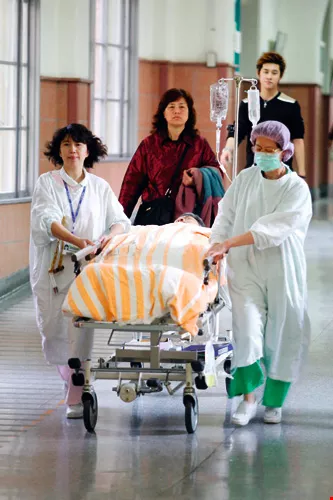
With an aging population, the demand for nurses and doctors is increasing, but the numbers of practicing nurses are declining rather than growing. The shortfall of nurses in Taiwan now totals more than 7000.
As nurses have taken on too many extra duties, they have become “spinning tops,” bouncing frantically from task to task. In fact, they only spend about 30% of their time actually performing their nursing duties. The rest of their time is spent in various administrative duties, including keeping records (24.25%), making preparations (12.68%), and handling transitions between shifts (8.42%).
Lu explains that even when the next shift arrives, nurses from the earlier shift have to stay for a quite while to fill out various forms that will later be used by evaluators to authenticate infection controls, mother-baby friendliness, the quality of emergency and critical care, cancer controls and so forth. The whole process needs to be reconsidered and streamlined so nurses don’t waste so much of their precious time on record keeping and paperwork.
Some hospitals even ask nurses to share responsibility for equipment upkeep and repairs, cleaning, and making beds.
How do you go about ensuring that nurses do only the professional work for which they were trained? NTUH’s Huang suggests that there are suitable foreign models.
Take the United States, which has three levels of nurses: registered nurses, licensed practical nurses, and certified nursing assistants. Each designation has its own responsibilities. In Taiwan, on the other hand, there is the single catchall designation of nurse. Taiwan should be moving toward mixing and matching nurses of different levels of certification, allowing caregivers or nurse’s aides to help patients with the tasks of daily living, so that registered nurses can return to focusing on nursing.
Please come backThe Council of Labor Affairs has announced that beginning in 2014 units such as operating rooms, emergency rooms, intensive care rooms and delivery rooms must allow their medical personnel to work regular hours. But will those institutions be able to resolve their shortage of nurses by that time? That remains to be seen.
Lu points out that by the end of this year the DOH’s Bureau of Medical Affairs will designate three reasonable nurse-patient ratios. “We don’t dare ask to start out like Japan at 1:7, but that’s our ultimate goal.”
“Improving labor conditions is the most effective solution,” says Lu. After the Australian state of Victoria mandated minimum nurse-patient ratios for each of the three shifts, nursing school enrollment increased by 25%, and within one or two years several thousand nurses returned to the profession.
In 2004 California implemented safe nurse-patient ratios of 1:4–5 for day shifts and 1:6–7 for night shifts. The move brought more than 30,000 nurses back to the profession and greatly aided recruitment.
Foreign examples demonstrate that the nursing shortage is not an unresolvable problem. So long as they are offered reasonable compensation and the respect they deserve, nurses—those embodiments of pure and warm caregiving—will remain caring for the ill.

@List.jpg?w=522&h=410&mode=crop&format=webp&quality=80)

@List.jpg?w=522&h=410&mode=crop&format=webp&quality=80)


