The World in a Seed
Thousand Fields Seed Museum
Sam Ju / photos Jimmy Lin / tr. by David Smith
March 2013


The city of Tainan is best known for its historic sites, delicious local cuisine, and refurbished old buildings that have been put to new uses. But visitors in the last two or three years have been discovering lots of other nooks and crannies packed with fascination. One site tucked away on a narrow lane that’s been getting rave reviews on the Internet is the Thousand Fields Seed Museum.
Liang Kunjiang and his wife Zhao Yingling are in the business of landscape architecture. Four years ago they began publicly displaying some 300 types of seeds that they had spent over 20 years collecting. The British poet William Blake wrote of seeing “a world in a grain of sand, and a heaven in a wild flower.” He could just as well have been writing of Thousand Fields Seed Museum, for in every single seed there indeed exists a virtual microcosm of the universe.
Spring is the planting season. This spring, then, let us start by familiarizing ourselves with seeds.
Thousand Fields Seed Museum is just a 10-minute taxi ride away from Tainan Railway Station, down a small lane off Dongfeng Road, on a shady property of about 660 square meters that calls to mind a rural European manor.
Aged 63 and 60, Mr. and Mrs. Liang began leasing the gently sloping property 22 years ago from the National Property Administration, and have been using it to run their business, the Thousand Fields Landscape Services Company. But for the couple, this has been more than just a place of business. It has also been their base of operations as they’ve scoured the countryside amassing a huge collection of plant seeds. The hazel bottle tree (Sterculia foetida) saplings they planted near the entrance back when they first moved in have since grown into towering specimens.
Although he graduated from the agricultural mechanics department of the National Pingtung Institute of Agriculture (now the National Pingtung University of Science and Technology), Liang has a special interest in plants, as is typical of many who have grown up on a farm. He began growing rosary pea (Abrus precatorius) during his student days, and the hobby stuck. He ended up planting things for a living.
Friends and relatives have looked on for over two decades as the Liangs have emerged as seed experts. During the process, Liang has been the one to do the collecting, while the task of organizing their collection has fallen to Zhao. The two have been uncompromising in their methods, and this spirit has defined what Thousand Fields Seed Museum is.

A seedpod of the earleaf acacia makes quite a stylish earring.
The first thing that greets the museum visitor’s eye is sack after sack of drying seeds hanging from the ceiling joists. “Almost all our seeds come from the Jianan Plain south of the Tropic of Cancer, north of the Hengchun Peninsula, and west of the Central Mountain Range.” This is the opening line in every guided tour given at Thousand Fields Seed Museum. Mr. and Mrs. Liang want only the seeds of plants that are endemic to the area and well adapted to local conditions. Everything’s got to be natural, and unforced. These are the principles that have guided the building of their collection.
Zhao explains why they only collect the seeds of plants that are commonly seen alongside the streets and in the parks and schools of southern Taiwan: “We don’t collect indiscriminately just for the sake of collecting. We absolutely won’t do anything that would be harmful to the seeds.”
For example, golden shower senna (Cassia fistula) is a common tree on the campuses of nearby National Cheng Kung University and the National University of Tainan. We visited the museum and watched as Zhao gave a tour to a group of a dozen or more visitors around 20 or 30 years of age. She pointed out that when the black seedpod of golden shower senna is squished, a white foam comes out. And because the flowers bloom in dense bunches, the abundant nectar often “rains” down to the ground, thus the tree’s common name.
And then there’s the appleblossom shower (Cassia javanica) that one finds all over the campus of Tainan National University of the Arts. It’s sort of a pink version of the golden shower senna, and Zhao pops open a seedpod to reveal seeds that look for all the world like Mentos lozenges. The visitors exclaim in amazement as Zhao explains: “The pod is very hard, and keeps the seeds very well protected.”
Next is earleaf acacia (Acacia auriculiformis), says Zhao, who clips a dry seedpod to a female visitor’s earlobe, eliciting cheers of delight. The earleaf acacia is very well suited to southern Taiwan, and is found on the campus of Kaohsiung Senior High School.
Zhao affirms: “In our whole collection, you’ll only find one type of seed from a plant that grows in the hills. That’s the Konishi tanoak.”

The Thousand Fields Seed Museum is run by Zhao Yingling (left), Liang Kunjiang, and their second son Liang Chaoxun (right).
“Have you seen the movie Ice Age? Here’s the acorn that squirrel was chasing all over the...” And before she finishes her sentence, the visitors gasp: “Ah! How cute!!” The group makes quite a happy ruckus in the tiny room.
Zhao informs the visitors that the “acorn” being chased by the prehistoric squirrel was a fabrication of animators, so it’s hard to be sure exactly what kind of plant it came from. “But by the looks of it, I’d say it was from a Konishi tanoak tree.”
“We collected the acorn of the Konishi tanoak specially for kids.” Zhao acknowledges that almost every kid who’s visited the museum in the four years it’s been open has asked to see the acorn from Ice Age. To satisfy their curiosity, Liang went collecting for the very first time in the hills above 1,000 meters. At the Aowanda National Forest Recreation Area in Nantou County, he found the seeds of the Konishi tanoak (Pasania konishii) and decided they would make a good Ice Age acorn.
Zhao draws roars of laughter with her humorous monologue: “This was one smart acorn. The squirrel never caught it in four whole movies. And the really awesome thing is that even though it was just an acorn, it was able to split the world into five continents!”
Zhao is in equal measures pleased and chagrined by the way their acorn has become animated and “Hollywoodized.” On the one hand, the cartoons do seem to pique a child’s desire to come into sensory contact with actual plants. On the other hand, however, it also appears that kids more often than not fail to make the jump from cartoon seeds to the real-life versions.
The Liangs are firmly convinced that to learn about nature one must start by seeing, touching, and embracing it with all five senses. This is precisely the idea that led them to open their collection to the public.
And this is why the seeds that they talk about in their one-hour tour are either striking in appearance or tie in with current cultural phenomena. The idea is to have visitors make connections with things in their daily lives. In addition to the connection between the Konishi tanoak and Ice Age, they’ve also got seeds from the sneezewort (Dregea volubilis), which are reminiscent of the jellyfish-like seeds of the Hometree inhabited by the Na’vi people in the movie Avatar, as well as seeds from the looking-glass mangrove (Heritiera littoralis), which are featured in Ang Lee’s Life of Pi.

One can readily imagine how these bright red achiote (Bixa orellana) seeds might have gone into the makeup used by the women of an earlier time.
Professor Kuo Hwa-jen of the Department of Agronomy at National Taiwan University, who has known the Liangs for over a decade, opines that the Thousand Fields Seed Museum makes its social contribution by providing a fun place where people can go to see seeds on display and get a hands-on feel for what they’re like. But, says Kuo, the museum cannot and should not be seen as a seed bank capable of rescuing plant species from extinction, and it would be quite unreasonable to expect a pair of amateur collectors to take on such a burdensome task.
As a professor of seed science, Kuo has seen just about every sort of seed in existence, but he’d never come across the brilliant blue seeds of the traveler’s palm (Ravenala madagascariensis) until he visited the Thousand Fields Seed Museum.
In addition to its focus on the science of seeds, Thousand Fields Museum also doubles as an art museum. One of the display rooms is devoted solely to artworks made from seeds. There’s a big spider, for example, whose head is made of the seeds of the balloon plant (Cardiospermum halicacabum), the body from the seeds of the Chinese soapberry (Sapindus mukorossii), legs from the seeds of the canna plant (Canna indica) and the golden rain tree (Koelreuteria henryi), and tail from the seeds of the rusty-leaf mucuna (Mucuna macrocarpa).
The seeds of the oil palm (Elaeis quineensis), meanwhile, come with holes in the surface that make them look eerily similar to the contorted visage in The Scream, the famous work by Norwegian painter Edvard Munch. And seeds of the wood gossip caesalpinia (Caesalpinia crista) have been tweaked with a few brushstrokes to make a decent likeness of the Po Yo (“grandma’s melancholy”) birds in the noted Evening Call series of paintings by deceased artist and anthropologist Max Liu.
On the day we visited the museum, a pair of visitors from Shanghai named Gu Yiling and Luo Chenyun had made a special trip there to see the collection. Still in their 20s, the two were nevertheless seasoned travelers. Gu said she had never heard of any place in Shanghai or anywhere else in mainland China dedicated to the collection and display of plant seeds. “We usually just casually look at things like flowers, trees, leaves, and whatnot. Few people go and study what the seeds look like.”
Luo was interested in the museum’s ornamental objects made from plant seeds, especially the necklaces, and said such things are rare on the mainland.
Gu marveled at the good luck of people in Tainan, who can drop in at the Thousand Fields Seed Museum whenever they feel like it. Luo said that the museum has a distinctly simple and unadorned feel about it.

The sight of dozens of sacks of seeds hanging from the ceiling joists is rather disconcerting at first, but it certainly makes a lasting impression on visitors.
Visitors to the museum have steadily increased over the four years since it first opened. On the ROC’s Double Tenth National Day last October there were over 400 visits, but Zhao couldn’t get excited about it. “I felt they just looked at us as a tourist spot, and merely wanted to ‘do something cool.’ They weren’t here to truly appreciate our collection.”
The very next day, she discussed the situation with her family. They decided to start charging adult visitors a guided tour fee of NT$100, and to accept visits only by appointment. The idea is to assure the quality of the experience.
The Liangs currently have a farm in Ligang Township, Pingtung County, that they use to keep up a supply of seeds for the museum and produce herbal distillates to sell. From Monday to Friday the museum is run by Zhao and second son Liang Chaoxun, who returned to Taiwan in late 2011 after completing a master’s degree in music in Britain. Their eldest son works as a producer with the Performance Workshop, a performing arts troupe headed by Stan Lai. Zhao confides: “I’m rather worried about being able to pass this museum to the next generation, but we can’t expect our children to live as simply as we have.”
Says Papa Liang: “We in our family are the type to get obsessed with something. And what the heck, there aren’t so many dummies in this world, so why not be among the select few? A lot of friends worry about our finances, but I think we really must provide people with the opportunity to get to know plants better. What else can we do? I just hope the existence of the Thousand Fields Seed Museum will give old folks something to reminisce about, and young folks something to look forward to. I want for people, when they look up and suddenly see a seed or a leaf falling to the ground, to be inspired to wonder about the world that the falling object represents.”
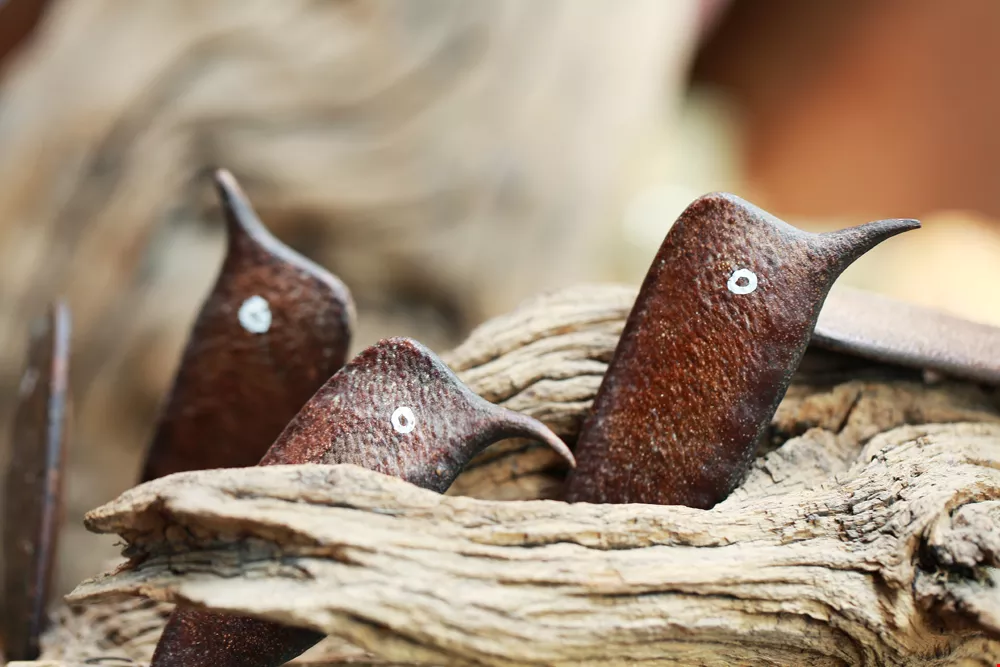
Wood gossip caesalpinia seeds have been tweaked with a few brushstrokes to make a decent likeness of the Po Yo birds in the Evening Call series of paintings by the late Max Liu.
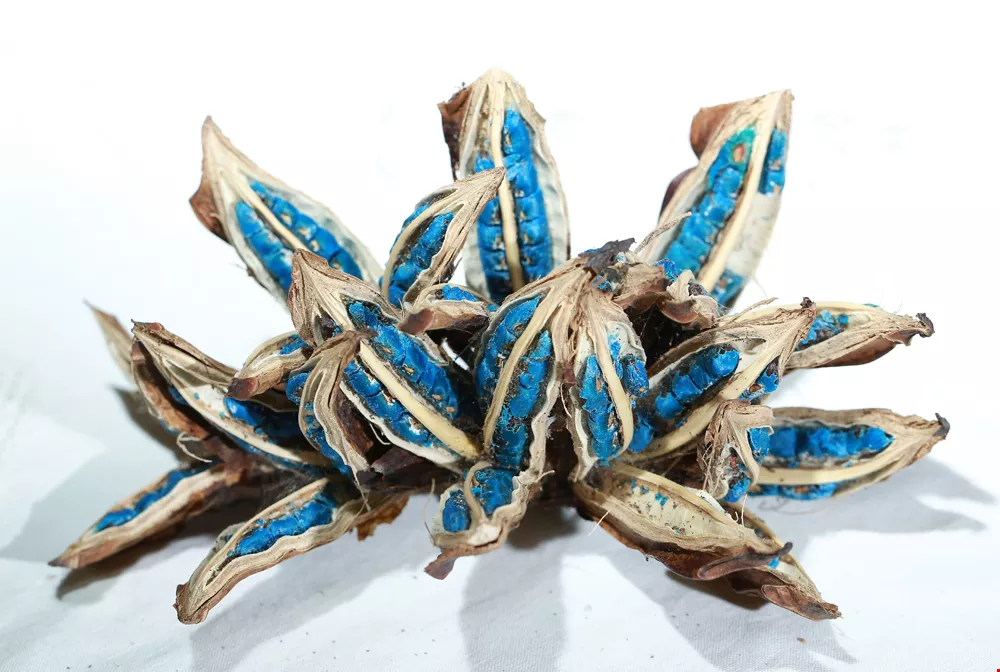
The blue seed of the traveler’s palm is extremely rare, and can be used as a natural eyeshadow.
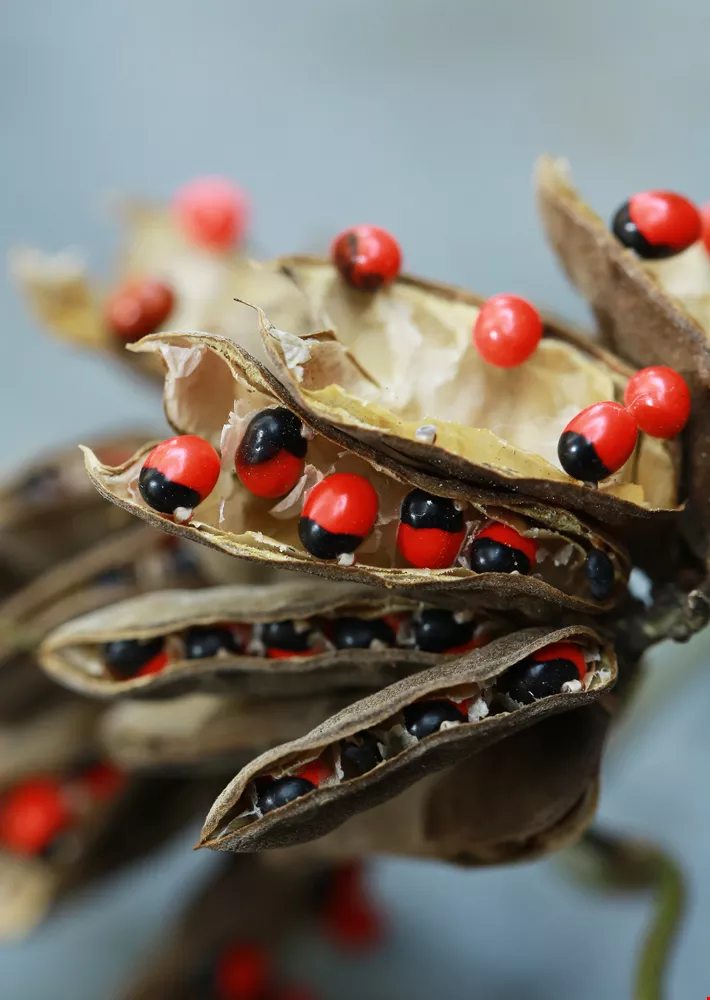
A brilliant combination of blood red and black indicates that the rosary pea is toxic, and not to be eaten!
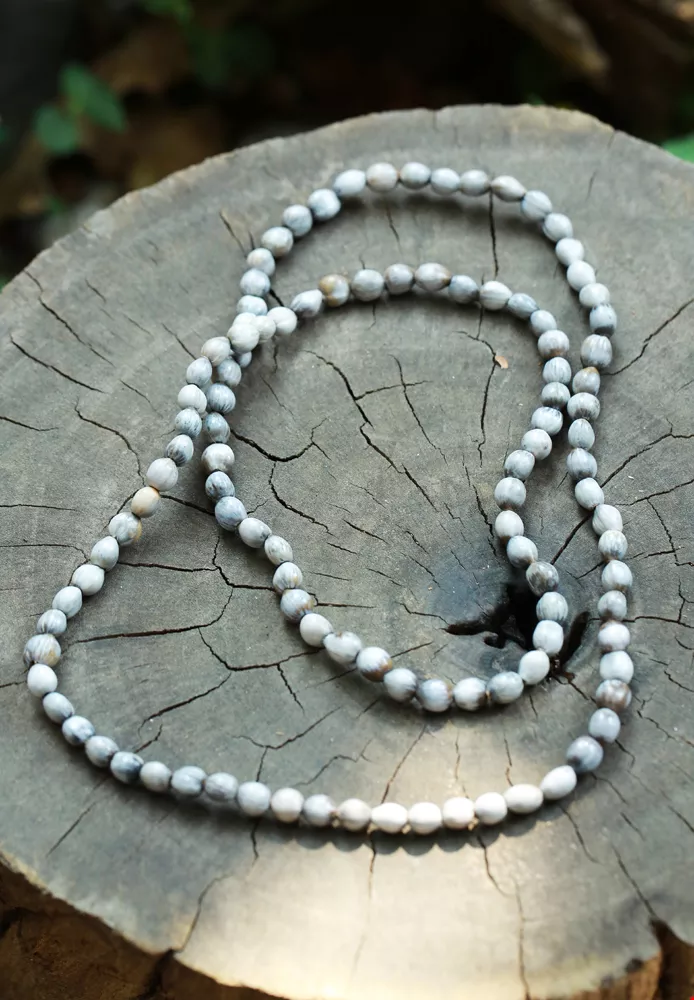
This necklace fashioned from a string of Job’s tears (Coix lacryma-jobi) seeds is utterly captivating.
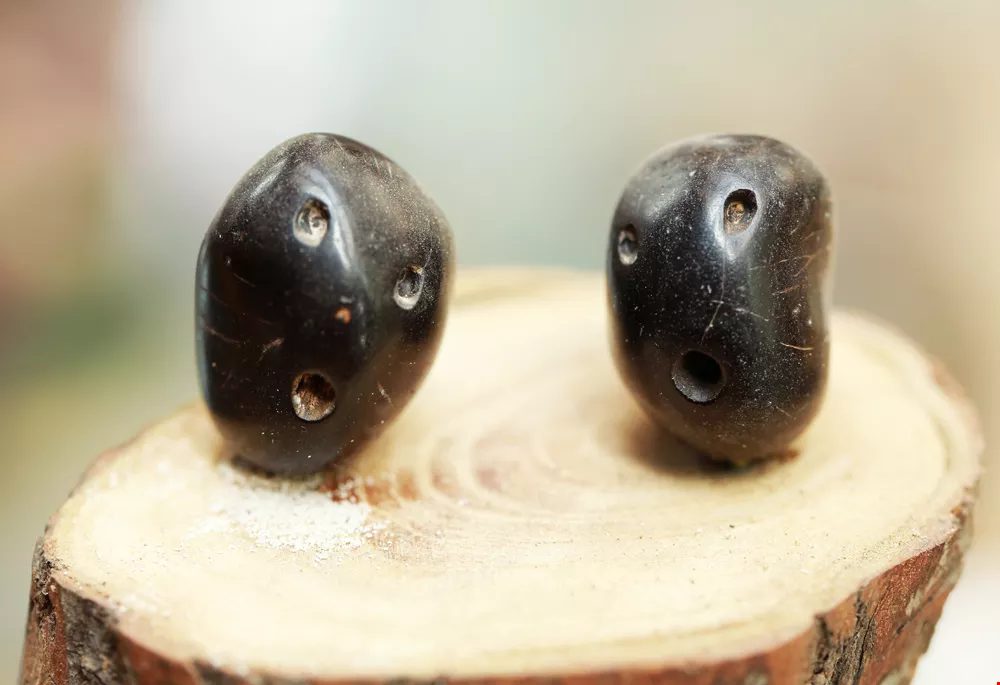
The natural holes in the seeds of the oil palm make them look eerily similar to the contorted visage in The Scream, the famous work by Norwegian painter Edvard Munch.
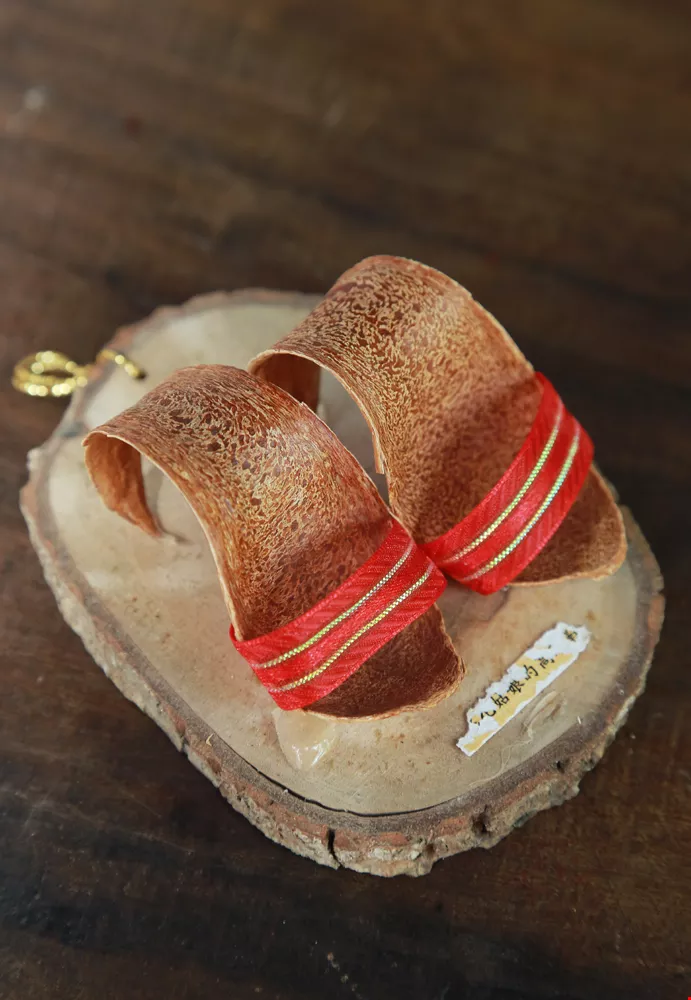
The Thousand Fields Seed Museum has taken these mahogany seedpods and made them into an ornament in the image of a pair of high-heeled shoes.
@List.jpg?w=522&h=410&mode=crop&format=webp&quality=80)

@List.jpg?w=522&h=410&mode=crop&format=webp&quality=80)


@List.jpg?w=522&h=410&mode=crop&format=webp&quality=80)

@List.jpg?w=522&h=410&mode=crop&format=webp&quality=80)
