Jade Journey: The Aurora Pavilion
Lin Hsin-ching / photos courtesy of Aurora Group / tr. by Phil Newell
May 2010


At the Shanghai World Expo 2010 there will be three "made in Taiwan" halls. The Taiwan Pavilion has political symbolism and the Taipei Pavilion (in the Urban Best Practices Area) is representative of Taiwan's municipal areas. There's nothing unusual about a country or city setting up a pavilion in a World's Fair devoted to city life. On the other hand, the Taiwan representative among the corporate halls is, strangely enough, not one of the big hi-tech firms (like Foxconn or TSMC) nor is it one of the food products giants (like President or WantWant), but rather is a group that got its start making office furniture: Aurora. Moreover, the pavilion will have a theme that seems to have nothing whatsoever to do with the image of its corporate sponsor: Chinese jade culture. It's incomprehensible!
But it turns out that Aurora chairman Chen Yung-tai is one of the best-known collectors of antiques on either side of the Taiwan Strait, and in his more than 40 years of antiquarianism, he has accumulated over 4000 exquisite jade pieces. He has even opened museums in Taipei and Shanghai, and has established the "Aurora Ancient Culture Research Center" in cooperation with Peking University.
It is this collecting experience and passion for art that lies behind Aurora's investment of RMB100 million (about NT$480 million, or roughly US$15 million) to construct the Aurora Pavilion. This site where the cream of 8000 years of Chinese jade culture will be on display has been well received, and has been chosen as "top choice for collectors" by a non-governmental website focusing on the expo. It is, in its own way, one more thing that can be labeled "the pride of Taiwan."
Take a stroll around a Taiwanese office-from the photocopier, printer, punch clock, and filing cabinet to the personal desks and chairs, you will, to one extent or another, find the Aurora label hung on the office products.
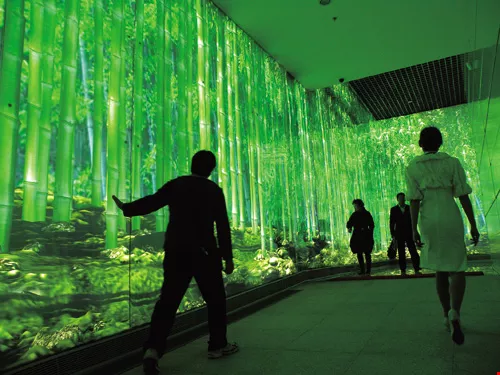
(above) The 18-meter bamboo corridor will put visitors in a calm frame of mind.
In Taiwan, Aurora is virtually a synonym for office design and office furniture. This enterprise, which made its mark with the philosophy, "simple, durable products and strong after-sales service," though entering the mainland Chinese market relatively late (1995), has in 15 short years become the ninth largest brand in the printer market there (the first eight all being Japanese) with a market share of over 5%. Even in the field of office furniture, where the rate of piracy is high and price fluctuations are large, Aurora still holds a market share over 1%. The group's annual revenues for both sides of the Taiwan Strait have hit NT$12 billion, with annual growth of over 20%. It is an exemplary Taiwanese firm that has genuine competitiveness and is expanding outward from a highly stable foundation.
Despite its high-precision modernized hardware image, Aurora has always been firmly grounded in culture, and has a profoundly traditional side. The firm's Chinese name Zhendan is a Chinese transliteration of the ancient Sanskrit name for China, Cinasthana "land of the Qin"), thereby evoking the passage of Buddhist culture from India to China. The Chinese characters, though originally used phonetically, refer to the sunrise, so "Aurora," the name of the Roman Goddess of Dawn, was chosen for the firm's English name. The selection of Aurora's "Chinese jade culture" proposal by the Shanghai World Expo Coordination Bureau to be the only Taiwanese-sponsored hall among the 18 corporate pavilions can be seen as a culmination of decades of cultural achievements.
Jaimy Tan, deputy director of the Aurora Pavilion, explains that the corporate pavilions at Expo 2010 fall into three main categories: joint pavilions, pavilions run by mainland Chinese state-owned enterprises (SOEs), and those built by a single corporate sponsor.
The first type consists of halls managed cooperatively by numerous mainland private or foreign-invested firms, such as the Shanghai Corporate Joint Pavilion and the Japanese Industry Pavilion. The second type includes pavilions run by SOEs such as those in the petroleum and aerospace industries. The third category consists of independent exhibition halls built by private mainland Chinese or foreign firms with strong financial resources. The Vanke Pavilion (built by a large property developer, which will feature five stories related to ecology, including efforts to protect the Yunnan snub-nosed monkey), the Coca-Cola Pavilion (featuring corporate promotional videos illustrating concepts of environmental protection and energy saving), and the Aurora Pavilion all fall into this group.
"The fact that Aurora was selected is very much related to our focusing on 'jade culture' as the theme. If you look at the whole World's Fair, the Aurora Pavilion is the only exhibition hall besides the China Pavilion to be related to Chinese culture," says Tan.
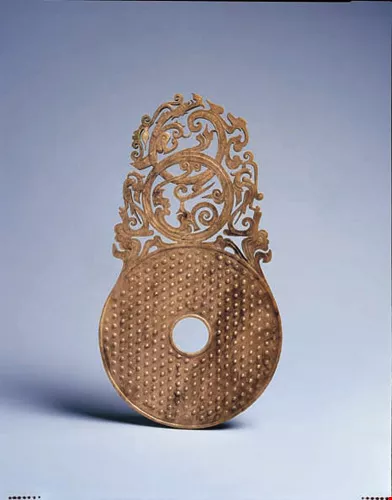
The jade piece at left, with a dragon and phoenix motif, will appear at the pavilion holographically.
Since it "has the audacity" to touch the cultural realm of which China can be most proud, Aurora knows it has to pull out all the stops.
First off, the 3000-square-meter pavilion is designed in an L shape. It looks very unpretentious from the outside, but in fact the design concept comes from the right-hand side of the simplified character oA (li), meaning "rituals" or "etiquette" and is a reference to the ancient description of China as a land of ritual propriety and sincerity. On the rooftop stand two six-meter-tall replicas of the "Jade Man of Hongshan" which suggest "a joyous welcome to visitors from all directions." They are based on a piece held in the Aurora museum collection of a "jade divine beast" with a human form and a dragon face, about 15 centimeters in height and dating back to the Hongshan culture of about 6500 years ago.
In front of the hall is an area for visitors to wait in line, where Aurora has thoughtfully placed two large LED screens displaying scenes of people shopping for jade at various well-known jade markets, including the Temple of the City God in Shanghai, Yaumatei in the Kowloon area of Hong Kong, and the Jianguo Jade Market in Taipei. These bring out the special relationship that Chinese are said to have with jade, not only in "treasuring" it, but also in "understanding" it.
For the entryway, Aurora has drawn on the ancient metaphor equating the qualities of jade with those of the complete man of virtue. It was said by ancient philosophers that jade evokes the "five virtues" of benevolence, righteousness, manners, wisdom, and steadfastness. The entryway, christened the "Corridor of the Five Virtues," shows slides depicting these five virtues in action in modern city life. For example, "manners" is illustrated by an image of citizens on the Bund enthusiastically helping foreigners find their way. "Wisdom" is evoked in a slide of university students passionately discussing their coursework in Shanghai's Century Park. Walking through this long corridor, visitors will clearly understand the connection linking Chinese jade culture with the overall theme of the World's Fair, "better city, better life"-the five virtues extolled through jade can be a civilizing force in urban life.

(above) Visitors will be able to see precious works like this Han Dynasty jade dancer in extraordinary detail thanks to the wonders of holography.
After completing the Corridor of Five Virtues, next comes an 18-meter long "Corridor of Green Bamboo," a verdant oasis that has the effect of "calming the mind" for visitors before they enter the exhibition proper.
Finally, you reach the main event: the five exhibition areas.
In the first, the Aurora Pavilion tells the story of jade's "ancestry" through a 3D multimedia theater presentation of the story of "Nu Wa Repairing the Vault of Heaven," an early Chinese myth. In remote times, the God of Water Gong Gong and the God of Fire Zhu Rong had a fight, and Gong Gong, furious at losing, knocked over one of the pillars holding up Heaven, tilting the world and breaking the sky, and causing continuous disasters. In the legend, Nu Wa, the earliest ancestor of the human race, melted down five-colored stones to repair the sky. Ultimately, however, the colored stones tumbled down and were buried in the ground, becoming the jade that Chinese love so well today.
The second exhibition area illustrates the categorization that has been strongly promoted in recent years by the Aurora museums: material, workmanship, form, and contour.
As Jaimy Tan explains, the "material" refers to the jade itself. Professional carvers apply their "workmanship" to shape the jade into a "form" that will exploit the natural "contours" of color and shading of the material. Only with all four ingredients can the full beauty of a jade artwork be realized.
To allow visitors to understand what jade looks like before it is worked, the hall has six roughly 20-centimeter pieces of raw or uncarved jade on display, in six colors: blue, white, yellow, black, green, and emerald. Visitors can touch the stones and get a sense of their texture, smoothness, and warmth.
The third area displays more than 40 exquisite artifacts. In origin they range from the neolithic Hongshan that existed in northern China over 6000 years ago, right through to the Ming and Qing dynasties. All the pieces are from Aurora's museum collections.
Tan laughs as she says that for security reasons, although the Aurora Pavilion cannot exhibit the originals, the most advanced optical holography (otherwise known as 3D photography) has been used to create 1.8 meter high images of these jade pieces. Visitors can therefore get right up close to rare and priceless works of art like the "Jade Boar-Dragon" from the Hongshan culture (a carving that looks like a combination of a boar and a dragon), a jade clasp from the Warring States Period (an item meant for practical use, with "hollow carving" that shows highly refined and complex workmanship), or the Han Dynasty "Jade Dancer" (an image of a beautiful woman in the midst of a dance, with meticulous carving of the performer's posture and her broad, flowing sleeves).
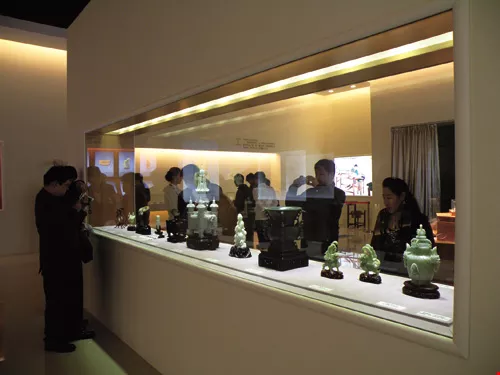
Aurora chairman Chen Yung-tai is renowned as a collector of antiques, including jade. The Aurora Pavilion, which includes many of his treasures, explores jade through four concepts: materials, workmanship, form, and contour. The photo above shows the pavilion's exhibition area #2 during the Expo 2010 trial opening.
The theme of the fourth area is "applied aesthetics." Information is presented on how jade was worn and used by the emperors Qin Shi Huang and Tang Taizong and by Qing-Dynasty empresses. This brings out the connections between jade and the Chinese way of life, and recalls the aphorism, from the Book of Rites, that the superior man always keeps jade with him to remind him of virtue and divert him from unworthiness in his everyday behavior.
Tan relates that in ancient times the nobility often had jade shoulder clasps with cloud motifs, or small jade bangles or beads, embroidered into the lower hem of a long robe or dress. Besides simply looking nice, these objects were also functional, serving to pin clothes together or keep the hems of robes or skirts from flying in the wind. This area of Aurora's pavilion is packed with fun facts of this kind that illustrate the day-to-day practice of historical culture.
The fifth and last exhibition area punctuates the pavilion with a 2.5 ton "jade mountain." This term describes a large lump of jade carved to retain the shape of a natural setting (like a mountain or boulder) with figures of people, animals, or plants.
The provenance of the Aurora Pavilion's "jade mountain" is far from ordinary. In its original incarnation it was a large piece of deep green "Mi" jade from Henan Province, found in the 1960s. (Internationally this type is often known as "Henan jade" or "Mi County jade.") In China, it is considered one of the "four renowned types of jade," alongside Tian (or Hetian) jade from Xinjiang, Xiu (or Xiuyan) jade from Liaoning, and Dushan jade, also from Henan. They are divided by hue into green, red, white, and black varieties, with deep green being the most highly valued.
The work on display commemorates the first-ever ascent of the north face of Mt. Everest, achieved by a Chinese mountaineering team in 1960. A few years after the event, the mainland authorities invited 13 top-level jade sculptors to create this massive piece, which took three-and-a-half years to complete, illustrating the struggle of the team members against the Himalayas. With the jade texture and colors fully exploited to represent mountains and snow, the resulting image is vivid and realistic. When former PRC premier Zhou Enlai visited its exhibition, accompanied by US president Richard Nixon, in 1972, he proclaimed it to be a "national treasure."
In addition, examples of the medals awarded during the 2008 Beijing Olympics, which are inlaid with jade, are also on display here. Visitors can get an up-close and personal look at the stylishness of these first-ever medals in Olympic history to combine the splendors of this precious stone with the precious metals of gold, silver, and bronze.
When you leave the five exhibition areas, there are three "Aurora robots" that can sing, dance, and converse interactively, to say farewell to visitors. "From ancient culture you can walk through to modern technology, putting a perfect ending to the visit." Tan describes this journey through time and space that combines ancient and modern as "certain to provide endless memories."
As the first ever Taiwanese firm to have its own pavilion at a World's Fair, the Aurora Group brings with it a cultural commitment of nearly half a century. Although you won't find a single object on display related to office furniture or equipment, the pavilion's elegance somehow percolates into your brain and creates quite an aura for Aurora. This may very well be the best kind of marketing of all!
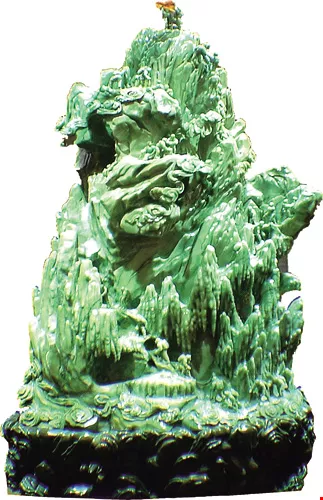
(right) A 2.5 ton "jade mountain" in the Aurora Pavilion commemorates the first ever ascent of the north face of Everest, achieved by a Chinese team in 1960. It is an impressive and evocative work.

@List.jpg?w=522&h=410&mode=crop&format=webp&quality=80)


