From Poppies to Plums--Twenty Years of Agricultural Assistance in Thailand
Chang Chung-fang / photos Vincent Chang / tr. by Sophie S.F. Tuan
June 1994


Formerly the mountain slopes were covered with poppies; narcotic dealers thrived, the people lived a hand-to-mouth existence, and the entire atmosphere of the region was fraught with a sense of mystery and danger. But now the mountain valleys grow an abundance of peaches and plums, and the air is heavy with the fragrance of blossom and fruit, a veritable Garden of Eden.
This is the result of twenty years' implementation of King Bhumibol Adulyadej's agricultural development plan for the mountainous regions of northern Thailand.
International recognition has now been accorded to the distinguished achievements of the Royal Project of Thailand. In 1988, this project was awarded the Ramon Magsaysay Award, popularly known as the Asian equivalent of the Nobel Prize.
The Ramon Magsaysay Award Foundation of the Philippines distributes five prizes every year, and the International Cooperation Prize is one of them. The Committee proclaimed:"Through joint cooperation between Thailand and the international community, the Royal Project of Thailand has not only reduced world production of narcotics, but also promoted the peace and prosperity of northern Thailand."
Under the call to action of King Bhumibol, the Royal Project of Thailand obtained international support. Apart from the support provided by the United Nations Food and Agricultural Organization, the United States, New Zealand, Japan, and other countries, the Republic of China has more than any other country become the partner in growth of northern Thailand for over twenty years.
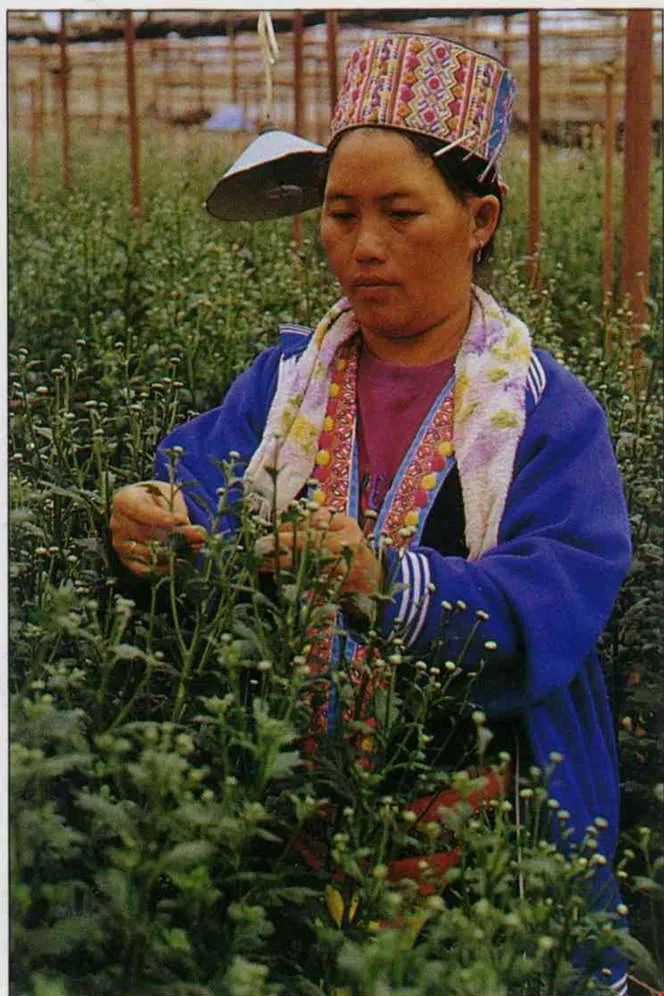
The industrious minorities, under the direction of Taiwan specialists, have grown chrysanthemums.
The noxious effects of the poppy
The region of northern Thailand extends for over a thousand miles, and approximately half a million minority people from ethnic groups such as the Hmong, Yao and Lahu, as well as immigrants from mainland China, live there.
In the past, the mountain inhabitants earned their living by hunting or--to a far greater degree--by growing poppies. The cultivation of the poppy here has had a long history. It is said that it started with the prohibition of opium under Lin Tse-hsu, when growing poppies was halted in southwest China. A portion of the minority tribes crossed hill and dale to settle down in northern Thailand, and started to grow the poppy again in the mountainous areas.
According to Thailand's The Universal Daily News, the volume of the narcotics trade in northern Thailand has been over 150 tons per year.
However, such a vast volume of narcotics trade not only did not succeed in making the inhabitants of the mountain areas wealthy, it resulted in serious destruction of the mountain environment.
The inhabitants of northern Thailand adopted the scorched earth method of planting. The poppy cultivation drained off a great deal of the earth's fertility, and they were unable to grow successive crops on the same patch of soil. Fields had to be rotated. In addition, minority people used to cut down a good many trees in order to build houses, so that what was originally a stretch of virgin forest in northern Thailand had become a bald mountain with burnt out patches in between.
There is a saying in these parts: In the deep forest, who knows where Burma ends and Thailand begins? The answer is very simple--if you see a patch of green forest in the mountains, then it is sure to belong to Burma. The treeless area belongs to Thailand.
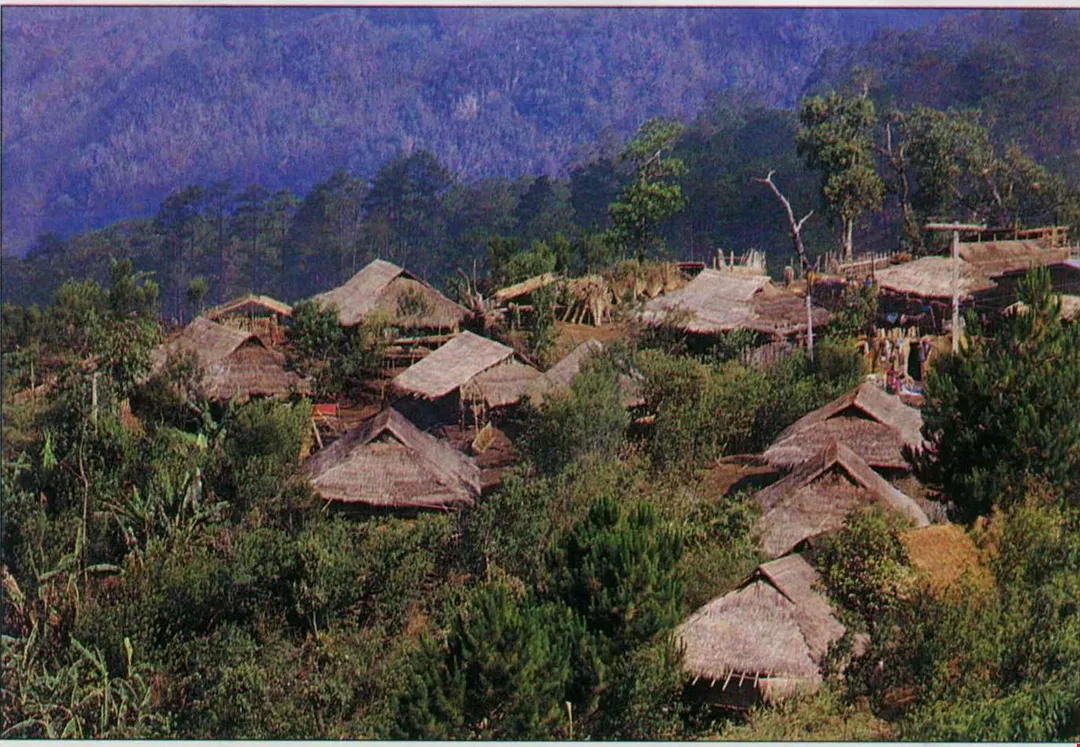
The mountainous areas of northern Thailand are inhabited by over five hundred thousand minority people. The photograph shows Lo Li Village, Doi Ang Khang, located at the Thailand-Burma border. This village still possesses traditional buildings and living conditions.
Poppy paupers?
King Bhumibol of Thailand is perceived by his subjects as a just and loving monarch. The King demonstrates his diligence and love for the people by frequently making excursions to remote districts in order to understand the lives of the poorer people.
Over twenty years ago, King Bhumibol learned from the mouth of an impoverished Hmong tribesman in northern Thailand that the cultivation of poppies brought in the same amount of revenue as the cultivation of the indigenous peach for use as a pickle.
The price of narcotics is very high, and one frequently hears of people going bankrupt once addicted. Is there really no difference between the cost of cultivating the poppy and the cultivation of the cheap local peach? Not only was the king astonished, even ordinary people regard it as incredible.
As a matter of fact, the inhabitants of northern Thailand know how to grow poppies, but they do not understand the art of processing them into heroin. Nor do they have distribution networks. They remain confined to selling their unrefined crop at the cheapest possible rate to drug procurers who enter the mountains to buy. Hence, the ones who earn big money are those who process and distribute the opium. Those mountain people who grow poppies still struggle for daily sustenance.
In 1969 (year 2512 according to the Buddhist calendar), the King of Thailand instigated a program for the agricultural development of northern Thailand, in the hope that the poppy could be replaced by other cash crops. This could effectively kill two birds with one stone--the eradication of poverty, and the elimination of dope peddling.
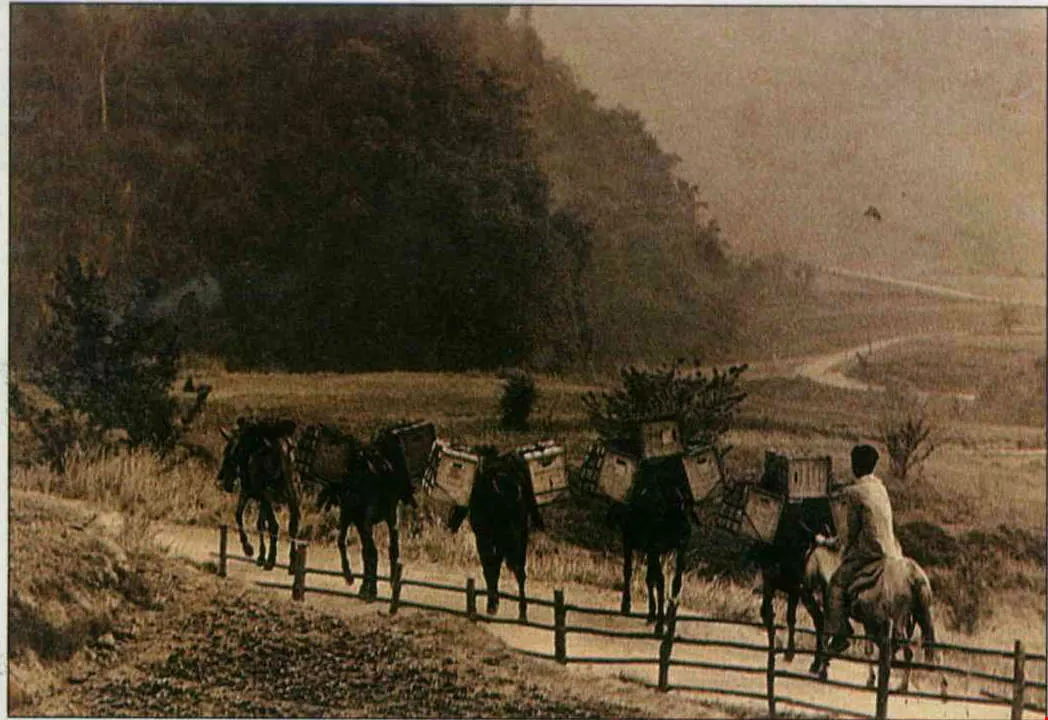
During an earlier epoch, the mountains of northern Thailand were not easily accessible. The local inhabitants depended on either their two feet or the donkey for traveling. Doi Ang Khang, for example, requires a seven-hour hike into the mountains. (Photo courtesy of the Royal Project of Thailand)
Agricultural Aid for Thailand
After having heard about the successful experiments long since carried out in Taiwan in the growth of temperate zone fruit trees in Taiwan's subtropical climate, Prince Bhisatej Rajani personally headed a delegation of over ten professors from the agricultural college, on a visit to the Lishan (literally "Pear Mountain") area of Taiwan, where the cultivation of temperate zone fruit had been successfully carried out. Wherever they went they saw tree branches heavily laden with fruit, and the war veterans who tended the orchards were so prosperous that they had married local "apple" brides. Prince Bhisatej was greatly impressed. He decided to request the aid and guidance of Taiwan, in the hope that the hills of northern Thailand could also become a second "Pear Mountain."
The Thai king, with the assistance of then ROC Ambassador to Thailand Sheng Chang-huan, requested our country's aid and assistance.
In the following year, 1970, the Vocational Assistance Commission for Retired Servicemen appointed Sung Ching-yun, the deputy director of the Mt. Fushou orchard at that time, to go in person to northern Thailand to make an on-the-spot investigation, in order to implement a plan of assistance.
Mr. Sung had already visited Lishan in 1957 and had had over ten years of experience planting fruit trees. He declared that if you counted on growing temperate zone fruit trees in a tropical zone such as Thailand, then what you depended on was not so much astute agricultural skill and technology, as the ability to exploit the temperature differences in the mountainous areas.
Sung Ching-yun points out that you can only grow peaches in an area which enjoys over 600 hours of temperature under 7°C per year. Over 800 hours are required to grow pears, and over 1000 hours before you can grow apples. Only in a climate with low temperatures in winter and high ones in summer can deciduous fruit trees prosper.
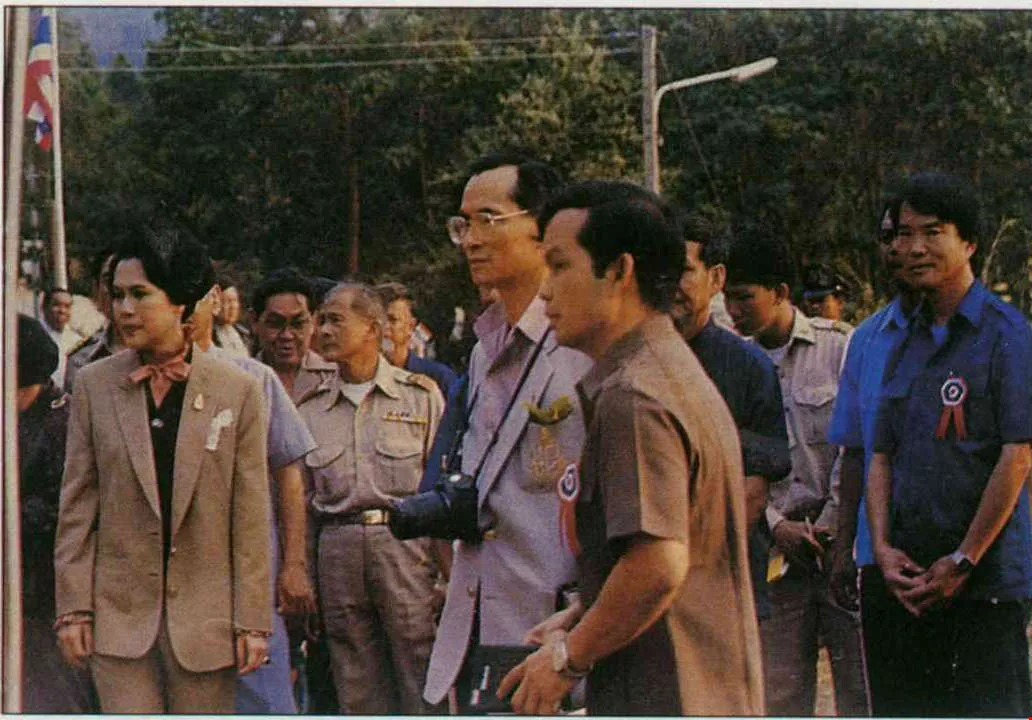
King Bhumibol is trying hard to change the harsh living conditions of the mountain residents through the introduction of cash crops. The photograph shows the Thai King and his queen touring the Doi Ang Khang nursery. (Photo courtesy ot the Royal Project of Thailand)
Starting from scratch
However, when Sung Ching-yun first arrived in northern Thailand, he discovered that this region possessed no information on either climate or local customs. With no prior knowledge, Sung Ching-yun was compelled to grasp circumstances through on-the-spot investigation.
In order to locate a suitable area for growing fruit trees, Sung Ching-yun boarded the royal helicopter and spent nearly 20 days in aerial reconnaissance of the mountains in northern Thailand. He studied forest distribution, investigated every high elevation ecosystem and "interviewed" many mountain area residents: "How many rainy days are there in the year? Is there any frost?" "What do you wear when the weather gets to be the coldest?" "And what do you wear when the weather is hottest?" Sung Ching-yun could deduce from this data what the weather conditions were really like.
When he arrived at Doi Ang Khang (Ang Khang Mountain), Sung Ching-yun was in a position to make all sorts of predictions either by careful examination of the triple leaf pine, or the horse tail pine, or by listening to the local inhabitants' accounts of the climate and the frequency of frost, all of which led him to deduce that Doi Ang Khang's weather was closely akin to Taiwan's mountains around Wusheh and Kukuan. Whereupon he decided to select Doi Ang Khang as the experimental region for growing temperate zone fruit trees.
In 1971, the Republic of China donated its first batch of saplings--10,000 in all--to Thailand. The kinds of trees included: the Hengshan pear, Yingko peach, plums, apples, persimmons, loquats, and so on.
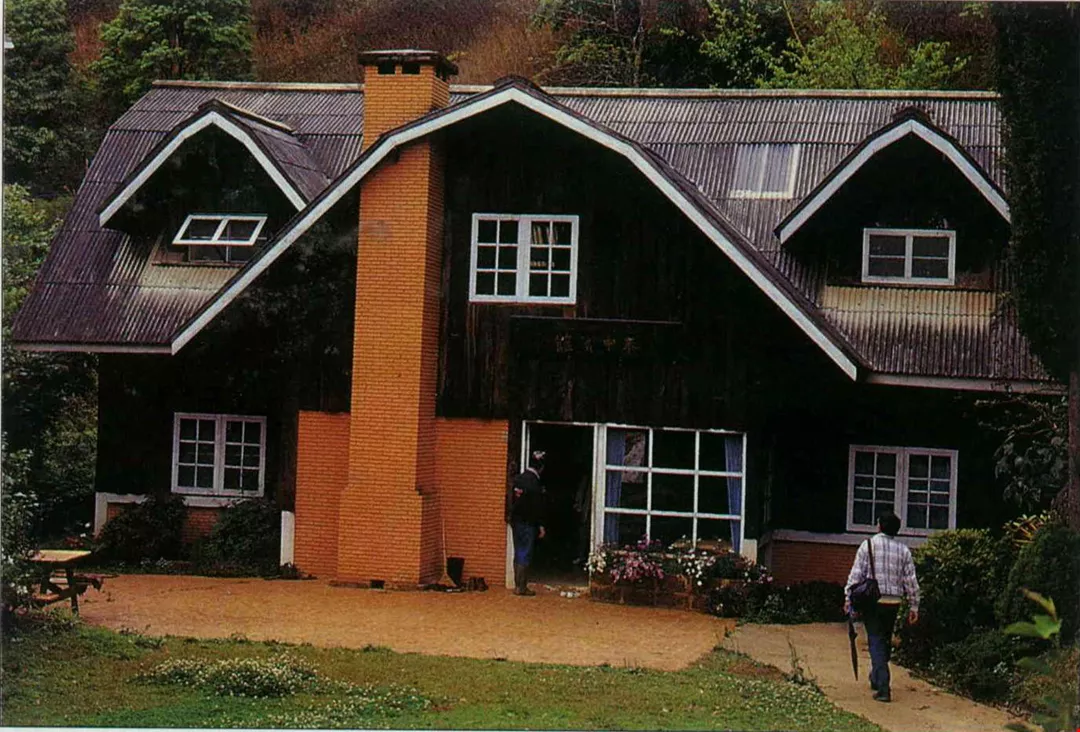
Apart from supporting the Royal Project of Thailand, the ROC has erected buildings such as the Tehlin Hotel and the Sino-Thai Hotel at the Doi Ang Khang nursery to commemo-rate the friendly relations between the two countries.
"Papa Sung"
However, the first batch of fruit tree saplings met with an untimely fate, and the problem was that the orchards were not adequately supervised or taken care of. Sung Ching-yun relates that under those conditions, either the weeds grew to be taller than the trees in the orchard, or else the saplings were devoured by cattle. "The success rate of the original 10,000 saplings was only one in three," much to the distress of Sung Ching-yun.
It was too obvious that they could not continue in this way, and so it was decided that agricultural know-how should be developed and promoted through the construction of a model nursery. In 1973, the ROC's legislature formally passed a resolution to assist the Royal Project of Thailand for a four-year period, and it was at Doi Ang Khang that they started the first model nursery.
Sung Ching-yun headed a team of three agricultural technicians, and they planted 6,000 fruit tree saplings at Doi Ang Khang. Using those fruit trees which had been successfully planted and grown as the mother trees, they fostered and nurtured an increasing supply of saplings, part of which was distributed to local farmers.
In the mountains of northern Thailand, a succession of farms was established, based on the model of the Doi Ang Khang nursery. Sung Ching-yun, together with his team of experts, rushed from orchard to orchard in order to dispense supervision and aid. They launched themselves into technical guidance work, such as teaching the farmers how to prune the branches, and the art of fruit thinning.
Under the instructions of the agricultural team, the mountain inhabitants started to plant such cash crops as plums and peaches. Their revenue was better than growing poppies, and so it came about that everyone switched crops and adopted the planting of fruit trees.
With the passage of time, the consultant Sung Ching-yun's reputation spread far and wide like the fruit trees themselves. In northern Thailand his fame became ubiquitous. The sobriquet "Papa Sung" was known to practically every inhabitant of northern Thailand. Even the Thai King would affectionately call him "Papa Sung."
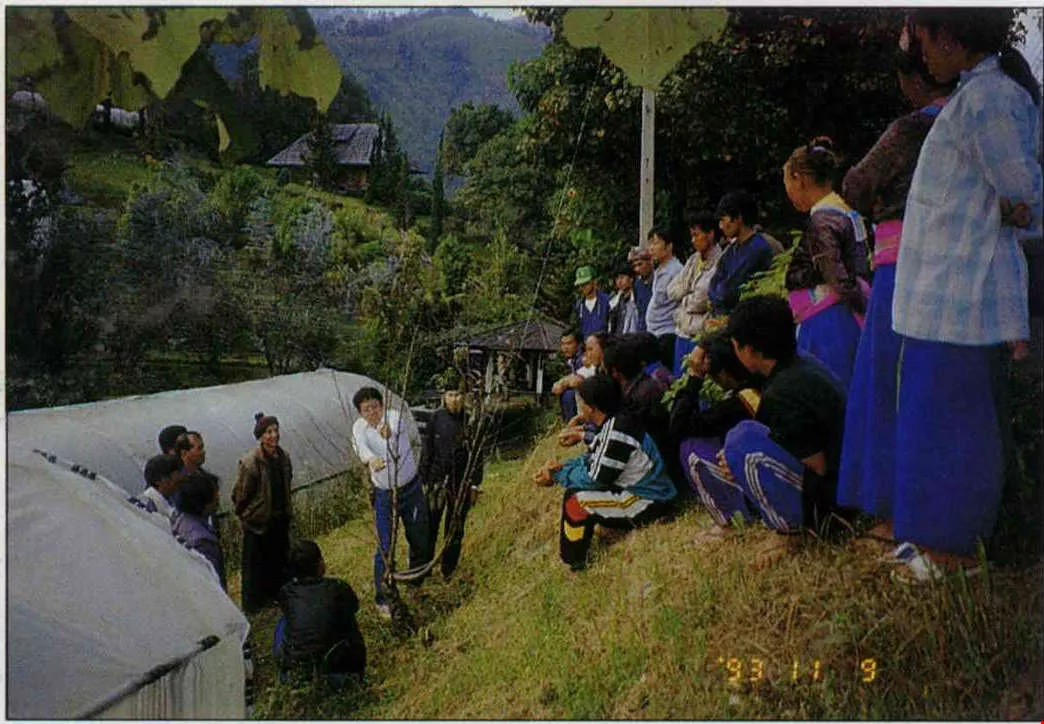
The ROC's agricultural team is stationed on a long-term basis in northern Thailand in order to transmit and direct all kinds of agricultural techniques. The photograph shows fruit tree expert Chien Chi-yueh demonstrating to local farmers the art of pruning branches. (Photo courtesy of Chien Chi-yueh)
A new broom sweeps clean
Sung Ching-yun retired at the end of last year, and as of now, the ROC team of agricultural experts in Thailand is comprised of Chien Chi-yue, technical advisor for the fruit tree division, and Shu Wei-lieh, technical advisor for the forestry division.
"Ahjan Chien" and "Ahjan Shu" are the respectful appellations applied by the Thai people to Chien Chi-yue and Shu Wei-lieh, for in the Thai language it means "Scholar Chien" and "Scholar Shu."
As a matter of fact, apart from the ROC experts stationed in Thailand, the Royal Project of Thailand also enjoys the enthusiastic participation of a good many professors from Thailand's agricultural colleges and other local specialists. But because they lack experience in growing trees, pragmatically speaking they don't quite measure up to those agricultural specialists with over ten years of experience in growing fruit trees at Lishan.
Professor Vithaya Suriyapananont of Kasetsart University's department of horticulture in Bangkok states sincerely, "When it comes to deciduous fruit trees, without the help of Taiwan's agricultural team, we would never have succeeded!"
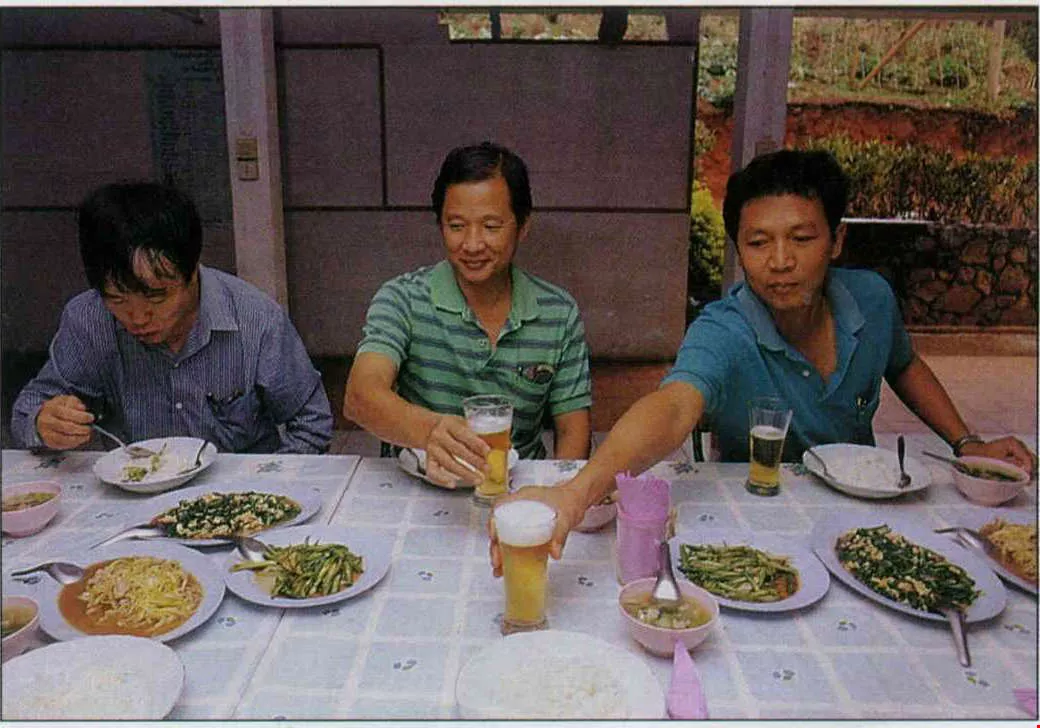
The asparagus, scallions, and leeks shown on the dinner table are all derived from Taiwan stock. They have all been successfully grown in the Banda nursery.
Years of hardship and difficulty
"A new broom sweeps clean," Chien Chi-yue declares. A concept expressed by Thais might not exercise the same impact as that very same concept expressed by a "new broom."
These specialists who have earned the respect of the Thai people are fully entitled to it. For they have toiled shoulder to shoulder, day after day, with the local inhabitants of the mountain regions.
Chien Chi-yue, now 48 years old, was only 26 when he first came to Thailand. He was still at the age of romance. At that time Doi Ang Khang was primitive and undeveloped, and every type of food and medicine could only be brought to the mountain by the monthly helicopter visit. Chien Chi-yue laughingly declared that every time the helicopter was held up due to inclement weather, he grew desperate at not receiving his love letters; this has still left a strong impression on him.
Because of a dearth of material goods, the pioneering agriculturalists led an extremely hard life in this mountainous region. Sung Ching-yun once had to put up with a diet of salted rice for months on end. And Chien Chi-yue, when he simply couldn't find anything to eat, would resort to chewing the pistil and stamen of banana flowers.
The material hardships they suffered made their family members at home sorrowful and anxious. Questions of safety caused them to be doubly anxious. Chien Chi-yue recalls that in the early days, life in northern Thailand was very insecure. The area was haunted by roving bandits, and the agricultural technicians would always carry a gun when entering the mountains.
In order to reassure his mother and girlfriend, Chien Chi-yue, after staying for over a year in northern Thailand, returned home on his mother's orders. And he laughingly added that it was not until his girlfriend became his wife, and after a new baby had been born, that his mother finally consented to let him go once again.
At the present time the experts on this agricultural team speak the local language so well that they have even been mistaken for bona fide Thais.
The members of our agricultural team are not only fluent in Thai, they are also quite used to indigenous cooking, and they easily penetrate into the life of the local people. Shu Wei-lieh has even become an expert practitioner of the Siamese dance.
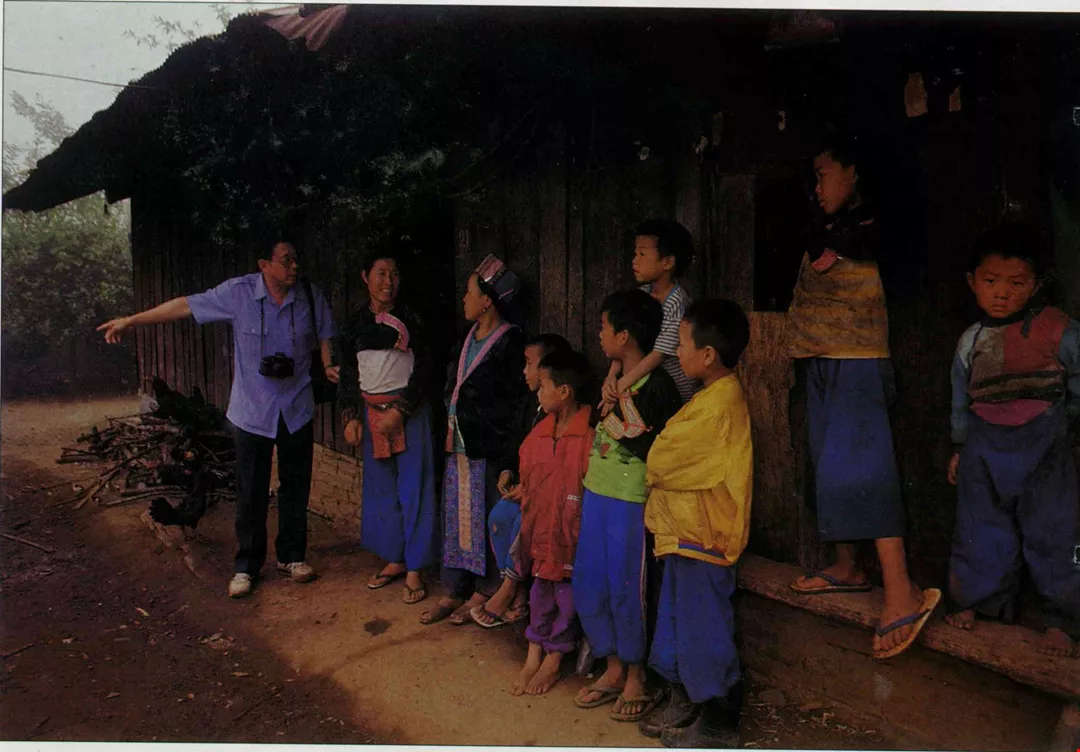
This Hmong couple has five children and two grandchildren. The male host says that his father came from China and could speak Chinese. Formerly both he and his father planted poppies. Nowadays they have switched to other flowers, whose purpose and profitability are utterly different.
In search of know-how abroad
Through their combined efforts, the Royal Project of Thailand continued to expand beyond fruit trees to gradually encompass vegetables, forests, bamboo groves, flowers and nursery plants, all of which belong to the agricultural program.
For many years now, the agricultural technology team has aided Thailand to establish over 30 stations for the propagation of farming techniques in many important mountain districts in northern Thailand.
Amongst them, Inthanon has developed into a nursery center for flowers and plants, because its transportation facilities provide greater convenience, and at the same time it enjoys an abundant supply of water.
At Inthanon there are over 200 people who are engaged in the planting and growth of flowers. In order to save on natural resources, over ten flower farming households gathered together to construct a large-scale greenhouse with tier upon tier of flowers in bloom, a veritable s of flowers which is most pleasant to behold. It was more easily constructed, because Thailand does not suffer from typhoons.
These greenhouses have introduced the choicest selection of flower seeds from every country in the world for experimental planting. Thai citizens have also come to Taiwan to study botanical nursery techniques. For example, in such places as Yuanlin and Tienchung, chrysanthemums have been electrically illuminated, in order to improve on natural sunshine and thus increase their height and prolong their blossoming season. All these techniques are becoming widespread here.
Apart from dispatching an agricultural team to Thailand for a prolonged sojourn, aid to the Royal Project of Thailand also consists of receiving annually 15 to 20 Thai agricultural and technological trainees, for short-term practical training in the Republic of China.
For over 20 years, several hundred people have already come to Taiwan in turn to observe and to put into practice what they have learned. Hence we have trained quite a few technical experts for Thailand.
Bunyoung, the head of the Inthanon farm and homestead, came to Taiwan 14 years ago to receive training for two months. He declared that he studied liowers for two months in Taiwan, and he learned how to thin fruits and the art of pollination, techniques of which he was previously ignorant. "All this is very useful," he said.
A male member of the Hmong tribe, aged 36, with five children and two grandchildren, said that after switching to growing flowers, life had become far easier. With satisfaction in his voice he remarked, "We used to plant opium, but it was on an on-again-off-again basis. Nowadays we have six flower beds cultivated on a rotational basis. So we have work all the year round, and our income is higher than before."
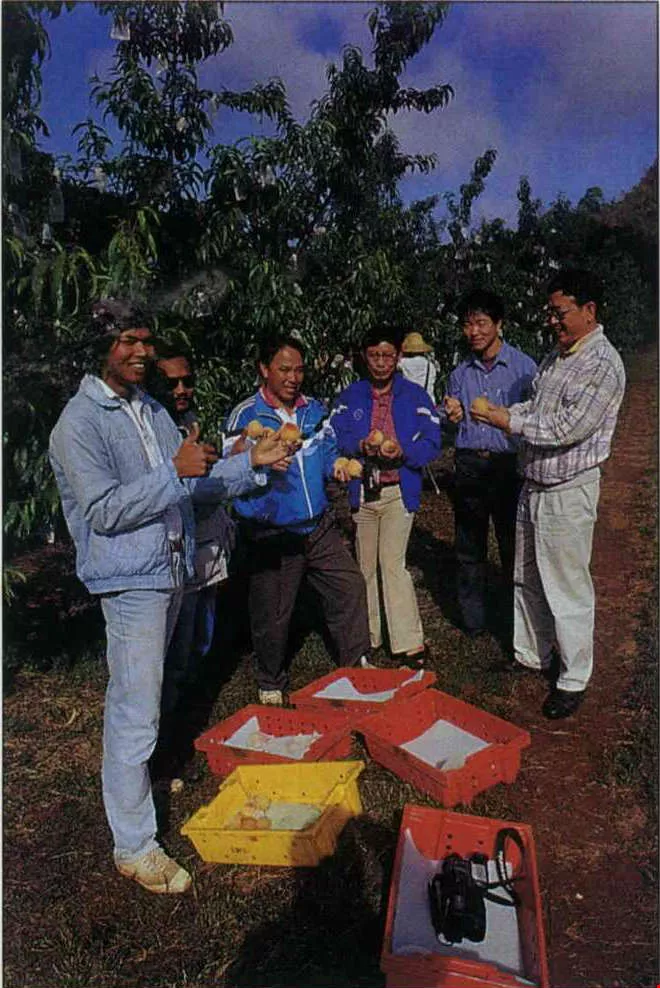
Peach harvest falls at the end of March. The trees are heavily laden with fruit, and the fruit pickers, hardly able to conceal their joy, are all smiles.
Contributions of the unknown worker
An interlude which our last ambassador to Thailand, Ma Chi-chuang, takes great pleasure in relating, is one which shows how truly outstanding were the contributions made by our agricultural technological team, for they not only earned the respect and love of the local inhabitants of northern Thailand, they also exerted a direct and positive influence on relations between the Republic of China and Thailand.
It is reported that once the Thai King led in person a corps of foreign diplomatic personnel on a visit to Doi Ang Khang. On the way home, he invited the diplomats to a banquet at his estate in Chiang Mai. Ma Chi-chuang, who was not the senior member of the diplomatic corps, and who was furthermore a newcomer to his job, was quite unexpectedly seated at the right hand of the king, the seat of honor. Whereupon the American ambassador, Kentner, softly whispered in Ma Chichuang's ear, asking him, "What secret does Your Excellency possess to receive such royal treatment from the King?" Ambassador Ma replied: "Sincerity of heart, plus the joys and hardships of the joint work put in by our specialists who worked shoulder to shoulder with the Thai people."
But the international situation can change overnight. And this makes relationships between countries even more complex. For a good many reasons, Thailand established diplomatic ties with the Chinese Communists, and broke off their diplomatic relations with the ROC.
At this juncture, when Ambassador Ma Chi-chuang was about to leave his post, the King of Thailand specially invited him to dinner, and expressed with great emotion in his voice, "The ties between one country and another are no more solid than a sheet of paper, which can be scrapped at any time, but the deep sentiments of friendship cannot be so lightly disposed of."
Thailand's Prince Bhisatej once publicly explained at an international agricultural conference that the agricultural assistance from every country was limited to either financial aid or the appointment of chosen specialists to draft a research report. Only the Republic of China's specialists came in person to northern Thailand to help the Thais grow vegetables and fruit. This proved to be of enormous benefit to the daily lives of the local inhabitants of this district.
We also take care of our own people
The ROC has been only too happy to help rid the world of narcotics, and to help a friendly country in the development of their agriculture. However, for over a score of years, the ROC did its best to assist in the implementation of the program, involving an annual donation of several million dollars in financial aid, technology and manpower, for reasons of a more confidential nature.
Sung Ching-yun, now retired, reveals that the other reason for supporting the Royal Project of Thailand was to use this opportunity to take care of over 50,000 retired KMT of ficers and soldiers in northern Thailand.
Shu Wei-lieh states, "The recipients of our guidance were not only the minority tribespeople of northern Thailand; we also had to consider and include our own refugees." Taiwan's agricultural team could justifiably do so within the framework of the general direction and guidance given to the Royal Project. Their motivation to work is higher, which makes them more efficient, and hence they can often serve as model farmers for the minorities. Ever since 1982, when agricultural workers for the Free China Relief Association arrived in northern Thailand, they have subsequently shouldered the responsibility for helping the refugees.
Contributions in a foreign land
Every event has a conclusion. In recent years because of the greatly increased development program within Taiwan, financial resources have been decreased, and the ROC's international assistance plan has been correspondingly affected.
At the beginning of this year, the Ministry of Foreign Affairs announced that assistance for the Royal Project of Thailand, which has lasted for over twenty years, may well be terminated by the end of next year. Hsieh Mei-ling, section chief of International Cooperation Department of the Council of Agriculture, has however said that in the interests of prudence, the Council of Agriculture will organize an inspection team with concerned departments and go to northern Thailand in order to gain an understanding of existing conditions before they come to a concrete decision.
At the end of last year, Thai Prince Bhisadej expressed on the occasion of the retirement of Sung Ching-yun, "Papa Sung, who has worked shoulder to shoulder with our people for the development of the mountain areas for over twenty years, is now going to retire. And our farms have lost a friend and a father. We wish him happiness and the best of health, and we hope that he will recall at all times, that we in the past were proud to have helped the mountain tribes, so that the world has witnessed a reduction of opium and the reduction also of the destruction of Thailand's forests and water resources."
Just as Prince Bhisatej has said, the Republic of China has made a contribution towards the development of that faraway mountain area of northern Thailand.
[Picture Caption]
p.122
Although the poppy is beautiful, it is harmful to human beings. In the past, the mountain slopes of northern Thailand were covered by that I insidious flower.(Photo by Chien Chi-yueh)
p.123
The industrious minorities, under the direction of Taiwan specialists, have grown chrysanthemums.
p.124
The mountainous areas of northern Thailand are inhabited by over five hundred thousand minority people. The photograph shows Lo Li Village, Doi Ang Khang, located at the Thailand-Burma border. This village still possesses traditional buildings and living conditions.
p.125
During an earlier epoch, the mountains of northern Thailand were not easily accessible. The local inhabitants depended on either their two feet or the donkey for traveling. Doi Ang Khang, for example, requires a seven-hour hike into the mountains. (Photo courtesy of the Royal Project of Thailand)
p.125
King Bhumibol is trying hard to change the harsh living conditions of the mountain residents through the introduction of cash crops. The photograph shows the Thai King and his queen touring the Doi Ang Khang nursery. (Photo courtesy ot the Royal Project of Thailand)
p.126
Apart from supporting the Royal Project of Thailand, the ROC has erected buildings such as the Tehlin Hotel and the Sino-Thai Hotel at the Doi Ang Khang nursery to commemo-rate the friendly relations between the two countries.
p.127
The ROC's agricultural team is stationed on a long-term basis in northern Thailand in order to transmit and direct all kinds of agricultural techniques. The photograph shows fruit tree expert Chien Chi-yueh demonstrating to local farmers the art of pruning branches. (Photo courtesy of Chien Chi-yueh)
p.127
The asparagus, scallions, and leeks shown on the dinner table are all derived from Taiwan stock. They have all been successfully grown in the Banda nursery.
p.128
This Hmong couple has five children and two grandchildren. The male host says that his father came from China and could speak Chinese. Formerly both he and his father planted poppies. Nowadays they have switched to other flowers, whose purpose and profitability are utterly different.
p.129
Peach harvest falls at the end of March. The trees are heavily laden with fruit, and the fruit pickers, hardly able to conceal their joy, are all smiles.
@List.jpg?w=522&h=410&mode=crop&format=webp&quality=80)

@List.jpg?w=522&h=410&mode=crop&format=webp&quality=80)


@List.jpg?w=522&h=410&mode=crop&format=webp&quality=80)

@List.jpg?w=522&h=410&mode=crop&format=webp&quality=80)
