

The World Health Organization estimates that some 1.4 billion people around the world are overweight, with fully one-third of those being obese.
With the obesity “contagion” spreading, nations fearing dire consequences are working to ward off the epidemic. The US is treating the problem as a matter of national security and planning a public health response; Denmark and Hungary have begun levying taxes on food-related products linked to obesity, including salt, sugar and fats; and the Canadian province of Quebec has passed legislation barring food and beverage makers from advertising to children under the age of 13.
Taiwan has been affected as well. Our citizens, once completely devoted to their health and beauty, have in recent years become “Asia’s fatties.” The Bureau of Health Promotion (BHP) at the Department of Health began treating the problem two years ago with a “smart eating, happy moving, daily weighing” campaign and the establishment of a hotline for consultations on weight (0800-367-100).
People in Taiwan nowadays ask one another about their weight nearly as frequently as they greet each other in the age-old manner with “Have you eaten?”
The truth is that Taiwanese, young and old alike, are carrying a few extra pounds nowadays. In fact, a 2009 Ministry of Education survey showed that some 25% of Taiwanese elementary-school students and 27% of middle-school students were either overweight or obese. Studies done from 2009 to 2011 on factors contributing to the health crisis similarly found that an average of 38.5% of adults over the age of 18 were overweight or obese.
Last year, the BHP released an even more startling finding: 51% of Taiwanese men and 35% of Taiwanese women have BMIs above recommended levels. Those figures make us the fattest nation in our region.
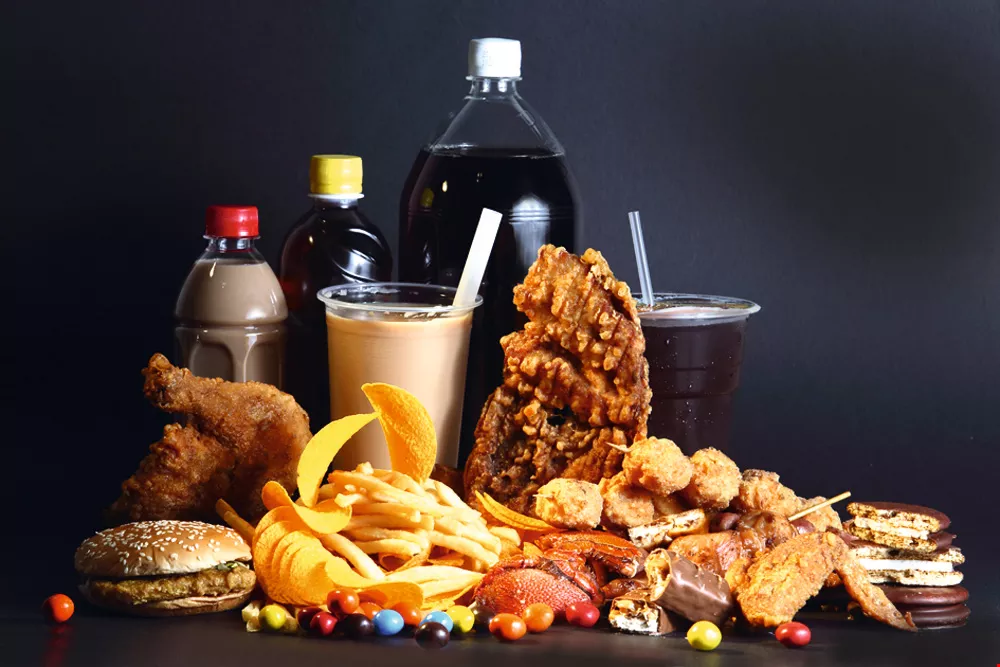
Though they may be tasty, foods that are high in calories exact a heavy toll from our bodies. Fresh fruit and vegetables offer a healthier, if blander choice.
“We don’t look fat, do we?” Many people just don’t get how we’ve become Asia’s fatties.
While we were busy feasting over the lunar new year holidays, Taiwan’s television networks broadcast a BBC report on our love affair with dieting. The report noted that tasty, unhealthful snacks are available virtually everywhere in our cities, and argued that our love of eating and relatively sedentary lifestyles are likely one of the causes of our increasing obesity.
Photographer Harold Tseu is a case in point. Tseu, who moved back to Taiwan from the US three years ago, found his self-control slipping after his return to our “foodie nation.”
When Tseu lived in the States, he weighed in at a relatively svelte 80 kilograms or so. But after returning to Taiwan he found himself constantly tempted by the plethora of tasty treats awaiting him every time he left his apartment. As a result, his weight quickly ballooned and his blood pressure shot up. He jokes now that “all that extra weight was ‘Made in Taiwan.’”
Tseu tried several diets, bought exercise DVDs, and even sought help from a doctor of traditional Chinese medicine, all to no avail. Six months ago, he began taking classes at a weight-loss studio. By controlling his diet and walking 10,000 steps per day, over a 49-day period he lost 8.5 kilograms, shrank his waist by 7.5 centimeters, and lowered his blood pressure from 162/106 to 120/80. As a result, he no longer needs to take blood pressure medication.
His efforts have given him a keen appreciation of the law of conservation of matter: if he overeats or skimps on his walking, his weight goes right back up again. Though tasty foods haven’t entirely lost their allure, he now does a better job of making adjustments elsewhere to keep off the pounds he worked so hard to lose.
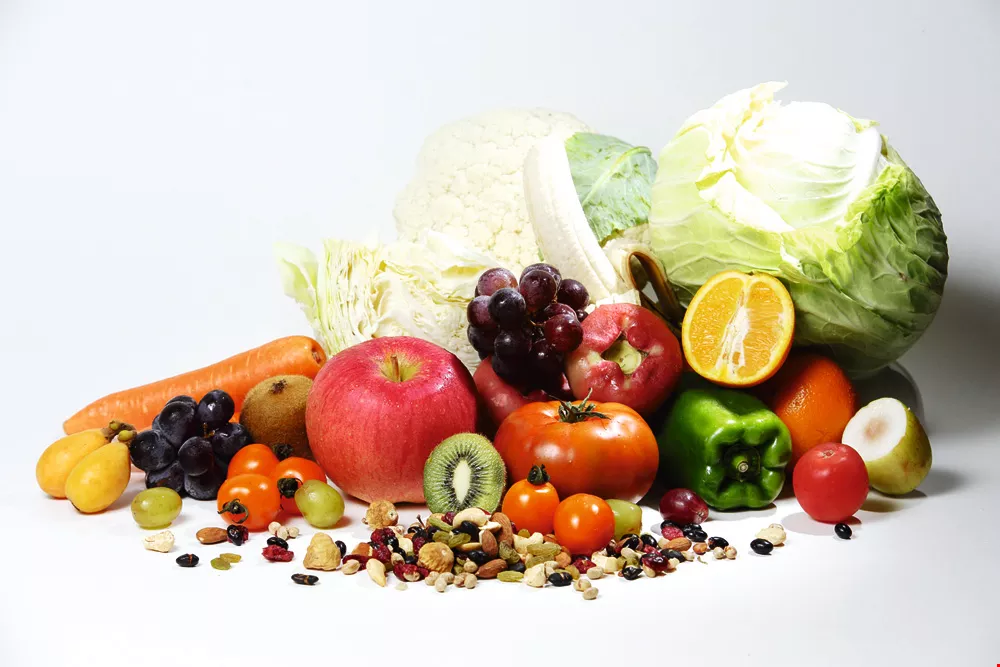
Though they may be tasty, foods that are high in calories exact a heavy toll from our bodies. Fresh fruit and vegetables offer a healthier, if blander choice.
Given our genetic predispositions and lifestyle changes, weight gain is almost unavoidable in the modern era.
Pan Wen-harn is a research fellow with both the Institute of Population Health Sciences at the National Health Research Institutes and the Academia Sinica’s Institute of Biomedical Sciences. She explains that a sedentary lifestyle results in the burning of far fewer calories, and that our hectic, sleep-deprived modern lives interfere with the hormones that regulate our desire for food. The result is that our bodies are slow to tell our brains that we’ve eaten enough, causing our bellies to grow.
Pan notes that other factors are contributing to Taiwan’s recent weight gains, including excessive working hours, confused biological clocks, and inadequate sleep, which are all more pervasive in Taiwan than in many other nations. Making matters worse, the fried and sweet foods we enjoy are more fattening than the raw foods beloved by Japanese and the pickled items popular in Korea.
How fat is “fat?” Objective measures offer the best answer.
The WHO uses body mass index (BMI, which is a person’s weight in kilograms divided by the square of their height in meters), as well as waist size. It defines “overweight” as a BMI in excess of 25 and “obese” as a BMI of greater than 30. Using waist size, the WHO’s thresholds are 88 cm for overweight and 102 cm for obese. But scientists have learned in recent years that the BMI thresholds for Asians are somewhat lower, at 23 and 25.
Pan’s research shows that at every BMI level, Taiwanese have a higher prevalence of high blood pressure, diabetes, gout, and metabolic syndrome than white Americans. What this means is that though Taiwanese look slimmer than Westerners, we are quicker to suffer the repercussions of obesity.

Taiwanese musical duo OneTwoFree and South Korean fitness queen Jung Dayeon have jointly produced a music video promoting exercise.
Obesity is a disease, and fat can be fatal.
Chiou Shu-ti, director-general of the Bureau of Health Promotion, says that seven or eight of the top 10 causes of death in Taiwan are linked to obesity. Chiou notes that it does as much harm as smoking.
The nations of the world are already paying a heavy price for obesity. The United States is home to more than 72 million obese adults, and the medical expenses resulting from that obesity cost the country some US$147 billion per year, an amount equal to 6–10% of total healthcare expenditures.
Fu Tsu-tan, a research fellow with the Academia Sinica’s Institute of Economics, has calculated that healthcare expenditures linked to excess weight and obesity in Taiwan amount to roughly 2.9% of total healthcare spending. In 2009, for example, obesity-related medical expenditures totaled NT$26.4 billion.
Research by Chu Nain-feng, president of Taitung Hospital, has shown that the medical expenses of overweight people being treated for metabolic-syndrome-related diseases average 2.7 times more than those of people of normal weight.
Body fat results from the consumption of excess calories, but calories don’t equal nutrition. In fact, fattening foods are typically nutritionally unbalanced. The Nutrition and Health Survey in Taiwan has shown that the prevalence of overweight and obesity is especially high among residents of Taiwan’s mountains and our east coast, debunking the widespread notion that people living in the mountains are healthier.
Pan says that residents of the mountains and the east coast tend to consume little fruit, few vegetables, and few dairy products, while eating an excess of organ meats, fatty meats, sugary drinks and alcohol. A decline in the popularity of hunting has made matters worse. With activity levels now no higher than those in urban Taiwan, these areas are suffering obesity rates even higher than those found in our cities.
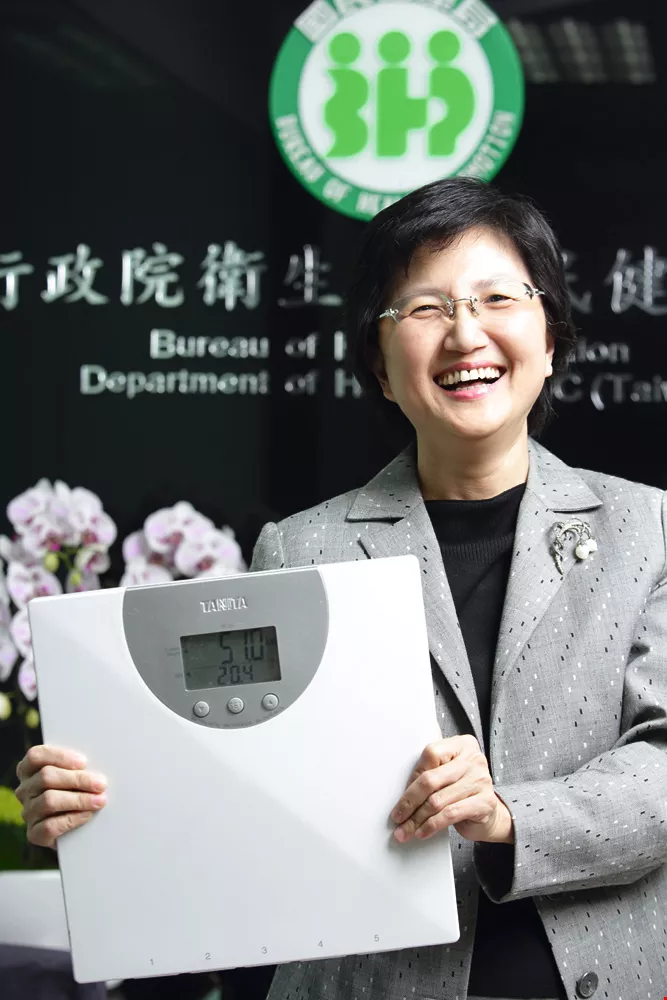
“Smart eating, happy moving, daily weighing.” The Bureau of Health Promotion’s Chiou Shu-ti is urging Taiwanese to live healthier lives.
With Taiwanese getting progressively heavier, dieting is surging in popularity.
In a 2012 AC Neilsen survey of dieting in 56 nations and territories, some 60% of the more than 500 Taiwanese respondents thought they were overweight. In addition, 66% of respondents were dieting, a figure not only well above the global average of 53%, but also the highest among the nations surveyed.
Dieting has become a national pastime in Taiwan, but many of us find that the more we diet, the heavier we get. The problem is that the dieting world is brimming with myths and misconceptions.
Some people claim that Taiwanese are gaining weight because we don’t like to exercise. A 2012 study on exercise in our cities from the Sports Affairs Council found that nearly 70% of us don’t get regular exercise. “The base metabolic rate for adults is relatively low, meaning we are dependent upon exercise to lose weight.” Chiou says that only 31% of Taiwanese men meet the basic standard for exercise—three times per week, 30 minutes each time—and that just 20% of Taiwanese women do. Both figures are far below those found in Europe.
In fact, it’s hard to lose weight through exercise alone. A January 2013 study in The New England Journal of Medicine entitled “Myths, Presumptions, and Facts about Obesity” identified seven myths, six presumptions, and nine facts about weight loss.
Wynn H. T. Pan, a Taipei City councilor and pharmacology professor at National Yang Ming University, says that while most people believe that they can lose weight by exercising, research shows this to be untrue. On the other hand, exercise certainly does improve one’s health.
“Exercise can help you maintain your weight, but doesn’t do much to help you lose it,” says Pan. He explains that on average you have to burn 7,700 kilocalories to lose a kilogram of bodyweight. Yet, for a 50-kilogram person, an hour of walking burns just 77.4 kcal and an hour of cycling fewer than 75 kcal. Worse, a grueling half-hour jog doesn’t even burn all the calories contained in a single piece of cheesecake.
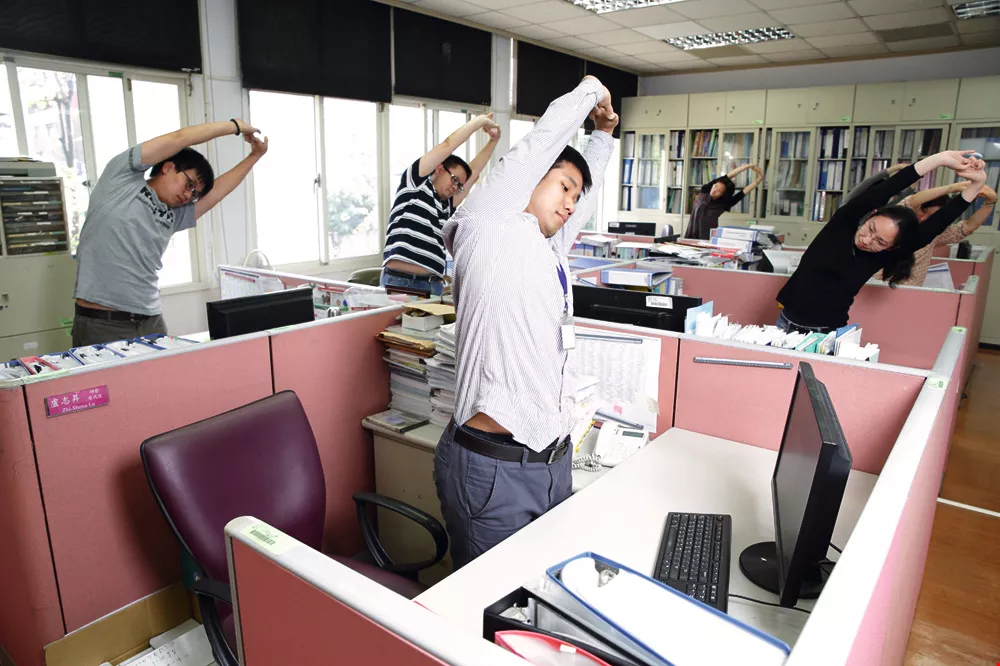
The BHP practices what it preaches: bureau workers devote a few moments to physical activity every morning and afternoon.
So how should you go about losing weight? There are a million approaches—the apple diet, the meal-substitution diet, the high-protein diet—but the results are usually the same: poorer health and weight regain.
Pan offers the Atkins diet as an example, explaining that long-term consumption of a diet focused primarily on meat increases the risk of cardiovascular disease, stroke, and cancer. Eating less or fasting to lose weight leads to vitamin and amino acid deficiencies that may result in depression. People who cycle between cutting back and binge eating find it even harder to control their weight. A study by the American Psychological Association actually found that two-thirds of dieters end up heavier two years on than they were before dieting.
Low-calorie and meal-substitution diets are effective over the short-term, but extremely hard to maintain. Once people go back to their normal lifestyles, they almost immediately gain back all the weight they lost. It’s the same story with diet drugs. Setting aside their side effects, appetite suppressants and fat blockers work while you’re taking them, but once you stop, your old eating habits reemerge and you quickly regain lost pounds.
Those of us in Taiwan have still another option: traditional Chinese medicine (TCM).
Liau Wan-rung, a physician with the Yurong TCM Clinic who has used thread-embedding therapy to help more than 100,000 patients lose weight, says that thread embedding is, like acupuncture and moxibustion, a modality aimed at stimulating the body’s meridians. The differences are that it’s more convenient for busy people and that it stimulates the meridians for a longer period of time.
Thread embedding can also reputedly bring about spot reductions in weight. The process involves using an acupuncture needle to embed a bit of catgut, which the body can absorb, in a meridian. But Liau stresses that thread embedding is only an aid, that patients must accompany it with changes to their diets and a regimen of Chinese medicine appropriate to their personal physiology if they are to adjust the functions of the zang-fu (the organs as perceived by TCM) and lose weight in a healthy fashion.
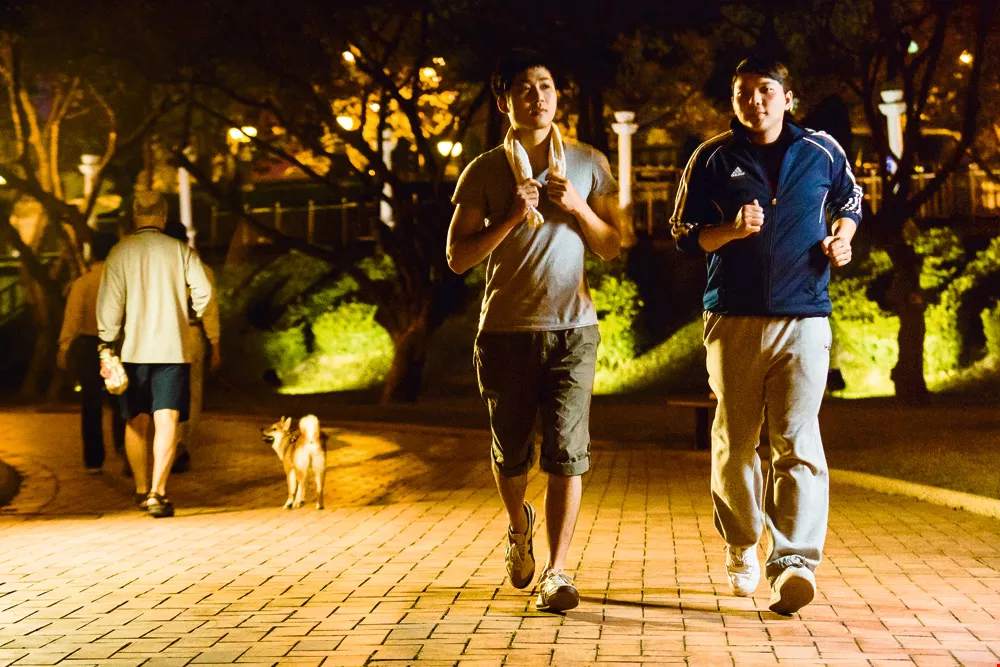
Exercise is awesome! It improves both your health and your mood.
In 2011, the BHP rolled out a healthy weight-management program aimed at aiding Taiwanese to lose weight in a healthy manner.
The BHP’s clarion call attracted the participation of some 720,000 people at businesses, schools, and hospitals, and involved the collective loss of 1,104 metric tons of excess bodyweight. Some 51,000 of these participants also succeeded in lowering their BMIs into the normal range. In 2012, the number of participants increased to 780,000 who lost a total of 1,137 tons, or an average of 1.5 kilograms per person.
“Groups are powerful,” says the BHP’s Chiou. She adds that the bureau used the idea of losing a kilogram per person as a hook, and says that people using the right approach will usually lose more than just one.
That said, “The number of kilograms isn’t important.” Chiou says the real highlight of the event was that tens of thousands of people got their BMIs back into the normal range, reducing their risk of disease and their need for medication.
But simply encouraging the public to eat less and be more active is unlikely to lead to long-term weight loss.
“Changing the environment is crucial,” says Chiou, explaining that weight gain is in many respects brought on by the environment. Taiwanese advertisers have agreed to a self-regulatory arrangement under which they avoid targeting children with advertisements for fried or fatty foods by not running them before 9 p.m., but the rest of our environment still needs improving.
The fact is that weight management is a lifelong project.
Pan says that healthy weight loss requires finding a new life balance, one involving different eating habits, and possibly cycling or walking to work instead of driving. The key is adjusting your way of life such that you take in fewer calories and burn more.
There are no shortcuts to weight loss: you have to eat a balanced diet and learn to count the calories you consume every day.
“The decision to lose weight is one of the most important you’ll make in your life,” says Harold Tseu, who is keenly aware of the benefits of doing so. “Don’t hesitate: do it now!”

While it seems that most of us are dieting these days, we still need to learn how to lose weight in a healthy fashion.

@List.jpg?w=522&h=410&mode=crop&format=webp&quality=80)
@List.jpg?w=522&h=410&mode=crop&format=webp&quality=80)


