A Sweet and Sour Life--The Fate of Hong Kong's Immigrants
Vito Lee / photos Chuang Kung-ju / tr. by Geof Aberhart
July 2007


The 1981 Hong Kong film Sweet and Sour Cops features as its protagonist an immigrant named A-Tsan, who has made the arduous journey into Hong Kong from China. Once in Hong Kong, he works hard to succeed, but meets with laughter and derision for his rural ways and ineffective methods.
A-Tsan soon came to represent all Chinese immigrants in the minds of Hong Kong people. Since the 1997 handover of the territory to China, such new immigrants have grown rapidly in number, and are currently estimated at over half a million people. Coupled with the 10 million mainland tourists pounding the pavement in Hong Kong each year, this phenomenon has led to Hong Kongers having to try and erase the memory of A-Tsan and find a way to live in harmony with their mainland brethren.
Dreaming of a better life, A-Tsan's Chinese compatriots have long journeyed to Hong Kong in search of a place where the streets are paved with gold. Over the past few decades, most of these new arrivals have set themselves up in the Sham Shui Po district, a 9.5-square-kilometer section of northwestern Kowloon. Chinese immigrants now account for about 20% of Sham Shui Po's population of 365,000.
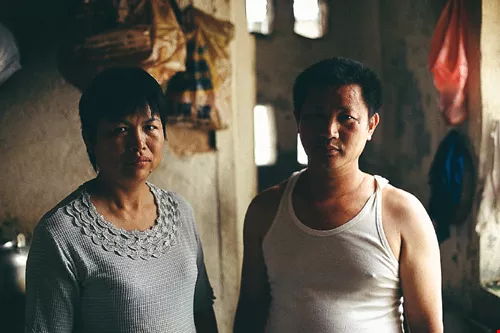
However, their journey toward a better life is generally a hard, rocky one. For years before obtaining residency, one Mrs. Chen, terrified of the high cost of living in Hong Kong, relied instead on constantly securing two-way permits to visit her husband in the territory.
After working out what her husband was earning and what it was costing him to live in Hong Kong, Mrs. Chen began trying to get him to move back to Zhuhai. Despite experiencing an economic boom in recent years, Zhuhai, which neighbors Macao, is still substantially cheaper to live in than Hong Kong.
"But every time I mentioned this, he'd just say, 'It's not that easy! I can't just pack up and leave!'" says Mrs. Chen.
Unable to convince her husband, Mrs. Chen eventually applied for and received a single-entry permit--the Hong Kong equivalent of a residency visa--in 2003, and traveled across the Pearl River delta to Hong Kong with their two children, then aged 12 and 16. Not long after they settled in the territory, the family welcomed a new member, a third child now aged three.
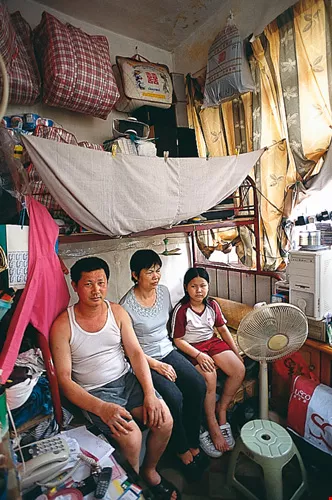
Using the edge of the bed as a "lounge" (above), and gingerly typing at the computer while balancing on a bunk bed (below)--this is the starting point for many immigrants to Hong Kong living in "partitioned homes."
A rude awakening
Once these immigrants make it in, they soon find themselves confronted with two major problems--money and work. The Chens were no exception.
To make ends meet, the family relied on Mr. Chen's pay as a construction worker--just under HK$5000 (NT$21,000) a month. Even in Sham Shui Po, where the average income is the lowest of Hong Kong's 18 districts at only HK$14,000, this was a paltry sum. Comparing this with the HK$3 million or more that foreign managers in Hong Kong make each year, the painful truth behind Hong Kong's reputation as a "laissez-faire paradise" becomes all too apparent.
"Rent here is a bit over HK$1000 a month, and although the children get free education, each semester we have to pay HK$3000 or more for books and uniforms," says Mrs. Chen, her voice lowering as she discusses the difficulty of providing food and shelter for her children.
The Hong Kong Special Administrative Region government defines "new immigrants" as immigrants to Hong Kong who have lived in the SAR less than seven years and do not have permanent residency.
"To most Hong Kongers, though, if these immigrants don't leave Sham Shui Po, they'll always be A-Tsan, always be 'newcomers,'" explains Sze Lai-shan of the Society for Community Organization (SoCO), which has a long history of immigrant counseling services. A first-generation immigrant herself, Sze has seen innumerable new arrivals get set up in Sham Shui Po, put down roots in Hong Kong, and then gladly leave the district. On the other hand, she says, "Almost half of them gradually lose hope and resign themselves to being stuck in Sham Shui Po for life."
Sham Shui Po, known as "the Harlem of Hong Kong," is a place that immigrants have a love-hate relationship with. Like Tucheng and Sanchung in Taipei County, Sham Shui Po was an early industrial center: in the 1960s, when light industry in Hong Kong was at its peak, the district was home to a number of textile firms, clothing factories, canneries, and food wholesalers. But as Hong Kong's economy grew and evolved, this once-prosperous area began to fall into decline, with the number of factories down more than half from its peak of over 6000.
As a result, according to a survey of local immigrants by SoCO, the majority of immigrant families are left living on a single source of income, with over 60% of these relying entirely on construction work or low-paid jobs such as security or cleaning.
There are also plenty of female immigrants looking for work, but according to SoCO's figures, unskilled senior high school graduates accounted for 75.8% of female immigrants to Hong Kong in 2006, and their lack of education makes work opportunities scarce. According to SAR government data, the more than 26,000 women who migrated to Hong Kong to join family or spouses in 2006 earned an average monthly income of just HK$1760.
Such financial issues have caused urban renewal in Sham Shui Po to lag behind the rest of Hong Kong, and have also led to many local poor and immigrants cramming themselves into "cage homes" ("rooms" with walls of iron bars and only big enough for a single bed) and "partitioned homes," creating a side of Hong Kong many find hard to believe could exist in the prosperous territory.
Ten minutes by foot from Mrs. Chen's public housing estate live Mrs. Fang and her family, who moved from Zhongshan, Guangdong Province, and for whom life is even harder.
Entering their four-decade-old apartment building and stepping into a stairwell barely wide enough for one person, the first thing you see is a mottled wall on which is painted "Drug-taking and defecation prohibited." Reaching the second floor, you see a 115-square-meter apartment divided by thin partitions into seven units, each housing two to six people. This is a so-called "partitioned home."
Each evening, as the Fangs come home from work and school, the floor's only bathroom and kitchen are quickly filled up as the six families--18 people in total--take their turns using them. "By the time everyone's finished cooking, it's already time for bed," complains Mrs. Fang.
In such difficult circumstances, even the children have learned to make every dollar count. To save the HK$8.80 return bus fare, the Fangs' eldest son instead walks 45 minutes to and from school each day. At weekends, virtually no-one even goes out. Though only eight subway stations away, the bustle and prosperity of Hong Kong Island seems like another world.
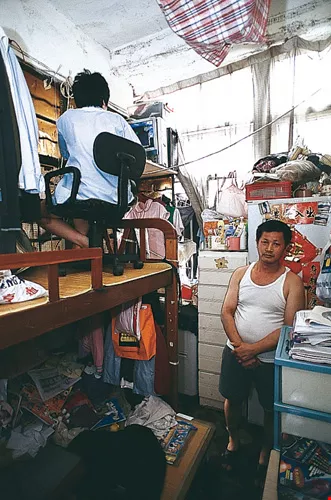
Using the edge of the bed as a "lounge" (above), and gingerly typing at the computer while balancing on a bunk bed (below)--this is the starting point for many immigrants to Hong Kong living in "partitioned homes."
The invisible district
Faced by an influx of migrants from China, the former British colonial government of Hong Kong put in place a policy allowing residency to any Chinese citizen who entered Hong Kong.
In 1983 the colonial government extended this to those coming to join family, and decided that after seven years in the territory, these migrants would become eligible for permanent residence and Hong Kong passports. Since taking over in 1997, the SAR government has followed suit, granting as many as 150 single-entry permits a day, which equates to over 50,000 new immigrants settling in Hong Kong each year, or over 500,000 in the past decade.
"China's emigration policy is exactly what one would expect from an authoritarian regime," explains Sze Lai-shan. "Migrants to Hong Kong are granted permission to come here by China, which they're leaving, rather than by Hong Kong, which they're moving to." However, with increased numbers allowed in, what was once a 15-20 year wait for "cross-border couples" has dropped to only five or six years, saving much heartache for many people.
This increasing number of new residents has left both the government and the people of Hong Kong struggling to adjust to the new reality.
For one, although requirements were relaxed in 1999, public housing is still a problem, as construction can't keep pace with demand, meaning that applicants for housing still face an average wait of five years or longer. While they wait, they have to find what they can and make do with a decidedly below-par lifestyle in cage homes or partitioned homes at rents far higher than for public housing.
And with regard to the Comprehensive Social Security Assistance--which includes an unemployment benefit--that immigrants can apply for, Sze says, "The SAR government is not handling it as well as the British did." Previously, those who lived in Hong Kong for only a year could apply for CSSA benefits, but since 2004 immigrants must have lived in Hong Kong for seven years and gained permanent residency before they're eligible, except in extreme cases like domestic violence.
Meanwhile, the past three years have seen Hong Kong's economy rebound, further widening the gap between rich and poor, and new immigrants have been the first to suffer. In 2004, HKSAR chief executive Tung Chee Hwa publicly stated that the rich-poor gap was a major threat to Hong Kong, and proposed plans to establish a committee to support the poor and a project to expand housing construction, in an effort to address the closely linked issues of immigration and poverty. However, with Tung's public dressing-down by Beijing and subsequent resignation, these plans came to nothing.
Such economic issues aside, near-constant discrimination also continues to be a thorn in the side of new immigrants.
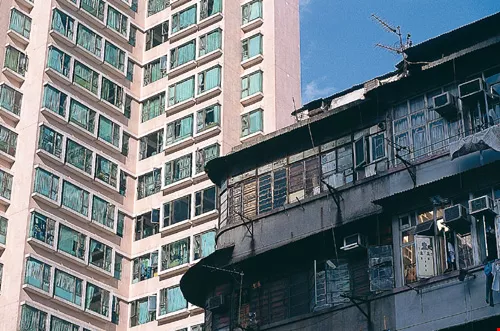
(above:) In front of a brand-new building, this old building of partitioned homes that house new immigrants is gradually falling apart. (below:) On the bustling streets, new immigrants work transporting goods to make ends meet. Behind Hong Kong's glitz lie many heartbreaking and tragic stories.
Watching nervously
"The label of 'new immigrant' is a hard one to shake. It even followed me into Hong Kong University," says "Lisa," who now works as a manager for a Hong Kong-based international airline. In 1983, Lisa and her mother were beneficiaries of the relaxation of restrictions on immigrants seeking to join family in Hong Kong. Lisa's parents, already struggling to get by in Sham Shui Po, gritted their teeth and sent Lisa to study at CCC Ming Yin College, and English-medium school, in an effort to help her integrate into Hong Kong life. After graduating from high school in 1990, Lisa lived up to her parents' hopes and tested into her first-choice school, Hong Kong University.
HKU, which prides itself on continuing in the British tradition, also continues to uphold English high society's emphasis on class, including assigning students to dormitories based on their backgrounds. The dormitories compete with each other academically and on the sports field, and are also often visited by former residents, who maintain close contacts with their old dorms.
"But you have no say in which dorm you're in. It's all down to your family's social and economic standing," says Lisa, whose assignment to the relatively undistinguished and remote R.C. Lee Hall is a clear source of discontent for her.
Outside the school grounds prejudice is even more readily apparent. "The most obvious aspect is the language the media use," says Pang Ka Fat, a visiting professor at the Chinese University of Hong Kong's School of Journalism and Communication and former professor at Taiwan's National Cheng Chi University. With A-Tsan fading from Hong Kong's collective memory, the new discriminatory euphemisms of choice most commonly seen in the Chinese-language media are "northern girl" and "mainland girl."
Additionally, despite the more than HK$20 billion that the 10 million tourists from the mainland bring into Hong Kong each year, clashes between local businesspeople and mainland tourists are still commonplace.
"In Hong Kong, English is well regarded and Cantonese will get you a warm reception, but the moment you start speaking Mandarin, the shopkeepers just about stare daggers at you," says one Taiwanese author currently staying in Hong Kong of her experience there.
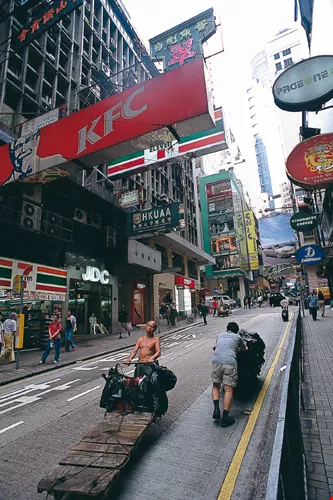
(above:) In front of a brand-new building, this old building of partitioned homes that house new immigrants is gradually falling apart. (below:) On the bustling streets, new immigrants work transporting goods to make ends meet. Behind Hong Kong's glitz lie many heartbreaking and tragic stories.
Confronting discrimination
From immigrants to tourists, through finances and language, a kind of "us versus them" mentality has developed in Hong Kong, and sometimes this is evident even at the highest levels. Last year, an official from the SAR government publicly stated that Hong Kong's local population was growing by less than 10,000 per year, while over 50,000 people were coming in from China, and that he believed that these immigrants would destroy the quality of life Hong Kongers enjoyed and lean on the government for housing and social welfare assistance, essentially filching funds from the hard-working people of Hong Kong.
Needless to say, words like this are neither kind nor accurate. China's competitive attitude and ability have already left their mark on the modern world, and these newcomers who have made their way to Hong Kong and who fight to make a living on their own are too strong to be held down. Regardless of the complex feelings the people of Hong Kong have toward China, the SAR relies on China for its survival and enjoys the benefits of China's power as a production hub and potential as a thriving market.
Hong Kong not only craves access to the Chinese market, but has long coveted the immense pool of skilled talent there. To go some way to sating this demand for highly skilled people, in 2005 Hong Kong established special opportunities for three newly defined classes of immigrant, "professional," "elite," and "investor." Additionally, each year Hong Kong's top schools, including Hong Kong University, make excursions to schools in each of China's major cities, such as Beijing's Number Four High School, to scope out talent for their own student bodies. So far, however, results have not been particularly outstanding, with so-called "Chinese exchange students" numbering only in the thousands.
Looked at in this light, says Pang Ka Fat, "The discrimination in Hong Kong against immigrants of the same ethnic and linguistic heritage isn't really a matter of ethnic discrimination so much as values-based and class discrimination. This is something that both sides are going to have to work together to overcome."
At its core, perhaps this discrimination is simply a reflection of the nervousness and resentment of the people of Hong Kong: are not those purebred "new masters" of China who can now call the shots in Hong Kong both politically and economically, the very same A-Tsans that they looked down upon so much, though now repackaged with a different class background?
Even with the handover ten years past, integration between Hong Kong and China is still somewhat problematic. If Hong Kong is to continue to reach out to China, it must strive to learn all it can from the lessons of the past decade.
Using the edge of the bed as a "lounge" (above), and gingerly typing at the computer while balancing on a bunk bed (below)--this is the starting point for many immigrants to Hong Kong living in "partitioned homes."
@List.jpg?w=522&h=410&mode=crop&format=webp&quality=80)

@List.jpg?w=522&h=410&mode=crop&format=webp&quality=80)
@List.jpg?w=522&h=410&mode=crop&format=webp&quality=80)


@List.jpg?w=522&h=410&mode=crop&format=webp&quality=80)
