Calling All Tree Doctors! Combating the Brown Root Rot Menace
Chen Hsin-yi / photos Chuang Kung-ju / tr. by Josh Aguiar
July 2011


The grisly tragedy caused by the sudden collapse of an old termite-ridden tree on the slopes adjacent to the Alishan Forest Railway in late April this year was an urgent reminder of the public threat posed by infirm trees.
Even more worrisome than termites, though, is the more insidious brown root rot disease, which according to projections infects over 7000 trees nationwide, including over half the trees on school campuses. Moreover, one out of every four trees over 50 years old is host to this life-threatening scourge.
In fact, last year in Taipei City alone there were six cases of trees toppling without warning. Some of them appeared to be healthy trees with supple branches and abundant leaves, while others went down unprompted by even the slightest breeze. Such trees are urban time bombs set for an unknown time.
The demise of these green giants makes us consider: is it the trees themselves that are unhealthy, or is it the environment or perhaps our attitudes and lack of awareness?
"There are doctors for sick people, veterinarians for sick animals. Who takes care of sick trees?"
This is the question that has consistently frustrated Huang Li-yan of the agricultural management branch of Wu-jie Township, Yi-lan County. But one day in May 2011, her hopes were finally fulfilled when the county government's anointed tree expert, Shirley Chen of the Fu-Tien Tree Healing and Conservation Foundation, arrived to diagnose an ailing banyan tree with a red ribbon tied about its trunk located in the interior court of the police station.
The police officer who made the report recalled that at the end of last year the aged tree that everyone affectionately terms "grandpa" was producing only a scant covering of sallow-looking leaves. This year it managed to put forth new buds at the rather late stage of April, but even then there was no mistaking its sickly disposition.
Chen needed but three minutes inspecting the tree to nail down her diagnosis: the notoriously intractable brown root rot disease. The proof was the thin layer of yellow-to-amber mycelium covering the roots on the side closest to the wall. When she scraped away blighted portions of bark with a small shovel, there was no immediate gushing of milky liquid, as would be expected from a healthy tree. "What's happening is that the conducting tissues of the outer bark have died, so that the tree is losing its ability to convey water and other nutrients upwards from the roots to the rest of its body," she explained.
She pointed to a spot on the trunk about one meter from the ground. "The mycelium has already climbed this high, which means that the roots and inner wood have been seriously eroded. Brown root rot infects from the bottom up and from the inside out." After determining the pathology, she gave a prognosis: "There isn't any cure for brown root rot yet; the only treatment is to amputate the infected roots and stems. I'm afraid that this tree is too far gone to have any real chance of survival. I recommend tearing it out and thoroughly sterilizing the infected soil before replanting."
Seeing the dejected expressions on the faces of her listeners, she quickly added, "Old trees possess a will to live that rivals people. When they know they're seriously ill, they gird up all their strength in an attempt to overcome. Just look at these new buds here-you know that this tree has fight in it yet!"
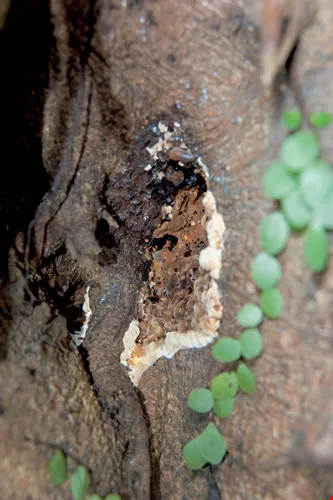
(above) Fu-Tien Tree Healing and Conservation Foundation "tree doctor" Shirley Chen's diagnosis is the notoriously intractable brown root rot disease. (below) The telltale symptom is the mycelium layer clinging tightly to the roots by the base of the tree. As the disease progresses, it changes from white, to yellow, to amber, and finally to brown.
It was around 3 a.m. on a summer morning back in 2007.
The residents of Wu-gong Borough in Puli Township, Nan-tou County who lived near Feng-xiang Park were jolted out of their slumber by a deafening sound accompanied by convulsive shaking. At first, people swore it was an earthquake, but when they rushed out of their homes, they soon discovered the true cause. A Formosan sweetgum more than 20 meters high, deceptively robust in appearance, had suddenly cracked from the roots and toppled over, caving in the roofs of three nearby houses and obliterating two cars. No one was injured, thankfully, but the terror of that night was not easily forgotten.
The park has 17 native sweetgum trees that experts estimate to be at least 450 years old, all of which appeared tall and straight, hale and robust. However, in recent years they all seem a little bit diminished. The experts have detected the presence of brown root rot, but despite this ominous development, older folk in the community are opposed to any action that could disturb tree spirits. In the meantime, the trees' condition continues to deteriorate while the local government drags its feet.
Immediately after this near-catastrophe, Shirley Chen, then an assistant at the Council of Agriculture's Forestry Research Institute, conducted an onsite investigation. She explains that root rot infection starts in the network of roots beneath the soil. Though the roots may be completely rotten, everything from the tree base upwards may continue to appear healthy. But as the tree becomes more top-heavy, the likelihood of a fall greatly increases. "This particular incident wasn't just an accident-it was public hazard that the local government needed to prevent," she says.
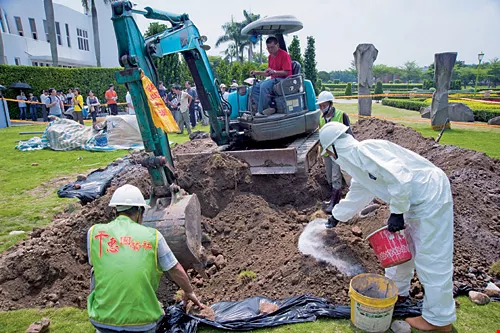
The Taipei City Parks and Street Lights Office is currently treating a golden rain tree at Xinsheng Park for brown root rot. First they remove the blighted wood and roots before fumigating the soil. On the left we see a branch-carefully labeled and identified with a red band by the project supervisor-with the fungus deliberately left on it, to be inserted into soil for experimental purposes.
What exactly is brown root rot? What makes it capable of such catastrophic consequences?
As a researcher at the Division of Forest Protection of the Taiwan Forestry Research Institute, Fu Chuen-hsu has devoted countless years to the prevention of brown root rot. He describes the disease as root decay caused by fungus (as opposed to bacteria or viruses), which ultimately causes the demise of the entire tree. In Taiwan, it occurs most prevalently in low-lying areas. It is capable of contaminating a wide range of hosts-thus far, there have been reports of more than 100 different species.
Brown root rot disseminates in two ways. The first is direct contact between the root of a contaminated tree and a root of a healthy tree, which explains how a tree on a school campus and a tree on the street on the other side of the school wall manage to get infected at the same time. The other method occurs when a tree trunk or some other dead wood rots to the point that the fungus begins to produce fruiting bodies, which make spores that are then dispersed by the wind.
Fu stresses that brown root rot is an extremely aggressive and malignant fungus, because it is at once both a pathogenic and a rotting agent. The former capacity is what compromises the conducting tissues' ability to transport water and nutrients; the latter guts the cellulose and lignin in the middle of the wood, precipitating an internal havoc that is not casu-ally observable. This is why it so easy for an infected tree to be blown over by a strong breeze, or even to fall without warning.
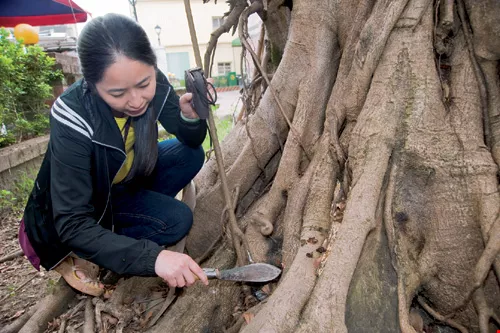
(above) Fu-Tien Tree Healing and Conservation Foundation "tree doctor" Shirley Chen's diagnosis is the notoriously intractable brown root rot disease. (below) The telltale symptom is the mycelium layer clinging tightly to the roots by the base of the tree. As the disease progresses, it changes from white, to yellow, to amber, and finally to brown.
Fu explains that the disease originated in the tropical latitudes of Africa and Asia. The earliest reported case in Taiwan was in 1928, when the Japanese colonial authorities noticed a foreign strain of fungus afflicting fruit trees in Kao-hsiung and specimens at the tropical botanical garden in Heng-chun. Their suspicions turned immediately to plant varieties brought to Taiwan from the South Pacific.
Until the last decade or so, brown root rot in Taiwan did not seem a particularly pressing concern. When the Forestry Bureau launched its Forest Health website back in 1999, only a few dozen cases were reported annually. The public at large was generally ignorant of its presence. "Because the onset of the disease is quite slow-six months to two years-accurate diagnosis requires lengthy monitoring. Often times researchers would either misdiagnose it or else fail to take it seriously," he says.
Unlike "high-value" botanical pursuits like horticulture and floriculture, the study of tree parasites remains a relatively unpopular field. Monitoring and researching all the various tree diseases and related complications is a large task that the Division of Forest Protection at the Forestry Research Institute carries out unassisted. The Forestry Bureau is responsible for devising policy to control and prevent the spread of tree illness. But these two entities' hands are tied when it comes to dealing with the local county and township authorities scattered across the island-they can inform and advise, but their power falls far short of dictating policy.
The growing number of root rot cases has intensified the need for action. In 2008, legislator Tien Chiu-chin began calling for more aggressive approach. Labeling the disease "the H1N1 of the plant kingdom," she urged the Council of Agriculture to adopt the strategy used in the past to combat red imported fire ants, by forming a special cross-departmental committee to draft policies to initiate a nationwide campaign of investigation and prevention.
From 2009 to 2010, the Forestry Bureau enlisted the aid of the Forestry Research Institute, the Taiwan Agricultural Research Institute in Taichung, the National Taiwan University Experimental Forest, and the Taitung District Agricultural Research and Extension Station in conducting an exhaustive investigation of tree health. They identified 7,284 infected trees throughout the island, covering an area of some 50 hectares. More than half the 8000-plus schools were home to diseased trees. Cases were even discovered at some of the high-altitude national parks.
What is the cause of the epidemic's rapid spread? Fu explains that the disease is capable of surviving for more than 10 years in rotted wood or soil. Cities embarking on beautification campaigns or civil engineering projects are likely to move vast amounts of contaminated soil to either to fill in holes or to simply discard. Dead wood is often ground up to be reused as organic fertilizer. In any of these instances, the fungus is given an easy means to extend its morbid grip over great distances. "The areas with the most frequent 'greening' efforts are usually the ones where the epidemic is the most prevalent."
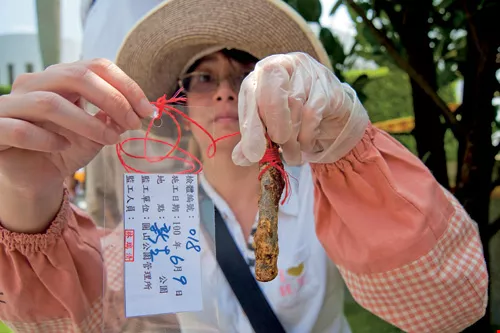
The Taipei City Parks and Street Lights Office is currently treating a golden rain tree at Xinsheng Park for brown root rot. First they remove the blighted wood and roots before fumigating the soil. On the left we see a branch-carefully labeled and identified with a red band by the project supervisor-with the fungus deliberately left on it, to be inserted into soil for experimental purposes.
Forestry Research Institute fellow Chang Tun-tschu says that presently there is no fungicide capable of com-pletely stamping out brown root rot. The existing chemicals serve only to suppress it for a short period, because while systemic agents benefit living conductive tissue, they are incapable of penetrating deeper into the xylem (the agents at most have a range of two to five millimeters). Thus, the only failsafe method is to physically extract the affected roots and eliminate the pathogenic fungus within the soil.
There are several essential procedures to be followed throughout the treatment. First, any infected roots over one centimeter in diameter must be removed and burned together. Before fumigating the soil, a ditch must be made to isolate the infected soil. The soil must be maintained at an optimal moisture level of 50-60%. The diseased soil and the fumigant (the fungicide dazomet) should be mixed evenly before covering the mixture with a thick black opaque plastic sheet. After two to three weeks, the fumigant gas will have naturally dissipated throughout the treated soil. If the root rot is detected early, it may be successfully treated by removing just a few diseased roots and processing the contaminated soil in the manner detailed above. In the interim, scaffolding should be used to stabilize the tree.
The government has recently handed over the reins of the project to the private sector, which will most likely charge based on the area treated, roughly NT$1-2000 per square meter.
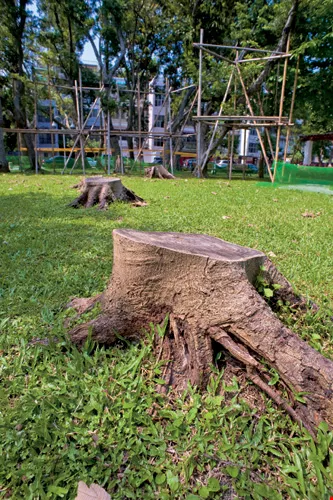
The once-flourishing trees of Minsheng Park in Taipei's Songshan District have been stricken one after another with brown root rot. Experts fear that if the rotted wood and contaminated soil is not removed all at once, the scope of the epidemic may increase.
As local governments get more involved in the prevention of brown root rot the problem becomes increasingly to assuage the misgivings of ordinary citizens whose conservationist impulses can occasionally create obstacles. Often times they may wonder: "This tree still has healthy foliage; isn't it a bit premature to cut it down?"
The division chief of the Floriculture Experiment Center of the Taipei City Parks and Street Lights Office, Chang Chan-jung, recounts a singular case in which the residents of Min-sheng Community were all up in arms about the removal of two banyan trees in a small neighborhood park that experts had deemed compromised by illness. When the district office sponsored a town-hall-style meeting to explain the decision, the place was jam-packed with dismayed locals, many of whom were disruptive during the experts' speech. The next day, the office invited residents to examine the roots up close before proceeding with the operation. After seeing the terrible state of decay, they became convinced of the urgency of the situation. Nonetheless, there were a few obstinate holdouts who wrapped white bandanas of protest around their foreheads and, perching on the doomed trees, declared that they were prepared to be cut down with them. After a little bit of coaxing everyone cooled down, and the work proceeded without further incident.
But the Minsheng Community re-cently found itself rehashing the same controversy, this time over the 33 diseased banyans discovered in 1.8-hectare Min--sheng Park. Parks and Street Lights' preemptive measures were stymied by residential opposition, and in the end, they consented to a moderate approach involving light fungicide application and the use of scaffolding for reinforcement. Thus far, seven trees have had to be removed due to advanced rot. Even more alarming is the fact that several previously unaffected trees are showing symptoms of infection. Jie-shou Borough Chief Cai Jin-wen-whom neighbors once accused of supporting the more aggressive measures in order to profit by selling the trees for pulp-says, "Brown root rot disease is contagious. If we don't have the guts to take action, the result will be that the entire community will be in danger!" He hopes they will be able to hammer out a consensus at the next public hearing that will facilitate the execution of a comprehensive treatment.
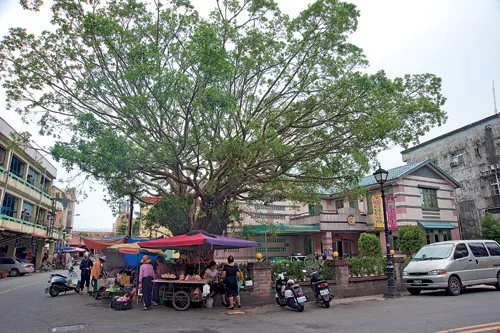
Since becoming infected, this old banyan tree in the courtyard of a police station in Wujie Township, Yilan County has turned a sickly shade of yellow and has been losing its leaves.
In reality, the debate that has taken hold over at Minsheng mirrors the discourse playing out within academic circles.
Assistant Professor Liu Tung-chi of National Chung Hsing University's Department of Horticulture, a Japanese-certified arborist, is a proponent of "natural healing." Staunchly against the use of chemical fungicides or "surgical" procedures (i.e., tearing out infected areas), he advocates instead fortifying trees' self-recuperative powers.
Liu believes that root rot doesn't need to be eradicated; it is nothing more than a common soil-dwelling rot-inducing fungus that plays a role in the ecology breaking down wood. "The use of chemical killers just disrupts the natural cycle. Not to mention that it doesn't always produce the desired results," he comments. Referring to the spread of the epidemic, he points to the despoiling of trees' natural habitat at the hands of human encroachment. For instance, asphalt and manmade surfaces deprive roots of ventilation, causing them to rot. Building and road construction is also harmful to tree roots. In each case, human tampering makes it easier for the disease to prey on weakened trees.
He refers to one of his "patients," a nationally protected old banyan tree in front of the Hall of Great Achievement at Tai-nan's Confucius Temple. This venerable giant had been a part of Tainan folk's collective memory for generations. Its lush canopy of 800 square meters once provided shade for the entire courtyard, but in recent years, since being diagnosed with root rot, its branches and leaves have become increasingly shriveled and spare.
Liu's tack was to introduce tubes near the sick tree roots both to improve ventilation and to infuse nutrients. He also helped the aerial roots, the numerous long stalactite-like strands that are a banyan's defining feature, continue growing deeper into the earth. Around the trunk of the tree, he dug holes and filled them with charcoal. "All of these measures were designed to bolster the root network without harming the ecosystem."
Little did he know that his efforts would be derailed by bizarre circumstances. In April, 2010 there was a report of someone having maliciously sprinkled an unidentified fungus-growing tonic on the tree. When Liu arrived on the scene it was clear that "someone was making a deliberate, professional assassination attempt on the tree." The tree's condition continued to deteriorate, and the lush coverage disappeared, leaving bare trunk and branches. In September, 2010 the Tainan City Government took preventive action, taking off sickly branches with the help of a large crane.
By March of this year, the city government's agriculture bureau appealed to the Forestry Research Institute for help. They sent researcher Chang Tun-tschu, whose inspection showed that the aerial roots Liu had been attempting to revive were completely rotted, and the trunk was completely desiccated. The tree was then pronounced dead. Since nearby trees in the garden were already exhibiting early stages of the illness, Chang recommended uprooting it, as well as clearing the infected soil to be replaced. However, the temple authorities have responded sluggishly, as no action has yet been taken.
Brown root rot has provoked debates similar to the ones in both Chinese and Western medicine surrounding the proper treatment of serious human illnesses like cancer: is it better to implement aggressive, invasive procedures or to attempt more organic cures? Will postponement allow the disease to gain the upper hand? These questions require careful, rational consideration.
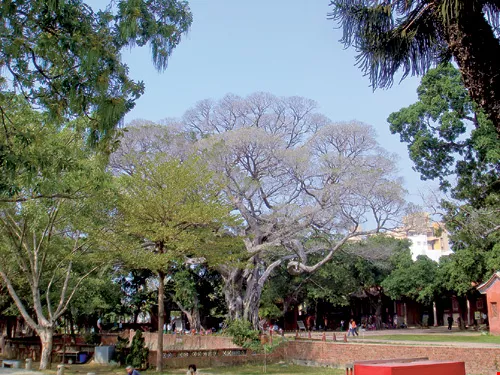
The efforts to revive this brown-root-rot-stricken old banyan at Tainan Confucius Temple lasted three years before ultimately being abandoned. Here we see the tree at the beginning of last year-ailing and yellowed, but still standing firm and dignified.
It is clear that some reflection is in order. Is it possible that we understand too little of tree physiology and pathology? Have we in our daily lives deprived them of their living space?
In actuality, there are ways in which all of us can better care for trees. We can improve their habitats (for instance, by eliminating the concrete flower planters that have become popular on school campuses). We can do our best to avoid harmful practices such as excessive trimming. And when we do encounter tree disease, we should take immediate action to cure it. Finally, we should refrain from bringing strange plants from overseas back to Taiwan, so as to prevent outbreaks of unfamiliar diseases.
On the governmental side of things, the Council of Agriculture should promote the adoption of a seedling certification protocol that can bring ecological threats under control in the farming sector. Forestry authorities throughout the island should do away with regional discrepancies and work together-after all, epidemics don't recognize mankind's arbitrary jurisdictional boundaries!
When one of Nature's green things dies, it may not create much of a stir in the overall environment, but we human beings do feel it in our hearts. Only by taking the brown root rot threat seriously can we ensure that our beloved verdant island will continue to offer us comfort and shade.
How to Recognize Brown Root Rot
1. The tree's growth is abnormal: the tree loses its vitality; most of its leaves fall or begin to turn yellow; the whole tree seems withered.
2. There is a layer of mycelium: examining the roots by the base of the tree reveals that fungal hyphae have formed a mycelium film that clings closely to the bark. The color is white initially, progressing to yellow, then to amber and finally to brown as the condition worsens. Depending on the moisture in the environment, the mycelium can climb as high as one meter off the ground.
3. Slicing open the bark of an infected root, the wood structure will reveal an irregular brown texture.
@List.jpg?w=522&h=410&mode=crop&format=webp&quality=80)

@List.jpg?w=522&h=410&mode=crop&format=webp&quality=80)
@List.jpg?w=522&h=410&mode=crop&format=webp&quality=80)


