Grownup Children, Grownup Fun: Taiwanese RC Comes of Age
Chang Chiung-fang / photos Chin Hung-hao / tr. by Josh Aguiar
August 2012


From aircraft streaking across the sky, to boats gliding on the water, to cars and trucks rumbling across the land, radio-controlled models are available in every conceivable permutation, providing exhilaration at just the press of a button.
It may come as a surprise that 85% of all such devices, be their medium air, land, or water, originate in Taiwan, earning the country the nickname “the RC kingdom.”
Last year, the Taiwan Tech Model Sport Association was founded to promote competition using radio-controlled models. The RC racetrack near New Taipei City’s Erchong Floodway was recently repaved, to the delight of the enthusiasts who come to pit their skills against one another. And at the nearby canal, on holidays one can see sails bespeckling the water and bright mists kicked up by surging motorboats. At the Xisheng Park RC airfield in Xinzhuang, pilots put on astonishing displays of skill, the air throbbing with the engines’ hum. Will all this activity further advance Taiwan’s reputation as the RC kingdom?
Some say radio-controlled models are just souped-up toys for adults.
If you go to any of the many riverside parks, you will find that it’s true: virtually all the people with RC models are grownups in their 30s and 40s with time and money to invest into their hobby.
There are estimated to be tens of thousands of RC model users in Taiwan, 70% of whom own land vehicles, while 30% prefer air and water craft. The reasons for this distribution are simply that cars are easier to manipulate and pose less of a threat to others, an important consideration in such a densely populated land.
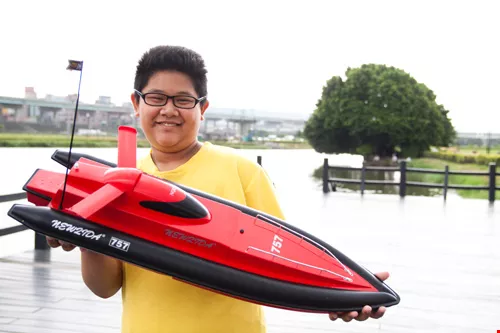
RC models may be “toys,” but they also are superbly crafted technology. Encountering them early in life can be very stimulating, though in Taiwan, the lack of available space makes it difficult for it to catch on. Boats have been least popular of all.
These grownup toys come at grownup prices, with a single RC car typically costing around NT$20–30,000 on the low side, all the way up to several hundred thousand NT dollars on the high end. Virtually every kind of vehicle is available, from monster trucks to SUVs to sedans, typically manufactured on a scale of 1:10, 1:8, or 1:5. The larger the vehicle, the more it costs, so a 1:5-scale RC car with additional customizations could run as high as NT$300,000.
Lin Zhengxiong once ran an RC store on Penghu, but has since moved to mainland China to manufacture lithium batteries for the models. Over the years he’s owned over 100 different models, and his current collection boasts more than 10 vehicles of varying dimensions. He estimates that in the 30-odd years that he’s nurtured his hobby he’s invested at least NT$10 million.
SUVs seem to be the standard choice around the world. According to RC store owner Zhan Mingzhang, the quick learning curve and durability accounts for their popularity. A remote-control SUV could plunge off a two-story building and keep ticking. If a sedan, on the other hand, were to slightly bump into something at 80 or 90 kilometers per hour, it would most likely be unsalvageable.
Airplanes require more skill and are more expensive, to boot. They come outfitted with a number of different kinds of engines, from turbine, to jet, to electric motor. Zhan explains that in the past jet engines cost NT$10,000 for every pound of thrust, meaning that an RC airplane engine alone would account for as much as NT$80–120,000. Put in perspective, that means that an RC jet plane streaking across the sky used to carry a NT$300–400,000 price tag, equivalent to a small car.
“RC requires finesse and coordination,” says Lin. Airplanes are the most challenging, since one has to have a grasp of air flows—for taking off and landing, one must fly into the wind—and a bad landing can easily destroy the plane.
The inherent difficulty in piloting RC planes combined with unpredictable weather has produced more than a few crashes. For example, last year the media made much of an incident in which two planes collided in midair, one crashing into the Dahan River and the other striking a cyclist.
Three years ago, a man accidentally flew his plane into a 26-story residential building in Xindian, causing extensive fire damage to a living room in one of the units. He was found guilty of violating public safety laws and fined more than NT$8 million.
Radio-controlled boats are comparatively easy and safe, but they remain less popular, perhaps owing to the need for sufficient navigable watery spaces. Unlike ground vehicles and aircraft, as yet there are no competitions for watercraft.

The RC kingdom is indeed expansive, with models to rule the air, land, and sea. Thunder Tiger’s Odyssey 2 looks just like a real sailboat. (right) a monster truck.
Outsiders may wonder what is pleasurable about an activity in which the thrill and danger is experienced indirectly.
Lin Zhengxiong, now aged 43, has been a stalwart hobbyist since age 13. He is one of only a handful of individuals to be adept at land vehicles, aircraft and watercraft. He has frequently represented Taiwan at competitions in Japan, Mexico, and the US, and in his finest effort to date won first prize in a Japanese event for 1:10-scale piston-engined cars.
To Lin, each type of RC model offers a unique thrill. Boats offer equal pleasure whether they’re just floating by or chugging ahead full steam, whether they’re touching off gentle ripples or spitting up torrents of foam. The extra dimension in aviation, meanwhile, provides another thrilling layer: one can swoop, invert, barrel roll. “Watching your airplane take off or land, hearing the rush of the engine really gets the adrenaline flowing.”
With cars the focus tends to be on the exhilaration of racing. Curves need to be taken at breakneck speed, but still under control; when jumping, the landing must be secure. These are the hallmarks of superior skill.
Aling Lai, veteran RC user and chairman of Thunder Tiger model company, smilingly comments that the “vicarious” thrill of operating a remote-control vehicle is simply beyond the comprehension of those who have never experienced it. “RC satisfies on so many levels. It rewards curiosity, fosters self-respect, and provides challenges!”
Zhan explains that a radio-controlled car needs only three seconds to reach 100 km/h from a standstill—even elite sports cars are no match in terms of acceleration. People with a yen for automobile racing have to spend millions of dollars, not to mention the threat to their lives and health. RC reduces the costs and risks considerably.
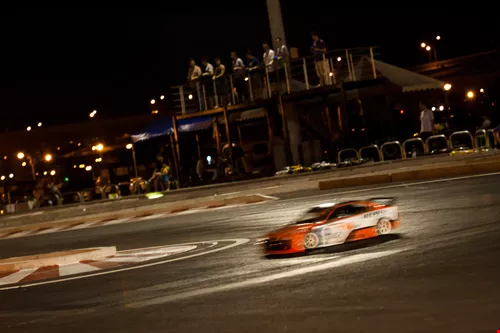
A glimpse at the competitors perched on the platform reveals unwavering concentration, as though they have merged their consciousness with the vehicles speeding along the racetrack.
There are presently around 20 specialty stores in Taiwan, that form the backbone of the RC community. Hobbyists typically support their local store through purchases, repairs, and upgrades, and even form race teams bearing its insignia to compete against other clubs.
At age 40, Zhan represents the second generation of RC users in Taiwan. Ten years ago he took over proprietorship of Shangshou, one of the industry pioneers and currently in its 27th year.
In the early days, he says, RC was a pastime reserved for those with sufficient capital and leisure time, but its affordability in recent years has permitted broader popularity. For instance, the drift cars currently in vogue cost only NT$4000.
Not only are the costs lower, the technical bar for successful ownership has been lowered substantially. Early on, a person had to pay extra for store personnel to assemble the vehicle, but today’s models come preassembled, or “RTR” (ready to run), in the industry lingo.
An RC store is more than a place to find parts and supplies: it’s also a support center. Shangshou rents out its workshop to people wishing to make repairs or modifications to their favorite car.
“Yesterday when I was racing my car, the rear tires lost their grip due to centrifugal force. The rear was moving faster than the front and it lost control, went into a tailspin and hit a wall,” recounts 37-year-old Luo Minghong, who joined the Shangshou race team six or seven years. The recent completion of the RC racetrack near the Erchong Floodway in New Taipei City inspired him to get involved again after a period of inactivity.
“It’s not much fun operating a car by yourself—it makes you feel a bit foolish!” says Luo, emphasizing the need for camaraderie within the sport.
Zhang Xiang, 38, won Taiwan’s 13th annual Piston Cup Championship in April of this year. For him, achieving oneness with your vehicle involves more than just incessant practice; a vehicle’s setup plays a crucial role.
Moreover, that setup speaks volumes about the personality of its driver.
For instance, wheel alignment greatly influences how a car handles. Some people prefer a toe-in angle that is on the “sharp” side—that is, the angle by which the front tires are pointed inward toward the centerline of the vehicle is reduced—which facilitates cornering but can make a car more likely to spin out. Others prefer a more neutral configuration that emphasizes stability, which can be achieved by reducing the angle on the rear tires.

At the Xisheng Park RC airfield in Xinzhuang, a 30-year RC veteran puts on an astonishing display of skill. This stunt, a deliberate mid-air stall, looks simple enough, but it is only too easy to lose control.
RC models have flourished overseas, but despite being a bastion of RC manufacturing, Taiwan has been unable, for reasons that include limited land and open spaces, to foster a comparable culture. As a result, Taiwanese achievement in international competition has always been somewhat lackluster.
Economic factors like the rising costs of raw materials and labor have forced Taiwanese manufacturers to move their operations offshore. Even industry leader Thunder Tiger was obliged to open a factory in mainland China 20 years ago, and its remaining domestic production lines are scheduled to be relocated there before September.
Chairman Aling Lai, now aged 63, created his empire singlehandedly. When reflecting on the trajectory of Taiwan’s RC movement, he feels that he was ”born at the wrong time.”
Lai first became enamored of radio-controlled airplanes when he was 10 years old, at a time when they were extremely difficult to come by in Taiwan. In 1974 he opened up the first Thunder Tiger store on Daya St. in Taichung. By 1979 he had formed Thunder Tiger, Ltd. and had begun investing in model engines and the production and development of model airplanes, cars, and boats.
Thunder Tiger’s core of expertise is machining. Lai has devoted his energies to developing engines for his company’s airplanes, helicopters, and cars, a process that has involved refining mold casting and chemical system engineering to an elevated degree. In fact, Thunder Tiger’s jet turbine engine once won a prestigious Taiwan Excellence Gold Award.
The introduction some three or four years back of brushless DC electric motors and lithium batteries has dealt a tremendous blow to companies like Thunder Tiger that made use of engines. The harm has been exacerbated by the revolutionary shift in RC transmitters away from the traditional 72 megahertz to a higher frequency band of 2.4 gigahertz.
“The changes in the industry have created hardship for many older firms,” says Lai. Even as his own company was hard pressed to keep pace with the change, he had no choice but to sell off warehoused older products at a reduced prices. His company faced grave jeopardy.
Lai admits there have been seismic shifts within the industry. To cope with the shock, he gradually converted his Taiwanese factories to produce medical technology, specifically dental drills.

Here we see one of Thunder Tiger’s helicopters performing a mid-air frontal flip.
The total value of the global RC market is estimated at US$2 billion. Thunder Tiger’s own annual sales total around NT$1.6 billion. In the past, some 45% of that revenue derived from the European market and 40% from North America, but with Europe paralyzed by the debt crisis, its prospects are greatly diminished. Mainland China, on the other hand, offers seemingly limitless potential.
“The future is the mainland,” states Lai. As part of a plan to bolster science education, the PRC government has spent extensively to promote the growth of air, water, and land remote-control vehicles in an effort to woo children away from their video games by offering an attractive outdoorsy alternative. Beijing and Ningbo are two cities whose governments have invested large sums in creating special remote control activity centers.
While Thunder Tiger’s Taiwanese factories have been repurposed, their mainland plants in Ningbo have been cooking up one innovative new product after another on a near monthly basis.
In June 2012, one of Thunder Tiger’s helicopters garnered accolades at a competition in the US. One of their AE series cars has to date scored an impressive 57 victories in international competitions, and is also Guinness Record holder for fastest straight-line speed for an RC vehicle, at over 200 km/h.
According to Lai, competitions are determined 60% by driver skill, 30% by the quality of a vehicle’s design, and 10% by pure chance. Small wonder, then, that Thunder Tiger should apportion US$4 million to cultivate a team of skilled racers, some of whom receive salaries in excess of US$100,000.
Many countries, such as Japan, have come to regard RC as an essential component of science education, with children first trying their hands at making RC airplanes as early as elementary school. However, in Taiwan it has yet to be viewed as anything other than a sophisticated toy.
“RC actually requires a wealth of technological knowhow that is applicable to other fields.” As an example, Lai refers to the three-axis gyroscopes used in RC helicopters, which in terms of precision and underlying scientific principles greatly resemble those used in guided missiles. It’s easy to make the case for RC toys as a conduit leading into careers in science and technology.
From production right on down to sporting competition, Taiwan’s remote control industry is making feverish inroads into mainland China. So long as they enjoy the intense support of Taiwan’s RC community, their prospects appear to have no bounds.

Thunder Tiger has put out the very first remote-control submarine, the Neptune SB-1, which is capable of diving to a depth of five meters. In 2010 it received a Taiwan Excellence Gold Award.

The RC kingdom is indeed expansive, with models to rule the air, land, and sea. Thunder Tiger’s Odyssey 2 looks just like a real sailboat. (right) a monster truck.
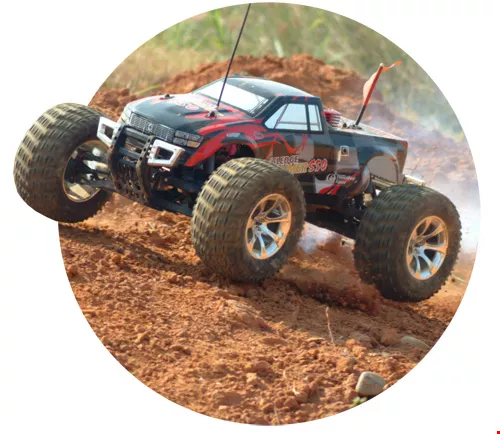
The RC kingdom is indeed expansive, with models to rule the air, land, and sea. Thunder Tiger’s Odyssey 2 looks just like a real sailboat. (right) a monster truck.

Thunder Tiger is the frontrunner of all the Taiwanese RC manufacturers. Company chairman Lai holds in his hands the Raptor 90 3D, a helicopter capable of performing aerial flips.

The RC kingdom is indeed expansive, with models to rule the air, land, and sea. Thunder Tiger’s Odyssey 2 looks just like a real sailboat. (right) a monster truck.

@List.jpg?w=522&h=410&mode=crop&format=webp&quality=80)

@List.jpg?w=522&h=410&mode=crop&format=webp&quality=80)


