Adventure Education-- Too Cool for School
Coral Lee / photos Jimmy Lin / tr. by Robert Green
June 2004


Toward the end of May, four students of the Holistic High School in Cholan, Miaoli County, an advocate of the exploring spirit, set out under the guidance of O-Young Tai-sheng, an expert mountaineering instructor. They were going to scale Mt. McKinley, which rises more than 6,000 meters above the Alaskan ice fields. They sought sponsorship from businesses for their great expedition but received little-nor did they receive much attention from the media.
Taiwan's culture and educational system have always lacked the nutrients for cultivating the exploring spirit. Public opinion is harsh when it comes to college students caught in accidents in the mountains, and parents rarely support their children engaging in risky activities. On the other hand, other Asian peoples, such as the Japanese and the Koreans, engage in these activities with great enthusiasm, and produce many world-class explorers. Two years ago, when a Korean South Pole expedition team was looking for one or two young teammates, as many as 8,000 people applied.
Fortunately, in recent years, encouraged by a few determined people, the seeds of Taiwan's "adventure education" have begun to sprout, after the arduous efforts of those blazing the trail. With the optimism and will to break new ground-the characteristics of an explorer-they are diligently working to chart a path for exploration education in Taiwan.
Traveling along a path lined with tung-oil trees in full bloom at 6 a.m., students from Cholan Holistic High School, popularly known as Forest High, exert themselves on one of their daily ten-kilometer training runs. A few days later, carrying 20 kilograms of gear each, the same group of students hike from Tatachia across the main peak of Yushan (Mt. Jade) and descend to Tungpu, taking just a day and a half to complete a course that generally takes two and a half days. This is part of their preparation for the "Taiwan Youth Mt. McKinley Expedition," due to kick off on May 19.
Aside from the intensive physical training for strength and stamina, the youngsters have received two years of training for the icy environment, including ice climbing, rescue exercises with rope lines, rock climbing, and other special techniques, and have studied glaciers and high-altitude climbing, says their instructor, O-Young Tai-sheng.
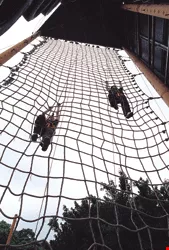
Through suspended rope courses, rock climbing and other adventure activities, Project Adventure, newly arrived from America, gives people concrete challenges to break personal boundaries and helps them understand the value of group support.
Mt. McKinley is located in Alaska near the Arctic Circle. It stands nearly 6,200 meters tall, and the temperature at the summit averages minus 30°C with temperatures varying by as much as 50 to 60 degrees between daytime and nighttime. Experienced mountaineers consider it a favorite challenge among the high peaks of North America. Six months earlier, when the team of prospective climbers from subtropical Taiwan submitted their application, the authorities had misgivings because of the youth of the applicants. Later when they realized that the students had quite a bit of high-mountain experience and had received training for snowy regions, they gave the green light.
Although the four students in the expedition team were very young-ranging from their third year in junior high school to their third year of senior high school-they had climbed more than ten of the tallest mountains of Taiwan and hiked the Shengling Trail, a breathtaking ridge trail that links nine major peaks from Mt. Hsueh to Mt. Tapachien. The students honed their abilities in the mandatory mountain climbing classes at their school. Every year, the teachers and students climb a peak of at least 3,000 meters, carrying their own supplies instead of hiring porters.
School principal Huang Cheng-hsiung, nicknamed Ta-hsiung (the Chinese name of the ineffectual character Nobita from the Japanese cartoon Doraemon) by students, is extremely supportive of the expedition-and a little envious too. Although there are risks of varying seriousness, under the guidance of seasoned instructor O-Young the dangers will be minimized. "Just growing up presents risks," he says. "If the students don't take any chances, how can they extend themselves and make more of their lives?"
Ta-hsiung encourages the students to embark on all kinds of adventures-setting off on their bicycles along the Southern Cross-Island Highway, circling the island on foot, or climbing solo into the high mountains. He encourages them all and hopes the students will return to school to share their experiences. "Exploration activities really help fill young people's need for self-affirmation," he says. This is a good method to foster curiosity and provide a sense of accomplishment. The ultimate goal however is to spur students to explore both their inner selves and the outside world.
Dangers real or imagined?In the school's open and encouraging environment, in which choices abound and teachers persistently encourage and guide, a kind of garden for the cultivation of the adventurous spirit takes shape. Nevertheless, this is the exception. Although education in Taiwan is not lacking in encouragement for the investigative spirit generally, the attitude often changes markedly when one turns to the subject of exploration.
"Every time I want to take junior high school students hiking up rivers the principal cancels the trip because of safety concerns, even though it's obvious that all has been well prepared." Hsieh Chi-mou, who returned from abroad just a few years ago to promote outdoor education as an instructor in the Department of Sports Management at the National College of Physical Education and Sports (NCPES), gives an example: When students learn rock climbing, they usually climb to four or five meters and then their parents start yelling at them to stop: "It's too high, and too dangerous!" In fact, he says, most children are eager to test their limits, and they are able to do all sorts of things, but their opportunities to try are limited by adults' fears, and as they grow up their natural curiosity and adventurousness are continually repressed.
Danger can be divided into two categories: perceived risk and objective risk. Wu Kuan-chang, exploration aficionado and a student in the doctoral program in Leisure Behavior at Indiana University's Department of Recreation and Park Administration, points out that people's anxieties about mountaineering and other adventure activities are primarily subjective perceptions of risk. In fact many studies from abroad indicate that the risk of injury while engaging in these kinds of activities is much lower than the risks involved in playing many ball sports.
The subjective perception of danger is influenced by particular cultural attitudes. Perhaps because of the unchanging nature of an agricultural society, the notions that action is not as appealing as tranquility and that each should be content in his lot-ideas long cultivated among the Chinese-have resulted in deeply ingrained personality traits. Although Taiwan is a land of immigrants, the adventurous spirit came from economic incentives. Later the impulse was further exerted on the development of industry, and Taiwanese businessmen could be found under every rock the world over. Yet after a few decades of economic prosperity and a life without hardship, comfort gradually became more important, and the adventurous spirit of earlier times was lost.
"The emphasis on practicality, so prevalent in Chinese culture, was not conducive to the cultivation of a spirit of adventure," says Principal Huang. Every time he would go mountain climbing in college his parents would be mystified as to why he would want to exhaust himself like that. "Where's the use in it?" they would scoff. Kids who loved to "play" at mountain climbing, camping, and exploring rivers never got the same degree of affirmation as those who liked studying.
Where's the spirit of adventure?In recent decades, Taiwan's political and social atmosphere has also stifled the spirit of adventure. The restrictions on entering the mountains and visiting the sea during the martial law period-the result of security concerns-prevented the public from having contact with the magnificence of the mountain forests and the sea. The martial law regulations were formulated from the point of view of protecting society, but excluded the interests of mountaineers, says Lien Chi-chan, the head of the 523 Ecological Mountaineering School. As soon as there is an accident in the mountains, public opinion focuses only on how much it costs for the helicopter to race to the rescue, how reckless the mountaineers are, and how ill-prepared to get themselves out of their own jams. Lien believes that this deflects from serious discussion of the causes of accidents and how to prevent and respond to them. "No one goes to the mountains to commit suicide!" he says with a grimace.
Subjective dangers involve cultural and social elements, perhaps both complicated and hard to grasp. How then should we weigh objective dangers?
O-Young Tai-sheng points to the Mt. McKinley expedition as an example. He must consider such factors as the students' physical capabilities and their skills, and how to equip the expedition team. What dangers will the journey present? He must consider whether the team members are adequately prepared to handle these dangers. Finally, he must weigh the key factor in any group activity: will the expedition members be able to work together?
Thorough preparation, moreover, is the golden rule for explorers and allows them to confront potential dangers. "I rely on years of accumulated experience and vast knowledge to carefully prepare for the risks," says South African explorer Mike Horn. Last year, he set out on a six-month, two-person expedition down the Amazon to the sea in an unmotorized craft. "I prepared relentlessly," he said when interviewed by the National Geographic Channel. "We're not nuts." His preparations included measuring the depth of water in rapids, estimating when the rise in the water level would reach them after storms upstream, determining what conditions would force them from the river, how to avoid being infected by insect bites, and so on.
An all-round challengeYet even if preparations are thorough, the natural world is full of all sorts of surprises. Many explorers agree that it is just these surprises that test a person's wisdom, courage, willpower, and stamina, and that these challenges are what most attract people to exploration. "Because the challenges of exploration come in many forms, the pleasure and the experience you gain when you overcome them is enormous," Hsu Jen-hsiu says with obvious excitement.
Lai Ming-you, a post-doctoral research fellow at the Academia Sinica Institute of Molecular and Atomic Sciences, took Taiwanese ice climbing to new heights by taking on the north face of the Matterhorn in 2002. He recalls that aside from the frozen waterfalls, the most memorable thing about climbing the 1,000-meter-tall ice-covered north face-which has an average slope of 60 to 70 degrees-was having to traverse a narrow ledge above a precipice he came across unexpectedly. The ledge was only a few centimeters wide and covered by a thin layer of ice. It alarmed him, for although it was only eight meters long, it completely prevented him from climbing any further, and no matter which of his old tricks he tried, he was stuck. Finally, he had an idea. After many attempts, he hit on a method of half crouching and using one hand to support himself he inched safely away in a strange-looking posture. Lai, who is generally a garrulous fellow, says that surviving that scrape made him happy beyond description.
"Passing through that terrifying experience must have given not only a sense of accomplishment with regard to skill and physical ability, but also a kind of spiritual strength," says Lien Chi-chan of the 523 mountaineering school based on similar experiences of his own.
Perhaps having such moving experiences while exploring makes people want to share their enjoyment with others, and some adventurers are taking concrete action to put that desire into practice.
The "523" in the school's name when read in Chinese sounds like the words for "I love mountains." The school was the brainchild of a National Chengchi University graduate who originally organized it as a mountaineering association. Later he went on to establish the mountaineering school with the cooperation of the mountain-mad Lien Chi-chan and other enthusiasts. The whole group then entered the business of promoting exploration education and ecologically minded mountain climbing. They operate by accepting different projects and offering the general public training in all types of rock climbing, river exploration, and environmental awareness. They also offer extended expeditions deep into the mountains to train guides, and design wilderness experience activities for high-school dropouts.
Decades of outdoor educationThe concepts and methods of the 523 school are based on the rationale of Outward Bound International and the National Outdoor Leadership School (NOLS).
Outward Bound was founded in the 1940s by Kurt Hahn, a German Jew who took refuge in Britain during the Second World War. Hahn noticed that after the repeated sinking of British merchant marine vessels by German U-boats, older sailors were far more likely to survive. He discovered that younger sailors' survival instincts were insufficient. Because they had become accustomed to a life of comfort and pleasure, they hadn't developed the toughness of the old seamen.
"Hahn further pointed out that young people lacked physical stamina, a spirit of adventure, imagination, a sense of obligation, self-reliance, and other abilities," says Wu Kuan-chang. Hahn later designed a system of training using the outdoors as a classroom, and in this unforgiving environment, young people could understand firsthand the importance of these traditional values.
Since Outward Bound arrived in the US in the 1960s, it has expanded rapidly and today the group has branches in over 30 nations. The types of people trained in the program have also expanded to include adults, the destitute, the disabled, and entrepreneurs, among others.
New perspectivesNOLS, also founded in the 1960s, aims to train qualified instructors for Outward Bound. Aside from cultivating the skills needed for exploration, the program stresses leadership skills and environmental education for mountain climbers. Many notable personalities in the world of exploration started out at NOLS. Wu Kuan-chang, who participated in various NOLS courses, describes his experiences during a ten-week outdoor education course. For a month, the class practiced climbing in a remote mountain region in Utah, including three days in which the students had to travel alone in the wilderness. Afterwards there was a three-week rock-climbing class, followed by three weeks canoeing along the Colorado River "Previously I thought that I had quite a good foundation in mountaineering skills from my experience during three years of climbing while I was studying at National Chengchi University," says Wu. "But on the course I realized how much there is to learn in mountaineering."
The idea of "learning by experience," which has been introduced into Taiwan in recent years, has greatly helped foster a spirit of adventure. According to Hsieh Chi-mou, the concepts underpinning this way of thinking originally come from American thinker and advocate of pragmatism John Dewey. After examining the methods of teaching in use, Dewey determined that they were detached from real life and thus insufficient to meet students' needs. Then in the 1930s he advocated "learning by doing," "education is the product of experience," and other concepts. By the 1970s, these concepts had developed into "education through firsthand experience," "education by investigation," and other concepts that differed from traditional educational models and developed in tandem with contemporary Outward Bound programs in the US.
No adventure is the real dangerHsieh explains that the thrust of this educational approach comes from placing the student at the center of the educational experience. The teachers don't teach, but offer students the opportunity, environment, and tasks. When students run into trouble, teachers offer resources and assistance, but do not give students the answers. For example, in his classes on the outdoors, adventure counseling, and wilderness first-aid, he took students on a 14-day trip to a national park in the western United States and presented them with various problems and tasks that they had to finish in a set amount of time. The exercises allowed students to develop various skills to solve problems in unfamiliar surroundings and gave them a practical understanding of the importance of teamwork.
He also uses this set of concepts to educate young people and students who have dropped out of school. The National College of Physical Education and Sports (NCPES) provides facilities for courses that include high and low rope exercises, rock climbing, and water activities, among others. Participants stand on a pole three storeys high and leap after a leather ball or face off on a narrow plank suspended high in the air and try to find a way to switch places. Although safety lines are used in all these exercises, they are still extremely challenging. "Afterwards, in group discussions, the participants share their thoughts about their personal progress and the support they received from other team members," Hsieh says.
"Making breakthroughs and facing dangers are intended to alter the comfort zone," Hsieh emphasizes. Stagnating is dangerous: it obstructs human development. "Change is necessary for growth," he says. "Although change presents risk, the value of progress is even greater." He feels that Taiwan's restrictive culture represses the impulse to explore and is an obstacle to educational progress.
Exploring conventional educationAfter returning from studying abroad six years ago, Hsieh decided to take a road less traveled, opting to forgo the usual teaching path and instead accept a teaching position at the NCPES, which he thought was likely to be a type of educational adventure in its own right.
"Taiwan needs nonrestrictive educational models," Hsieh says, remembering his own experiences with a chuckle. "Going to class meant heading into the mountains for a few weeks. There was no fussing over the hourly rate." Conventional education concepts are deeply ingrained, but through the many efforts of the last few years the value of a practical education is slowly coming to light. "Students are self-motivated and show initiative," he says. "They have patience and a sense of compassion. Their temperaments differ markedly from other students." Taiwan's exploration education is gradually developing, whether it's Hsieh Chi-mou or others sowing the seeds in academies; the ideas of Forest High; O-Young Tai-sheng, the 523 school, or other grassroots organizations putting these ideas into practice; the work of wilderness preservation groups; or the large-scale expeditions organized by Alan Hsu. These pioneers, with their adventurous spirit, have blazed a path for Taiwan and continue to prepare the ground for the cultivation of the explorer's spirit. They should be applauded most heartily.
Outward Bound http://www.outwardbound.org
Wilderness Education Association http://www.weainfo.org
Colorado Mountain School http://www.cmschool.com
Yamnuska Mountain School (Canada) http://www.yamnuska.com
Project Adventure (PA) http://www.pa.org
National Outdoor Leadership School http://www.nols.edu
523 Ecological Mounteering School http://www.523.org.tw 02-25557540
Taiwan Alpine Outdoor School 02-329-0336
@List.jpg?w=522&h=410&mode=crop&format=webp&quality=80)

@List.jpg?w=522&h=410&mode=crop&format=webp&quality=80)


@List.jpg?w=522&h=410&mode=crop&format=webp&quality=80)

@List.jpg?w=522&h=410&mode=crop&format=webp&quality=80)
