A Great Love, Illuminating the World—Fo Guang Shan’s Buddha Memorial Center
Ping Peng / photos courtesy of Fo Guang Shan Buddha Memorial Center / tr. by Scott Gregory
February 2012
On December 25, 2011, Kaohsiung’s Fo Guang Shan Monastery officially opened its Buddha Memorial Center, which was built to display a tooth of the Buddha. The rare relic, which was transmitted through India and Tibet, is at the center of a park.
To the vast numbers of Buddhists in the nation, it is a special karmic occasion for Taiwan to host the relic, and the solemn and stately area opens a new chapter in the history of Buddhism.
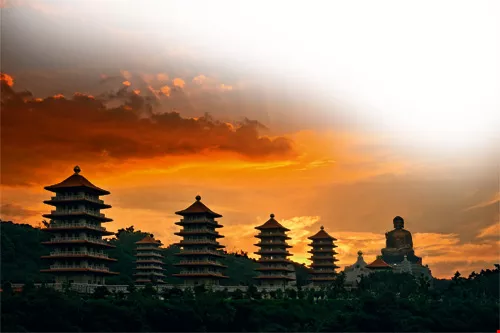
Located in Dashu District, Kaohsiung, the memorial center complex took eight years to construct. Its massive scale—eight pagodas in front, a giant Buddha in the back, and replicas of places where the Buddha preached to the north and south—makes its opening a major event in Taiwan’s religious history. The complex covers more than 100 hectares, and the center itself is over 13,000 square meters. The main pavilion is an “inverted bowl” style stupa made of granite and decorated at the base with yellow sandstone. There are 48 underground chambers holding all types of items related to the Buddha, such as sand from the Ganges, stones from the Stupa of the Turning of the Dharma Wheel, and bricks from the Nirvana Stupa.
Behind the main pavilion, there is a large bronze Buddha, smiling as he forms different mudras (hand gestures) with his right and left hand. The dais and the Buddha statue together are 108 meters tall, around the height of a 36-story building, and made from 1,872 tons of bronze and steel. The statue is the landmark of the park, and the world’s largest bronze sitting Buddha.
“Taiwan is so small, but the Buddha is big, and there are believers all over the world. We hope that in the future, the world will better know Taiwan through the Buddha Memorial Center,” says Fo Guang Shan’s founder, Master Hsing Yun.

The completion of the vast Buddha Memorial Center in late 2011 was a major event in Taiwan’s Buddhist world. Its grounds serve as an educational center as well as a tourist spot.
The construction of the Buddha Memorial Center was rooted in the Buddhist belief in relics.
It is said that the Buddha was cremated after he achieved Nirvana, and because of his great compassion, his body turned into fine relics called sarira so that he would leave behind a permanent dharma body for all sentient beings. These included four teeth, one of which was taken to the Heavens by the god Indra. The other three remained in the human realm.
One of the Buddha’s teeth was taken from India to Sri Lanka, and is now held in the Sacred Temple of the Tooth Relic. Another was taken to China by the monk Faxian in the Yuanhui reign of the Liu Song Dynasty (473–477 CE). Over a millennium and countless wars later, it is now held in Lingguang Temple in Beijing’s Xishan district.
The third tooth was originally placed in Nalanda Temple in India. In the 13th century, when Muslim invaders took India, it was taken in by the king of Tibet and placed in Namgyal Temple. During the Cultural Revolution, Namgyal Temple was destroyed and the tooth’s whereabouts were unknown. Only later was it revealed that it had been hidden away by one Kunga Dorje Rinpoche.
In order to protect the tooth, Kunga Dorje Rinpoche underwent many hardships. He trekked across the Himalayas, bringing the tooth back to India. There, high Tibetan lamas authenticated it and urged him to build a temple for it so that sentient beings might benefit from revering the body of the Buddha.
In February, 1998, Master Hsing Yun traveled to India to confer precepts. Kunga Dorje Rinpoche felt he had little time left. Seeing that it would be impossible to bring the relic back to Tibet and that he could not find the resources to build another Buddhist temple for it in India, Kunga Dorje Rinpoche hoped to pass the relic on to the reliable Master Hsing Yun for safekeeping.
In April, 1998, the Buddha’s tooth that had been brought from Tibet to India made its way through Bangkok to Fo Guang Shan. Fo Guang Shan started planning the memorial center, and construction began in 2003. It was finally completed in late 2011.
The day the center was completed, monks from both sides of the Taiwan Strait and more than 100,000 believers from all over the world gathered in Taiwan to chant the Heart Sutra in search of world peace.
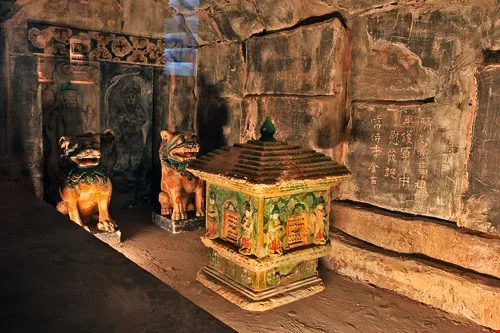
The underground chambers are temples of the netherworld. After Buddhism was introduced to China, local traditions were reflected in the burial of relics and ritual items such as incense burners and jars. The Buddha Memorial Center features 48 underground chambers, which hold a variety of Buddhist items.

The design of the Buddha Memorial Center mixes ancient and modern, Chinese and Western, the traditional and the contemporary. It serves cultural, educational, contemplative, and practice functions.
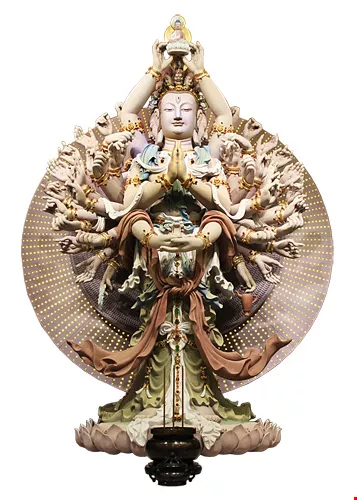
To bring people into closer contact with Buddhism, there is a 4D theater inside showing a film on the Buddha’s life. When Siddhartha becomes enlightened under the Bodhi tree and is tempted by demons, a wild wind whips through the theater. When he achieves Nirvana, Bodhi leaves float through the air, making the audience feel as if they are there. Loretta Yang of the Liuligongfang glassware studio also specially created a Thousand-Armed Guanyin statue that is 388 centimeters tall and 1,200 kg in weight. It sits in the memorial center’s Guanyin Pavilion, with two attendants by its sides who offer up holy water from two vases for visitors to use.
Another highlight in the memorial center is the 48 underground chambers, which function as “time capsules.” They hold contemporary memorabilia, and it is planned that one will be opened every hundred years. As they are opened, they are to be refilled with new items. It’s referred to as the longest exhibition in the world.
Master Hsing Yun says that each building in the memorial center embodies the Buddhist dharma. For example, there are four pagodas to represent the Buddha’s Four Noble Truths: Suffering, Causation, Cessation, and the Path. In the square, there are the 18 Arhats, and in addition to the 10 great disciples of the Buddha and the Arhats in the sutras, there are three nuns—a rare example of images of nuns in Taiwan, which illustrate that the Buddha’s dharma is wide enough to encompass both sexes.
The significance of the Buddha Memorial Center for our age is that through the power of the Buddha’s love for humanity and study of the Buddha’s compassion and wisdom, everyone can find the Buddha within and build a Pure Land in this world.

Liuligongfang artist Loretta Yang made a Thousand-Armed Guanyin figure specially for the memorial center. Its image reflects compassion for all humanity.