Peng Wei-chua: Taiwan's Wushu Champion
Chen Hui-yin / photos Jimmy Lin / tr. by Chris Nelson
April 2010


Ten years of preparation, one minute on stage. Peng Wei-chua, Wushu (Chinese martial arts) contender at the 2009 World Games in Kaohsiung, leapt and pirouetted with power and grace, drawing strength from his qi, clinching the championship in both Nanquan ("southern fist," a form of unarmed combat) and Nangun ("southern staff," a style of stick fighting) in one stroke.
Behind the spectators' near-frenzied cheers, the road to Peng's success in Wushu has been a tortuous tale. If not for the stern advice of his mentor Chang Shi-po, and if not for Peng's key habit of "practicing with a smile," Peng may have missed his chance to become "the pride of Taiwan."
Growing up as part of the Sheng Gong Yue Hakka opera troupe and touring frequently during his youth, Peng describes himself as a "child of the theater tent." In fifth grade, his parents sent him to study drama at the National Fu Hsing Dramatic Arts Academy (now the National Taiwan College of Performing Arts).
During those "iron curtain" years of the drama school's disciplinarian education, the young Peng underwent an arduous daily routine of rising at 5:00 a.m. for practice and endured harsh treatment by teachers and elder students, only going home during the Chinese New Year break. But these tough eight years brought out Peng's inborn Hakka hardiness.
Having performed as an acrobatic clown in drama school, Peng began studying Wushu in order to enter the field of Peking Opera. But at the time he didn't know much about martial arts, thinking of it as little more than showing off. After graduating from high school, he tested into Chinese Culture University where he studied Chinese drama. After a semester his tuition became too onerous, so his father hocked all the gold jewelry he had in the name of having a college student in his family and preserving the family art, telling Peng to focus on his studies. But Peng preferred not to pursue the college life, instead wanting to earn money to help improve his family's economic situation.
So against his father's wishes, he decided to suspend his studies, returning to teach part time at his high school and at the same time joining the Taiwanese Opera troupe Ming Hwa Yuan as an acrobatic performer. His Wushu coach and mentor, Chang Shi-po, who had trained him from an early age and was then teaching at Taipei Physical Education College, suggested that there was no harm in changing his path in life, switching from Peking Opera to Wushu. He encouraged Peng to apply to TPEC, rekindling Peng's dream of being a college student.
After ages without touching a book, Peng crammed an entire week in preparation for his audition. The evaluation panel would have rejected him if not for a technical fault committed by the previous candidate. Little did he know that this amazing stroke of luck would one day propel him to stardom in Taiwan.
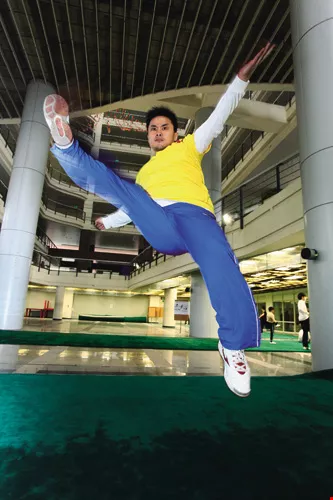
Dashing, valiant Peng Wei-chua strikes a warrior stance. This is the result of the tough training he underwent after entering National Fu Hsing Dramatic Arts Academy in fifth grade.
After entering the Department of Exercise Science-Martial Arts at TPEC, he decided upon total self-liberation in the wake of his boring drama classes and dead-end work. During his freshman year he indulged in dancing, singing and drinking, often cutting class. And with his high pay from performing with Ming Hwa Yuan, not only did he not have to ask for financial help from his family, he could afford to rent a comfortable studio apartment on his own.
One day in his sophomore year, Peng showed up drunk, stumbling while sparring. Coach Chang, seeing his drunkenness, chastised him: "Don't come here again in this state!" He went on to say, "What else can you do besides talk big and do a few easy forms and rolls?" His statement hit Peng like a club, awakening him.
He recalls that his strict drama school education had given him the experience of success, including earning the acclaim of Chinese masters in a cross-strait Peking Opera contest. But he never had the chance to play a leading role on stage, and he pushed this dream down into the hidden depths of his heart. The coach's heavy words prompted him to bid farewell to his decadent ways and start afresh.
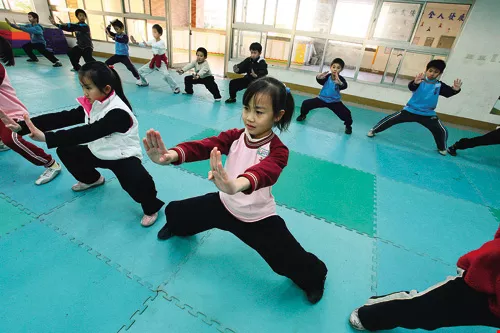
Peng trains the next generation in martial arts in a Wushu class at Bei Shi Elementary School in Taoyuan County. More than 20 children stand in line and move in unison. These kids are the new hope for Wushu in Taiwan!
After a year of observing Peng, Chang sent him to train in mainland China, but it was only then that he learned what true competitive Wushu was, becoming aware of his own inadequacies. After returning to Taiwan, he would practice privately for four hours each evening, on top of the five hours a day of practice at school.
One day when he had no class to teach, Coach Chang made a special trip to the school to watch Peng practice his Wushu. On his way home afterwards, he was hurt in a car accident. Braving the pain of his injury, he want back to the school to tell Peng: "I just sustained an injury for the sake of watching you practice. You have to keep going and win the world Wushu championship, or else you owe me an apology!" Peng was moved to tears, and from that point he started giving his all. When he was a junior, he wrote his three life goals on a wallboard: to enter graduate school, to win the World Wushu Championships, and to win the Olympic gold.
In 2002, Peng went abroad for his first bout in the World Wushu Championships, barely doing well in Nanquan (fifth place) and coming in third from last in Nandao ("southern sword," a style of sword fighting). Amid Peng's disappointment and frustration, his coach sanguinely reminded him, "Failure is the beginning of success!"
Heeding Chang's advice that persistence leads to success, Peng worked hard, practicing alone every day. Once he fractured his foot when he landed badly after a back flip, but thankfully this didn't stop him. Peng had developed a limber physique while in drama school in his youth, so he was less injury prone than most martial artists.
In 2005, as a second-year graduate student in sports education at TPEC, Peng won two silvers and a bronze at the East Asian Games, and at the World Wushu Championships he won the silver in Nanquan and the gold in Nandao while competing against contestants from more than 80 countries. Taiwan's representative teams hadn't won so many titles in years, and Peng began to climb his way upward in international Wushu circles.
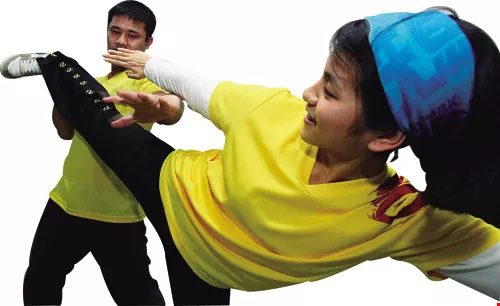
Even after winning the World Games championship, Peng doesn't let up. Pictured here, Peng and his girlfriend Liu Yu-chien face off.
In 2008, Peng attended the Beijing Olympics, a contestant in a sport that drew little attention and in which there were no national resources (only subsidies, airfare and lodging in the Olympic Village courtesy of the Chinese Martial Arts Association of ROC). His Wushu performance won him the silver, causing a great sensation in mainland China.
"I expected there'd at least be a welcoming committee greeting me at the airport when I returned to Taiwan. I had no idea that one news station would show just three seconds of scrolling text about it. I felt unappreciated," he says. Peng understands, however, that Wushu is not a formal event in the Olympics, and Taiwan also doesn't confer any awards in this area, and this feeling of neglect is something that all domestic Wushu contestants contend with. Peng had to be self-reliant.
To earn a living, Peng laid down his Wushu robe and started working, rejoining Ming Hwa Yuan as a martial arts drama coach and restarting his career touring from stage to stage. In mid-2009, Peng, with no preparation whatsoever, was suddenly drafted to take part in the World Games as a Wushu contestant. He immediately began a rigorous month-and-a-half program of training.
Peng had not practiced formally in almost a year. His mentor Chang told him he must rid himself of the sense of glory of having been a world champion, and imagine himself a greenhorn who had never won a prize before, re-analyzing the meaning of every movement. Peng jogged in raingear to lose weight, quickly shedding six kilos by sweating buckets.
During training, Chang demanded that Peng smile each time he entered the classroom, no matter what his mood, because "Only when you're happy can you truly learn, and only then will the things you touch turn positive." So the instant he crossed the threshold of the training room, Peng would tell himself, "Today I'll do even better," and imagine himself in the most splendid place in the world, so he could practice his routines with a sense of joy in his heart.
During this crucial month and a half of training, Peng re-learned Wushu. The process was exhausting, but he maintained a happy mood, and continued to improve. At the World Games, he displayed unprecedented explosive force, winning the championship in both Nanquan and Nangun in one fell swoop.
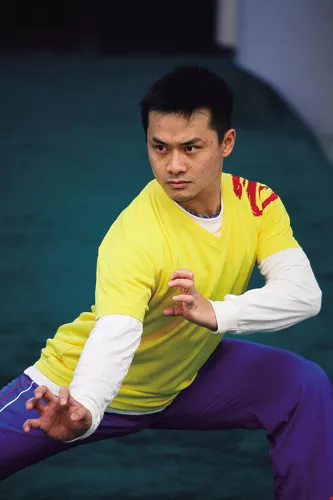
In Chinese Wushu, it's said that "in the south, it's in the arms; in the north, it's in the legs." Nanquan, developed south of the Yangtze River, focuses on upper limb movement and often imitates animal stances. Here, Peng looks the part of a kung fu action hero with his steady footwork and steely gaze.
Wushu is not judged solely on skill. For instance, the judging in Nanquan evaluates not only technique, but also fluidity and refinement from beginning to end. As per Chang's description, Wushu is a "nano-sport": the deeper and finer a contestant's concentration, the greater his likelihood of winning, "because at such a time you have full belief in yourself."
Peng laughs, saying that his goal of studying Wushu was initially to strengthen his body and show off, and later it was to become an Olympic champion. But only after truly entering this field did he discover its profound philosophy.
Beyond skill, Wushu is a holistic discipline that integrates refinement, temperament and spirit; there is also an interpersonal relationship of give-and-take with the opponent. Peng gradually broke free from simple physical conditioning, allowing himself to rise from competitive Wushu to becoming a scholar of martial arts.
Peng would regularly peruse the I-Ching, The Art of War, and books on Chinese philosophy and traditional Chinese medicine to broaden his vision and build his cultural acumen. He found that the perspective from which he looked at things had changed, and his disposition saw a significant transformation, turning from hot-tempered to calm and mild. This was something he had never imagined would happen.
Peng provides the example of the "eye of a hawk, spirit of a monkey" (keen expression, alert actions) formula, which stresses calmness of form and purposefulness of action. The idea of the "six faces of Wushu" suggests that one should consider at least six aspects of anything one sees: besides concentration, one must bear different levels of thinking. This was quite different from Peng's past habit of one-track thinking.
Peng also believes in gaining something from whatever one does. He had joined Ming Hwa Yuan to earn a living. Unlike stadium sports, Ming Hwa Yuan frequently played to full houses, an experience that trained him to feel no fear on stage before countless eyes. But in Ming Hwa Yuan's stage performances, the audience cared only for surface technique, so even if he made a mistake he could make minor adjustments to save his performance. Furthermore, there was no scorecard pressure. But in Wushu tournaments, the slightest error is not tolerated; even if you think you did well, you may not do as well as you thought in the subjective eye of the referee, so you need to know how to cope mentally.
This isn't Wushu!As a martial artist, Peng has watched popular kung fu and wuxia movies (romantic fiction featuring martial-arts "knights errant") in depth.
He says that in both the Chinese and Western worlds, wuxia movies have been critical in stirring up people's interest in Wushu. But if you take away the special effects, what's shown in wuxia movies is vastly different from real Wushu, leading to many misconceptions.
For example, during a sword fight, the image of clashing swords brings thrills galore. But in reality, it takes only one strike to decide the winner. One thrust through an opening, and in that decisive split second the outcome is known, so there won't be incessant clashes of swords or rounds of fighting as seen in the movies.
In the Hong Kong movie Once Upon a Time in China, the dozen or so "no-shadow kicks" performed by Jet Li were highly exaggerated; in comparison, the combat action was very good, though a bit fancy, in Ip Man, last year's film about a Wing Chun master's life.
Comparing the Wushu traditions of Taiwan, Hong Kong and mainland China, Peng believes that there is little of the essence of Wushu left in China as a result of the interruptions in transmission of the art during the tumultuous periods of the Chinese Civil War and the Cultural Revolution. Add to this the national policy of patterning martial arts performance toward competitions, routines and forms, and the true meaning of the study of martial arts has gradually diminished.
However, many older martial arts masters (such as Wing Chun master Ip Man and Changquan master Sun Shaotang) opened schools in Taiwan and Hong Kong, continuing a solidly rooted line of transmission, resulting in styles superior to those in China.
But given the undeniably high visibility and influence of international sports competitions, it is worth paying attention to how martial arts in Taiwan develop under such pressure, unrestricted by China's formulaic Wushu policy.
Three-in-one teachingRegarding the development of Wushu in Taiwan, Peng says that quite a few Taiwanese students study martial arts, but they tend toward simple training models. Since the study of martial arts requires a high degree of endurance and willpower, it's necessary to draw the students' interest when teaching, otherwise they would give up halfway.
So how do you make students fall in love with martial arts? Peng introduces it to students through sayings and stories. For instance, he tells them to use their imagination, thinking how to interpret the saying "the best strategy is to get away" through their actions. And when performing the cries of Nanquan, they are useful both for "striking fear into the enemy's heart" and for "creating a diversion": the roaring sounds deter the opponent. The stories, sayings and sparring are his form of "three-in-one teaching," making students more willing to accept Coach Peng's tough training.
Despite announcing that he will no longer compete internationally after winning the Wushu championship at the 2009 World Games, Peng still regularly practices in order to coach effectively. His girlfriend Liu Yu-chien is also a practicing martial artist, and when they go out they often spar. And it's real sparring: she has knocked him to the ground on many an occasion! Peng says with forbearance, every time they spar with each other, they do so with full force. Though during practice they may hold back a notch, they can't perform effectively without going all out, or they would grow accustomed to lower levels of force.
Says Peng, before graduating from TPEC, his family didn't know what he would be doing with his life, thinking that he would just become a pugilist. But when he won the World Wushu Championship in 2005, his father was flushed with pride at his success. As for Peng, his feelings for Wushu are not from being a sports champion, but from deeply understanding and interacting with it. Says he, there are no bounds in the study of martial arts; he will keep studying until the day they lower him into the ground.
@List.jpg?w=522&h=410&mode=crop&format=webp&quality=80)

@List.jpg?w=522&h=410&mode=crop&format=webp&quality=80)


@List.jpg?w=522&h=410&mode=crop&format=webp&quality=80)

@List.jpg?w=522&h=410&mode=crop&format=webp&quality=80)
