Golden Dreams of a Century Ago Chinese-Australian History Lives On in an Old Gold Rush Town
Liang Chi-yun / tr. by Geoff Hegarty
August 2005


History should never be boring. Places that preserve the settings of important periods in history are able to bring the past alive for today's generation, and make history interesting for everyone.
The re-creation of the old town of Ballarat, a former gold-rush center in the Australian state of Victoria, has become a very popular tourist destination, as well as an important site for primary and high school students to visit as part of their history lessons. It should also be a place of particular interest for Australian Chinese. There are tea houses and stores as well as a Gold Museum (the Sovereign Hill Museum) in this historic town.
The re-creation of the old town and the Sovereign Hill Museum occupy a substantial area that is proudly and conscientiously looked after by the local community. The town is a walking, talking history book with detailed exhibits showing how gold was first discovered in about 1850, and explaining the process of recovery and the distribution of the precious metal. Visitors can see the tools the miners used for panning, as well as the methods of gold refining and the instruments used, and can follow the footsteps of the people from all around the world who took part in the rush for gold.
Early Australian and American history are similar in that the discovery of gold brought huge numbers of immigrants from many diverse cultures. After the gold mines dried up, the migrants settled and established homes and communities in their new land. Among the early gold-panners were Chinese, mainly from villages in Guangdong and Fujian provinces in mainland China. Because they are near the coast, these regions were the first to receive news from overseas. Thus, most Chinese who went abroad in search of gold-or simply a new life-were from these two provinces. Around 1850, gold rushes in the USA were followed by more discoveries in Australia, and Chinese people called Australia "New Gold Mountain" ("Old Gold Mountain" being San Francisco).
Although the dream of instant fortunes made from gold vanished over a hundred years ago, the great rushes of the 19th century provided the original lure for Chinese people to migrate to Australia, and a visit to old Ballarat town will allow us to follow the fortunes and travails of these early Chinese Australians.
The old town at Sovereign Hill in Ballarat was built on the ruins of a long-exhausted gold mine. It faithfully reconstructs the features and living conditions of 1850s society, and is a perfect example of a small gold mining town from this period. The combination of the simulated 19th-century wooden buildings, the Cobb & Co coach rattling along the street, and women wearing the dress of the period strolling by all create the authentic ambiance of a small western mining town of 150 years ago.
A gold-bearing stream flows by the old town, lined by small huts where tourists can use the authentic gold-panning tools of the past and experience the thrill of the gold rush, the lucky ones being occasionally rewarded for their efforts. Shops cluster close together along both sides of the streets: inns and pubs, bakeries, grocery and furniture shops, the saddler selling horse saddles, whips, and other leather goods, and (the most important shop in town) the gold office, where the precious yellow metal was bought and sold.
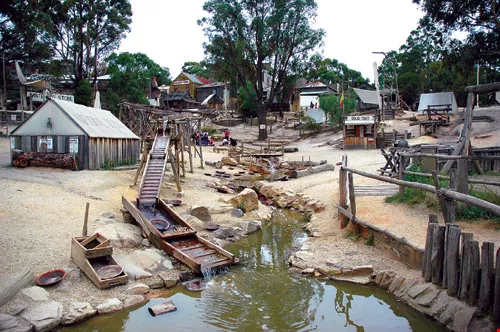
Tourists can experience the excitement of panning for gold in the stream flowing by the old town at Ballarat.
Visitors can see firsthand the skills involved in casting piles of gold dust and rough nuggets into gold ingots. They can buy bread baked in an old brick oven, or browse Victorian style jewelry. Those who are feeling tired can retire to one of the little inns to enjoy morning or afternoon tea served by waiters dressed in 19th-century clothes.
During the peak of the gold rush era-a period of about 40 years-Australian gold made up around 40% of gross world production.
The brilliant yellow metal had a fatal attraction for many. The discoveries stirred the blood of gold-panners from all over the globe and attracted all sorts of treasure hunters. Among them, there were large numbers of Chinese, dressed in the style of the Qing dynasty period with their hair in long pigtails. They gathered together and lived mainly in tents near the goldfields. Examples of these quaint and simple temporary homes can be seen in the old town at Ballarat today.
When we walked into one of these, not far from the entrance we saw two full-sized models of Chinese gold miners dressed in peasant clothes and wearing bamboo hats. One was sitting down and the other standing, the latter holding a large basket and a shovel. For the majority of tourists, these sculptures are not particularly attractive or meaningful, yet they never fail to touch the hearts of Chinese visitors.
Because we had seen these two Qing-dynasty "fellow-countrymen," we decided to visit the place where the Chinese miners settled, forming an ethnically based community of their own. The Chinese village occupies quite a large area, with reconstructed tents, little wooden grocery stores and a small temple. Chinese brush-written announcements are posted on the wall of the grocery store, announcing the arrival of some goods, the dates of meetings organized between people from the same birthplace, and news from various hometowns.
We wandered through the old town and gazed with interest at the different kinds of stores and buildings, later walking down to the stream to try our hand at panning for gold using the original equipment; unfortunately the gods were not looking after us that day.
It must have seemed to the early Chinese miners that the gods had totally abandoned them as well. They were not popular with the Europeans, probably because they wore strange clothes and generally weren't able to speak English. This huge cultural gulf between the different nationalities resulted in at least two serious riots aimed at getting rid of the Chinese. All this sad history is recorded and displayed in the gold museum near the old town.
Because of the race problems, the Chinese immigrants understood well the importance of cooperation. The first Chinese community initiative, a "protector's office," was established in the goldfield. Chinese people also realized that they had to try to blend into and adapt to Australian society. Some miners even cut off their pigtails and put on Western-style clothes, and a few learned English to be better able to communicate with their fellow miners.
We cannot change history. The race riots on the Australian goldfields, reflections of similar experiences of Chinese in the USA and Canada, resulted mainly from the huge differences in culture and language which restricted communication with Europeans. We need courage when we reflect on these aspects of the past. Four poems from the Australian Chinese poet Liao Yun-shan capture the feelings of the time when Chinese workers shipped off to a strange land in search of fortune.
"The Chinese adventurers signed their contracts and, being poor, signed away their lives. / Their countless tears watered the Australian soil, and their ordeals became a page in the history of a foreign land. / Toiling together through the hard life of the mines, sweat and blood soiled the miners' clothes. / Lives were exploited and health was destroyed, and few were ever able to fulfill their dream of returning to the homeland. / These early migrants were stones in the foundation of a new nation, and their significance should be marked by Australia. / Yet who in the last 150 years has recognized the contribution of these early Australians? / The story of the first Chinese Australians remains to be told in full. / The Gold Museum at Sovereign Hill may be a turning point of hope. The remains of those wonderful and terrible days are there for all to see and reflect on. / Looking back is a good preparation for moving forward. Peace between cultures depends on communication."
In Ballarat, the sculptures of the two gold miners wearing poor clothes and sad faces, the tents covered in dust, an incense burner and dishes made from rude pottery, all tell the story of early Chinese immigration to Australia. Although the adventurers experienced racial hatred and other difficulties that we can only imagine, they were unwilling to give up their new homes. We can gather a sense their hopes for the future from the community notices on the walls of the old temple, written with simple Chinese brush pens. They stuck together, supporting each other, even as they simultaneously strove to become a part of mainstream Australian society, thus laying the foundations of Chinese society in Australia today.
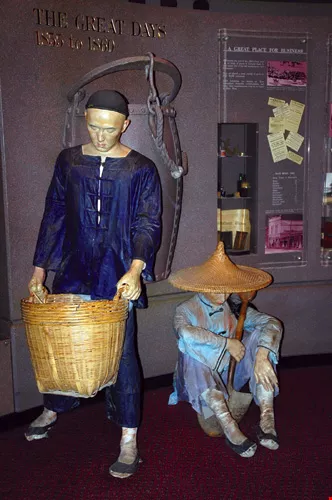
The models of Chinese gold-panners dressed in Qing-dynasty style vividly display the hardships of their lives.
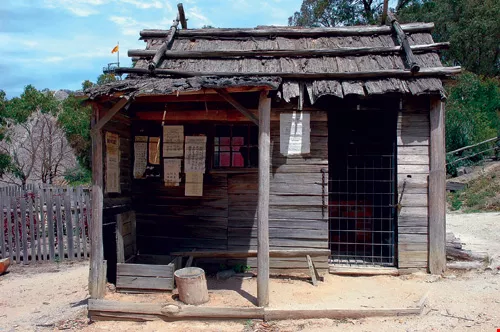
Posted on the wall of a grocery store near the Chinese gold-panners' tent dwellings is a notice announcing a meeting for miners from the same hometown.

@List.jpg?w=522&h=410&mode=crop&format=webp&quality=80)

@List.jpg?w=522&h=410&mode=crop&format=webp&quality=80)


