Cleaning Up with Peace of Mind-Cha Shan Fang Soap
Coral Lee / photos Chuang Kung-ju / tr. by Scott Williams
August 2011


There was a time when the 30-some members of the Lin family all earned their livings making soap. But then the industry went into decline, the factory closed its doors, and family members, both young and old, were compelled to take on part-time work wherever they could find it. Five years ago, the grandson of the factory's original owner, sensing the economic opportunities in nostalgia and the simple-lifestyle movement, revitalized the 50-year-old factory by manufacturing all-natural soaps, reintroducing consumers to the kind of healthy, natural cleanliness that their grandparents once knew.
"Blocks of tea soap! Soap! Soap for bathing or washing your face!" cries the bearded young vendor out hawking soap on the streets of Sanxia's old town. A half century ago, his great grandfather walked the area behind Taipei Station, selling blocks of tea soap from baskets slung on a bamboo pole. Now, like a blast from the past, he too is vending soap amidst the brick walls and arched doorways of the old town area.
Lin You'an, the unpretentious and straightforward 32-year-old president of Cha Shan Fang Soap, is the grandson of Lin Yicai, the founder of the Meishengtang soap factory of 50-some years ago. Behind Lin, sales clerks bustle about, assisting customers in the simple, elegant Cha Shan Fang shop, where a 100-gram bar of soap sells for NT$100-200. A couple of young women dawdle in front of a display, studying the different ingredients-which include tealeaves and tangerines-in each of the soaps. One customer buys a dozen-odd bars as gifts, while another asks about an as-yet-uncut 70-kilogram block of soap.
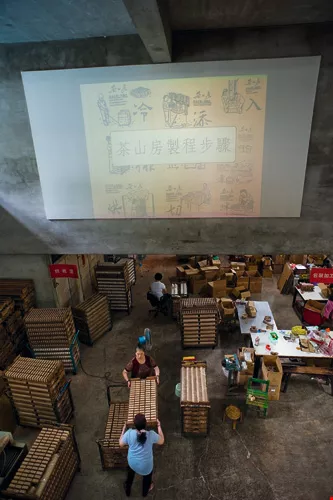
(opposite page, below) The viewing gallery and docents of the Cha Shan Fang factory offer visitors a glimpse of history, introducing them to the old-fashioned hot process that the facility still uses to make its soaps.
The Cha Shan Fang Soap Museum, located near Mount Baiji about 10 minutes by car from the shop, is a great place to learn about handmade soaps. This 660-square-meter site, which became a factory open to tourists back in 2010, attracts more than 100 visitors a day on weekdays and around 200 per day on holidays.
"When Lin Yicai was learning to make soap, the constant exposure to lye gave him eczema on his hands," explains a docent. "After consulting with many doctors, none of whom was able to cure the condition, he began developing a pH-neutral soap that was gentle to the skin and eventually opened his own factory on this very site."
A decade ago, the Lin family couldn't have imagined that they'd someday see a seemingly endless parade of visitors through their factory, buying tens of thousands of bars of soap every month.
The factory's story begins more than 50 years ago. Lin Yicai first took up soapmaking in 1947 and founded the Meishentang soap factory with his younger brother in 1957. In those days, soda ash was replacing sodium hydroxide in the manufacture of soap. Sodium hydroxide is highly corrosive and dangerous to handle, whereas food-grade soda ash is safer and more natural. Seeking to produce the least alkaline soap possible, Lin developed his "soda removal" technique, which involved allowing the basic oil, water, and soda ash mixture to saponify, then adding water and boiling the resultant mixture to eliminate any excess soda. Repeating this step several times, he was left with a lightweight soap of density lower than water. On top of that, adding in later ingredients required constant stirring that whipped air into the soap, lowering its density even further. The result was a soap that would float.
Meishengtang's Float soap was well known to Taiwanese born in the 1960s. In fact, from the 1970s to the 1990s, the company sold 100,000 bars per month to the government-run commissaries that catered to soldiers, civil servants, and teachers. But the growth in the popularity of bath washes over the last 20 years and other changes in consumer habits sent the brand into decline.

(opposite page, above) Lin You'an, the 30-plus owner of the Cha Shan Fang brand, is the grandson of the founder of the Meishengtang soap factory. In rolling out his new brand, the younger Lin has revitalized the family business.
"By 1996, business was terrible and grandfather was unwilling to make body washes. With no work at the factory, my aunts and uncles began earning their livings elsewhere. By 2001, the factory was half-shuttered. We'd make a half barrel-12,000 bars-in a month, which would fill six month's worth of orders."
Lin You'an, grandson of the patriarch, says that his relatives, who'd spent most of their lives making soap, weren't very adept at running a business. Their efforts largely failed and they ran up large debts. Lin found the atmosphere at home stifling: his father drowned his sorrows in alcohol and his mother frequently wept. After high school, Lin enrolled in a physical education college, but gave it up after less than a year as a working student. The financial strain and troubles at home left Lin disinclined to continue his schooling, and he knew he'd never be a top athlete. Given the circumstances, he decided it made more sense for him to enter the working world full time.
Drawing on his judo training and youthful energy, Lin held down four jobs simultaneously. He worked in recycling in the morning, sold tea in the afternoon, worked as a trainer at a gym in spare moments, and dealt in used cars.
During that period, which lasted seven or eight years, he began toying with the idea of rebuilding the family business, but such thoughts always got lost in the constant rush from one job to the next.
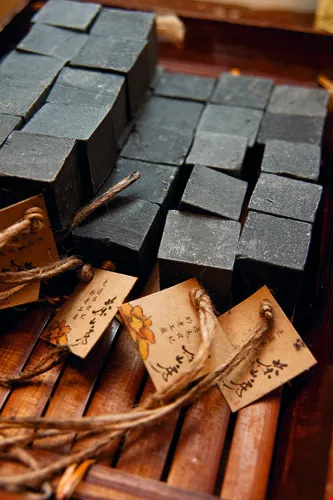
Cha Shan Fang's natural soaps contain a variety of natural ingredients, including (from left to right) bamboo charcoal, Clerodendrum cyrtophyllum (a medicinal herb), roselle, and tangerines. They are a success story that has evolved from the Float soap of 50 years ago.
While selling tea, Lin discovered that Sanxia's senior citizens had a particular fondness for tealeaves, bathing themselves or their feet in tea to treat everything from skin problems to sweaty feet and body odor. This prompted him to take the tea dust and crumbs produced when rolling tea, grind them up, and add them to soap to create a green tea soap. He promoted his new soap by giving it away as a gift with tealeaf purchases, and received a very positive response. Lin's interest in establishing his own brand and reviving the family business grew when customers came back wanting more.
Lin then examined the domestic and foreign handmade soaps on sale in the marketplace, and noticed that consumers favored three attributes: natural ingredients, soft textures with little or no scent, and subdued colors. He realized that his grandfather's techniques-hot processing and soda removal-preserved these characteristics and believed they would produce a market-friendly soap.
But when he approached his 80-year-old grandfather, the elder Lin opposed his plan. He worried that the price-NT$100-200 per bar-was too high and that if his grandson did get things up and running again, the whole family would come back looking for work. "Can you bear that much responsibility?" the elder Lin asked his grandson.
Driven by a sense of familial responsibility and a never-surrender attitude, the younger Lin got the family on board and dove in. He produced a test run of 12,000 bars in 2005, got the local agricultural association to sell his soap together with tealeaves at the credit cooperative, and went looking for more opportunities.
He also persuaded his younger brother Lin Juncheng, who was working in planning at a television station, to come back and help. Juncheng put his skills in storytelling and marketing to work building a website that appealed to consumers with its tale of a half century of soapmaking, the passing down of a family business, and ethical business practices. When the renovations to Sanxia's old town were unveiled in late 2006, the Lins rented a storefront and tested the market's response to their Cha Shan Fang brand. Business boomed, and they gained the confidence to expand.
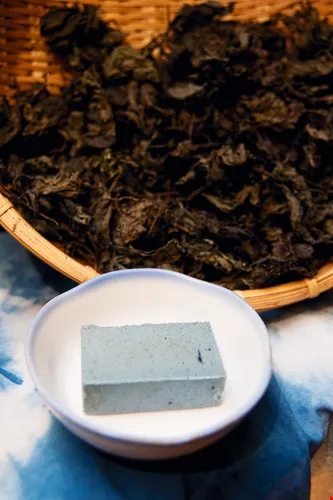
Cha Shan Fang's natural soaps contain a variety of natural ingredients, including (from left to right) bamboo charcoal, Clerodendrum cyrtophyllum (a medicinal herb), roselle, and tangerines. They are a success story that has evolved from the Float soap of 50 years ago.
Cha Shan Fang is currently one of the few soap manufacturers in Taiwan still using the old-fashioned hot process method. The company employs techniques passed down from Grandpa's Meishengtang days, a process that includes 10 steps and takes seven to 10 days to complete.
The first step is the most important and the most difficult. Lin adds coconut oil, olive oil, water, and soda ash to a pot in a precise ratio, then brings the mixture to a boil at 100° Celsius. "It's like making rice porridge," says Lin. "You have to stir it constantly, add some more, then bring it back to a boil. You've got to monitor it continuously for two to three days, adjusting the weightings of the ingredients and the boiling time to account for the weather and humidity. Humid winter days, for example, mean more boiling time." Lin says that his uncles, who are very experienced at the job, handle this step, known as saponification, which combines the oil, water, and soda ash into a soap base. The next step involves extracting the excess soda to produce a pH-neutral soap that's gentle on the skin.
"Everyone used hot processing 40 or 50 years ago," says Lin. "But no one does anymore because it takes too long and costs too much." To the best of his knowledge, Ivory is the only one of the few hot process soaps still made from which the excess base is extracted. This extraction step is what most differentiates Cha Shan Fang's product from the cold-process handmade soaps on the market, like l'Occitane and Yuan. Cold-process soaps combine sodium hydroxide, oil, and water, then heat the mixture to about 50°C, stirring until it congeals. The resulting soap then has to sit for a month and a half before coming to market to allow the sodium hydroxide to evaporate. But the sodium hydroxide evaporates only from the surface of the soap, leaving a slightly alkaline interior that can damage the skin.
Most brands also incorporate ingredients derived from petrochemicals. Frequent use of the harsh soaps that result can produce the dry, cracked hands characteristic of housewives' eczema and the itching red bumps of atopic dermatitis all over the body.
"Grandpa liked to say that soapmaking should be an ethical business," says Lin. "I want to live up to that ideal." He says that Cha Shan Fang doesn't add scents or essential oils to its soaps to make them more fragrant or visually appealing; they add only natural ingredients. The current list of additives to their dozen-odd soaps includes things like tealeaves, herbs, medicinal herbs, and fruit extracts.
The company's development process is for Lin to keep testing until he finds the most appropriate ratio of additional ingredients to soap base. Additives like tangerines are problematic: the fruit loses its vitamin C when dried, but has too much moisture when fresh, which makes soap made with it difficult to preserve and prone to molding. Since adding preservatives violates Lin's soapmaking ethos, he had to work out ratios of skin to flesh for each tangerine variety. He ran dozens of tests before finally getting it just right.
Cha Shan Fang now has six locations around Taiwan, including shops in Taipei, Yilan, and Danshui, in addition to its flagship store in Sanxia. Lin disagrees with the notion that his company's expansion has been slow. He says it might have expanded and grown its profits more rapidly through franchising, but thinks franchising could well have damaged the brand. He argues that training his employees himself and keeping the brand solidly grounded is the key to long-term viability.
Ordinary folks wonder how Cha Shan Fang's prices can be lower than competitors' given its soaps' labor-intensive manufacturing process and natural ingredients. Lin says the reason is that they keep their margins low.
"A customer once wanted to know how natural the 'natural' soaps on the market really were and conducted his own experiment." Smiling, Lin says that the customer put each brand's "natural" soap into a water-filled tank containing a live fish to see how long the fish would survive. The customer reasoned that the most natural soap would take the longest to kill the fish. The fish in the tank with the Cha Shan Fang soap lived the longest.
This consumer's doubts are hardly unfounded. The myriad bath soaps, shampoos and facial washes on the market make a wide variety of claims about nourishing the hair and skin, while laundry and dish detergents trumpet their strength and stain-removing capabilities. Companies are constantly introducing new products with various purported capabilities. But behind every "antibacterial," "floral scented," "extra strength" claim lurks environmentally damaging chemicals. Moreover, numerous experiments on animals have shown that such soap may damage the liver, kidneys and hair follicles, and affect fertility.
With more and more consumers realizing that cleaning products contain toxins, people are turning to alternatives like kucha powder for washing dishes and soapberry for bathing, or spending as much as NT$200 per bar for handmade soaps. The use of a single soap from head to foot marks a return to the simpler lifestyle of our grandparents.
In our more environmentally conscious era, we celebrate the ways in which natural, handmade soaps preserve the wisdom of our agrarian forebears. They have allowed consumers to experience soap as not just a cleaning product, but as an aspect of a more natural, environmentally friendly lifestyle. Walking through Cha Shan Fang's soap-scented factory, you realize that making a vibrant healthy soap is no easy matter, and appreciate it all the more.
Cha Shan Fang's natural soaps contain a variety of natural ingredients, including (from left to right) bamboo charcoal, Clerodendrum cyrtophyllum (a medicinal herb), roselle, and tangerines. They are a success story that has evolved from the Float soap of 50 years ago.
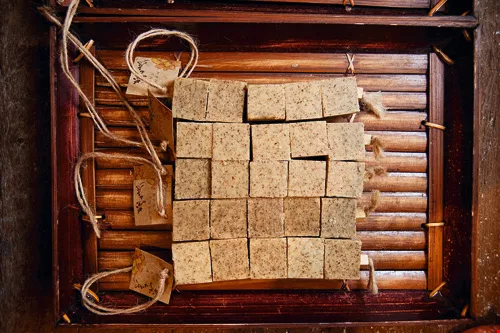
Cha Shan Fang's natural soaps contain a variety of natural ingredients, including (from left to right) bamboo charcoal, Clerodendrum cyrtophyllum (a medicinal herb), roselle, and tangerines. They are a success story that has evolved from the Float soap of 50 years ago.

Cha Shan Fang's natural soaps contain a variety of natural ingredients, including (from left to right) bamboo charcoal, Clerodendrum cyrtophyllum (a medicinal herb), roselle, and tangerines. They are a success story that has evolved from the Float soap of 50 years ago.


