

Located at a convergent tectonic plate boundary, Taiwan is dense with seismic faults and experiences frequent earthquakes. Few are aware that such a geological setting is like a gift from heaven: it's a geothermal paradise. Looking around the world, we see that other countries making active use of geothermal power, including the United States, the Philippines, Japan and Iceland, all lie at the edges of tectonic plates.
Capitalizing on its rich geothermal resources, Taiwan built a geothermal plant in the 1980s that was quite advanced for its time, but operations suddenly ceased in the 1990s due to declining output and falling international oil prices. More recently, with the global trend toward renewable energy sources, government research agencies such as the National Science Council (NSC) and the Industrial Technology Research Institute (ITRI) have become involved in researching and developing new technologies. But how great is Taiwan's geothermal potential? Is there anything worthy of Taiwan's attention amid the latest international development trends?
Why is geothermal activity so abundant around tectonic plate boundaries? It can be explained by the structure of the earth.
It so happens that the temperature of the earth's core is around 4,500-6,000°C; that of the mantle ranges between 500 and 4,500°C; and that of the earth's crust increases by 30°C for each kilometer below the surface. This copious heat energy locked within the earth is known as geothermal energy.
Most of this blazing heat remains isolated in the earth's interior under layers of rock, unable to rise to the surface. But in areas where the earth's crust is fractured, mostly around the edges of tectonic plates, there are numerous cracks where the thermal energy can more easily escape to shallow areas, accessible for human use. For example, hot springs are subterranean water heated geothermally within porous rock strata, which flows to the surface through faults and fractures formed by tectonic movements. The steam given off year round by Taipei's Mt. Datun results from volcanic activity caused by subduction, elevating the ground temperature and transferring large amounts of thermal energy and fluids to the surface.
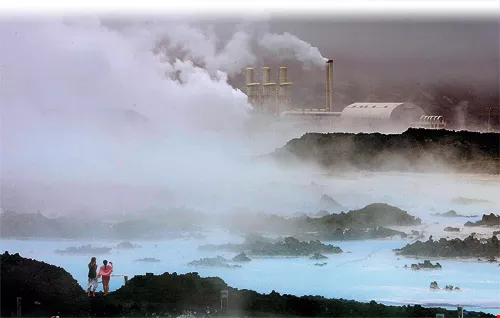
Over the last three decades, major strides have been made in geothermal technology; half of Iceland's electrical power is generated geothermally. Shown here is Iceland's renowned Blue Lagoon hot spring, where tailwater from the geothermal plant is mixed with seawater.
In fact, people discovered the secret of geothermal power over a century ago, using it for industrial heating and greenhouse cultivation. The Italians went on to discover that geothermal energy can be used to generate power. After the first successful geothermal plant was built in 1904, other countries started opening them. In 1973, in the wake of the global oil crisis, countries became more active in geothermal exploration in hopes of quickly developing domestic energy sources to replace petroleum.
In the last few decades, most countries have concentrated on shallow geothermal technologies, in which steam and water are media for drawing thermal energy from porous rock strata in the earth's crust to the surface. These areas are known as geothermal fields.
The principle of geothermal power generation is that steam from beneath the surface of the earth drives turbines which generate electricity. This is the same principle used in thermal power generation, but thermal power plants require the burning of heavy oils or coal, which need to be transported and result in pollution. With geothermal energy, it's like having the boiler and the fuel under the ground, and all you need to do is extract the steam and you can generate electricity.
National Taiwan University professor of geology Song Sheng-rong, who has been commissioned by the NSC to do geothermal research, notes that in the past 30-plus years, geothermal resources around the world have been developed rapidly, with materials and technologies advancing in leaps and bounds. Power output has grown from 1,300 megawatts (the installed capacity of the Fourth Nuclear Power Plant's two power generators will total 2,700 MW) to 9,450 MW, and by 2020 it is estimated to reach 30,000-40,000 MW, three to four times today's capacity.
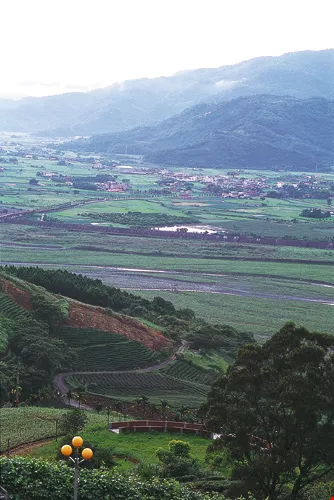
On-site surveys have shown that Qingshui and Tuchang, in Yilan's Datong Township, are brimming with geothermal potential, well worth developing. Shown here is Yilan's Lanyang Plain.
The US, the country with the greatest geothermal power output, launched a major project in 2000 to develop geothermal resources in the western states. So far, 29 geothermal plants have begun operation in California, Nevada and Utah, for a total installed capacity of 1,250 MW, enough to supply 1.2 million households. By 2020, the geothermal power output in the US may reach 20,000 MW.
Song points out that the Philippines, located in the same tectonic boundary as Taiwan on the Pacific Ring of Fire, has built a 1,931 MW geothermal plant with the help of American technology and funding, supplying 13% of the country's total electrical output, making it the world's second largest geothermal power generating country. And in Iceland, geothermal power accounted for half the country's electricity in 2006.
But when compared to the other 20 or so countries developing geothermal power generation, Taiwan's progress has been somewhat halting.
In 1965, Taiwan's government started conducting explorations into geothermal resources. Exploratory drilling was carried out in geothermal areas at Mt. Datun in Taipei and at Qingshui and Tuchang in Yilan's Datong Township, and they found plenty of high-temperature steam. The site at Mt. Datun had the most, but because of its location within a national park, as well as its corrosive acidity, the Qingshui geothermal field became the principal center for development. The NSC went on to conduct successful tests of geothermal power generation at Qingshui. In 1981, a geothermal plant was built, making Taiwan the 14th country to generate geothermal power.
Qingshui: lost potentialSays Ouyang Shoung, a researcher at ITRI's Green Energy and Environment Research Laboratories, the Qingshui Power Plant had a capacity of 3 MW when it was built, and the actual output during its initial period of operation was over 2 MW, a considerable degree of efficiency. But later on, the steam output gradually diminished due to crystalline deposits obstructing the wells, causing the output to drop over the years to 0.5 MW. In 1993 the power plant was closed, and when petroleum prices fell, government research and development in this area was put on hold.
According to Ouyang, there are a few reasons why defeat came when victory was within grasp. First, the power generation method was poorly selected. At the time, mainstream generators consisted of steam-driven turbines, but at the Qingshui geothermal field, it was mostly hot water that came out of the shallow layers, with steam making up only 20%. It's a pity that the hot water wasn't used to generate power. Second, in order to maximize productivity, the well valves were left fully open, but whenever pressure dropped, minerals in the hot water crystallized, blocking the passages. Thirdly, the amount of hot water extracted was too great, and there was not enough natural rainwater to make up for it; this caused a loss of groundwater, in turn leading to a gradual drop in power produced.
"These problems can be overcome by current ideas and new technologies," says Ouyang. ITRI has been working on ways to control encrustation, methods for post-encrustation well flushing, and technologies for injecting water back into the subterranean strata after use, which can help maintain underground water levels, and also prevent environmental problems caused by dumping hot water into rivers.
ITRI has also developed artificial fracking techniques for rock strata that lack natural fractures, as well as numerical simulation methods to analyze the properties of geothermal fields and calculate the positioning of recharge wells, the optimum volume of water to be injected into the wells, and which water levels are the best.
These shallow geothermal technologies are quite developed overseas, but because of the high complexity of Taiwan's geology and topography, research teams need to make adjustments for local use.
Deep geothermal energyTraditional shallow geothermal power generation is limited by the volume of subterranean water and whether there are natural fractures in the rock. But the thermal energy stored 3,000-10,000 meters underground is greater and is not limited by geography, and is currently an active area of research by various countries.
Song explains that the greatest difference between shallow and deep geothermal energy is that shallow geothermal power generation makes use of hot water and steam from underground to naturally bring thermal energy to the surface, while its deep counterpart makes use of external force to pump surface water deep into the earth, which then is heated and drawn up for use.
Ouyang relates that the new technology for deep geothermal power generation is called an enhanced geothermal system (EGS). The US, EU and Australia have all invested considerable effort into research; for instance, President Obama, after taking office in 2008, signed a US$350-million geothermal budget, with over half of it allocated to EGS development. The EU and Australia use different names, but the concept is similar: water is pumped down from the surface, then the liquid flows through manmade fractures in the rock strata. The crux of the technology lies in how to position the fractures for optimal effectiveness, and how the pressure, temperature and structure of the rock strata are related. In EGS, carbon dioxide can also be injected instead of water to extract the thermal energy, or a heat exchange system can be placed directly in the wells, the resulting heat energy being used to generate electricity.
"MIT professor James Tester's team estimates that the global potential for deep geothermal power generation is 300 times greater than that for fossil fuels," says Song. This vast potential is a great hope for replacing rapidly diminishing fossil fuel stores.
Shallow versus deepIn Taiwan, the advantage of EGS is that the geothermal gradient (the temperature increase for each kilometer down into the ground) of over 50% of the land is 40°C; even higher in some areas. This is at least 10°C higher than that of most other countries; that is to say, to reach 200°C of thermal energy, one would have to drill a well 5,000 m deep elsewhere, whereas only 4,000 m would be needed in Taiwan, given its superior natural conditions.
What potential does Taiwan have for deep geothermal power generation? According to the NSC's 2008 report National Science and Technology Program-Energy, it is estimated that over 7,000 MW can be generated, equivalent to 2.7 times the power output of the Fourth Nuclear Power Plant (at 2,700 MW). If secondary regions are included, there's a potential for as high as 25,000 MW of power, corresponding to 9.7 times the output of the same nuclear plant.
Liu Tsung-kwei, coordinator-in-chief of the NSC geothermal project and professor of geology at NTU, notes that geothermal surveying is an advancing field: first, large areas can be surveyed using surface geology as well as geophysical (seismic waves, electrical resistivity, earth's magnetism, etc.) and geochemical (water quality, gases) methods; then shallow exploratory wells can be dug; and finally deep exploratory wells can be drilled and samples analyzed. It's a long, drawn-out process, so from the standpoint of scholars, the earlier it's started, the better.
Song stresses that geothermal energy is not only an environmentally friendly way to generate power, with zero carbon emissions and high efficiency, it is also the power generation method with the greatest ability to withstand natural disasters. The recent 9.0 magnitude earthquake and tsunami in Japan caused serious damage to the Fukushima nuclear plant leading to disastrous radiation leaks, but several neighboring geothermal plants were barely affected, and the power output was not affected at all. Because of the high selectability of locations for building geothermal plants, they don't need to be located by seacoasts or rivers, so they're well suited for quake- and typhoon-prone Taiwan.
Taiwan has been granted a gift from heaven above... or more aptly, from the earth below. Now is the time for preparation, followed by action.

@List.jpg?w=522&h=410&mode=crop&format=webp&quality=80)
@List.jpg?w=522&h=410&mode=crop&format=webp&quality=80)


