Tainung No. 1 Pixie: The Dawn of Small-Flowered Phalaenopsis
Chang Chiung-fang / photos Hsueh Chi-kuang / tr. by Chris Nelson
June 2010


Three to five little green leaves complement a white-based pink-striped flower, vivid and lithe, like a host of fluttering butterflies.
This is Tainung No. 1 Pixie, a new Phalaenopsis orchid variety. Plant breeders' rights for this orchid were granted to the Taiwan Agricultural Research Institute's Floriculture Research Center by the Council of Agriculture in 2008, and this April, Grand Biotechnology won authorization to grow and sell it.
There are those who say that just as the 17th century was the age of the tulip, the 21st century is the age of the Phalaenopsis.
Taiwan has been called the Kingdom of Orchids. Back in 1994, Phalaenopsis joined the mango, high-mountain tea and tilapia as one of Taiwan's big four agricultural exports. Phalaenopsis cultivation has been going on in Taiwan for nearly a century, and the process has been industrialized for 20 years, with splendid development in quality, shape and color.
Hsieh Ting-fang, director of the Floriculture Research Center at the Taiwan Agricultural Research Institute (TARI), tells us that Phalaenopsis is a member of the family Orchidaceae. The moth-like shape of the flowers, dancing gently in the breeze, gives this genus the common name of "moth orchid."
Subtropical Taiwan is the northernmost limit of the moth orchid's range. Of some 50 species of Phalaenopsis, Taiwan is home to just two indigenous species: red-flowered P. equestris and white-flowered P. aphrodite. But with constant hybridization, there are over 1,000 Phalaenopsis varieties found in Taiwan, with flowers as big as 17 centimeters across and as small as 2.5 cm. The coloration is highly diverse: among white flowers alone, we're availed of pure white forms, white with a red labellum, white with a touch of red halo on the lobes, white mottled with black dots, and much more. The colors of the red flowers range from deep red and light red to pink, light pink and light pink with stripes. And Phalaenopsis Golden Emperor, rare and stately, as well as Phalaenopsis Harlequin, adorned with curious purple-black splotches giving a clown-like appearance, are Taiwan-bred orchids that took the world's major exhibitions by storm. "Basically, the colors of Phalaenopsis have been so diverse that it's hard to breed any new colors," says Hsieh.
Certainly, professional and amateur orchid growers have tried countless crossbreeding possibilities, enriching the staggering variety of Taiwan's moth orchids. However, after many years of breeding and growing, the simple, elegant red and white varieties still dominate the market. But growers relentlessly cultivate new varieties with a gambler's mentality, hoping to hit the jackpot with the next market leader.
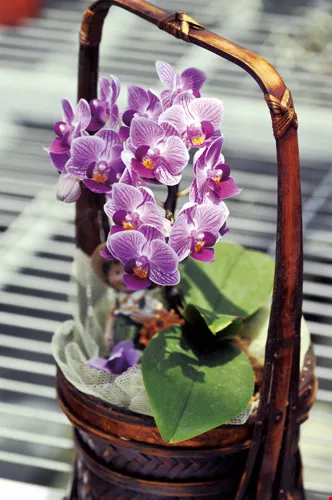
Little white flowers with pink stripes and a dainty peach-colored labellum exude the sentiment "I love you." Are you enchanted by this new Phalaenopsis variety-Tainung No. 1 Pixie?
Could the Pixie be the next great Phalaenopsis variety? What are its properties and potential?
Tainung No. 1 Pixie is a short-stalked, miniature, multi-flowered new Phalaenopsis. It's straight-stemmed, with twin leaves only 10 cm wide and a stalk less than 15 cm tall; plus the flowers' "wingspan" is only 3.5 cm. This orchid is small enough to be held in the hand, and can be grown in a small coffee cup, ideal for the office desk or windowsill.
Besides having a short stalk and numerous flowers, it has a greatly reduced juvenile period, a major advantage of this variety.
Not counting the incubation period of about a year and a half, most Phalaenopsis varieties require one to one-and-a-half years between the time a seedling is removed from its sterile culture bottle until the time it blooms. But the Pixie only needs six months for this. Floriculture Research Center researcher Tsai Wei-ting, its developer, notes that if temperature control is used (28-32oC during the growth period, and 15-16oC during budding) and the waiting period is extended to a year, then two stalks will grow simultaneously, with more than 20 flowers blooming. This is great for sales.
But this short juvenile period is not to be taken lightly. According to Tsai, shortening the waiting period by between six and 12 months greatly reduces costs to growers, boosting potential for market development.
Interestingly, this elegant orchid quietly lay undiscovered for many years before being noticed by Tsai.
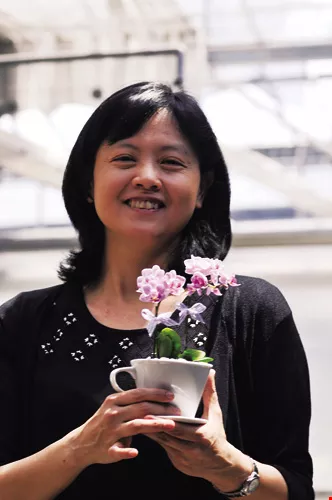
Tsai Wei-ting, researcher at the Floriculture Research Center and creator of new hybrids, admires the short-stalked, multi-flowered, easy-to-grow Tainung No. 1 Pixie that she holds in her hand.
TARI opened the Floriculture Research Center in Gukeng, Yunlin County, in 2002, after which research began on breeding and germplasm preservation for Phalaenopsis, Oncidium and Anthurium varieties meant for export.
At first, the center grew seedlings straight from seeds (rather than from meristem tissues, which are used in tissue cultures and cloning) that were provided by private Phalaenopsis growers. But four years ago, Tsai, who had acquired a discerning eye through eight years of Phalaenopsis breeding at the Taiwan Sugar Corporation, noticed this dainty orchid upon joining the center.
Tainung No. 1 Pixie's pedigree is quite complex, with a hard-to-verify lineage, but it can be confirmed that it originates from a hybrid of red-flowered Phalaenopsis equestris and white-flowered Phalaenopsis Timothy Christopher.
On finding this lovely little Phalaenopsis with a short stem and many flowers, Tsai says, "I knew right then that this was a rare variety with a lot of potential." Breeding new hybrids isn't hard: what's desired are properties that stand out, whether it's the color or shape of the flowers. But the results of crossbreeding are often unpredictable and public whimsies are hard to foresee; in other words, the key to the value of a new hybrid is whether there's a market for it. Tainung No. 1 Pixie meets the criteria for mass marketing in terms of shortness of juvenile period and ease of transplanting, but only experience will tell if it will be liked and where the market is.
According to Tsai, Japan, one of Taiwan's major export markets for Phalaenopsis, has long favored large white flowers, but the Japanese are not so fond of white flowers with pink stripes, since they look like blood vessels. However, Chinese and European consumers like striped flowers.
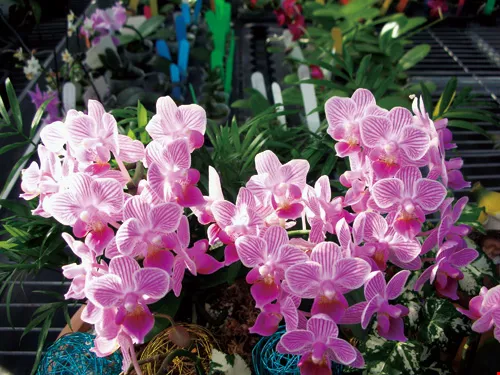
Little white flowers with pink stripes and a dainty peach-colored labellum exude the sentiment "I love you." Are you enchanted by this new Phalaenopsis variety-Tainung No. 1 Pixie?
After over two years of meristem breeding, TARI unveiled the Pixie at a hybrid convention in 2007. Its revelation elicited pleasant surprise from those who saw it for the first time, with many people expressing deep interest in it. Tsai named it "Pixie." And since it was the first new Phalaenopsis hybrid developed by TARI, it became known as "Tainung No. 1 Pixie." In 2008 it was granted Taiwan plant breeders' rights.
Last year the Pixie was entered into a number of orchid exhibitions, winning the bronze medal at the Taiwan International Orchid Show, the Outstanding New Flower Award at the Beixuan Temple Taiwanese Orchid Festival, and third prize at the Taiwan Orchid Breeders Society exhibition.
The rave reviews it garnered from these shows evoked a high degree of interest among orchid growers. Thereafter, TARI held a bidding session in October 2009, authorizing Grand Biotechnology to grow and sell the orchid, which earned TARI nominal royalties of NT$161,000 plus NT$2 per sale.
"The Floriculture Research Center's goal is to help promote and upgrade the Phalaenopsis industry, not to make a profit," stresses Tsai regarding the center's function as a technology research institute for Taiwan's flower industry.
In mid-May, 350 Pixies were sent to Grand Biotechnology, and placed temporarily in a greenhouse, awaiting further tissue and meristem culture, after which large-scale cultivation would take place.
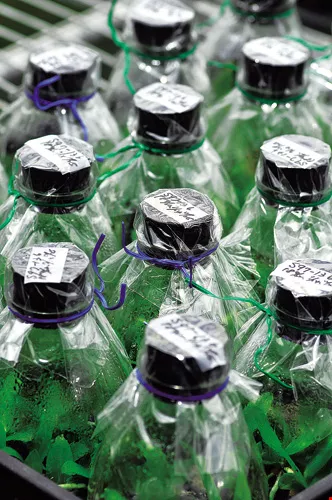
In the high-tech cultivation of Phalaenopsis, seedlings are grown for a year or more in an agar matrix in sterile glass bottles before they can be transplanted.
Grand Biotechnology, located in Hsinchu Science Park, is one of the few Taiwanese tissue culture facilities dedicated to growing flower crops, fully equipped with labs, clean rooms, processing rooms and greenhouses. Besides large-scale Phalaenopsis cultivation, Grand Biotech has been commissioned to proceed with tissue cultures for papayas and forget-me-nots.
Grand Biotech president Zhao Hongyan sees great prospects in Tainung No. 1 Pixie. He says that before bidding started, interested growers asked him to pay close attention to this Phalaenopsis; that is to say, the market had formed before Grand had even started growing it.
It will be a while before the Pixie hits the market, but keen-eyed consumers may have already noticed many small-flowered Phalaenopsis orchids appearing on the market over the last couple years. The small-flowered orchid varieties now available are somewhat dissimilar to the Pixie in color and shape, but they hail the dawning of the age of the small-flowered Phalaenopsis.
Regarding private enterprise's resourcefulness in seizing this opportunity, Hsieh says helplessly that despite the Pixie's market debut being hampered by sluggish bureaucratic procedures (securing plant breeders' rights, being evaluated by intellectual property committees, launching bids, and so forth), which has made the Pixie lose its lead in the market, he believes its easy cultivation and compressed juvenile period will be an advantage that other small-flowered varieties will find hard to catch up to.
It remains to be seen whether the years of persistence in the cooperation between TARI and Grand Biotech will enable Taiwan's Phalaenopsis growing industry to scale new heights.

@List.jpg?w=522&h=410&mode=crop&format=webp&quality=80)

@List.jpg?w=522&h=410&mode=crop&format=webp&quality=80)

@List.jpg?w=522&h=410&mode=crop&format=webp&quality=80)
@List.jpg?w=522&h=410&mode=crop&format=webp&quality=80)

