Couchsurfing around the World
Lin Hsin-ching / photos Chuang Kung-ju / tr. by Scott Gregory
June 2009


"Wouldn't it be great if you had a friend to lend you a place to stay everywhere you wanted to go?" It sounds like a dream, but it's been made real. These amazing travelers call themselves "couchsurfers," "surfing" their way around the world one couch at a time. Just join up on their website and you can get free accommodation just about anywhere you can imagine.
It's evening, and 26-year-old Yang Bingxuan is riding his bicycle into a warm, late-spring breeze. He carries a simple pack as he cuts through traffic in crowded Hsinchu City. He makes a skillful turn and pulls onto Minghu Road, the road to the famed scenic spot Green Grass Lake.
To most cyclists, riding up winding Minghu Road would be something of a challenge. But it's not to Yang, who's traveled around the entire island in less than half a month. He surveys the villas along the way and says excitedly, "Tonight I'm staying at Fengying's place. I've heard her place is really pretty, and she's friendly too. I'm really looking forward to it!"
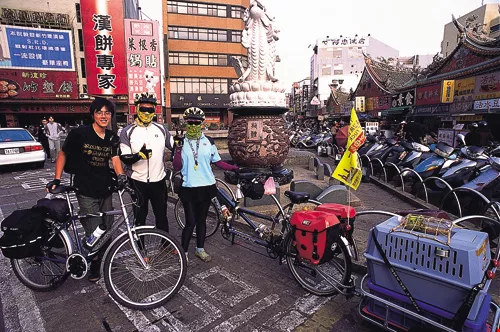
In Hsinchu, Yang ran across a couple who were also making an around-the-island tour by bicycle. They pulled a trailer behind them. Rather than baggage, the cart carried their pet dog. Since the biking craze swept Taiwan, around-the-island riders have become a familiar sight all over.
The "Fengying" he speaks of is Wu Fengying, a technician at the National Synchrotron Radiation Research Center in the Hsinchu Science Park. She's known online as a cordial host.
Wu, who lives with her two daughters in a multistory villa, not only provides free accommodation to backpackers visiting Green Grass Lake, but she's also always willing to give out personal recommendations for local sights to see and foods to try. On weekends, she'll even cook a delicious full-course meal for these on-a-shoestring backpackers.
To welcome Yang, Wu has set up the guest room on the second floor. Not only does the room have air conditioning and heating, it also has a private bath with an enclosed shower. Even the sheets and spread cover have been changed for fresh ones. It's more comfy than a hotel.
Why is she willing to give up her privacy and provide free lodging to young travelers? A devout Christian, Wu says with a smile that she loves to share and she's often entertained friends from church, friends from the Internet, her daughters' friends, and even friends of friends. "It's my belief that people who've stayed here are friends. Basically, if a friend introduces a friend, I can trust them and am happy to have them because sharing is the best way to receive."
Wu says she loves to travel but when she was young she was too busy with work and family. She never imagined she could put everything down to go traveling like young people are doing now, so she admires their courage. If she can help them achieve their dream, she feels like she is participating in it.
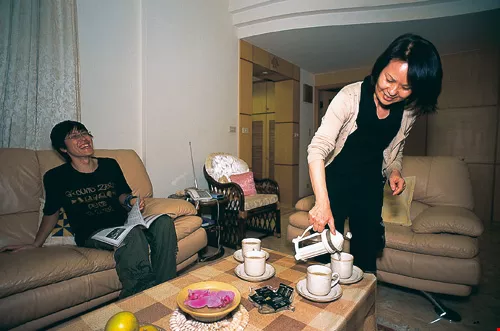
iHaoke member Fengying is a warm and cordial host. Not only does she offer her immaculate guest bedroom to young travelers, she also treats them to tea, snacks, and hotpot meals.
This way of traveling, in which strangers like Yang and Wu come together by fate, is the new favorite of the world's young backpackers-"couchsurfing."
The concept behind couchsurfing arose in 2000 when an American named Casey Fenton found a very cheap flight from Boston to Iceland online. But he had to use the ticket within four days. Pressed for time and knowing nothing about Iceland, he didn't know where to stay or what to do there. After pondering the problem for a while, he came across a list of email addresses for University of Iceland students and inspiration struck. He sent out a politely worded email to 1,500 students asking if they would be willing to put him up for free. Within 24 hours, he ended up with responses from over 50 people. With their help, he had an inexpensive and unforgettable trip.
Upon returning to America, he began promoting the idea of lending a couch to travelers. In 2003, he established the CouchSurfing website. The site declares that it is not just a means for travelers to get cheap accommodation, but also a channel for uniting the world's cultures. Understanding is created through contact with the cultures of strangers, and a sense of trust and sharing can be re-established between strangers. The ultimate goal of the couchsurfers is a more peaceful world.
Many backpackers responded strongly to Fenton's concept, quickly making the website one of the world's most popular travel sites. Currently it has over a million registered users in 232 countries.

Yang, who loves to make new friends, tries to strike up conversations with locals wherever he goes. He's pictured here after coming across the procession of the Hsinchu City God in front of its temple. To better understand the meaning of the ceremony, he sought out volunteers for more information.
Travel writer 943, who uses the CouchSurfing site and managed to travel around the world in 80 days on just NT$100,000, says that staying at someone's house is not just a way to save money. The best part is that you can get close to local people's lives.
For example, when she went to Paris, she stayed with a female student and tried to live at the same pace as everyone else: she woke up around noon every day and prepared a simple sandwich for a picnic lunch on the grass. In the afternoons, she'd go swimming at a free community pool, and in the evenings she'd have a simple pasta meal and some drinks. It was a relaxed way of life.
"This trip made me realize that some French girls really love to chat," she says. "All day they'd talk about who was with who or other such gossip. Even at the pool they'd go in the water and then come back up to chat. This was pretty different from the view we have of French people as romantic, fashionable, and cultured. It's really something most travelers don't get to see," she laughs.
Couchsurfing is cheap and fun, but to many who've never been involved it sounds dangerous. To assuage such concerns, CouchSurfing uses a credit card verification system. Members can opt to pay a US$25 verification fee and register basic information such as their names and addresses. Profiles of verified members have codes for others to check.
943 suggests that backpackers interested in giving it a try should select members with positive ratings from others, and that it is safer to stick with members of the same sex or with couples. She usually only inquires about staying with members who've hosted at least three single females before and who have received positive marks from past guests.
943 points out that many Taiwanese would feel ill at ease about staying with a stranger, or fear they would be taking advantage. They might be too suspicious of the other party's motives, or of being robbed, or of getting stuck with inferior accommodation. But in reality, "accommodation exchange" has long been common in Western countries, where many people give guests a spare room. "Many hosts will give you a key to their home as soon as you arrive and let you come and go as you please. They're not in the least afraid you'll take everything while they're out. They've figured out that extra precautions aren't necessary," she laughs.
Couchsurfing, Taiwanese styleWith the trend toward sharing accommodation, a local CouchSurfing-style website has been created. In November of last year, four avid travelers started the site iHaoke, the first of its kind in Taiwan.
One of iHaoke's founders, Liu Junyi, used to do marketing for online travel agent Star Travel. While working there he noticed that whereas in the past young people on a budget would usually choose "DIY packages" of discount tickets and accommodation in youth hostels or cheap hotels, now they were jumping at the chance to save even more and see more of the local lifestyle at the same time.
"Taiwanese are warm and hospitable, so I believed that many people would love to support this friendly style of travel," Liu says. "The only problem was that CouchSurfing's all-English interface presented a barrier. So we wanted to make a Chinese-language site."
The Taiwanese version of CouchSurfing, iHaoke, has only been up for a few months but already has nearly 3,000 members. Of them, around half are Taiwanese and the rest are from China, Hong Kong, Macao, Singapore, Malaysia, and other countries in Europe and the Americas.
Many people get the chance to live out their travel dreams through the site. Last October, for example, a member named Jason made a trip around Taiwan entirely for free before starting his military service by staying with iHaoke members and eating free boxed meals that were about to expire from convenience stores. During this year's Lunar New Year holiday, some members volunteered to deliver gifts and cheer to orphanages around Taiwan. Yang Bingxuan plans to travel extensively around the island for two months on just NT$20,000 with the assistance of members like Wu Fengying.
Liu points out that after traveling in this way, many people are deeply touched by the warmth of people all over Taiwan. A person from Hong Kong he recently hosted named Cat, for example, had been to Taiwan several times and thought she'd seen it all. But because some good friends she'd made on the site took her bicycling at Riverside Park and out for snacks at Ningxia Night market, she fell in love again with Taiwan. Now she comes back once every couple months.
"The simplicity and passion of the Taiwanese people are our richest travel assets. This sort of deep travel style really should be promoted," Liu says.
The cooperation promoted by CouchSurfing and iHaoke breaks down psychological barriers between strangers and revives the rarest sort of trust. In this contemporary world of isolation, such a utopian dream is especially precious. Its being made reality is the best showing of the positive value of travel.

@List.jpg?w=522&h=410&mode=crop&format=webp&quality=80)
@List.jpg?w=522&h=410&mode=crop&format=webp&quality=80)


