Sean Chen and New Cabinet Aim to Spread Prosperity
the editors / photos courtesy of the Government Information Office / tr. by Scott Williams
March 2012


On February 6, President Ma Ying-jeou swore in Premier Sean Chen and his new cabinet. As the President expressed the hope that the new cabinet would bring peace of mind to the public, Premier Chen called for the creation of “an economy that enriches the people.”
Sean Chen is the first finance professional to serve as ROC premier. The 62-year-old Chen is an alumnus of National Taiwan University’s graduate program in law, where he was one class ahead of President Ma.
Chen was recruited into government service from his position as general manager of strategic planning at the Farmers’ Bank of China in 1989 by then finance minister Shirley Kuo, and quickly ascended to the rank of deputy finance minister.
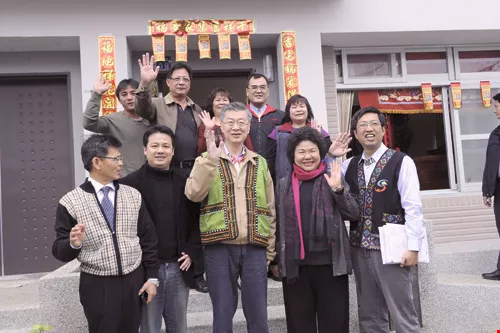
Premier Chen toured the reconstruction work in Kaohsiung’s Da’ai Village with minister without portfolio Yang Chiu-hsing (left) and Kaohsiung mayor Chen Chu (second right) immediately after taking office.
Chen took over the chairmanship of the Taiwan Stock Exchange in 2002, during the Democratic Progressive Party’s tenure as ruling party. While there, he helped bring the exchange up to international standards, oversaw the listing of the Taiwan 50 Index Fund (an exchange-traded index fund), and won wide acclaim from the market. He moved on to the chairmanship of the Taiwan Cooperative Bank in 2004, overseeing the bank’s privatization, its listing on the stock market, and its acquisition of the Farmers’ Bank of China, while simultaneously growing its after-tax earnings tenfold to more than NT$10 billion. In spite of his many successes, he was pushed out in the late-2006 flurry of replacements of heads of domestic financial institutions.
In 2009, he took over as chair of the Financial Supervisory Commission where he immediately inspired new ideas, such as anti “fat cat” rules aimed at the financial industry. Chen felt that salaries for the chairs, CEOs, board members and supervisors of financial institutions needed to be linked to their institutions’ performance and risk burden to protect the interests of shareholders and prevent the board, supervisors, and upper management from paying themselves a fortune while running their companies into the ground.
In their efforts to rake in large bonuses, Wall Street traders and executives designed complex structured notes and sold them as far afield as Taiwan, where they created steep losses for many investors in the global financial tsunami. Chen proffered a better incentive structure as a solution. Arguing against the conventional bonus system, which rewards bankers on their short-term sales of financial products, Chen proposed linking compensation to long-term performance.
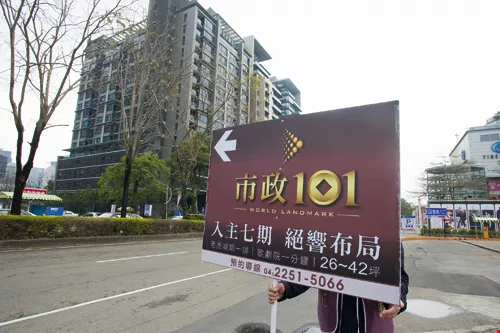
With urban housing prices soaring ever higher and the gap between rich and poor growing, the new cabinet’s mission is to “create an economy that enriches the people.”
Chen combines banking, insurance, and securities expertise in a single package, and has often shared his perspective in columns he has written for the media. In 2007, he went even further, taking the pulse of Taiwan’s financial industry in a book entitled French Wolves and Owls: Sean Chen’s Take on Finance and the World.
In it, he relates a French fable about a pack of wolves that one day hear of a pristine land filled with prey on the far side of a deep gorge. Not knowing how to get across this natural obstacle, they twice approach a wise owl for its thoughts. The first time, the owl suggests they transform themselves into birds. The second time, it recommends becoming fish. Unable to figure out how to do either, the wolves approach the owl a third time. This time, the owl says: “I offer ideas. Putting them into practice is your problem.”
“Taiwan has no dearth of owls,” writes Chen. “The problem is that some of them offer unrealistic advice, just empty slogans that wear out the French wolves.”
“Taiwan has even more ‘French wolves.’ These are brave warriors who excel in the field. If they could just learn to think and evaluate a bit better, they wouldn’t be sucked in by the ill-considered remarks of the owls.”
Chen says he hopes he has the necessary intelligence, as well as the capability, to implement his ideas.
According to the Executive Yuan, the new 47-member cabinet averages 58 years of age. It includes 16 new faces, 11 women, and 32 PhDs (nearly 70% of the total membership). The administration is characterizing it as an assemblage of “new branches on a sturdy old trunk.”
President Ma even borrowed from Google in creating it, recruiting Simon Chang, head of Google’s Asia-Pacific hardware operations in Asia, as a minister without portfolio. Chang, regarded as the dark horse of the new cabinet, is an experienced hand who has previously served as a professor at NTU, a director of planning with the National Science Council, and vice president of Acer’s e-Enabling Services Business Group. He is being widely acclaimed for his willingness to give up his lucrative position in the private sector to join the cabinet, where he will work on strengthening Taiwan’s information technology sector.
Responding to criticism that the new cabinet is simply “more of the same,” Chen referenced baseball, noting that nine Wang Chien-mings don’t necessarily make an ideal lineup. Teams that hope to compete need members with their own unique strengths and attributes. He argued that the number of new and old faces in the cabinet isn’t important. What matters is that the first baseman take care of first base when the pitcher takes the mound. Similarly, if the cabinet is to perform well, the ministers without portfolio and ministry heads that comprise it must bring their personal aptitudes and expertise to bear.
The economics of happinessIn contrast to the government’s previous pursuit of rapid economic growth, Chen is advocating the notion of a prosperous public as a source of national strength. The idea has its origins in the Han-Dynasty Wu Yue Chun Qiu, which states: “The King of Yue built up the nation’s treasury and cultivated his fields, making the people prosperous, the nation strong, the public happy, and society peaceful.”
Chen stresses that “prosperity” isn’t limited to economic or monetary value, and has more to do with the public’s quality of life and cultural level. He has already asked the Directorate-General of Budget, Accounting and Statistics to develop a happiness index for Taiwan to measure not just the public’s wealth, but its sense of satisfaction and fulfillment. The idea of a prosperous public being a source of national strength differs from the traditional notion of a prosperous nation giving rise to a strong populace. The underlying reasoning is that if the public has peace of mind and prosperity in this broader sense, the nation will naturally be strong and society will run smoothly.
The DGBAS says that it plans to study the OECD’s Your Better Life Index, as well as the happiness indices that Japan and the UK are currently testing. It expects to develop and introduce its own “National Happiness Index” within a year.
The international community adopted gross domestic product (GDP) as the default measure of an economy’s strength following World War II. Economists later switched to using per-capita GDP to compare economies. By this latter measure, Switzerland has the world’s strongest economy, with a per-capita GDP of roughly US$70,000 versus Taiwan’s US$20,000-plus.
However, this strictly economic measurement leaves out important issues like quality of life and social development. Recognizing this lack, in 1972 Bhutan introduced a “gross national happiness” index that combines measures of good governance, economic health, cultural development, and environmental conservation. As income distribution, environmental health, and economic development have come into ever greater conflict over the last 20 years, measures of happiness have garnered greater global attention.
Shrinking the income gapDuring an early cabinet meeting, Chen noted that the pursuit of an “economy that enriches the people” reflects the sentiment driving the president’s formation of a “peace-of-mind” cabinet. He added that he expects every ministry, department and commission to work together to bring prosperity to every citizen, particularly those in lower income strata.
Chen cited an article published last year in the UK’s Economist magazine entitled “The Rich and the Rest.” By dividing the world into the wealthy and everyone else, the piece made plain that income inequality is an issue affecting global economic development. Shrinking the gap will not be easy, and Chen argues that governments must strive to do so by increasing the incomes of middle- and low-income citizens rather than by dragging down those of the wealthy.
Chen sees education as the key to resolving global and regional imbalances because it fosters class mobility and reduces income disparities.
In Taiwan, which has already transitioned from a labor-intensive to a capital- and knowledge-intensive economy, creating jobs means establishing high-value industries and expanding the service sector. Chen says that the ministries of the government will focus on the development of exportable services through initiatives such as making Taiwan into a center of higher education for Southeast Asia, and developing international medical tourism. In the case of ordinary tourism, the administration will seek to increase the number of visitors to the island while also taking environmental and cultural impacts into consideration.
The administration doesn’t have the luxury of a honeymoon period. With the nation facing challenges ranging from the European debt crisis, tax reform, and the creation of new industries to social welfare issues, and negotiations on importing US beef, Sean Chen and his cabinet have a full slate.


@List.JPG?w=522&h=410&mode=crop&format=webp&quality=80)


