Finding Their Groove: Ten Drum Art Percussion’s Repertory Performances
Liu Yingfeng / photos Jimmy Lin / tr. by Scott Williams
October 2012


Tourists visiting New York almost invariably want to see a Broadway show. Those traveling to mainland China usually try to catch one of Zhang Yimou’s Impressions extravaganzas. South Korea has gotten into the act in recent years with its Nanta drum performances. But what do tourists hope to see in Taiwan?
Last year, the Council for Cultural Affairs (now the Ministry of Culture) began selecting performance troupes for support under its program to promote cultural tourism by subsidizing resident companies presenting repertory performances. Four groups received funding: All U People Theatre, Diabolo Dance Theatre, Up Art Integrated Marketing Services, and Ten Drum Art Percussion. One year later, only Ten Drum was still offering these kinds of performances as a resident company, the other three having given up as a result of either exorbitant costs or smaller-than-expected audiences.
Is the Taiwanese entertainment ecosystem not yet ready to support resident companies? Or is sole survivor Ten Drum simply more innovative than the other groups were?
Travelers see the characters for “Ten Drum” on a distant brick-red smokestack the moment they hit the Tainan exit ramp. The Ten Drum Culture Village—an old sugar mill transformed into a drum performance space—is about a 10-minute drive from the Bao’an Train Station. The railway line, which used to transport sugarcane, now carries trainloads of tourists to a “village” that reverberates all day long to the sound of drums.
With little money or manpower for marketing, the village had to rely on word of mouth to get the word out and took three years to reach the break-even point. Over the years, attendance has grown from a trickle to the current torrent of nearly 20,000 patrons per month. In fact, according to the ROC Tourism Bureau, the number of people visiting the village last year exceeded the 180,000 who visited Taipei’s Museum of Contemporary Art.
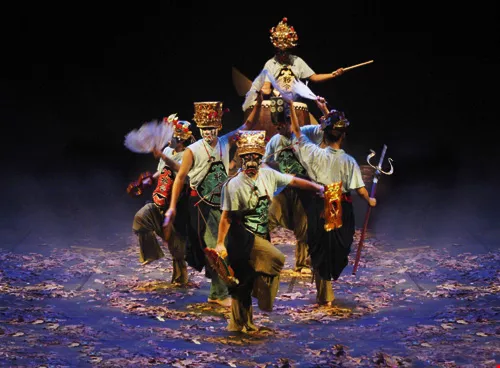
Ten Drum has created an indigenous style of drum performance that incorporates various temple dance moves, including those of the Taiwanese “Eight Generals” style.
Drum-related arts are everywhere in the six-hectare village, which offers performances every day, compared to just Tuesdays, Thursdays, and weekends when it first opened. It also has a master drum maker with 35 years of experience onsite to explain the drum making process to visitors, and a drum education area where visitors can join in with the performers. Even the village’s restaurant has gotten into the act, providing diners with utensils shaped like drum shells and drumsticks.
Ten Drum has been successful in transforming into a resident company offering repertory performances because it has been able to shrink the distance between audience and performer.
Ju Tzong-ching, president of Taipei National University of the Arts, says that Taiwan’s government defines “repertory performances” as fixed programs at fixed locations, but these can take many forms. South Korea’s mass-market Nanta, China’s natural-scenery-infused Impressions, the US’s very metropolitan Broadway shows, and Europe’s artistically pure operas are all examples of such shows.
Broadly speaking, Taiwan’s various regions all feature their own culturally oriented repertory performances, as well as theme-park performances like those at Formosa Aboriginal Culture Village. In Ju’s view the problem is that they don’t make the kind of lasting impression on visitors that a Broadway show does because their development has been so haphazard. Taiwan has the creative and performing talent to create repertory shows. If the government is serious about promoting their development over the long term, it can continue to spread resources across a broad swath of troupes, or perhaps select some group as a “national troupe” and back it fully. Ju believes that the public’s growing attention to the issue of repertory shows represents a breakthrough.
As for such shows’ potential for boosting tourism, Li Qiyue, a former member of the Godot Theatre Company and now the CEO of Chung Hsing Travel Services, says that Taiwan’s repertory productions need to offer audiences something special and unique. TaipeiEYE began staging traditional theatrical performances a few years ago, and even established a resident company with its own repertoire. But no one, whether a domestic tourist or a mainland Chinese visitor already well versed in traditional Chinese theater, had much interest in its shows.
Li notes that the government originally intended to foster the growth of a cultural tourism industry by promoting repertory performances to mainland tourists. But the cut-rate nature of the tours being offered to mainlanders has made it nearly impossible to incorporate these shows into itineraries, resulting in smaller-than-expected audiences.
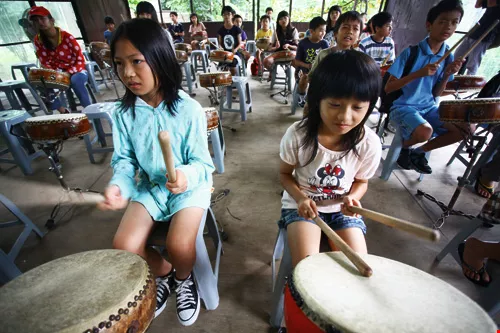
The arts take root at an early age. The village also has an educational area to provide visitors with first-hand experience of drumming.
The idea of repertory shows is a little new to domestic audiences, but has recently become a hot topic of discussion. In the case of Ten Drum, which was founded in 2000, the group was performing fixed programs at a fixed location long before it received government funding. In fact, it moved into the sugar mill in Rende Township, Tainan, in 2005. Renovated and renamed the Ten Drum Culture Village, the former mill has been the troupe’s main stage ever since.
At the time, Ten Drum founder Hsieh Shih was just looking for a place to practice without disturbing the neighbors. But he was also fond of old buildings, and when he stepped onto the mill grounds, possibilities immediately began springing to mind. “The moment I saw the mill’s warehouses, I started thinking, ‘We can practice over here and perform over there….,’” recalls Hsieh, gesturing excitedly.
But it was the enthusiastic response his troupe received abroad that got him really thinking about developing a repertory program. Hsieh spent 2005 actively planning the cultural village while also booking more and more performances abroad. Reveling in the group’s international acclaim, he began nurturing the secret hope that Ten Drum would one day not only perform around the world, but would also draw international visitors to theaters in Taiwan. That dream has now come true.
Hsieh’s memories of the rocky road his troupe traversed are still fresh. He recalls that when they were first looking at the mill site, it was an overgrown mess that hummed with mosquitoes in the summer. The troupe, which with Hsieh then consisted of only six people, laid paths and planted trees themselves. But their efforts did little to turn the mill into the venue they envisioned, and their lack of capital remained a serious problem.
Hsieh plunked down NT$25 million for just the first stage of the renovations. The second, third, and fourth stages brought the total investment to over NT$100 million. The renovation took place before banks began offering “creative and cultural loans,” and before the film Cape No. 7 had had its enormously successful theatrical run. Banks had only limited understanding of the creative and cultural industries, and were unwilling to provide Hsieh with a loan even with the Credit Guarantee Fund of the Ministry of Economic Affairs acting as guarantor. As a result, Hsieh was forced to turn to fellow members of the group, friends, and relatives for funding.
Hsieh raised the curtain on the Ten Drum Culture Village two years later. But when only 500 visitors dropped by in the first month, it was clear that the way forward would be difficult.
Hsieh believes that repertory programs can’t be too highbrow, and has therefore sought to balance the demands of art and the market. The village integrates performance, education, and sightseeing, and even tailors the content of its shows to different types of audiences. That is, its repertory shows include very sophisticated performances, as well as more commercial programs tailored to the tastes of the mass market.
“It’s like when a good chef tweaks the seasonings in a recipe,” says Hsieh. “Repertory shows have to be comprehensible to more than just the critics.”
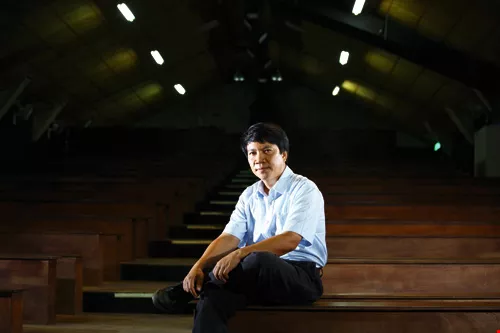
Introduced to drums by his father, Ten Drum founder Hsieh Shih has made the creation of music for drums his lifelong mission.
The 40-year-old Hsieh began his drum career at the age of just three.
With a Taoist priest as a father, Hsieh grew up calling a temple home, spent his early years playing on temple grounds, and was immersed in the resounding rhythms of temple drums from childhood. When one of the temple’s Beiguan musicians took a day off, the three-year-old Hsieh began fooling around with the musician’s drumsticks, and, though just a toddler, showed a real talent for drumming. When he got a little older, he began studying the instrument with his father and other musicians.
As Hsieh became more adept in the drum arts, he and his older brother would rush outside to trade drum riffs with passing musicians from other temples and Beiguan troupes. Hsieh jokes that he took up drums because so few people played that it was relatively easy to make a name for yourself. Later, as a student at Tainan Second Senior High School, he continued his love affair with the instrument by joining the school’s Chinese music club.
But it was a performance by Yan Xuemin’s traditional music group from Hong Kong that inspired Hsieh to become a professional musician.
Whether taking high-school classes in classical Chinese music or trading riffs with musicians by the roadside, Hsieh was always confident of his musical talent. But it was only after seeing Yan’s Tainan performance that he became aware of the existence of a level of excellence beyond anything he’d heard before.
“More importantly, in that moment I finally realized that playing drums was more than just an interest, that it could be a career,” recalls Hsieh. “It was then that I went from being a streetside performer to an artist.”
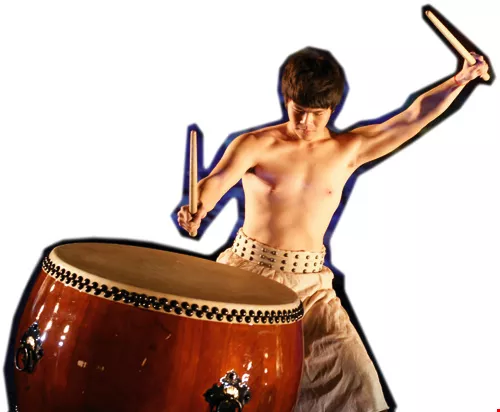
Ten Drum has received numerous international accolades over the years, including numerous invitations to perform abroad and even a Grammy nomination.
Hsieh founded Ten Drum and introduced its first piece, Legend of Drums,” in 2000. Ten Drum was invited to perform at the World Cup opening ceremonies in Korea just two years later. With the group flying high, Hsieh began transforming its style into something more “Taiwanese” by incorporating martial-arts-like movements from temple dances and parades.
Hsieh regularly spends time reading and talking to people, seeking out stories from everyday life in the interest of further evolving that style. He firmly believes that the only way for the Taiwanese performances troupes diligently seeking to go global to do so is by “going native” and embracing Taiwan’s own culture.
Ten Drum is therefore attempting to develop a truly Taiwanese drum style that rivals the traditional styles of China, Japan, and Korea.
Hsieh explains that Chinese drum performances typically take place in the context of larger musical pieces. The musical structures tend to be complex and varied, and the drummers’ movements very economical. As a consequence, the visual side of the performance consists of little more than the drummers’ facial expressions. In contrast, Japan’s Taiko drum performances feature relatively simple music played very powerfully, with the performers whipping their sticks about like samurai wielding swords.
One of Hsieh’s goals in life is the dissemination of traditional culture, and to that end he’s developed a new approach to drum performance that lies somewhere between the music-centric Chinese style and the movement-centric Japanese style. His 18 Buddhists Drum piece is a case in point, incorporating movements from the Luohan style of martial arts.
To get his performers into the spirit of the group’s repertoire, Hsieh introduced them to his “joy of farming” philosophy, which meant having them do farm work on top of rehearsals. “Music has its roots in the earth. By having troupe members work the soil, I could see their mental and physical state, both of which would affect their performance.”
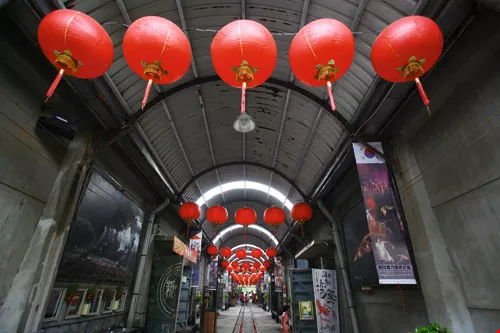
Ten Drum spent NT$100 million to turn an old Rende, Tainan, sugar mill into the group’s primary performance venue, the Ten Drum Culture Village.
Hsieh decided to call his troupe “Ten Drum” not just because his given name, Shih, means “10,” but also because the Chinese character for 10—“十”—looks like a pair of crossed drumsticks and represents a kind of perfection.
In 2009, the group released Island of Drums, a CD that was nominated for a Grammy Award in the Best Traditional World Music Album category. Last year, it was invited to France for the Festival d’Avignon.
Ten Drum has played an important role in Taiwan’s effort to develop home-grown resident company repertoires. Through his work in the fertile soil of Ten Drum and his attempts to balance high art and the tastes of the mass market, Hsieh himself has come to better understand audiences. That knowledge can only help the seed he has planted in Taiwan take root and grow.
@List.jpg?w=522&h=410&mode=crop&format=webp&quality=80)

@List.jpg?w=522&h=410&mode=crop&format=webp&quality=80)


@List.jpg?w=522&h=410&mode=crop&format=webp&quality=80)

@List.jpg?w=522&h=410&mode=crop&format=webp&quality=80)
