The Heart of Yilan-Lanyang Museum
Tsai Wen-ting / photos Chuang Kung-ju / tr. by David Smith
December 2010


Unlike ordinary museums focused on a collection, for the newly opened Lan-yang Museum, the exhibit is Yi-lan County itself.
Established by the county government, the Lan-yang Museum is a doorway to a deeper understanding of the natural setting and the people of Yi-lan County. Hopefully after seeing the museum, visitors will be inspired to explore every nook and cranny of Yilan.
"To understand Yi-lan, and the Lan-yang Museum," says Lin Zheng-fang, an assistant researcher at the museum, "you have to start right here where we're standing." We are standing at the entrance to the museum, right next to the former site of Black Rock Harbor in Tou-cheng Township. He continues: "The site on which the museum stands is a fascinating exhibit in its own right."
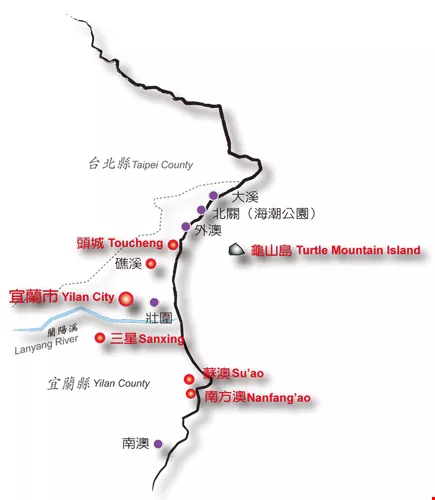
Located in northern Yi-lan County, the Lan-yang Plain is an alluvial delta pinched in between the Xue-shan and Central Mountain Ranges, bounded by the townships of Tou-cheng in the north, Su'ao in the south, and San-xing to the west. Han Chinese didn't much venture into the Lan-yang Plain prior to 1796 because of its inconvenient location beyond the mountains delimiting the eastern edge of the Tai-pei basin, and because it was populated by the Ka-va-lan tribe. That changed, however, after a group led by Wu Sha began settling the area around Toucheng.
Toucheng is thus the place the Lan-yang Museum chooses to start telling the story of Yilan.
Toucheng stands guard over the northern terminus of the Lan-yang Plain, and has always been remembered as the place where the Chinese first settled in the local area. Tou-cheng's Black Rock Harbor derived its name from the three big, dark rocks rising out of the water in the middle of the harbor.
During the Qing Dynasty, boats could navigate by river from Black Rock Harbor into the residential section of Tou-cheng, and from there on to Yi-lan City and even Yuan-shan Lake. Black Rock Harbor was thus the economic lifeline and the secur-ity lynchpin for the entire Yi-lan area. That is why the Qing court designated Black Rock Harbor as the principal entranceway to Yi-lan, and installed defense works there.
Shipping at Black Rock Harbor was very much affected by the annual monsoons. Stiff southerly winds kicked up each spring, heralding the beginning of heavy traffic as ships took advantage of the favorable winds to make their way northward. Black Rock Harbor would fill up, creating an annual pageant of wind-whipped rigging and heaving masts that rated a moniker of its very own-Springtime at Black Rock. It was seen as one of "the eight most beautiful scenes of the Lanyang region."
Silting of the navigation channel hampered Black Rock Harbor in the late 19th century, and then the Japanese colonial administrators opened a rail line to Yi-lan. As a result, shipping volume at the harbor gradually declined. At the deep-water harbor of yesteryear, water depth is now down to about one meter, and the black rocks that once gave name to a bust-ling shipping facility now stand in the middle of a 4.39-hectare wetlands, mere reminders of the harbor that once was.
To commemorate yesteryear's Springtime at Black Rock, the lampposts at the entrance to the Lan-yang Museum have been designed in the shape of ship sails. After the Xue-shan Tunnel opened to traffic in 2006, Tou-cheng regained its status as the gateway to Yi-lan, further accentuating the "entranceway" significance of the Lan-yang Museum. This also fits in nicely with the "all of Yi-lan as one big museum" concept that inspired the founders.
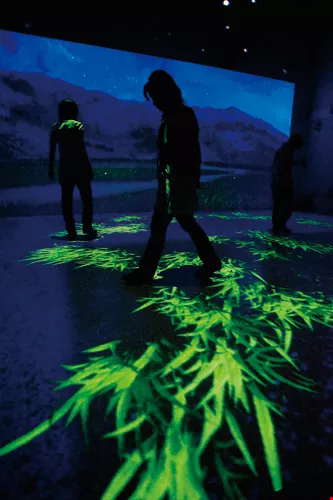
(facing page, from top) In the introductory exhibit room, long and slender lamps are a reminder of the rain that falls so frequently in Yilan, while the interactive theater there shows visitors how the Lanyang Plain was formed millions of years ago. A laser display in the mountain exhibit on the top floor tricks visitors into feeling as if they're in the middle of a forest.
In addition to its historical theme, the Lan-yang Museum also features a unique sloping design that further accentuates its connection to Yilan.
The museum wall slopes sharply on one side, and gently on the other, something like a mountain with almost an entire half cut away. This profile is inspired by what geologists refer to as a cuesta landscape, a special feature of Yilan topography. After the mountain building process thrust sedimentary sandstone and shale formations upward to form the island of Taiwan, wave action along the coast undercut the rock, causing the seaward sides of the mountains to collapse into the water. The result is asymmetrical mountains with one side plunging precipitously toward the sea and the other side sloping gently inland.
Cuesta formations are especially prevalent along a stretch of erosional coast not far north of Black Rock Harbor, extending for over 20 kilometers from Daxi to Wai'ao. The shoreline there features flat, wave-cut platforms at the water's edge, with sheer precipices rising abruptly from there.
Noted architect Kris Yao, who won the 2010 Far Eastern Architectural Design Award for his work on the Lan-yang Museum, got his inspiration from the local cuesta landscapes. The museum enters the ground at a 20-degree angle on the entrance side, while the glass curtain on the other side inclines at a very steep 70 degrees. The building feels at once disorienting yet irresistibly charming.
The museum features a fascinating interplay of the building itself and its -transparent glass curtain, via which visitors can look out upon outdoor scenery that includes in the distance Turtle Mountain -Island, the most distinctive landmark of Yilan County. The interplay of the indoor and outdoor scenery is a memorable aspect of a visit to the Lanyang Museum.
In addition to the Lanyang Museum's cuesta-inspired profile, its outer walls are worth careful scrutiny, for they are faced with four different types of stone machined to three different surface finishes, symbolizing the 12 gradations in tone of an octave in the musical scale. Moreover, the widths of the facing stones reflect the differing beats in the violin concertos of Vivaldi's Four Seasons. The Lan-yang Museum, which rises like a mountain from the earth, is thus a romantic melody in and of itself, perfectly embodying the idea that "music is architecture in motion, and architecture is crystallized music."
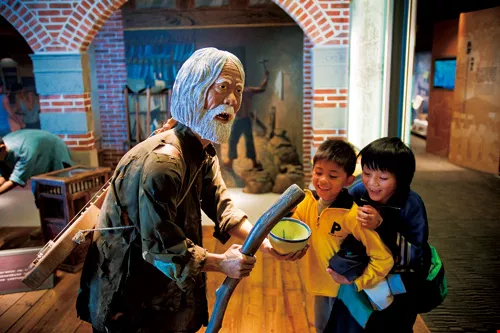
(above) Flightless ducks spend their lives in local rice paddies. They help farmers control bugs and weeds, and fertilize the crops with their droppings, and they can be smoked and shredded to make a local snack. (below) During the three-month trial run for the museum prior to its official opening, a lifelike "beggar" helped raise NT$28,952 in donations!
From the historic associations of its location at the former site of Black Rock Harbor, to its striking cuesta profile, the Lan-yang Museum delights visitors with one surprise after another. The column-free main lobby soars four stories high and features a massive glass curtain measuring 20 meters wide and 30 meters tall. Entering the lobby is a breathtaking experience. Outside lie the Black Rock wetlands, and beyond that the boundless blue sky. Inside, light streams in through the spectacular glass curtain and plays out in countless variations off the stone walls and floor.
Take the escalator up a flight, and the view outdoors expands still further, with the green wetlands and former site of Black Rock Harbor in the foreground. Beyond that lies the modern-day Black Rock fishing port. Raise your gaze a bit further yet, and behold the vast Pacific Ocean, bejeweled by Turtle Mountain Island in the offing.
To draw a parallel with the melding of mountains and sea in Yi-lan, the permanent exhibits at the Lan-yang Museum, beginning on the fourth floor and spiraling down from there, focus respectively on the themes of mountains, lowlands, sea, and time. In addition, there is also an introductory exhibit room near the entrance.
In the small introductory exhibit room, long and slender lamps hang from the ceiling, a reminder of the rain that falls so frequently in Yi-lan. Precipitation here averages 3,000 millimeters per year. Moisture-laden air is carried in by monsoons from the Pacific, and much of it is dumped as rain on a Lan-yang Plain hemmed in by mountains on three sides. The rains irrigate the farm fields here, and foster a poetic sensibility for which the people of Yi-lan are noted.
The introductory exhibit room has an interactive theater that shows a film called The Birth of Yi-lan. The movie displays on the walls and even the floor. As the ground is shown writhing, the narrative explains that the island of Taiwan first popped up above the waters of the Pacific Ocean about 5 million years ago, the product of a tectonic collision between the Eurasian and Philippine Sea plates. The very first place the two plates came in contact was right near Nan'ao in Yi-lan County. The age of the ancient Da Nan'ao metamorphic complex is estimated at around 250 million years.
Upheaval in the earth's crust millions of years ago has left behind volcanoes and geothermal activity as reminders of what went on. Scalding water pours from vents in the seabed near Turtle Mountain Island, providing an unusual environmental niche for equally unusual hydrothermal vent crabs. When a visitor's foot gets near the projected image of a vent crab, the cute little critter skitters out of the way. The scouring action of rainfall over the ages has built up the alluvial Lan-yang Plain, criss-crossed by streams and dotted by countless ponds, and as the visitor "walks over" it, waves of grass and flowers sprout and bloom where the foot passes. Each step sends out ripples across the water. The interactive nature of the theater affords visitors a chance to "stroll" through Yilan and witness its birth.
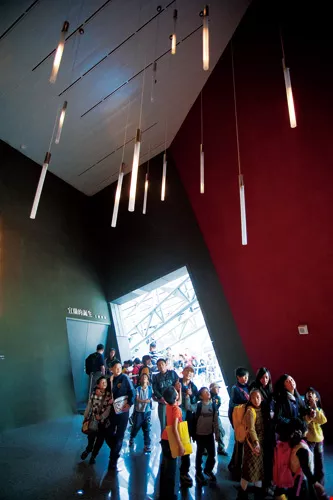
(facing page, from top) In the introductory exhibit room, long and slender lamps are a reminder of the rain that falls so frequently in Yilan, while the interactive theater there shows visitors how the Lanyang Plain was formed millions of years ago. A laser display in the mountain exhibit on the top floor tricks visitors into feeling as if they're in the middle of a forest.
Leaving the theater, the visitor takes a visually sumptuous escalator ride up to the fourth-floor "mountaintop" to peruse a permanent exhibit on mountain landscapes. The soft lighting, misty drizzle, cloth drapery, and upright display cases all suggest that the visitor is walking through a misty mountain forest.
High up in Si-yuan Pass, some time in late spring or early summer, you see a crested serpent eagle perched high up in a tree, while a white-faced flying squirrel peers dartingly left and right from the branches of a may chang tree. Down below, a rough-skinned toad deftly camouflages itself against a rock. Little wonder that Si-yuan Pass is dubbed a "treasure trove of plant and animal species."
A faint scent of cypress greets the visitor at the exhibit on Tai-ping Mountain, home to one of the three biggest logging sites in Taiwan. During the Japanese colonial period, it was Taiwan's biggest producer of cypress lumber. Cypresses tower up to 60 meters high, can reach six meters across at the base, and favor the shady, damp side of the mountain. Their rate of growth is slow. Extremely rare cypress trees are to be found in Yi-lan at elevations of 1,100 to 1,200 meters.
In addition to cypress, there is a 900-hectare stand of Formosan beech on Tai-ping Mountain in the Cuifeng Lake/Copper Peak area. It is Taiwan's largest stand of Formosan beech, a legacy of the ice age found only in Taiwan. The entire stand turns a flaming red each autumn in a dazzling display of fall foliage.
This rare habitat is home to an even rarer butterfly called Kuafu's hairstreak, the larvae of which will eat nothing but the tender new leaves of Formosan beech. When the afternoon sun sifts through the fog and into the forest, one may just be lucky enough to catch a glimpse of a Kuafu's hairstreak flitting about.
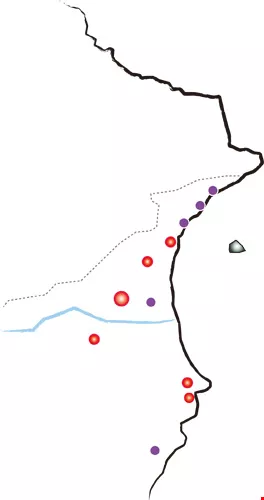
Standing next to the mountain exhibit, one can look down over the maritime and lowlands exhibits that await immediately below.
According to the Central Weather Bureau, rain falls over 200 days per year in Yi-lan. Water is a predominant facet of life in Yi-lan. The lowlands exhibit focuses on how rivers and streams have influenced the society and economy of the Lan-yang Plain, and how the people of Yi-lan have used their wits to work out a modus vivendi with their watery world.
You may have noticed before that there are no manmade reservoirs or other water collecting structures in Yi-lan, yet there is no lack of water to meet local needs. Besides the rainfall, this abundance is also due to the fact that the alluvial deposits making up the Lan-yang Plain consist primarily of wonderfully porous aggregate. Rain soaks easily into the land to form part of a big underground water system. Reservoirs aren't necessary, because the area sits atop a natural aquifer. Wherever the aquifer is subject to pressure or runs into hard bedrock, it burbles to the surface in springs that the locals describe as "hairy crabs spitting foam."
The local economy in years past grew along pathways determined by the course of river transport. In the 1920s, the area of Yi-lan City around West Gate Ford was a thriving commercial district. But water, as the old Chinese saying goes, "can either float a boat or sink it." Changes in the course of the Lan-yang River are clearly shown in overlapping acrylic maps that forcefully bring home the point of how nothing stays the same. Since the Qing Dynasty, every time the river has burst its banks and cut a new channel, farm fields have been obliterated, homes swept away, and lives cut short. Newspapers from the 1960s and 70s, for example, vividly depict the love-hate relationship between the people of Yi-lan and its rivers. We are especially receptive to the message today, just after Typhoon Megi brought record rainfall to Yilan.
"Hey...," a visitor exclaims, "why would they put a threshing machine on a skiff?" Outsiders, even from the older generation, are not necessarily aware that rice threshing was often done on boats here.
In the old days, when flooding hit, farmers would rush into their water-logged rice paddies to harvest what they could before the crop was ruined. Farmers waded through the paddies, grabbing up the sheaves and handing them to someone on a shallow-bottomed skiff, who then ran the sheaves through the thresher. This scene was repeated in Xiapu- and other low-lying areas in Yi-lan every time a big rainstorm hit or a typhoon pushed seawater inland. The people in Xiapu-, in fact, were very adept at planting rice seedlings while wading along on stilts so they wouldn't have to fight their way through the thick mud.
Throughout Yi-lan, one can see the sky and mountains reflected off ponds and rice paddies. "Duck-and-rice agriculture" is the term used to describe a time-tested farming technique commonly practiced in watery environments like this. Flocks of ducks mill about in rice paddies, gobbling up insects and fertilizing the crops with their droppings. It is a typical scene in Yilan.
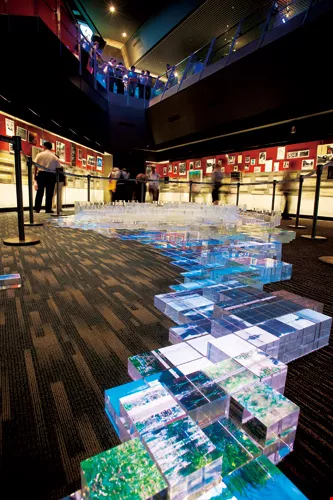
The "Light of Yilan" display-composed of 2,000 acrylic blocks-forms a contour map of the county. A local specialty or point of touristic interest is depicted in each of the blocks.
A dense network of rivers traverses the Lan-yang Plain. The three main waterways-the Lan-yang, Dong-shan, and Yi-lan Rivers-meet near the sea in Zhuang-wei Township's Dong-gang district. At the museum, the majestic sight of these three rivers coming together before spilling into the ocean is the cue to bid adieu to the lowlands exhibit and head on to the sea exhibit.
Browsing through the sea exhibit, one learns about Yi-lan's diverse coastline, the rich maritime resources delivered up by the northbound Kuroshio Current, the mysteries of ocean floor volcanoes, and the evolving local fishing industry.
The Kuroshio Current is a major feature of the Pacific Ocean current system. This maritime freeway rushes up from the depths just off the coast of Yilan, carrying with it immense quantities of nutrients that nurture huge colonies of plankton. The 101-kilometer coast of Yi-lan is home to over 10 fishing ports large and small. The granddaddy of them all of is Nan-fang'ao, where more than 1,000 fishing vessels can anchor at any one time. The Kuroshio Current feeds big fish populations, and these in turn provide both a living and a way of life for those in the local fishing industry.
A sing-song chant reveals the names of the six favorite fish here: "One, thread fish. Two, red shark. Three, pomfret. Four, mackerel. Five, croaker. Six, sea bream." Each of these fish species is on display here.
From November each year through the following April, fishing vessels from Japan, Keelung, and elsewhere used to converge on Nanfang'ao to spear hunt for swordfish. Standing on the deck of the South Wind No. 1, the largest exhibit at the Lan-yang Museum, one gets a feel for how the crew might divide its labor, and what it must be like to be poised with spear in hand aboard the South Wind No. 1 as the vessel pitches and rolls in a heavy sea.
The South Wind No. 1, built of cypress, was donated to the museum by a Mr. Zhuang Jin-rong. Because of the boat's size, it was put in place in 2007 in its intended display position, then the museum was built up around it.
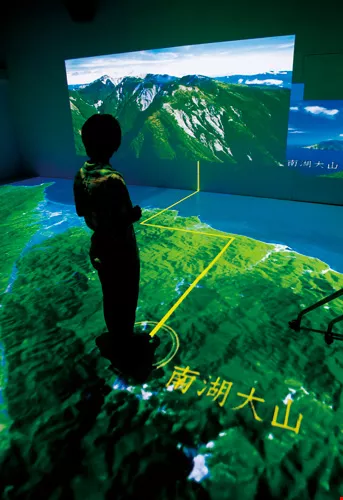
(facing page, from top) In the introductory exhibit room, long and slender lamps are a reminder of the rain that falls so frequently in Yilan, while the interactive theater there shows visitors how the Lanyang Plain was formed millions of years ago. A laser display in the mountain exhibit on the top floor tricks visitors into feeling as if they're in the middle of a forest.
Each winter when the northeasterly monsoons set in, swordfish go on the hunt for smaller fish in the wind-whipped waters off of Yilan. This is when the locals go out spearing for swordfish.
A spearing platform juts forward from the prow of the South Wind No. 1, and leaning far out from the platform is a fisherman, spear in hand, poised to launch his projectile. Museum visitors need not worry, though, because the man wielding the spear is just a mock-up, lifelike though he may seem. He's slipped both feet into a contraption rigged up to keep him from falling overboard, but the task at hand remains daunting. It takes considerable strength to heave the spear, which weighs well over 10 kilos, and he must maintain keen concentration, ignoring the breaking waves and tossing boat. Meanwhile, a fellow crewman back on deck is responsible for keeping the boat headed in the direction of the elusive swordfish. Once the prey is in range, the spear is released, and the catch is speared. But before it can be wrestled aboard, the swordfish must be battled to exhaustion. Only then does the crew haul in the catch. This traditional fishing method takes sharp eyesight, courage, and teamwork. The ability to hunt for swordfish using this traditional method is a rare skill these days, and local governments have begun to show concern about making sure swordfish spearing doesn't vanish altogether.
The sea exhibit has another huge exhibit, as well-a big hot bulb engine, which is commonly used to power fishing vessels. The construction of a harbor at Nan-fang'ao during the Japanese colonial period fueled the rise of various local support industries, including shipbuilding and metalworking. Fishermen in Nan-fang'ao built a type of modified Japanese hot bulb engine, and sold their product as far away as Southeast Asia. A shared memory for anyone from Nan-fang'ao is the rumble of hot bulb engines as the fishing fleet heads out to sea each fishing season.
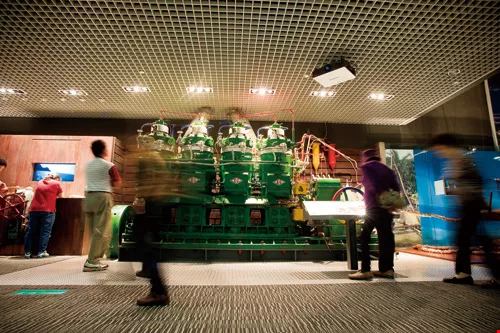
A spear-wielding fisherman leans out over the prow of the South Wind No. 1 (above), looking to spear a swordfish. Rarely does one have an opportunity anymore to see this spectacle in real life. The museum's hot bulb engine (below) bears testimony to how much Taiwan's fishing industry has changed over the past century.
The carefully designed Lan-yang Museum was a big deal for the locals well before it ever opened to the public. Getting it up and running was no easy task, but in the end, the 18-year struggle was well worth it.
The initial impetus for the museum came from local elders and antiquarians, and these same people have remained intimately involved throughout the entire process of bringing their ideas to fruition, picking up needed expertise along the way.
Assistant researcher Lin Zheng-fang, who's been involved with the museum for six years, explains: "Relying on yourselves, moving forward one step at a time, learning as you go-that's how people go about things in Yi-lan. It was that way with the Yi-lan International Children's Folklore and Folkgame Festival, and it's been that way with the Lan-yang Museum." Lin acknowledges that it might well have been quicker to do it as a government project, by awarding a contract to a private-sector entity to plan and operate the museum, but it would have been impossible that way to build up a solid base of local talent and experience.
The Lan-yang Museum is not a standalone museum, nor is it limited to the display of artifacts. Rather, it is the core of a network called the Yi-lan "family of museums."
Back when the Lan-yang Museum was still in the planning stages, the Yi-lan County Government was planning for a "family of museums" that would be set up throughout the county and focus on matters of unique local interest. These museums have provided resources that the Lan-yang Museum has been able to tap into. The Lan-yang Museum, for its part, could be described as the county's flagship museum that represents the county to the outside world.
After finishing a tour of the Lanyang Museum, it is time to walk into the living museum that is Yilan itself. You could hop in your car and drive through the county, or you also have the option of joining a tour of Yilan arranged by the museum. You can head for the forests of Taiping Mountain to get a feel for the logging industry there. Or you could wander around where the main rivers empty into the ocean, and watch flocks of white cranes swooping over the sand dunes. There's plenty of laid-back beauty in Yi-lan, just waiting there for the wanderer who's capable of appreciating it.
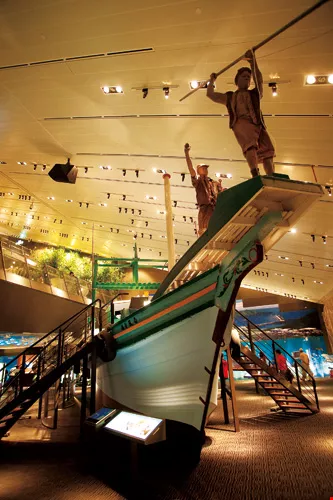
A spear-wielding fisherman leans out over the prow of the South Wind No. 1 (above), looking to spear a swordfish. Rarely does one have an opportunity anymore to see this spectacle in real life. The museum's hot bulb engine (below) bears testimony to how much Taiwan's fishing industry has changed over the past century.
Tel: 03-9779700
Website: www.lym.gov.tw
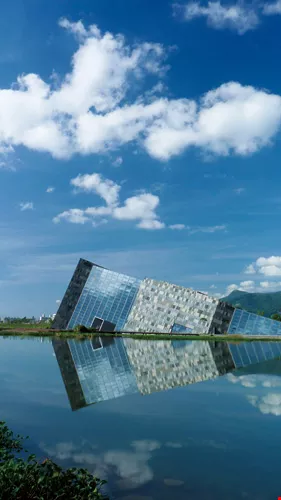
Mountains to the one side and sea on the other, the Lanyang Museum is tucked away on the Yilan coast in Toucheng Township, where the unique silhouette of the building reflects beautifully off the lagoon out front. The form of the building approximates the cuesta landscapes found along much of the Yilan coastline. Local architect Huang Sheng-yuan exclaims: "It makes me want to climb to the top!"
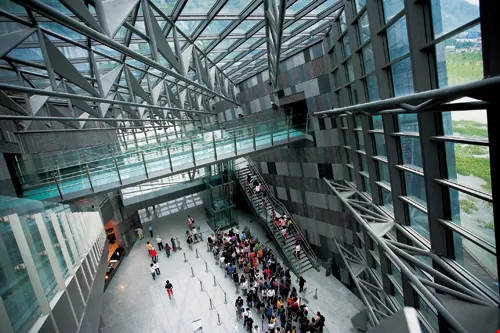
Noted architect Kris Yao makes heavy use of steel framework and glass curtains to create a powerful interaction between indoor and outdoor space. He received the 2010 Far Eastern Architectural Design Award for the Lanyang Museum.

@List.jpg?w=522&h=410&mode=crop&format=webp&quality=80)
@List.jpg?w=522&h=410&mode=crop&format=webp&quality=80)


