Writing and Not Writing: Chu Tien-hsin
Su Hui-chao / photos courtesy of Chu Tien-hsin / tr. by Scott Williams p.116
April 2011


Chu Tien-hsin, always nervous about hearing readers' opinions, made a rare appearance in a discussion forum at the Taipei International Book Exhibition (TIBE). Over the years, Chu, who has published relatively little in spite of coming to fame young, has chosen to live and write at her own pace, and to ignore the changes in the publishing industry. Chu the woman is much like her work: sharp, refined, candid, and anxious.
"Um, it really wouldn't be convenient for you to interview me in my home," says Chu, politely declining the request.
Few journalists have been invited inside Chu's Xin-hai Road home. At various times home to authors Chu Hsi-ning (her deceased father), Liu Mu-sha (her mother), Chu Tien-wen (her older sister), Tang Nuo (Chu Tien-hsin's husband), Xie Hai-meng (their daughter), and Chu herself, the house is a bona-fide writers' roost.
But Chu's reasons for not allowing it to be photographed verge on the surreal. The home has long been neglected and the bougainvilleas in the garden have burst through the window screens and into the house. Inside, there's no desk or study. On cold days, the 20 cats and three dogs that live in the house huddle together on the shapeless sofa. The home's human inhabitants are left to breathe damp air scented with wet pet, which, in Chu's case, has resulted in years of asthma.
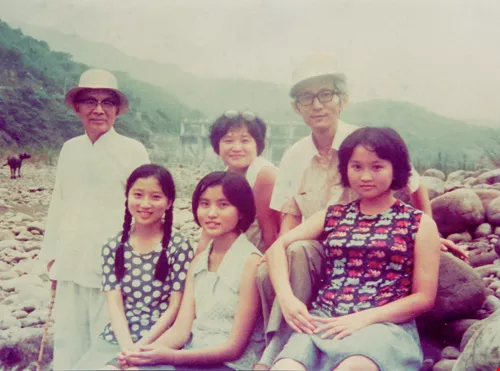
In 1976, the family vacationed with Chu Hsi-ning's good friend Hu Lancheng. This photo of the group on a rocky riverbank is a precious reminder of the trip.
Virginia Woolf said that women need "a room of one's own." Chu, on the other hand, has let a whole house slip away. Driven from her home, she's been compelled to do her writing in coffee shops, migrating from one to another for more than a decade. In a sense, the history of her work is the history of her cafe migrations.
Day after day, Chu and Tang Nuo walk to a Yongkang Street cafe to "start work," sometimes arriving together, sometimes not. They then settle in to read and write.
Lecturing, reviewing, giving interviews, and occasionally picking up literary prizes, Chu does her utmost to keep such distractions to a minimum, consciously taking the perspective of an observer or outsider and keeping her distance from the so-called mainstream. She worries that fame is too cozy a trap, and feels it's best to avoid temptation entirely.
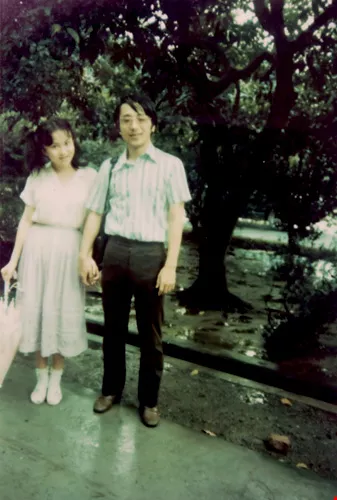
Chu and Tang Nuo stroll hand in hand around the National Taiwan University campus where they were seniors in the history department.
Chu can't change the facts that she had the good fortune to be born into in a literary family, and that she herself has become a writer. But her written work also includes "unwritten work."
Her literary career has spanned more than 30 years, from the 1977 publication of the short-story collection Days aboard the Ark and her long memoir Ground-Thumping Song to the 2010 novella Love in the Time of Early Summer Lotuses. But over the course of those many years, she's published just 14 or 15 works and has gone four or five years at a time without publishing anything at all. Generally speaking, the market has a tendency to forget authors who don't write. After all, it's a writer's job to write. But Chu has been firm in her conviction that authors have the right to write or not as they choose. "When writers don't write, it often suggests that they are facing difficulties in their lives, or are attacking bigger challenges."
Naturally, there are certain criteria for not writing. Chu happens to have a husband and family who don't expect her to cook, clean or hold an ordinary job. She has an understanding publisher. And she herself maintains a determined distance from the workaday world: ignoring reviews, staying away from computers, and never reading bestsellers.
Chu is terrified of hearing from readers. She believes that authors who have contact with readers and the market "either change or write themselves to death." She is horrified at the prospect of going either route.
"Um, it's like a fish swimming against the current, or a child pointing out that the emperor is naked," she says. Chu's existential games are highly personal, require concerted effort, and fall apart the moment that dedication wanes.
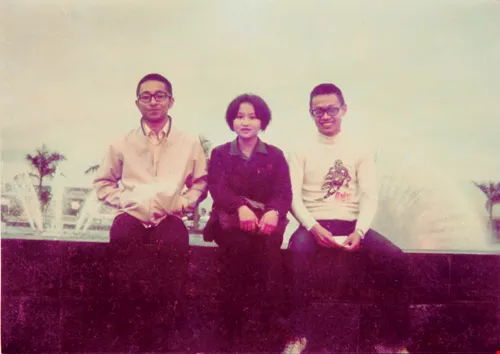
Chu's high-school years were a wellspring for her writing and the period in which she met Tang Nuo (left), whom she later married.
Chu has kept her back to the reading, the writing and even the lifestyle of the mainstream for decades. But these various rejections weren't especially connected. For example, Chu's reading isn't done for the sake of her writing. And her involvement with political movements ended after she underwent a sort of "social baptism" that convinced her that "things need to be this way."
Without the courage and strength to be different in her every-day life, Chu just wouldn't be Chu. How else could she wield her scalpel-like pen to dissect the slenderest of nerves? How else could she plumb the depths of reality like an explorer at the ends of the earth?
Chu once gave a lecture on fiction at Chenggong High School. After getting no reaction to a discussion of San Mao and the barest flicker of a response to mentions of Eileen Chang and Kenneth Pai, she didn't dare ask them what they thought fiction was or who they read. "I was afraid they'd tell me they read Giddens," she says.
As a judge for Taiwan Semiconductor's Youth Literature Award, Chu asked prize-winning students what they read. One mentioned the comic book One Piece. Another said he didn't read anything, but enjoyed Vincent Fang's song lyrics. The boy's rationale was that he didn't want to follow in anyone else's footsteps. "We read," a frustrated Chu responded, "to understand the world in front of us." She added, "If you take that attitude, you're likely to end up caught up in vulgar pop and commoditized culture, both of which are pervasive, yet think your own work wonderful."
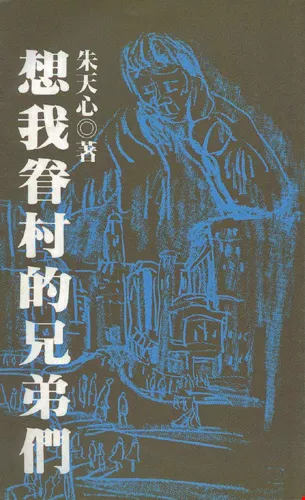
Though Chu's published work is limited in quantity, her adolescent snippets and histories of Taiwan's military dependents' villages and political developments have been enormously influential.
How does Chu define literature? She frames her answer with a negative question: "What is literature not?"
Literature isn't mass market. It isn't repeating what everyone else has said. It isn't pandering to mainstream values. It isn't repeating yourself. Literature shouldn't be an easy, fun read, or predigested pap. Instead, literature should challenge people's habitual modes of thought, confusing and subverting the order of things at every turn.
Perhaps literature means something different nowadays. But that's what Chu used to think. Used to, still does, and always will.
Chu published Days aboard the Ark and Ground-Thumping Song in 1977 at the age of just 19. These books forged an image of Chu as a young woman author that remained intact throughout the massive political and social upheavals of the 1980s. Her later work, whether involved with the news of the day, political movements, or nostalgia for the old military dependents' communities, was far removed from Ground-Thumping Song. Written in a discursive style, the later works delivered a kind of fictional urban anthropology that literary critics relished. Chu could turn a ramble through Taipei into the pursuit of a memory. Hunters, which concerned cats, was heavy as lead. Her work took a sharp turn with Love in the Time of Early Summer Lotuses, which won the 2011 TIBE Prize and reintroduced the word "love" to her fiction. Love, yes, but seen from the stark perspective of a married -woman of middle age who hasn't come to terms with getting older.
"Ground-Thumping Song is still feeding me," says Chu, her face a little red. "A teenager's book feeding a 50-something woman. That feels very weird."
The year it came out, she'd just begun university. Brian Wu's The Kid Who Said No to the Joint University Entrance Exam was enormously popular and a publisher was looking for an odd, attractive young woman to write a The Girl Who Said Yes to the Joint University Entrance Exam kind of thing. Chu met with the publisher a few times and understood the motivation, but was uncomfortable with putting her precious memories up for sale.
While she ultimately rejected the publisher's proposal, she remained interested in writing something, a memoir of a time at the Taipei First Girls High School that was different than people imagined. "The things I saw weren't the things you'd expect," she says. "We weren't testing machines who studied all the time. We weren't without feelings or dreams."
This thought grew into Ground-Thumping Song, which was released by Long River Publishing. When "Grandpa" Hu Lan-cheng wrote the introduction, he compared Chu to the great poet Li Bai. Chu has been known as a "child prodigy" ever since. Passed from generation to generation on Taiwan's high-school and university campuses, Ground-Thumping Song is Chu's best-selling work to date, a must-read for young people with literary inclinations.
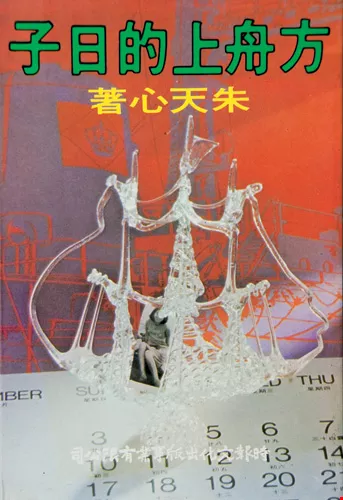
Chu wrote of her adolescent years at Taipei's First Girls High School in Days aboard the Ark and Ground-Thumping Song, quickly establishing her reputation as a prodigy.
When a publisher later released her work in simplified-character editions, she revisited Ground-Thumping Song and found herself scorched by the ardent fires of her youth.
She was startled by the passion, naivete, and childishness of her younger self, but also saw traits that have been with her for her entire life: her willful disregard of the market, her rejection of mainstream values, and her intense self-examination. "My basic impetus for writing hasn't changed," she says. Simply put, that impetus is "to see, to remember, and explain that things weren't like that."
First Girls High School wasn't. Second-generation immigrants from mainland China aren't. Gays aren't. Political dissidents aren't. Workers aren't. Women aren't. Children aren't. People misapprehend the world for innumerable reasons. Chu therefore feels she has to be especially diligent in writing what she sees and remembers, all of it to persuade people of what "is."
Nativist literature dominated Taiwan's literary scene in the 1970s with the Nativist literature debate ranging far and wide. Writing about farmers and laborers was considered the politically correct thing to do. Authors who hadn't ever lived in the countryside wrote about it anyway. Love was considered a tacky subject for a book. With even Eileen Chang being disparaged as a sentimental writer of the Mandarin ducks and butterflies school, Chu wondered what of herself, at best just a second- or third-tier writer.
"Even the emperor can't just walk all over literature, nor can a given set of values, however impressive it may be," says Chu. "Literature isn't commerce and it isn't a political tool." Her biggest shock came when she realized that people who've grown up and live in the same place don't necessarily share a common understanding of their nation or their history. The party that she knew so well but never joined, the administration she professed her love for in Ground-Thumping Song, were, in the eyes of this other group, "a party of demons to be cast out."
What on Earth was going on? Had something happened that she didn't know about?
Chu couldn't write a thing. Instead, she read books by the opposition dangwai, adding to her knowledge of Taiwan in an effort to understand people of her generation whom she just didn't get, Taiwanese who thought second-generation immigrants weren't Taiwanese.
After a time, she again picked up her pen and went to work on The Diary of Taiwan University Student Guan Lin, later renamed Times Change, Things Pass. Chu began to feel her way towards the mixture of fiction and essay that became the "persuasive novel."
The United Daily News presented its first "best novella" award to Hsiao Li-hung for A Thousand Moons on a Thousand Rivers. Chu's Wei Liao, which depicts life in a military dependents' community, won one of the five prizes awarded the following year. Chu spent the NT$120,000 award on repairs to her home.
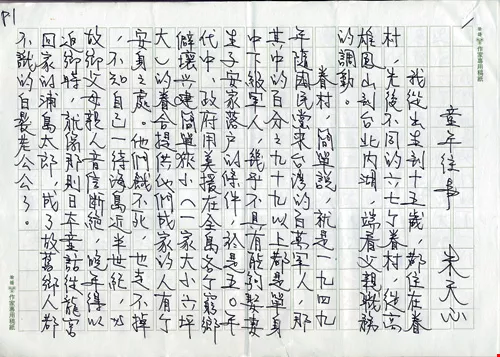
Wei Liao was her first fictional look at a military dependents' community. When she moved out of such a community herself, she hadn't realized she was leaving it behind forever. "My friends were still there, so I thought I could go back and visit whenever I wanted," she says. But then the community was torn down. By the time she went back, everyone had moved away. Her hometown had been wiped off the map. "How do you tell your kids where you came from when you've lost your hometown?" Wei Liao was an extended lament on her loss. By the time she wrote Remembering My Brothers in the Military Dependents' Community a decade later, the community felt more like something she'd experienced in a past life.
Her worldview had changed in the intervening decade. "Growing up" had been tough, but she'd learned that outsiders just didn't see the military dependents' communities the way she did.
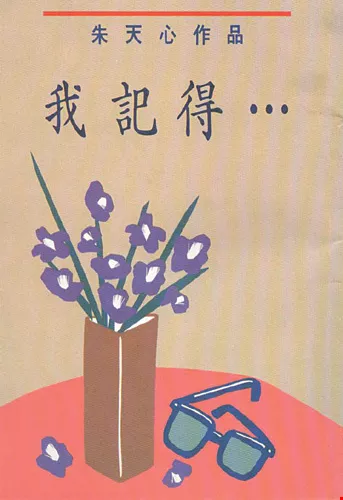
She didn't get it and was angry at the unfairness. In the years between I Remember and Remembering My Brothers in the Military Dependents' Community, "I didn't study abroad for even one day, but my existence suddenly became that of a 'second-generation mainland immigrant.' I was a lackey of our rulers. I had no legitimacy. Even though I was here, I had no right to speak. As Edward Said put it, I was an absent presence."
This sentiment persisted through The Old Capital, which came out around the time of Taiwan's first direct presidential election. She posits that the reason people of the past were so deeply suspicious and determined to test the loyalty of everyone around them was that they didn't have control over their own affairs. She argues that by becoming masters of our own domain, we've become our own people and made this our place. In our present situation, who needs tests? Chu proposes "fighting for the freedom to disagree," the right of immigrant workers, of people too poor to leave, of those who don't profess a love of Taiwan to exist here provided they don't engage in violence.
If the pre-The Old Capital Chu was still engaged in "direct struggle" and "direct resistance," still doggedly declaiming that "it's not that way" and "you're all misunderstanding," by the time she wrote Roaming, she "felt like a student in a class for rejects. I'd talked myself blue in the face and still wasn't accepted, wasn't liked by my teacher or classmates. But I could always still leave, right?" So she left in a huff.
Critic Huang Jinshu says the tone of Roaming is one of lamentation. Chu herself disagrees.
Critics have deemed Chu an "old soul." She finds this strange. "Shouldn't every writer be an old soul?" she asks. "Shouldn't every writer be the kind of person who remembers everything?"
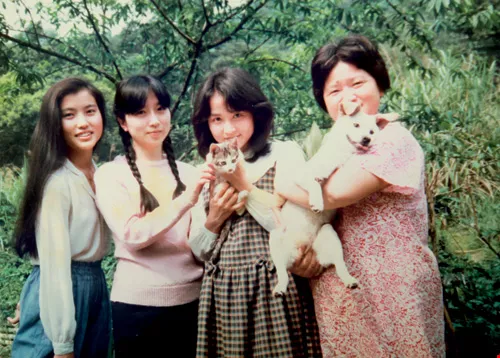
A family photo taken some time prior to Chu's marriage in 1985 catches Chu's mother holding her canine "son," Chu with a feline "daughter," and sisters Tien-wen and Tien-yi.
Books such as Hunters and Love in the Time of Early Summer Lotuses seem a bit out of place in her oeuvre.
Chu devotes a large part of her life to cats. She was involved with the multiple rounds of public hearings on whether to include animal traps in the Weapons Control Act, hearings that dragged on for two or three years. Since Taipei's decision to implement its trap, neuter, and release program for stray cats on a borough-by-borough basis, she's also been involved in persuading each individual borough chief to cooperate.
Most of Chu's lectures have nothing to do with literature, but are instead appeals on behalf of stray cats and dogs. She's also written a piece entitled "On Meeting a Cat" that elicited a flood of heartbreaking stories. "Most of the people who look out for stray cats have no time or means to make their voices heard," she says. "I have to speak for them." It was this part of her life that gave rise to Hunters.
Love in the Time of Early Summer Lotuses is Chu's "postgraduate work." In 2006, Joanna Lei, a First Girls High School classmate, dragged her into the planning of her class's 30th reunion. -Whether voluntary or compelled, the work put her back in touch with many of the other girls from her high-school years. Though now positioned at the pinnacle of society, they looked as dazed as ever. She noted their expressions and in her book speculated on the later loves that had given rise to them.
Chu says that one day, when very very old, she may write a book on writing with the same kind of feeling she puts into the preservation of endangered animals, a book that would necessarily touch on writing technique. "I don't stress technique," she says. It's a choice Chu's made. She's never been much interested in strengthening her technique, and has instead chosen to emphasize being different. "Technique I don't have the energy for it."
For the next couple of years, Chu will be in a cafe, head down, deeply immersed in work on her latest book. She is already at work again, combing through dangwai documents and boning up on a period in Taiwanese history with which she is unfamiliar. Her focus has shifted to society and the era's key players because "whether you support the greens or the blues, seeing history through the eyes of political actors gives you a stark and awkward picture."
With this book, Chu is taking on a new challenge, writing about Taiwan from 1949 to the present and explicating the history. "At my age, the challenges are historical, social, and political. My views are still out of sync with those of people today, but the process is far more difficult this time around."
Chu will undoubtedly succeed. She's trained herself to be very tough.
Though Chu's published work is limited in quantity, her adolescent snippets and histories of Taiwan's military dependents' villages and political developments have been enormously influential.
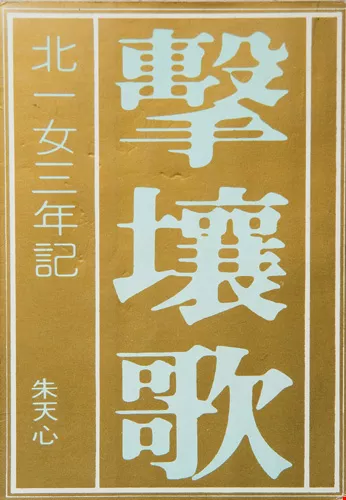
Chu wrote of her adolescent years at Taipei's First Girls High School in Days aboard the Ark and Ground-Thumping Song, quickly establishing her reputation as a prodigy.
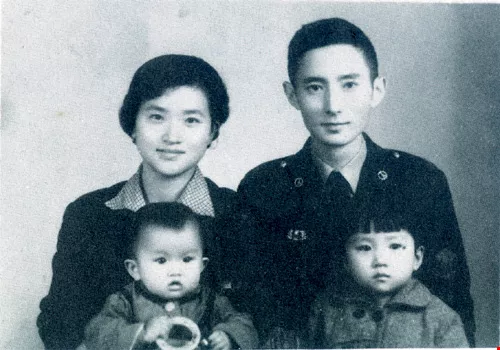
Chu's father, Chu Hsi-ning, was a well known anti-Communist author, and her mother, Liu Mu-sha, a writer and translator. In the photo, Liu holds a young Tien-hsin.
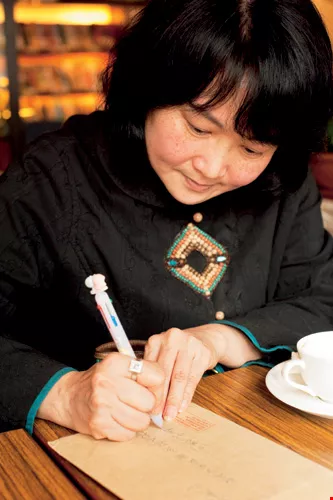
Chu has for many years "diligently avoided the real world," choosing instead to live life at her own pace.
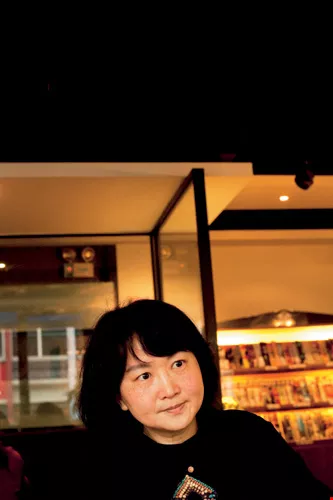
Sitting in the bookish cafe where she reads, writes, and gives interviews, a bright-eyed Chu Tien-hsin talks about how she got to where she is today.
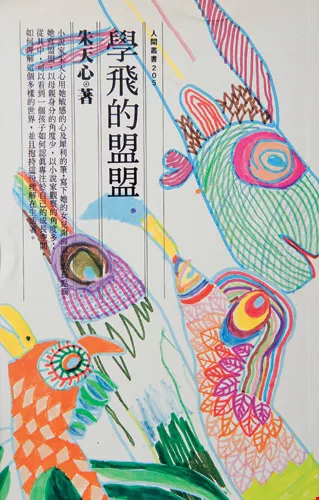
The Old Capital is a journey in search of Chu's own memories, while Mengmeng Learns to Fly is a record of her daughter's early childhood.

@List.jpg?w=522&h=410&mode=crop&format=webp&quality=80)

@List.jpg?w=522&h=410&mode=crop&format=webp&quality=80)


