Idealistic Etchings, Scenes from the Real World-The Poetry of Lee Min-yung
Kuo Li-chuan / tr. by Scott Williams
October 2010


Three years ago, when Lee Min-yung received the award in literature at the 11th National Award for Arts, the poet expressed his concern for Taiwanese letters, arguing that Taiwan must never give up on literature. Lee, who has also won the Wu Yung-fu Cultural Criticism Award, the Wu Cho-liu New Poetry Award, and the Lai Ho Literature Award, said that Taiwan needs more writers determined to create literature, more readers determined to read literature, and more publishers determined to publish literary works.
Lee has devoted himself to the writing of poetry, using his poems and lyrics to chart the course of Taiwanese history, soothe hurts and bring hope. His work has been translated into more than 10 languages, including English, Japanese, and Korean. Lee has also translated and interpreted the poetry of other nations into Chinese in an effort to open Taiwanese eyes to the wonders of poetry and to the larger world around them.
Born in Qishan Township, Kaohsiung County, in 1947, Lee's first experience with the power and beauty of language came at the age of 10 when he read Goethe's The Sorrows of Young Werther. But the young Lee continued to spend most of his time reading chivalric novels borrowed from book-rental shops, while also developing a love of film facilitated by an uncle's movie -theater in Pingtung.
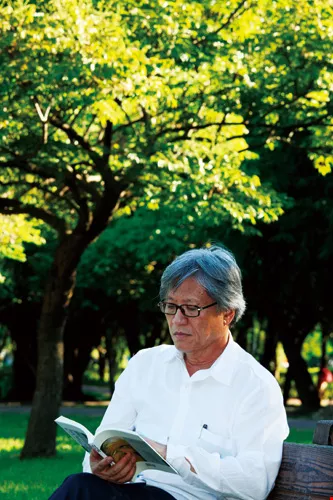
Lee Min-yung, who won the National Award for Arts in 2007, uses his poetry and song lyrics to trace Taiwan's history. He also translates foreign poems in an effort to open Taiwanese eyes to the wonders of poetry and to the larger world around them.
Lee was a solitary child who preferred to figure things out on his own. Until he tested into Kaohsiung High School, he found the well stocked local library a virtual intellectual amusement park. He read fiction, philosophy, political criticism, and poetry, as well as the existentialist and modernist literary works then popular with students. Used to educating himself through reading, he found it harder and harder to submit to the many limitations of the formal educational system.
But it was at school that he learned of the February 28th Incident, an event that the Taiwanese of the day weren't permitted to speak of. One day in physical education class, his teacher had pointed to bullet holes in the wall around the campus and said: "Those were made by soldiers executing students during the February 28th Incident." At the time, February 28" meant nothing to Lee; the incident had been carefully elided from the educational curriculum. Nor had he begun delving into the tragic history of the Kaohsiung High School self-defense brigade.
When he began high school, Lee attempted to cast his thought into various literary forms, and discovered that he most enjoyed poetry. "The world of poetry charmed and delighted me," he recalls. "When I was by myself, poems were practically my sweetheart." Lee matured early and fell deeply in love while still in high school, nearly abandoning his studies. But writing of his love also marked the start of his literary career.
In those days, KHS used to hold current events tests on a regular basis, and Lee, who was deeply interested in politics, economics, culture, and international affairs, typically represented his class in the competitions. But even though KHS was an elite high school that managed to place a high proportion of its students in universities, the literarily inclined Lee was so caught up in love and poetry that he skipped the university entrance exam and went straight into the military.
While in the army, he continued to publish poems and essays, met a wide variety of people, and got his fingers on the pulse of society. He also began thinking about going back to school, and tested into the history department of National Chung Hsing University. Lee published his first book, The Language of the Clouds, in 1969. Looking back on it, he says: "Everything I wrote in those days involved typical youthful sentimentality; they were practice pieces about the hurts of youth."
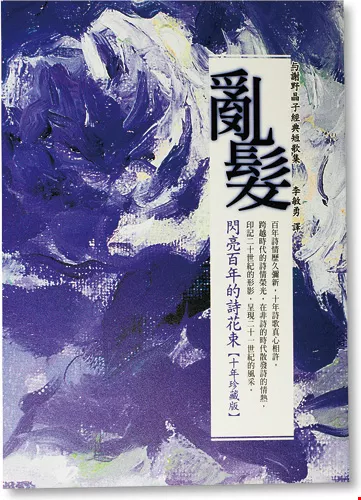
Lee and his wife love each other deeply. He translated Akiko Yosano's collection Tangled Hair just for her.
Lee later joined Li, Taiwan's first poetry society comprised of poets born in Taiwan. There he met a number of Taiwanese poets from the "language transition" generation, poets born in the 1920s such as Zhan Bing, Chen Chien-wu, Lin Heng-tai, and Jin Lian. The change in government had compelled these poets of the previous generation to abandon the Japanese language in which they were so adept, and make their stumbling way in Mandarin, feeling their way through its different poetic rhythms and structures like newborns. Stunned by the long, arduous process they'd put themselves through, Lee began to develop a consciousness of history, society, and the real world, and to grasp the currents of misfortune coursing through Taiwanese history.
"Handkerchief" gave Lee the sense that he'd "written a real poem," and set his work on a new path:
Your handkerchief sent back from the battlefield / Your handkerchief like a flag of truce / Your handkerchief that makes my tearstains grow / Pierces my heart like shrapnel
Your handkerchief sent back from the battlefield / Judges ordinary handkerchiefs / Your handkerchief begins the corruption of my youth / Buries me in a landslide / Deathly pale / A remnant of you / A seal / On my collapsing breast
Lee, who had never been to war, sparked discussion with his martial-law-era anti-war poems and became something of a spokesperson for his father's generation. In fact, Lee's own military service coincided with the end of the Vietnam War era, a period in which Taiwan keenly felt the communist threat and felt itself a part of a struggle with the Americans against a common adversary. American soldiers on leave seeking temporary release through wanton indulgence were all around, and American B-52s were constantly taking off from and landing at Taiwanese military bases.
Following his discharge, Lee began to write "war poems" and give voice to anti-war thoughts. Many critics believe that this period (1969-1971) marks the first important turning point in his work-from personal subjects to something more socially aware. The critic Peng Jui-chin discusses Lee's "Handkerchief" in "Bringing Light to the World: Poet Lee Min-yung":
This kind of war poem doesn't describe the cruelty of war; instead, it makes the reader feel it on his own. It doesn't write about injuries; the injuries are already present. It doesn't decry against war; war elicits loathing of its own accord. It is very different from the anti-war literature with which we are familiar, but that's what makes Lee Min-yung's anti-war poem interesting.
Lee's anti-war stance and his criticism of government arose out of his sympathy with human nature and life, and grew in step with his poetry. "No one has the right to deprive another person of life," says Lee. "Wars of aggression are evil because they leave people with no options and no opportunity to flee. They compel people to take up weapons and fight for their nation."
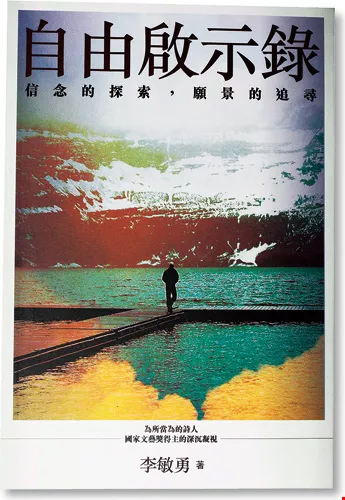
Revelation of Freedom, a collection of Lee's social and political commentary.
After graduating from university, Lee worked as a high-school teacher and a newspaper journalist. In 1974, he settled in Taipei and went to work for Cathay Advertising. There, he produced a series of ads on "advertising aesthetics," "advertising mechanics," and "advertising philosophy" in an effort to create an advertising "guidebook" based on his ideas about the field.
Even though poetry continued to hold a special place in his heart, the demands of workaday life forced him to stop writing for a time. He began contemplating a return to literature a few years later and made a decision in 1980 to split his life into three parts: creative endeavors, work, and participation in social movements. It was at this point that his poetry underwent its second major transformation, turning to environmental and political topics.
"The modern Taiwanese poetry of the 1980s was a poetry of the people," says Lee. During that period, his poetry and criticism remained grounded in the workaday world. His 1990 collection The Landscape under Martial Law Scenery is a case in point. It included the ecologically minded "Public Hazard," the political "The Landscape under Martial Law Scenery," and a piece entitled "Island Mood," an ambitious attempt to depict what lies in the hearts of the people of this island, but which utilized forms of expression that emphasized the poetic character of the work.
Lee also played an active role in social reforms through his newspaper column. These commentaries on culture and the arts were later collected in On Being a Taiwanese Writer, a book that broached the topic of the standing of Taiwanese writers and urged writers to reevaluate their own role and capabilities; it won the 1989 Wu Yung-fu Cultural Criticism Award.
Lee differs from other poets in that he also writes lyrics for songs. In 1980, at the request of Rock Records owner Johnny Duan, Lee penned a translation of Korean poet Sin Tong-jip's "There's a Person." Paired with a tune by Li Tai-hsiang, it was the first of Lee's works to be set to music.
Lee didn't get serious about songwriting until he met composer Hsiao Tyzen. Examples of their work together include "Love and Hope," a Taiwanese song that attempted to redress the grievous wrongs of the February 28th Incident; "Song of Freedom," which memorialized democracy activist Deng Nan-jung, who burned himself to death after being charged with insurrection; "Lily," a song about Taiwan's national flower; "Hurts," a tune intended to console the victims of the Jiji earthquake; "Yushan Hymn," a song praising Taiwan's "holy" mountain; and "Oh, Formosa!" a requiem to those who have sacrificed themselves for Taiwan throughout its history. Each song is a comment on the threads of Taiwan's postwar history weaving through the 1990s.
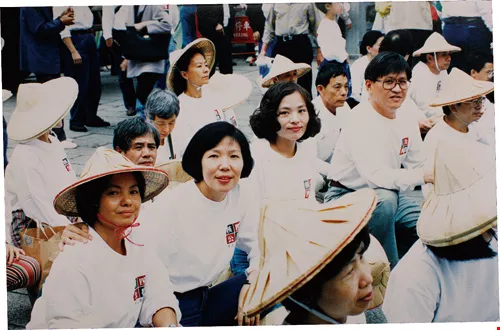
Lee (middle row, far right), a long-time social activist, and his wife (second from right) participate in an anti-nuclear rally.
The clearly political tenor of Lee's poems has caused some people to suggest his work might be too direct and insufficiently literary. In response to his critics, Lee quotes the poet Joseph Brodsky, a Russian Jew who lived in exile in the US. Brodsky wrote that poetry should criticize political authority until political authorities cease to interfere with poetry. The American poet Robert Frost made a similar comment on the power of poetry to stand in opposition to politics: "When power corrupts, poetry cleanses."
Lee's interest in social movements had grown only gradually. In 1977, he wrote "Land, Why Won't You Speak?" (part of his "Mother's Voice" series) to encourage the people who have persevered on this land to speak out. On May 20, 1988, farmers took to the streets to demand their rights in the most serious demonstrations since the ROC government had relocated to Taiwan in 1949. Lee wrote the poem "Sounds" in an attempt to capture the scene as riot police moved in on that rainy night, beating and dispersing the farmers and arresting their leaders:
What sound is that / It's the sound of the rain dripping / It's the sound of tears falling / Fragile bodies shivering / Pained hearts convulsing
On our land / In our time
In 1997, he wrote "On This Day Let Us Plant a Tree" in honor of the 50th anniversary of the February 28th Incident. With Taiwan now more open and democratic, a renewed hope and desire to console took the place of the sorrow and anger of his earlier work. The poem's second and third stanzas run:
Hear the cries / See the blood flow / But / Let us plant a tree / Not in hate / But in love / Let us plant seedlings of hope / Not weep tears of desperation
Let us plant a tree / Not to remember the deaths / But to embrace life / With each new sprout / With every new leaf / With each new growth ring / The photosynthesis of hope grows / Lush shade shall soothe the land's hurts / Cool green shadows shall ease our anguished hearts
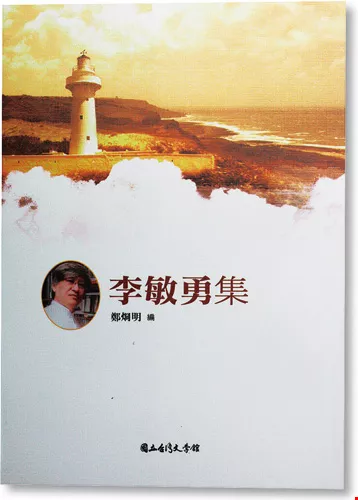
The Collected Works of Lee Min-yung, part of the National Museum of Taiwan Literature's Taiwanese poets series, introduces Lee's work and his thoughts on poetry.
Lee believes that poetry in Taiwan exists as a kind of decorative art with only the most tenuous of connections to everyday life. He also sees local poetry as having suffered from the repression of native languages by the foreign powers that ruled it for more than 400 years. For example, in the late Qing Dynasty and under Japanese rule, Mandarin poetry was written in standard Chinese characters while Taiwanese-language poetry had to struggle with the lack of standardized written equivalences for spoken words. This situation challenged both writers and readers, marginalizing Taiwanese poetry.
Seeking to bring poetry to a broader audience, Lee kicked off a "one-man cultural movement" in 2005. With the help of money and time from friends, he has been using poetry to promote reading, providing thousands of volumes of poetry to libraries and high schools. In the process, Lee has learned that getting people to donate books isn't difficult. He's also learned that many places don't lack books. Instead, they need volunteers to guide students and other members of the public through texts. He has therefore also arranged several classes on reading contemporary Taiwanese and world poetry at Taipei's East Gate College.
Remarking on the hectic lifestyle and never-ending quest for fame and fortune that characterizes contemporary society, Lee says that people need a quiet space where they can spend time with themselves. "Such spaces make for a more grounded life," he says.
Lee sees writing poetry as a completely solitary process. As he once put it: "Writing poetry begins with planting a seed in your mind. Once it sprouts, you have to put everything you have into looking out for it, carefully midwifing its birth and making sure nothing interferes with it. Poems aren't 'built' through acts of will, but instead represent thoughts and feelings in your heart and mind that are released through the medium of a pen."
"It's like the Greek poet Yannis Ritsos writes in one of his ter-cets: 'When he writes and doesn't look at the sea / He feels the pen shudder in his fingertips- / The moment when the lighthouse lights.' [Retranslated from the Chinese.] The pen merely draws forth the poem. The paper is like the birthing table on which a pregnant woman gives birth." Lee believes that poems are "gardens of words" and poets are garden builders. Readers, through their appreciation of poems, engage in their own acts of "recreation."
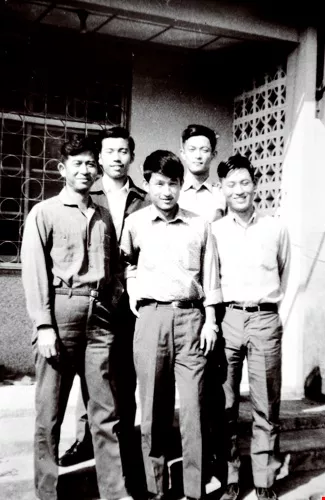
Several young poets visit Chen Chien-wu in Fengyuan in 1968. (front row, left to right:) Chen Chien-wu, Jian Cheng, Lee Min-yung. (back row, left to right:) Cheng Chiung-ming, Chen Ming-tai.
Lee has also translated poems from abroad in an effort to help Taiwanese readers develop a better grasp of poetry. Whenever he travels overseas, he looks for English translations of works by well known poets of the nations he visits. Over the years, those nations have included Denmark, Germany, Switzerland, Poland, the Czech Republic, the UK, the US, South Korea, Japan, and India. In some cases, he's managed to get his hands on books no longer in print, and even broken his luggage with the weight of his purchases.
Lee began by translating 33 poems by the Czech poet Antonin Bartusek after reading a Penguin edition of his poetry in English in the early 1970s. When he published his translations in the poetry journal Li in 1972, he wrote that "foreign poems educate and nourish."
Lee also reveres the work of Brodsky, who was exiled from his native Soviet Union in 1972. Brodsky, who won a Nobel prize in literature at the age of 47, subsequently took up residence in the United States and never visited his homeland again, arguing that his country had long since ceased to exist. Brodsky was a firm believer in the notion that "libraries are more powerful than nations," and that words, not armies, hold empires together.
Brodsky said (as paraphrased by Lee): "Poetry shouldn't be out of reach. It isn't hallowed and abstruse like the Bible. It's like an ordinary glass of water, as unremarkable as a drink of wine or a pot of flowers. Poetry is intimately connected to life."
Peng Jui-chin believes that Lee was profoundly influenced by Brodsky's idea, arguing that Lee's "poetry really embodies this idea. The language is clear and simple, full of intentionally constructed images."
Lee hasn't translated foreign-language poetry to become a translator. Instead, he sees translation as a means of doing close reading. Translating and explicating a poem draws him into its world, a process that he finds deeply fulfilling.
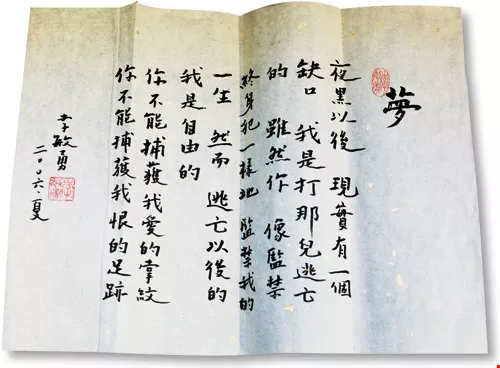
Lee has striven to maintain a place for poems in our hectic modern lives, providing readers a space in which their spirits can engage with poetry.
Lee, who has been composing poetry for more than 40 years, is often asked where he finds his inspiration. He typically responds with a remark made by the British poet Cecil Day-Lewis (as paraphrased by Lee): "Sometimes we see a thing that strikes us as beautiful. It becomes like a seed growing in the garden of our heart, a part of our experience. Sometimes it sprouts quickly. Other times, it takes time. Perhaps something new comes along that connects with our earlier experience, acting as a catalyst, like water sprinkled on the ground. When attentively cared for, these fragile poetic shoots grow and propagate."
Sitting in a Taipei office building, Lee thumbs through a collection of Brodsky's poetry and quotes a passage: "Sometimes, poets can answer questions that scientists and philosophers cannot." He stresses that poets don't simply sculpt words, but rescue them. "Rescuing words" implies engaging with the workaday world to safeguard its beauty and significance. In an era without liberty, the poet cannot yield to pressure or temptation, but must do his utmost to write the truth, to bear witness to the times.
Lee expresses his idea in "The Aspirations of Poetry":
We seek words unbroken / Pursuing the truth in a false country
Every poem is a story, each with its own secrets. The language of poetry has profound historical significance, serving as a bright beacon in dark times. Lee aims to bring this light to readers and hopes for a sympathetic response.
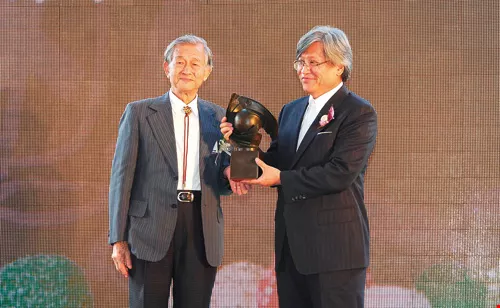
During the awards ceremony, Lee (right) asked Chen Chien-wu, founder of the poetry journal Li, to accept the award on his behalf.

@List.jpg?w=522&h=410&mode=crop&format=webp&quality=80)
@List.jpg?w=522&h=410&mode=crop&format=webp&quality=80)


