Chinese Animation Dreams Take Wings
Coral Lee / photos Chuang Kung-ju / tr. by Geoff Hegarty and Sophia Chen
December 2011


Animated movies from the US and Japan like The Lion King, Toy Story, One Piece, and Sponge-Bob Square-Pants, have pretty much monopolized the imaginations of Chinese kids from both sides of the Taiwan Strait.
But the situation is changing. Mu-Mu-Hug, a Taiwan-produced animation broadcast on YoYo TV and Taiwan Television, has recently introduced MuMu, and with his chubby belly and innocent smile, he's gaining enormous popularity. The TV series Pleasant Goat and Big Big Wolf from mainland China has also been well received in Taiwan, while Qin's Moon, recently adapted in a cross-strait collaboration from a martial-arts story written by the late tech-industry entrepreneur Say-ling Wen, has been a big hit on mainland television, and is now being made into a film.
Compared to the abundance of animated films emanating from the US and Japan, there is not a great number of outstanding ethnic-Chinese productions, but with the enormous potential of the Chinese market and sufficient funding and enthusiasm from the mainland and Taiwan, the creative forces are gradually amassing. What collaborative opportunities can be predicted for animation? Can the dream of creating a substantial ethnic-Chinese animated industry be realized?
Animated films like Mulan and Kung Fu Panda which have done well at the global box office are in fact US productions inspired by Chinese traditional tales and culture. Many have questioned why Chinese themselves cannot produce this kind of quality. After all, Chinese films can hold their own in terms of both quality and box office, frequently netting RMB100 million. So why are animated films lagging behind?

Animated TV series Qin's Moon, adapted from Sayling Wen's novel, has been well received by mainland animation fans. Above, Xiang Shaoyu, a character from the animation. On the facing page, the production team at Hangzhou Xuanji, including director Robin Shen (far right).
Taiwan, which has done a lot of the animation for Hollywood blockbusters, and China, where the film market is largely dominated by the US, have both embraced the dream of making their own animated films. Today, with the industry booming on both sides of the strait, hope springs.
Liang Gang, chairman of the China ACG Group, notes that from the 1950s to the 1980s China produced a number of great animations such as Why Are Crows Black, The Proud General, Uproar in Heaven, and Ne-zha Conquers the Dragon King. They used traditional Chinese artistic styles with ink, puppets or jianzhi (paper cutting) and won a number of international awards.
"Back then all animated production was organized by the state, so producers only had to concentrate on theme and style," says Zhu Yu-ping, executive president of the Shanghai Animation Film Studio. Over several decades, Shanghai fostered many excellent directors, art directors, and screenwriters, but at the end of the 1980s, because China was opening up to the world and moving towards a market economy, the film industry changed remarkably. The state no longer backed production, while directors tended to be artistic rather than business-oriented. Chinese production houses got into trouble, and at the same time, animation houses in Shenzhen working for US companies were offering 10 times the average salary to attract the best employees. As a result, the domestic industry lost a lot of good people.
The loss hit China's animation industry hard. By the mid-90s, the state was alert to the problem. By assimilating state-owned production houses with TV stations and boosting salaries, the situation was stabilized. But it left a huge gap.

Animated TV series Qin's Moon, adapted from Sayling Wen's novel, has been well received by mainland animation fans. Above, Xiang Shaoyu, a character from the animation. On the facing page, the production team at Hangzhou Xuanji, including director Robin Shen (far right).
By the mid-2000s on the mainland, the industry was being actively fostered. In order to protect local works, the government introduced measures to assist the industry by limiting imported productions, allowing only local productions on prime-time TV, and by providing financial support.
Currently, there are some 10,000 animation companies and about 1 million people in the industry; annual production of animated cartoons for television increased from 1,000 minutes five years ago to 220,000 minutes in 2010; and some 470 colleges have founded animation departments.
But the developments have not been without problems. The amount of animated program broadcast nationally is no more than 30,000 minutes a year, but as supply often reaches 220,000 minutes, a lot of it can't be sold. In fact, producers often have to pay the networks to take their material. It seems that many animation companies create product simply to benefit from state subsidies.
For example, because 2D and 3D animation is subsidized at RMB2000 to RMB3000 per minute, many companies try to keep costs below subsidy level and pocket the margin, often resulting in works of minimal quality.
Those companies keen to produce quality works are unable to show their stuff due to a lack of broadcasting demand. TV stations show scant interest in productions aimed at young viewers, because such programming generates little advertising revenue. Thus even good material may find no outlet.
Despite reasonably healthy investment in animated films, few have made money. Chinese-foreign joint venture animated films made in 2011 (Kuiba, The Tibetan Dog, Legend of a Rabbit) cost between RMB10 million and RMB100 million and, considering their quality, were expected to perform well. But the results have been dismal, with box-office takings of less than RMB10 million.
As a result, derivative products such as books, toys, and games have also suffered.

Shanghai Animation Film Studio's 2011 animated feature The Legend of Young Yue Fei, directed by Taiwanese animation director Cai Mingqin, delights with its phantasmagorical style, aesthetic beauty and touching storyline.
The current situation is depressing, but Pleasant Goat and Big Big Wolf in animated movie form has broken the drought. (Contrary to its English title, the cartoon features sheep rather than goats.)
Originally a TV cartoon series produced by Creative Power Entertaining in Guangdong, the story is very simple: the wolf wants to eat the lambs, but is never able to satisfy its desire, and like in Tom and Jerry, the hunter is always outsmarted by its prey.
The language in China-produced animations is often rigid and dogmatic, but Pleasant Goat and Big Big Wolf is simple, funny and unpretentious with no sense of imposing values onto its audience. The children love it.
More than 500 TV episodes have run since 2007. Ratings were fair, but not good enough to continue the series. When it was on the brink of closing down, Toon-max Media, a subsidiary of the Shanghai Media Entertainment Group (SMEG), discovered it, seeing the potential for a successful animated film.
In order to generate support for the film version, SMEG advertised through its nationwide TV network and marketed aggressively. As a result, Pleasant Goat and Big Big Wolf: The Super Snail Adventure, released during Chinese New Year in 2009, achieved great success. The box office hit RMB85 million, breaking all previous records for Chinese-made animated film. And sequels in 2010 and 2011 reached new heights with takings of RMB126 million and RMB150 million respectively.
"Production and distribution were the outcome of lots of market research," says Yu Jie, vice president of Toon-max Media. She says that many China-produced animated films don't have a clear orientation, so even though the producers may be happy, the children don't like them. Six months preparation went into marketing, organizing activities and getting the public enthused. As a result, audiences have expanded to include young adults, and the gray wolf's "good guy" image (he is in fact a reluctant hunter) has created a popular phrase: "If you want to marry, marry a gray wolf."
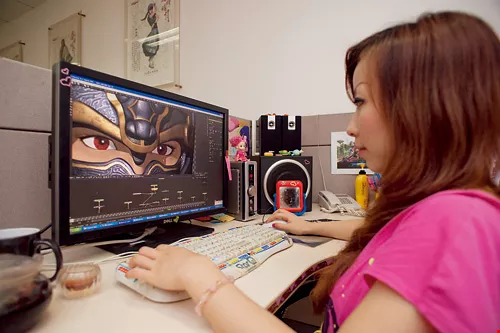
Mainland proficiency in 3D animation and special effects is catching up with international standards. The photo shows one of the companies involved, Hangzhou Xuanji Science & Technology Information.
During the 2011 summer vacation, animated movie Seer was adapted from a game on popular mainland website Tao-mee, and generated RMB48 million: another success.
The Internet game targets users from six to 14 setting up a virtual community. Players ride on the Seer Spacecraft, launch adventures in the universe, explore new energy forms, discover new concepts, and experience wonderful journeys through space.
The animation features a robot, -Xiaomo, who is assigned an urgent mission to lead three mythical beasts, Crab, Panda, and Goat, as a team to conquer an evil army in order to find new energy resources for the Earth. With the game's hundred million registered players as a potential audience, Seer was released in the 2011 summer vacation at the same time as Transformers 3. Although the box-office record of Pleasant Goat and Big Big Wolf held its place, this new venture has excited the industry.
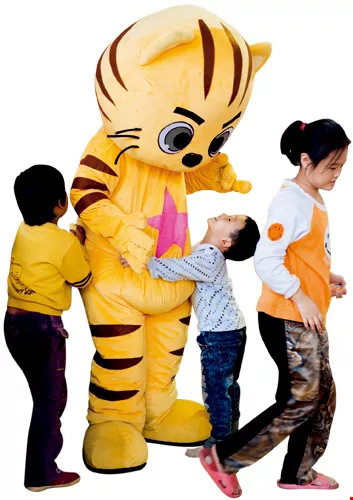
A TSTC animated production, Star Cat has enjoyed great success on the mainland through marketing cartoon images in its own stores, and in teaching materials for kindergartens.
In the early stages of the renaissance of China's animation industry, Taiwan companies had already begun to till the mainland soil.
Sayling Wen, founder of the Inventec Corporation, established Tomorrow Studio in 1999, providing a platform for cultural workers and artists.
In 2000, he set up Tomorrow Science & Technology China (TSTC) in Beijing, mainly to develop digital animation, and from 2002 the company produced animated television series-Qin's Moon and Star Cat-and developed derivative products.
"Martial arts animation is Mr. Wen's personal interest." Chang Yun-yang, the CEO of TSTC, says that the martial arts are a common interest of ethnic Chinese, and are also a symbol that the West identifies with Chinese culture. And internationally renowned figures like Confucius, Laozi and Sunzi, and the First Qin Emperor's Great Wall, are able to capture both domestic and international attention. So Wen took a historical tale of heroes rebelling against the First Qin Emperor over a period of 30 years in the late Qin and early Han dynasties, and composed a novel of eight volumes: Qin's Moon. Chronologically, the story reconstructs the attempted assassination of the emperor by Jing Ke, and then develops as a fiction around the hero's son, Jing Tianming. The tale makes much of the chivalrous spirit of the martial arts world.
Robin Shen, general manager of Hang-zhou -Xuanji Science & Technology Information, directed the animated film version and also adapted Wen's novel into the scripts. He says that in order to avoid competition with Japanese productions, 99% of China-produced animations target audiences under 12. Qin's Moon, however, was aimed at teenagers and college students. With no expense spared, a 20-minute segment cost RMB300,000. A martial arts expert was employed to model accurate martial arts movements. And to portray subtle body movements and facial expressions, they made much use of motion capture technology. Several dozen cameras capture action in real life, which is then imported into the animation.
According to the 2010 global animation popularity ranking on China's Baidu website, 99 works of the top 100 were Japanese, with Qin's Moon, the only non-Japanese production, at number six. A Japanese government white paper on digital content listed Pleasant Goat and Big Big Wolf, in the young children section, and Qin's Moon, in the teenage section, as successful China-produced animations. In recent years, the film version of Qin's Moon has been broadcast on China Central Television and on provincial and local television channels, and its revenue including broadcast fees, contest awards, and publications has covered its costs. This is unusual-most China-made animations suffer huge losses.
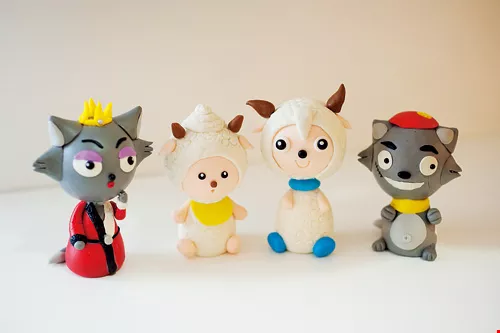
Ethnic-Chinese-produced animated productions are attracting attention. Seer, Pleasant Goat and Big Big Wolf, and MuMuHug (above, left to right) have gained fame on both sides of the Taiwan Strait.
Star Cat is another TSTC creation, an attempt at producing a Chinese Mickey Mouse. The animated TV series was launched in 2005, and some 10,000 minutes of the program has been produced, enough for a whole year.
The brand image of Star Cat is not particularly prominent in an environment inhabited by hundreds of diverse cartoon figures-competing with the popular Blue Cat makes it even more difficult to stand out. However, Star Cat was finally able to pay for himself through derivative products.
In 2009, TSTC developed peripheral merchandise including Star Cat toys and clothing, and founded Star Cat stores-more than 100 stores were opened in 25 cities in two years. A "happy childhood" marketing strategy targeted the children's market of around 300 million, and teaching materials were developed for kindergarten kids in some 200 cities.
Compared to animated films and TV series, which are extremely costly, short animated clips more suited for download to cellphones, iPads, and tablets have become the new trend for this mobile communication era-and an attractive market for the industry.
Taiwanese company Green Paddy was established originally as an animation ODM, and then began producing animated advertisements. When 3G arrived in 2004, Green Paddy introduced animated clips focusing on humor, fun and warm relationships for telecoms such as Asia Pacific, which won an award at MIPCOM (a TV and entertainment forum held in Cannes every year), and another from China's cellphone industry.
Because of the borderless nature of the web, Internet companies in China such as Sina and Ten-cent noticed Green Paddy's stunning work, and seeing the potential, suggested collaboration. As a result, web users on both sides of the Taiwan Strait can now watch more than 200 animations through monthly rental or individual download.
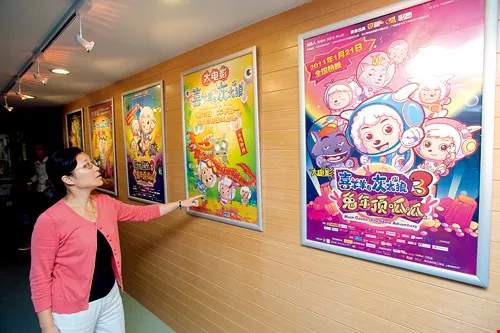
With massive marketing and advertising, Pleasant Goat and Big Big Wolf has set box-office records three years running. The photo shows production company Toonmax Media.
Zhang Yun-yang has been an investor in China's animation market for over a decade. He says that in recent years, the industry continued to expand infrastructure and personnel. Production teams, distribution companies and marketing all grew, but a lot of this was experimental. A successful industry model remained elusive.
However, the situation improved marginally after the success of Pleasant Goat and Big Big Wolf. Zhang notes that three very successful series are now in the can, signaling the beginnings of a new industry. If cinemas, production houses, investors and animators can continue to work together, it will be possible to attract more investment to further develop China's uniquely linked industry and business model.
As animation takes off, what role should each side of the Taiwan Strait play?
Liang Gang thinks that the emphasis should be on quality. He sees cross-strait cooperation in this area as one way for Taiwan to break into the mainland market.
Mu-Mu-Hug, for example, is very popular in Taiwan. But because it's produced by a Taiwan-funded company, it has been excluded from mainland prime-time television; Qin's Moon, on the other hand, was made on the mainland and so has a huge advantage in China.
Taiwanese creativity has always been respected by China, so a model using Taiwan-produced, China-distributed works is the current direction. For example, Shanghai-based Toonmax Media and Taiwan-based SOFA Studio (the producer of MuMuHug) are planning to coproduce a film through their newly established joint venture Two Tigers.
"Current mainland animated production is worth RMB40 billion, and at a conservative estimate, has scope to grow to RMB100 billion in the next three years." At the 2011 Taiwan International Cultural & Creative Industry Expo in September, Liang said that because China's animation industry is now confronted by a shortage of creative people and by missing links in its industrial chain, there is an opportunity for the two sides to integrate resources to complement each other's strengths, and offset weaknesses.
With 5000 years of history, Chinese culture embraces an enormous variety of ancient myths and classical tales, affording an inexhaustible source of themes for animators to draw upon. Creating a Chinese DreamWorks presents enormous challenges. But with cross-strait cooperation, it won't take long to realize the dream.

Ethnic-Chinese-produced animated productions are attracting attention. Seer, Pleasant Goat and Big Big Wolf, and MuMuHug (above, left to right) have gained fame on both sides of the Taiwan Strait.

Ethnic-Chinese-produced animated productions are attracting attention. Seer, Pleasant Goat and Big Big Wolf, and MuMuHug (above, left to right) have gained fame on both sides of the Taiwan Strait.
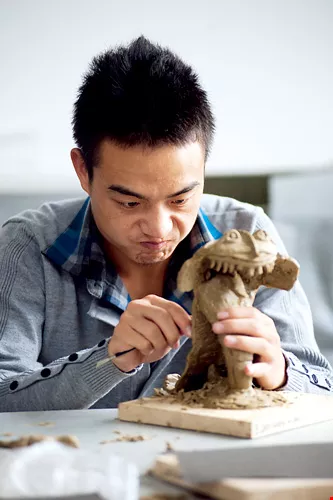
China is fostering the expertise of its future animators in several hundred colleges which have established animation departments. The photo shows a student in the Animation Department at Hangzhou Normal University.

Green Paddy's animated clips feature creativity and humor, so many cross-strait web users are willing to pay for downloads. The photo shows Neighbor Granny, an award winner.

@List.jpg?w=522&h=410&mode=crop&format=webp&quality=80)

@List.jpg?w=522&h=410&mode=crop&format=webp&quality=80)


