Historian Tsao Yung-ho Examines Global Perspectives on Taiwan
Kuo Li-chuan / photos courtesy of Tsao Yung-ho / tr. by Scott Williams
May 2010


National Taiwan University awarded Tsao Yung-ho, the 90-year-old godfather of Taiwanese history, an honorary doctorate last November. In fact, the ceremony was at the heart of the university's 81st anniversary celebrations. Academia Sinica has also recognized the importance of Tsao's work, and elected him an academician in 1998.
An autodidact with no university degree, Tsao is a meticulous student of Taiwan's obscure early history. His work looks at Taiwanese history from a variety of international standpoints and has given Taiwanese a new perspective on their past and on their identity.
Tsao Yung-ho has made a close study of early Taiwanese history and is an authority on the Dutch/Koxinga era. Fluent in several languages and well versed in Southeast Asian and world history, in 1990 he proposed utilizing both international and local perspectives to develop a history of the island of Taiwan. His concept, which has been influential in the field of contemporary Taiwanese studies, was to make the people who live on the island the principal focus of such a history.
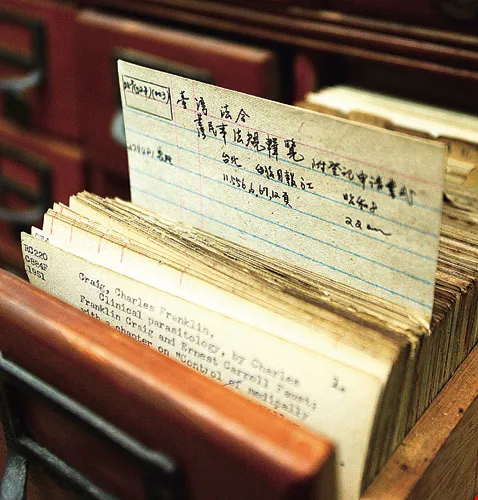
The tall stacks of books include many recently published foreign-language works. The ancient, musty card catalogue is stuffed with carefully composed notes on the key points of various books. This isn't the NTU Library, but the collection in Tsao's own home.
"No matter how the times and the environment change," says Tsao, "the relationship between Taiwan and the people who live here remains unchanged." Tsao believes that previous Taiwanese historical studies have been too focused on Han perspectives and political transitions and didn't fully grasp that "Taiwan itself is an independent historical arena."
Tsao emphasizes that history represents the interaction of three elements-people, time, and space. Space is the locus of human lives and work. Across the ages, people of all kinds have walked on and off this stage, their entrances and exits driving history's continuous episodic evolution. But the stage persists no matter how often the players are replaced. Tsao therefore argues that Taiwanese historical research needs to examine this stage with an eye to its geographic characteristics. He believes that historians must broaden their perspective and avoid limiting themselves to a single viewpoint. They need to build a structural, comprehensive, global historical perspective, to think about Taiwanese history in the context of world history in order to create a new, regionally situated history of Taiwan.
This new kind of history encompasses all the structures built by the human groups on the island. It takes a long-term overview of the maritime means by which Taiwan has constructed relationships with the rest of the world, of world trends during different periods in Taiwan's history, and of Taiwan's international standing and role. Tsao examines each of these subjects and elucidates his findings, giving non-historians a clearer understanding of Taiwan's "true" history. Tsao contends that the concept of a history of the island of Taiwan can help Taiwanese historical research free itself from the excess of political interpretations that have previously limited it.
In "The Establishment of and Key Issues for a Taiwanese History," Wu Mi-cha, who chairs the Taiwanese literature department at National Cheng Kung University and teaches in the history department at National Taiwan University (NTU), writes: "In contrast to the long-term practice of historians to write histories oriented around people, Tsao Yung-ho's 1990 proposal to make the island of Taiwan the subject of history introduced the notion of writing histories oriented around place."
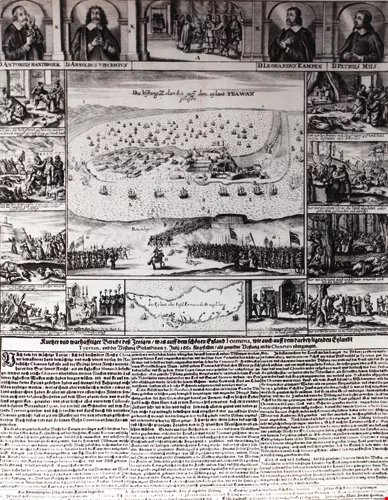
This Dutch document from the collection of Rotterdam's Atlas van Stolk Museum reports on Koxinga's attacks on the Dutch soldiers stationed on Taiwan. It includes the image of a martyred missionary and a map of Taiwan.
Tsao ("Cao" in Hanyu Pinyin) was born in Taipei's Shilin District in 1920. His ancestors had come to Taiwan from Fujian and had been teachers in Taiwan for generations. One grandfather, Cao Tianxiang, founded and taught at a private school. His father, Cao Ciying, graduated from the normal division of the Office of the Governor-General's Japanese-language school (now the Taipei Municipal University of Education) and went on to teach at Shilin's Bazhilan Public School.
Tsao's father began teaching him Mandarin at the age of five using the didactic Three-Character Classic. Tsao entered Shilin Public School (today's Shilin Elementary School) the following year. When he was in the third grade, his father took a job with the Bank of Taiwan and the family relocated to Taipei's Dadaocheng area.
While a ninth grader at Taipei No. 2 Middle School (now Chenggong High School), Tsao and his parents moved back to Shilin. Frequent illnesses caused him to miss a good deal of school, and he had trouble keeping up with his mathematics studies. After finishing secondary school, which in those days lasted five years, he failed to gain admission to an institution of higher learning. Devastated, he walked more than one hour every day from his Shilin home to the Governor-General's Library, where he skimmed numerous works on literature, history, philosophy and Buddhism. Having no money, he drank water for lunch. These daily excursions continued for six months and marked the start of his career as an autodidact.
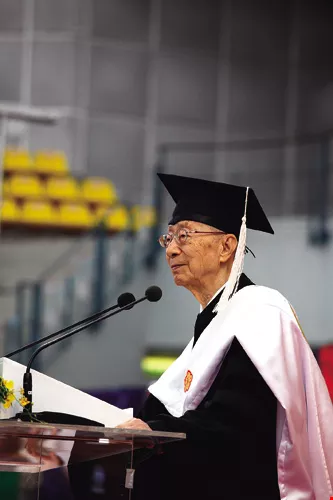
(right) Physically frail, introverted, and disappointed in his efforts to pursue higher education in his youth, Tsao put his tremendous willpower to work teaching himself. Already an academician with the Academia Sinica, he received an honorary doctorate from National Taiwan University last year.
In 1939, his father got him a job with the predecessor to the Shilin Farmers' Association. The following year, Tsao and his friends He Bin, Zhang Yu, and others formed the Shilin Cooperative Society. Shilin has always been a hotspot for writers and had a very high percentage of people with tertiary degrees. Tsao's society provided people who hadn't been able to continue their formal educations the opportunity to continue learning by organizing reading groups and inviting well-known individuals to give lectures. Tsao himself made use of his participation in the colloquia to write several published papers on folk customs.
Tsao married in 1945, but had to give up his job that November after contracting tuberculosis. A later bout of pleurisy put him in the NTU Hospital for a year. With his son's birth approaching and his savings exhausted, his wife had to find a job. Such real-world constraints forced him to abandon his dream of study in Japan and to make academic research his career. Tsao started working at the NTU Library in 1947, embarking on what would be a lifelong course of study.
Tsao's passion for history and literature led him to spend all his free time perusing the library's excellent collection. He became a living catalogue of the NTU collection, the man who knew the location of everything it contained, and assisted many students and faculty members with their research. Many Japanese scholars remained at the university in the years immediately following World War II, giving Tsao the opportunity to audit Rokuro Kuwata's course on the history of East-West communications.
"Under the Japanese system, you had to learn the language of the country you studied," recalls Tsao. "Consequently, those of us who did research had to become proficient in a number of languages. We weren't like today's students, who are overly willing to rely on others, always wanting us to hurry up and translate documents into Chinese and unwilling to put in the hard work of learning foreign languages for themselves."
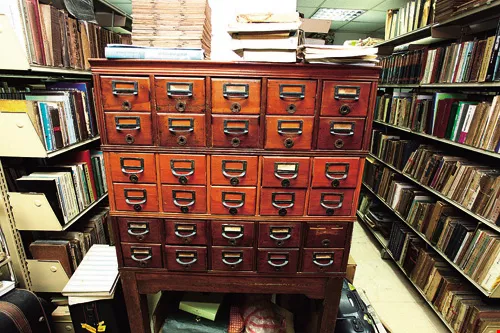
The tall stacks of books include many recently published foreign-language works. The ancient, musty card catalogue is stuffed with carefully composed notes on the key points of various books. This isn't the NTU Library, but the collection in Tsao's own home.
Tsao's work required him to deal with books and documents from the US, Europe and Japan on a daily basis. He'd studied German with his wife's brother Zhang Yu before he started at the library, which helped him a great deal when he began working with Dutch documents.
The Dutch were trailblazers during the age of Euro-American maritime hegemony, making familiarity with the Dutch language of the period a necessity for scholars working on early Taiwanese and Southeast Asian history. While Taiwan was under Japanese rule, scholars from Taihoku Imperial University (the precursor to modern-day NTU) made photographs of documents in the Netherlands and brought the images back to Taiwan for study.
Seeking to familiarize himself with the handwritten language of the archival images, Tsao first compared the Dutch original of the Dagh-register gehouden int Casteel Batavia ("Day Register of Ship Movements at Batavia and the Dutch Indies") to Naojiro Murakami's Japanese translation, and documents written by Dutch missionaries to William Campbell's English translations. He applied what he gleaned from these printed texts to his study of the handwritten documents in the archives, transcribing the latter and working through them word by word with the help of a dictionary.
"I thought there was no better way to learn than by patiently transcribing the documents, looking up words in the dictionary, making cards, and memorizing vocabulary," says Tsao, who waded through stacks of dictionaries in the process. He began by checking a Japanese-Dutch dictionary and a Dutch-English dictionary, and then went on to a modern Dutch dictionary that explained the usage of the colonial period. When he couldn't find a word, he turned to the Oxford English Dictionary, which includes etymologies of words in Western languages and provided him with useful leads on the many foreign loan words in the Dutch of the period.
Tsao devoted enormous amounts of time and effort to language learning, becoming very proficient in Japanese, English, and Dutch, and somewhat proficient in Spanish, Portuguese, French, German, and Latin. He also became well known for his studies of early Taiwanese history, which were facilitated by his grasp of Dutch documents.
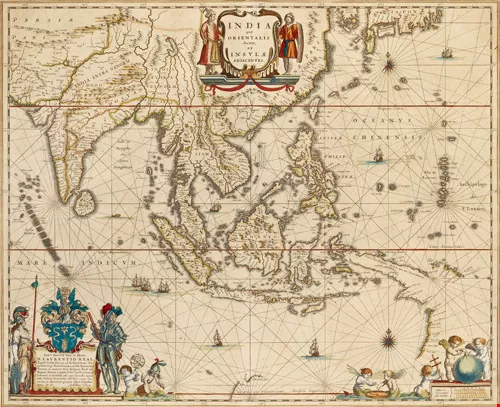
This 1635 map makes plain why Taiwan, which sits at the crossroads of Northeast and Southeast Asia, was able to continuously adapt to changing global trends.
In May 1948, the Gonglun Bao ("Public Opinion Journal"), a periodical edited by Chen Chi-lu, began publishing a weekly supplement on Taiwanese culture and customs. When the Nationalist government relocated to Taiwan in 1949, it reorganized the Taiwan Provincial Common History Historica as the Historical Research Commission of Taiwan Province. It also established historical research committees for each of the province's cities and counties, each of which had its own publications. Private-sector publications included the periodicals Taiwan Wenhua ("Taiwanese Culture") and The Taiwan Folkways. Taiwanese history and local customs had become a hot field of study and Tsao was intrigued.
Lian Yatang's General History of Taiwan and Kanori Ino's History of Taiwanese Culture both focus on the Qing Dynasty and offer only sketchy information about the pre-Qing period. Tsao therefore focused his first academic paper on Taiwan's deerskin trade, examining Dutch and Han Chinese trade with Aboriginal villages prior to the development of agriculture on Taiwan. After publishing the paper in Japanese in 1951, Tsao himself translated it into Mandarin. He ultimately chose not to publish the Mandarin version because he thought his Mandarin was too weak.
In secondary school, Tsao's Japanese was better than that of most native speakers and he became accustomed to thinking in the language. He says that when he switched to using Mandarin following the war, his thoughts often got muddled. "I had to think about things in Japanese first," he recalls, "then translate my thoughts into Mandarin, which made writing more difficult."
In 1952, Tsao became head of the NTU Library's collections section and continued his research into early Taiwanese history. Over the period 1953-1963, he published papers in Bank of Taiwan Quarterly and Taibei Wenxian ("Taipei Archives"), and received accolades from Zhou Xianwen, head of the economic research division at the Bank of Taiwan (BOT). After the two men got to know one another, they worked together to facilitate the division's publication of the very well regarded Encyclopedia of Taiwan (publishing 595 items on 309 subjects from August 1957 to December 1972).
While working on the project, Tsao and employees of the BOT's economics research division scoured libraries and archives around Taiwan. They also traveled to Japan, Hong Kong, the US and Europe to copy, collate, and translate documents, gazetteers, informal essays, poetry, prose and other information pertaining to Taiwanese history. In those days, all data had to be collated by hand, making it a daunting task.
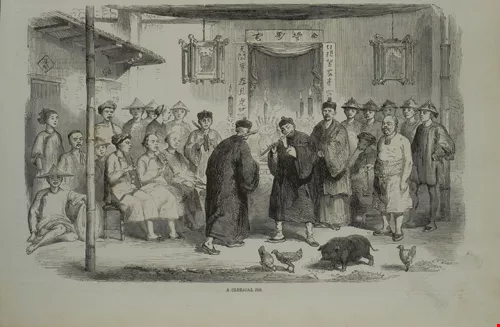
Because so many different ethnic groups live together on Taiwan, the creation of a comprehensive, structured history of Taiwan requires setting aside notions of ethnic superiority. (below:) An 1859 drawing by a British journalist shows a religious ceremony. (right:) An 1870 engraving made from a photograph by British photographer John Thomson shows a Pingpu woman holding her child.
Tsao devoted his free time to research and was an internationally respected scholar by the time he reached his 30s. But it was becoming Seiichi Iwao's student that most benefited and influenced him.
Iwao had been an early authority on Southeast-Asian history at Taihoku Imperial University. After reading Tsao's papers in Japan, he became interested in providing Tsao with the training he needed to further his research. Iwao recommended that Tsao participate in the 10-year-long Major Project on Mutual Appreciation of Eastern and Western Cultural Values begun in 1956 by the Toyo Bunko and UNESCO. Then, in 1965, Iwao secured a UNESCO Fellowship for Tsao that realized Tsao's long-cherished dream of studying in Japan by giving him the opportunity to study at the Toyo Bunko and the Historiographical Institute of the University of Tokyo for a year.
Iwao mentored Tsao, setting aside his duties at Imperial University in Tokyo for a little while every week to visit the Toyo Bunko. There he tutored Tsao in person, guiding him in the use of unpublished Dutch documents in his research. Iwao would continue the lessons until he left for home in the evening, earning Tsao's undying gratitude for his solicitous care.
As the 1960s progressed, the US began paying ever closer attention to Vietnam and its war, and became much more interested in Vietnam studies. At the recommendation of Professor Chen Jinghe, a Vietnam expert, Tsao spent 1973-75 at the Chinese University of Hong Kong participating in an international research project gathering Chinese-language information on Vietnam. Tsao's actual duties centered on revising The Complete History of Great Viet and several other volumes of Vietnamese history. In 1978, he was invited to Leiden University's center for research into the history of European development, where he worked on a project annotating De Dagregisters van het Kasteel Zeelandia ("Day Registers of Fort Zeelandia"). Tsao's work on these international projects broadened both the scope of his research and his academic vision.
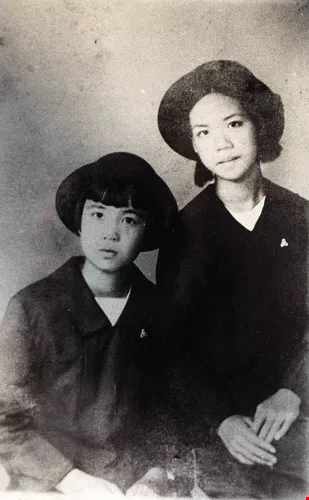
Tsao has always valued the understanding and support of his wife Zhang Huazi (left). At right is Tseng Wen-hui, later Taiwan's first lady as wife of President Lee Teng-hui; she was Zhang's classmate at Taipei No. 3 Girl's High School (now Zhongshan Girls' High).
Tsao truly shines at combing through data to unravel history's riddles. For example, most people believed that the "Red-hair Fortress" behind Penghu's Mazu Temple had been built by the Dutch, but during a 1988 academic conference on Penghu's history Tsao showed that the fort built by the Dutch had been located on the other side of the Magong harbor mouth on Fengguiwei's Mt. Shetou. Tsao made his case by comparing modern aerial photographs with a 1623 harbor map found in documents from the Austrian National Library in Vienna.
Then there's Danshui's "Red-hair Fortress," which had long been thought to be the Fort San Domingo built by the Spanish during their occupation. While there's no doubt that the Spanish built a Fort San Domingo, it turns out that the Dutch leveled it and built a new fort of their own-named Fort Anthonio after the Dutch governor-general-in 1647. The Japanese misidentified the Dutch fort as San Domingo, and the name stuck for over 100 years. Tsao's work with Dutch documents finally corrected the mistake in 2005.
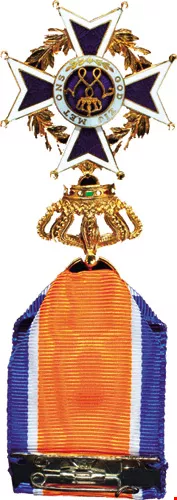
In 2002, Queen Beatrix of the Netherlands named Tsao an officer of the Order of Orange-Nassau.
In 1984, Academia Sinica's Institute of the Three Principles of the People named Tsao a research fellow. When Tsao retired from NTU Library in 1985 after working there for 39 years, he was immediately hired onto the faculty of the university's history department, where he continues to work to this day. In the afterword to the second volume of his Research on Taiwan's Early History, published in 2000, he wrote:
"Taiwan has been attacked by a Nativist zeitgeist for the last 20 years, and historians with their fingers on the pulse of society have had little choice but to reevaluate earlier perspectives on research.... My research subject has changed from specific ethnic groups to the land itself. My research ultimately concerns all the ethnic groups active on this piece of land. Working from my belief that history should be tied to place, I proposed the notion of an island history of Taiwan, and used this concept to construct the autonomous standing of Taiwanese historical research."
Though an island, Taiwan is advantageously located. It has been an important conduit for migrations from East Asia since prehistoric times, and has, since the 16th-century Age of Discovery, been involved in global competition. As a consequence, its sovereignty has passed through the hands of surrounding nations several times.
Tsao stresses: "Diverse ethnic relationships and frequent transfers of political power have several implications for the complexity of Taiwan's history. In its progression from isolated island to base of operations for international businesses to agricultural development to Japanese-era breakthroughs to post-World-War-II transformation, Taiwan has evidenced different characteristics in different periods."
Taiwan has been ruled by many different regimes over the centuries. Tsao argues that these political transitions have had little to do with the will of its peoples, who have only been able to passively play the limited role assigned to them by the times.
"Taiwan's complete history encompasses much more than just the history of its Han Chinese," says Tsao. He believes that creating a comprehensive Taiwanese history requires that we all abandon our sense of ethnic superiority and get to work researching and reconstructing the history of the Pingpu tribes.
"The study of history requires the building of a world that gives each ethnic group and each civilization within it equal standing such that each has the right to demand equal consideration and study. It doesn't permit any discrimination or exclusion."
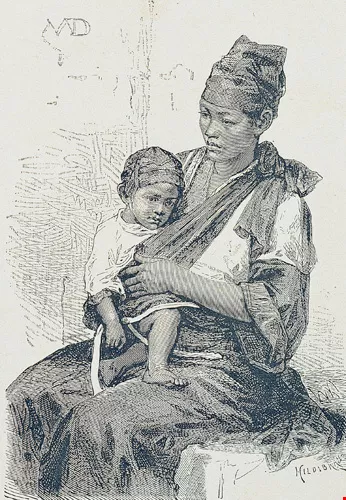
Because so many different ethnic groups live together on Taiwan, the creation of a comprehensive, structured history of Taiwan requires setting aside notions of ethnic superiority. (below:) An 1859 drawing by a British journalist shows a religious ceremony. (right:) An 1870 engraving made from a photograph by British photographer John Thomson shows a Pingpu woman holding her child.
Tsao's expertise on early Taiwanese history and the Dutch period has made him very well aware of the profound influence of the sea on Taiwan's development. Tsao therefore regards the sea not as an obstacle but as a means of access, and describes the Taiwan of the Dutch and Spanish period as "maritime" in nature. His objective is to reevaluate this island, which sits at the margins of mainland China and at the crossroads of Southeast and Northeast Asia; the nations and seas around it; and the Dutch East India Company that connected it to Europe, in order to understand from a global perspective Taiwan's ups and downs within East Asia's changing networks.
"Taiwan's island geography gave it some degree of maritime character during the Dutch and Koxinga periods," says Tsao. "Unfortunately, it never formed a cultural unit." Tsao believes that the present moment provides Taiwan with an excellent opportunity to transform into a "maritime culture," and that the notion of a history of the island might help lay the foundation for such a maritime culture.
In 1998, Tsao became the first (and so far the only) person without a university degree to be named an academician at the Academia Sinica. During an interview at the time of his elevation to the position, which coincided with the posting of the university entrance exam results, he offered students encouragement: "Don't lose heart if you fail to get into a university. If you do what interests you, and stick to it, you will ultimately make your mark."
Tsao's own children remember him clasping a book and reading. Students recall him carrying a bag full of books and giving generously of his time to those who dropped by seeking instruction. His fellow scholars acknowledge his conscientious research, objective and rigorous theorizing, and careful assertions. Tsao has always been faithful to his interests and devoted a lifetime to his work. In addition to receiving accolades both nationally and internationally, he has quietly toiled in the field of Taiwanese historical studies, planting seeds and tending the soil, becoming a model for other scholars of Taiwanese history through his diligent work and selfless contributions.
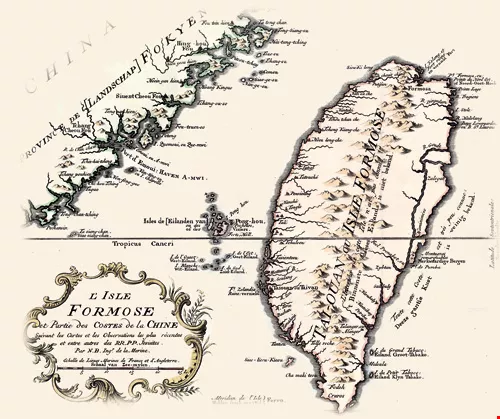
(facing page) Taiwan's diverse ethnic makeup and multiple transfers of political control have had implications for its complex history. Academia Sinica academician Tsao Yung-ho believes the only way to truly grasp Taiwanese history is to view the island as an independent historical platform. The photo shows a map of Formosa and coastal China produced by an early 18th-century French mapmaker working from Jesuit surveys.
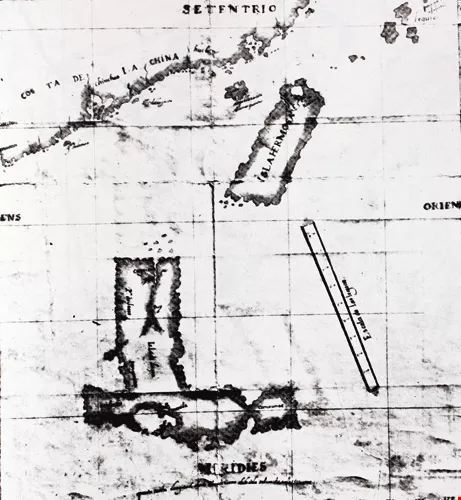
After occupying the Philippines in 1565, the Spanish hoped to move on to the rest of East Asia. In 1597, the governor-general of the Philippines appended this map to a letter he sent to the Spanish king recommending the stationing of troops in the area around present day Keelung.
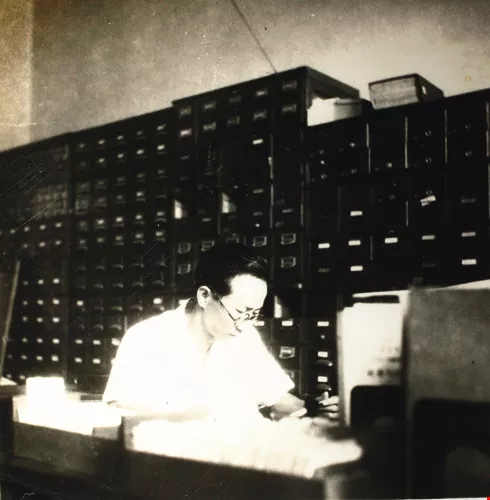
Tsao began working in the NTU Library in 1947, embarking on what would be a lifelong course of study.

@List.jpg?w=522&h=410&mode=crop&format=webp&quality=80)

@List.jpg?w=522&h=410&mode=crop&format=webp&quality=80)


