Insuring Against Disaster:Learning to Expect the Unexpected
Teng Sue-feng / tr. by Phil Newell
December 2001


Earthquakes, typhoons, floods, terror-ism, and now anthrax. . . . It seems that we are surrounded by risks and threats. Is there some way we can reduce loss of life and property amidst these omnipresent dangers? How much protection can insurance provide?
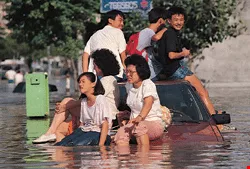
"I'm really afraid of floods," says Chou Chien-chung, neighborhood chief in the Chang'an Neighborhood of the Taipei County township of Hsichih. In recent years there has been flooding virtually every year in Chang'an Neighborhood. As soon as the water reaches the warning line, Chou goes on the radio to tell local residents to first move their cars and motorcycles to the school athletic field, which is on somewhat higher ground, while people who live on the first floor begin moving their TVs, computers, and other items upstairs.
A recent study conducted by the Academia Sinica on the willingness of residents of Hsichih, Wutu, and other districts along the Keelung River to participate in a flood insurance program sheds light on the problem. Hsichih suffered severe damage from typhoons in 1987 and 1996, and twice in 1998. Typhoon Xangsane, which hit in November of last year, caused the worst flooding on record, with water levels surpassing seven meters causing property losses estimated at NT$4.8 billion. The Academia Sinica survey shows that about 35% of the residents of Hsichih, Wutu, and similar areas would be willing to buy flood insurance.
Taiwan is hit by typhoons every year, and people in low-lying areas must always worry that their cars and houses will be soaked. If they had insurance, at least they could make up some of their property losses. But the problem right now is that in several areas, even if residents want to buy flood insurance, they are likely to be refused.
Selective insurance?
"Insurance for major natural disasters like typhoons and flooding falls under the Law of Large Numbers. The number of people who take out such insurance has to reach a certain level in order to spread the risk around," says Martin K.H. Sha, secretary-general of the Non-Life Insurance Association of the ROC. The areas in Taiwan subject to flooding are highly concentrated, and while people in these low-lying areas will all want to have insurance, no one else will. For insurance companies, taking on this kind of risk would be a definite money loser.
What's more, when major disasters strike, insurance and reinsurance companies are hard pressed to bear the load. "Before the September 21 earthquake, reinsurance companies in Taiwan and abroad just sat back and rolled in the money. But the earthquake, in a single stroke, caused them to pay out all the money they had taken in over the last several years," says Lin Wen-cheng, an agent at Fubon Insurance. His company was also badly hit by Typhoon Nari. For example, 75 outlets of the Family Mart convenience store chain were severely damaged in that storm, and another 20 ruined completely, leaving Fubon to absorb NT$50 million in losses.
Right now insurance companies tend to be very cautious when it comes to typhoon or flood insurance. At Fubon, for instance, they do not accept policies from Keelung or several surrounding towns on the Keelung River, nor will they give water damage insurance for basement residences in Taipei City. They are also very strict in reviewing policy applications from Nankang, Hsichih, and Neihu, and premiums are very expensive. This is what is known as "selective insurance."
If those who should be insured cannot get insurance, what is a body to do?
Chang Ching-cheng, a researcher in the Institute of Economics at the Academia Sinica, suggests that the government could follow the example of the American state of Mississippi and subsidize flood insurance for households in low-lying areas, or make such insurance compulsory.
But this is also problematic. For one thing, the government's finances are already stretched to the limit. In addition, as Chang Yu-hui of the Department of Insurance at the Ministry of Finance (MOF), says: "Many citizens believe that since it is their own property that is at risk, they should be the ones to decide on insurance." Of course, the government recognizes the danger of natural disasters, which is why it first began drawing up plans for earthquake insurance following the September 21 temblor.
Shaking up the insurance system
The earthquake insurance system mapped out by the MOF will go into effect on January 1 next year. At that time, throughout Taiwan, regardless of the area or type or age of structure, anyone who takes out residential fire insurance will automatically have a sup-plementary earthquake rider tacked on. Households that already have fire insurance may decide for themselves whether to purchase earthquake insurance. Premiums will be NT$1459 per year, and policy-holders can collect as much as NT$1.2 million in the event of a total loss of their homes.
There are roughly 7.6 million households in Taiwan, with about 50% currently holding fire insurance. In the past year, 700-750,000 households have taken out new fire insurance policies. Based on these figures, the Department of Insurance estimates that by the end of the first year 15% of households will have earthquake insurance.
Because the stakes are so high for earthquakes, the MOF will use a four-level mechanism to cope with possible losses. On the first level, domestic insurance companies and the Central Reinsurance Corporation will form a "collective insurance organization" which is expected to absorb up to NT$2 billion in losses. At the second level will be a "residential earthquake insurance fund," an independent legal entity, which will handle a further NT$18 billion. The third level will involve overseas reinsurance companies, who will help share among them a risk of NT$20 billion. The government will be the fourth level, and will compensate for up to NT$10 billion in damages. All in all, the four levels will be able to provide compensation for damages up to NT$50 billion.
When the MOF announced the new policy in early November, an insurance agent wrote an article arguing that the "automatic rider" for earthquake damage attached to fire insurance is equivalent to compulsory insurance, which is at odds with the concept of "the user pays." Because people with different levels of risk must accept the same premiums, this forces everyone into the same mold, and amounts to a disguised government-imposed tax.
The Department of Insurance responds that earthquake insurance cannot be compulsory, because there is no legal basis for that. However, they can understand why many insurance agents do not like the new policy. In order to make earthquake insurance more palatable to consumers, the government has reduced the profit margin for insurance companies to virtually nothing. The government has to consider, says the Department of Insurance, that since the September 21 earthquake, some citizens who want to take out earthquake insurance get turned down. Moreover, if this insurance is not automatically added to fire insurance, the subscription rate will be too low. The government hopes that in the end underwriters will strongly support this measure.
The last resort
"The tricky thing about earthquake insurance is that although residents throughout Taiwan face basically the same risk, structures built with steel T-frames have already taken earthquakes into account, and in fact there is no need for them to take out earthquake insurance," explains Mark Gia-khy Tang, a professor in the Department of Risk Management and Insurance at National Chengchi University. He suggests that the best thing would be for the government to inform the public about the risks involved, and let individuals make their own decisions about property management and insurance.
In fact, some private companies already offer comprehensive home insurance which covers all forms of natural disasters. For example, Zurich Insurance (Taiwan) will offer a plan to holders of the American Express card which indemnifies real estate and personal property for everything from burglary to explosions, fires, earthquakes, and typhoons. Premiums are about NT$7000 for cardholders, though more than triple that amount for others.
Though Taiwan has been struck by a series of natural disasters these last two years, experts from both the insurance industry and academia feel that the public has not changed its attitude toward insurance very much, maintaining the old approach of "insuring life first, property later."
When the US and Britain began bombing Afghanistan in mid-September, the number of people buying travel insurance increased sharply. The CKS International Airport counter of Cathay Insurance reports that before the September 21 terrorist attacks, on average the company would take in NT$310,000 in premiums for travel insurance each day. After the attacks, income from premiums increased to more than NT$350,000 daily.
However, industry experts remind consumers that accident and travel insurance do not cover death caused by war, civil conflict, or rebellion. Even if you have a travel policy, if the airplane crashes as a result of an act of war, the beneficiary will not be able to file a successful claim.
"People forget very quickly," says Martin Sha. Each time disaster strikes, there is an increase in the number of people calling to inquire about the coverage and costs of insurance. But this is only a backlash, and very few people will actually take action.
Sha says that it is difficult to define a standard by which to determine what kinds of insurance one should invest in. Besides premium costs, another consideration is the value of the specific item to the individual. For example, to a taxi driver or operator of a breakfast truck, their vehicle is their livelihood, and it is important to get full coverage, including flood damage. Moreover, as society develops and people place more importance on legal responsibility, Sha suggests that policy buyers should put first priority on automobile and fire insurance, since these involve the lives and property of others.
An ounce of prevention....
Insurance is all well and good, of course, but it is only useful after the damage is done. In fact, minimizing the damage caused by disasters is much more important than getting compensation after the fact.
Dr. Frank Fuh-yuan Shih, a physician in the department of emergency medicine at National Taiwan University Hospital, studied disaster response in the US. He explains that there are four stages to disasters: warning, strike, response, and restoration. "In Taiwan's case, given the local geography, the main types of disaster are earthquakes, typhoons, and floods. Although there was a tornado in Kaohsiung in 1961, this is very rare. In the future there's unlikely to be any great change in the threats facing Taiwan."
Shih continues: "For earthquakes, there is no warning stage, and they are impossible to predict. However, there is a warning stage for both floods and typhoons, and it is possible to evacuate threatened locations. The problem is that we often forget how terrible such events can be." In terms of deaths and injuries, Shih notes that for every person killed in an earthquake, another five will be injured, whereas in a flood, for each person killed only one other person is injured. Therefore, if appropriate preventive measures can be taken when typhoons come, damage can be reduced considerably.
"People in Taiwan don't grasp the basic concept of disaster preparedness. You have to minimize the threat of disasters, and not just depend on someone to rescue you after the fact," says Shih. Four years ago, when he moved into a new apartment building on Hangchou South Road, he was amazed to see that many of his neighbors had removed smoke detectors and sprinklers in the interests of interior decor. Shih, who is kept constantly busy in the emergency room each day, says that fire is the greatest threat to families in Taiwan. A large number of the people sent to the emergency room every day are there for burns. "People are more afraid of burglars than they are of fires, so they put steel bars on all their windows. In fact, the risk from fire is far greater than that from burglary."
Surrounded by danger
Is Taiwan at any risk from anthrax, which is currently causing such panic in United States?
Anthrax is caused by bacteria, and can be transmitted by skin contact, inhalation, or ingestion. The symptoms are similar to the flu, and include high fever, nausea, vomiting, stomach pain, and diarrhoea with hemorrhaging. In cases in which anthrax leads to death, the causes are usually shock from loss of blood, intestinal perforation, and septicemia. If caught in the early stages, anthrax can be effectively treated with antibiotics such as erythromycin, tetracycline, and penicillin.
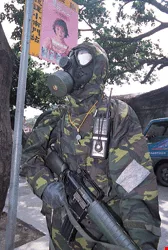
Frank Shih says that it is always best to be informed and alert. He warns people not to assume that biological warfare is something far removed from their lives. It is very easy to release poison gas or germs, and very difficult to control them. A single bottle could create a catastrophe.
Che Jun-feng, chairman of the Radiological, Biological, and Chemical Pollution Society, an association of academics and experts, points out that a simple protective mask can effectively guard against biological and chemical contamination and nuclear radiation. If you have no protective mask, you can soak a towel in soapy water and wrap it around your nose and mouth. If there's no soapy water at hand, immediately cover your respiratory organs with a handkerchief or tissue, and move away from the direction in which the wind is blowing the plume. Definitely do not panic, because if you do you will end up inhaling even more toxins.
The fact is that Taiwan citizens need not be overly concerned, because so far less than ten Americans have died from anthrax, far fewer than the more than 100 who die in the US every day in automobile accidents.
However, while there is no need for general panic, the government must be prepared.
Frank Shih says that no matter what the type of disaster, saving lives is definitely the top priority. There should be an organization which transcends ministries and centralizes control in a single location, which can deploy firemen and medical personnel in disaster relief from the earliest moments. In the US, for example, the Federal Emergency Management Agency (FEMA) was created in 1979. This is controlled directly from the center, and there are branches in all regions. FEMA includes 12 teams covering disaster and emergency response functions, including transportation, communications, public infrastructure, fire fighting, information and planning, victim care, resource provisions, hygiene and medical care, search and rescue, handling of dangerous materials, and food and energy. Each of these teams is further subdivided into agencies with primary responsibility and supporting agencies. The division of labor is precise, and close communication is maintained. It would certainly be worthwhile for Taiwan to study this example.
With regard to the recurrent threat of floods, after reassessment the ROC Central Weather Bureau believes that the current forecasting system, which can only provide two types of warning categories (a major rain storm, meaning 50 mm or more of rain, or a massive rain storm, with 130 or more mm), is inadequate. Therefore, the CWB plans to begin cooperating with the National Severe Storm Forecasting Laboratory of the US to develop precipitation forecasting tools. The goal of the program is to precisely forecast rainfall, so that in the future a forecast for Taipei City might say "340 mm," rather than the present "300 to 500 mm."
It is said, "Heaven decides the weather, and no one can know in advance what it will be, so that people may be stricken in the morning and fortunate by sunset." With so many unpredictable variables around us, rather than furrowing our brows and adding to our worries, we must face up to the fact that disaster response is now a "required course" for survival.
p.023
Starting January 1, 2002, the Ministry of Finance will require an earthquake insurance rider on all new fire insurance policies. Policyholders could recieve up to NT$1.2 million in the event of complete loss of their homes. (photo by Diago Chiu)
p.024
Car-owners beware: "Full" auto coverage does not include flood damage. But there are now comprehensive homeowner packages on the market that will cover all kinds of natural disasters. (Sinorama file photo)
p.027
Taiwan could also be a victim of bio-weapons, so preparedness is advisable. The photo was taken during an exercise held last month by the Environmental Protection Administration to deal with a terrorist gas attack in a subway station. (photo by Jimmy Lin)

@List.jpg?w=522&h=410&mode=crop&format=webp&quality=80)
@List.jpg?w=522&h=410&mode=crop&format=webp&quality=80)


