

Wu Zhaonan, master of crosstalk, is renowned for his vocal arts. No less a luminary than Zhang Daqian, the dean of Chinese classical painting, has compared Wu to the late Qing Dynasty’s Liu Gansan, widely regarded as history’s greatest Peking Opera clown.
“I used to perform crosstalk to live,” he says. “Now I live to perform crosstalk!” A hale, hearty and witty senior, Wu is the representative traditional performing arts figure of his generation and is known for having Taiwan’s “most memorable voice.”
At the end of September Wu Zhaonan, the 90-year-old master of “crosstalk” (xiangsheng, or comic dialogue), returned to Taiwan. On this occasion he and his student Fan Guangyao were performing Huang Tianba Toys with Diao Chan. Although Wu is getting on in years his talents are undiminished, and he found it easy to switch from playing a rich old bitch who is super picky about what operas to watch to playing a great beauty. Exposed to the charismatic and vigorous presence of a great master, audiences experienced a wave of nostalgia.
Born in 1925, Wu turned 90 this year (by the traditional Chinese method of counting a person’s age), and to celebrate that milestone his former students arranged a program of Peking Opera and crosstalk performances in the United States and Taiwan.
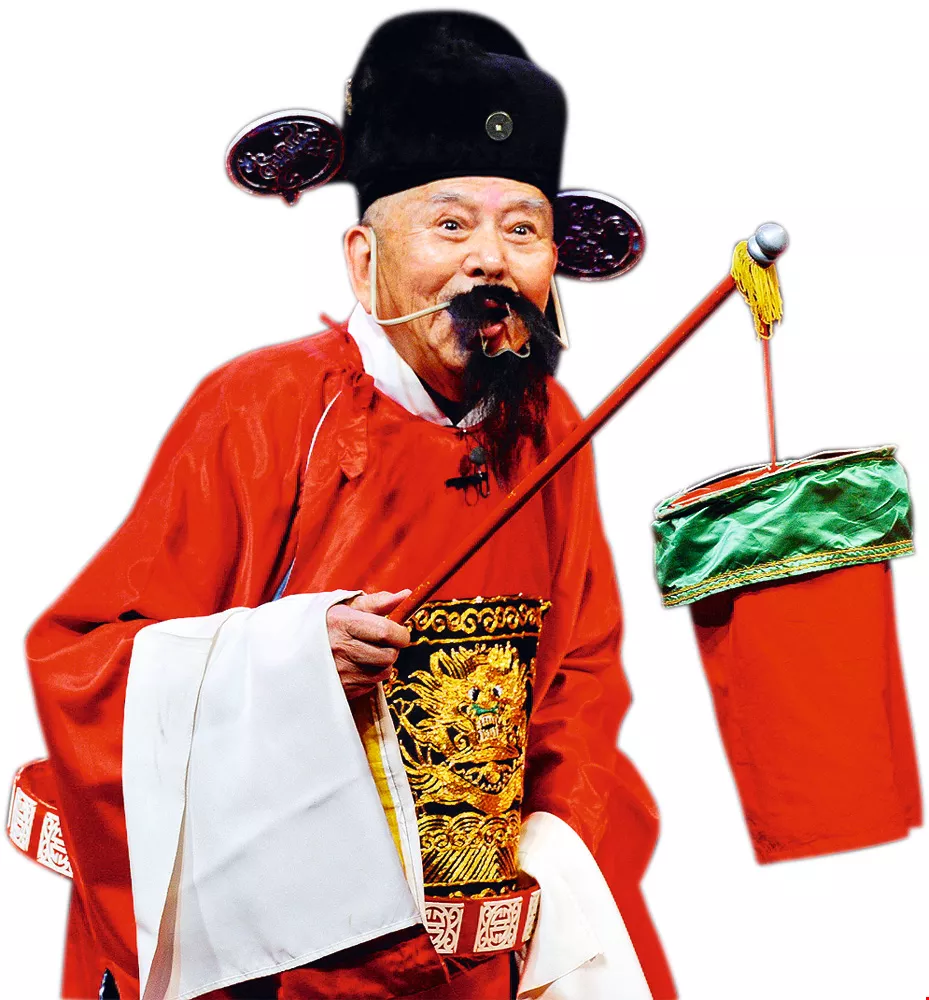
In 2012 Taipei’s Guoguang Opera Company invited the 89-year-old Wu to perform the role of a rich old man in Flour Vat. Wu’s comic performance brought the house down.
In the realm of traditional Chinese performance arts, Peking Opera and crosstalk are placed in the same category. Those in the know say that in opera one acts out a story, whereas in crosstalk and other spoken performances people must use their voices to animate a narrative story. Many crosstalk performers have a base of experience in opera, including the granddaddy of them all, Zhu Zhaowen, who started out playing clown roles in Peking operas during the late 19th century before turning to performing crosstalk dialogues in the Tianqiao area of Beijing.
At the end of last year, Wu Zhaonan accepted an invitation from Taipei’s Guoguang Opera Company to play clown roles in the operas Flour Vat and Spinning Cotton. The performances shone the spotlight on his Peking Opera skills. It turns out that Wu, who has long been known, along with Wei Longhao, as one of Taiwan’s greatest masters of crosstalk, is also a great master of Peking Opera.
Any description of Wu’s career in opera must start with a discussion of the war-torn era in which he spent his youth in mainland China.
Wu grew up in an era when Peking Opera was all the rage, and he became a big fan at a young age. His father was a banker, and the family’s circumstances comfortable, with cars to ride when they went out. He attended Yuying, a private junior high school, where he took a class on Peking Opera with a teacher named Shou Yichen. He also joined the school’s Peking Opera club, where he would watch, study, sing and begin to act in operas.
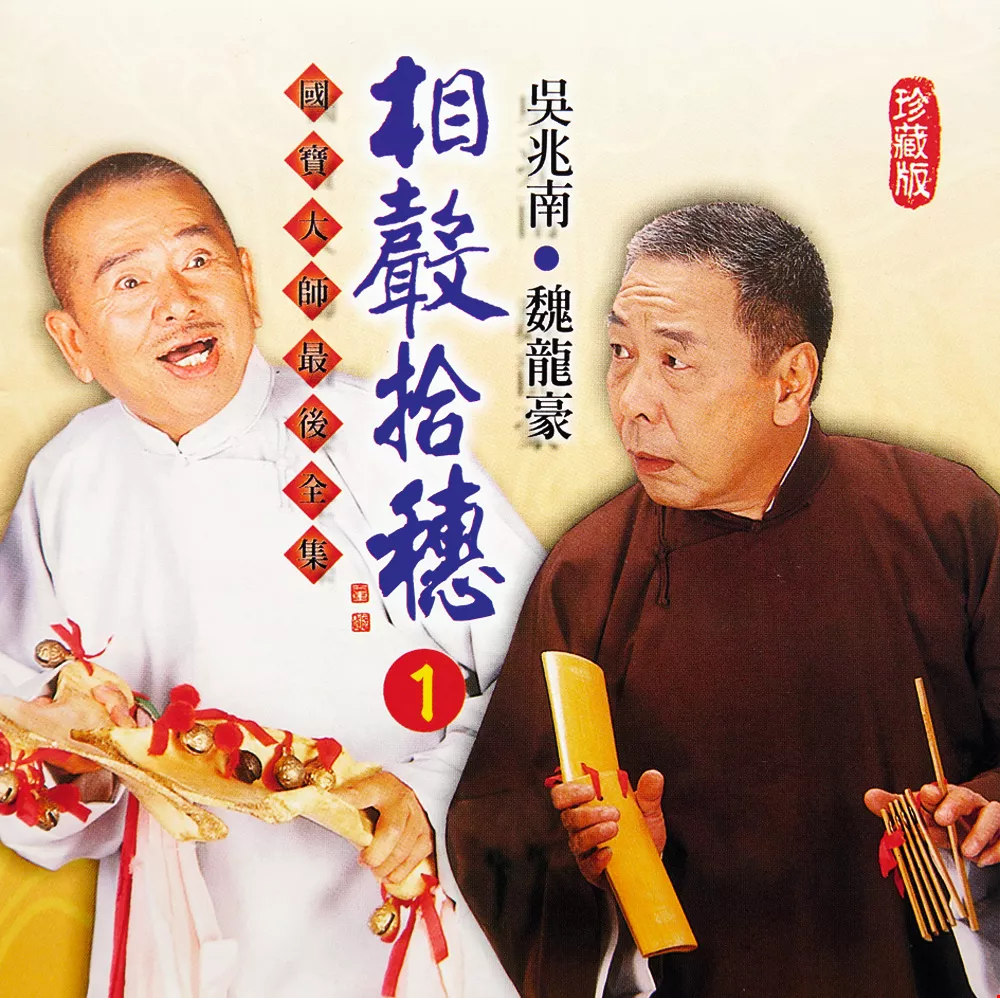
Wu Zhaonan and Wei Longhao Ascend the Stage to Take a Bow was a crosstalk program the two performers made for radio. Some 250 segments from the show were later released as cassette tapes. Wu and Wei’s voices are two of the most memorable in Taiwan’s history of performing arts.
The 1930s was a flourishing period for Peking Opera in Beijing, and Wu, as a child of affluence, would frequently spend all day at the opera house.
By the time he was 14 or 15, Wu was already performing operas up on stage. Back then Beijing had several opera houses that would offer professional performances at night but rent themselves out during the day to student groups, who would use them to put on their own performances.
“We would perform whatever people asked for,” Wu recalls. “Our costumes and accessories were all rented, and we weren’t too picky about them. With those performances, we typically broke even, or at most lost just a little.”
In those years Wu put his focus on studying and performing operas and practicing how to apply operatic makeup. “I was more diligent about opera than about my academic studies.”
In 1949, Wu came to Taiwan, where he experienced a dramatic fall in economic circumstances. A rich kid no longer, he had to figure out how to earn his own living.
Wu explains that he had majored in economics on the mainland, and when he arrived in Taiwan, a classmate gave him a lead on a job. “When I saw that the employee ID card read ‘Wu Zhaonan, janitor,’ it really pained me inside,” says Wu, smiling. “After all, I had been to college, and I felt that the job designation would look bad on my tombstone.” So he looked for some other way to make ends meet.
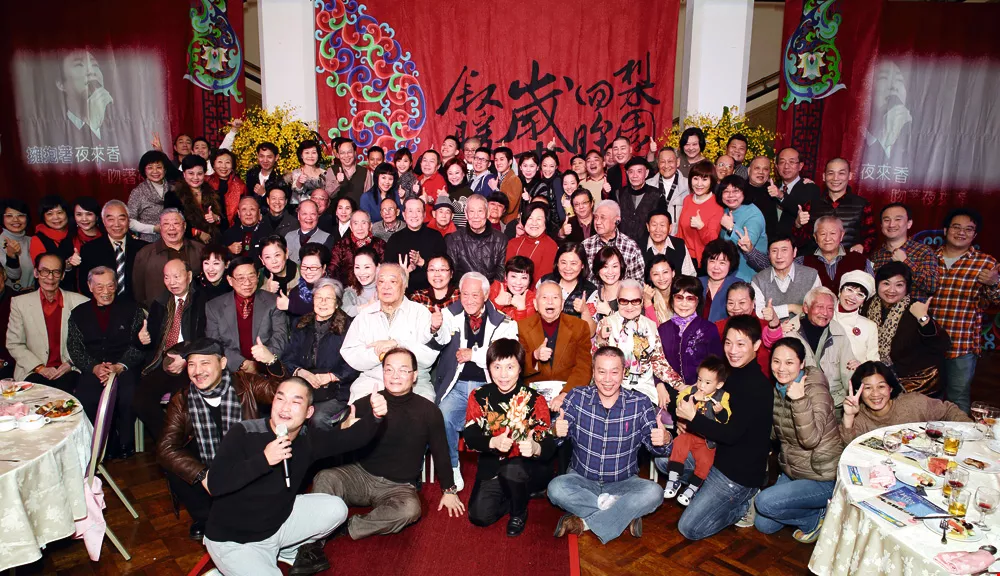
Before Chinese New Year’s in 2012, the National Center for Traditional Arts held a gala for senior Peking Opera performers. Wu Zhaonan (middle of the second row in a brown suit) was one of the guests.
Back then Wu and several friends opened a store on a swimming beach by a Keelung dock. During the day they sold cigarettes and foods such as noodles. At night the beach closed and customers were only allowed to leave but not enter. “After eating, we’d turn on the lights and entertain ourselves,” Wu recalls. “Someone would beat a drum. Someone else would play the huqin two-stringed fiddle. And others would sing.”
They started attracting a larger and larger crowd, including showbiz people such as the famous performer of clown roles Zhou Jinfu, the player of female roles Xiao Liu Yuqin, Ma Lizhu (mother of the starlet Hu Chin), and the player of male roles Zhou Zhengrong. “They were all role models. When I didn’t know how to do something, I’d watch them and then perform it right away for myself.” It was then that Wu finally took the plunge and officially became a Peking Opera actor.
At the end of 2012, when Wu was invited to perform with the Guoguang Opera Company, Wang An-chi, Guoguang’s artistic director, pulled out two photos during the press conference. One of them was of Wu playing a monk in Lady of Heaven Scatters Flowers for a TTV production in 1967. Wu’s costar for that production was Dai Qixia, who had been known as the “queen of Peking Opera.” The other photo was taken during a 1959 production of Shepherd Story on Keelung’s Zhongzheng Road. Wu played a female clown named Song. The two images incited much nostalgia among opera fans.
Wang explains that she had always felt that Wu was a funny man with everything needed to play clown roles in Peking Opera: “Big eyes on a round face, gift of the gab, and an eye-catching appearance that was extremely lovable.”
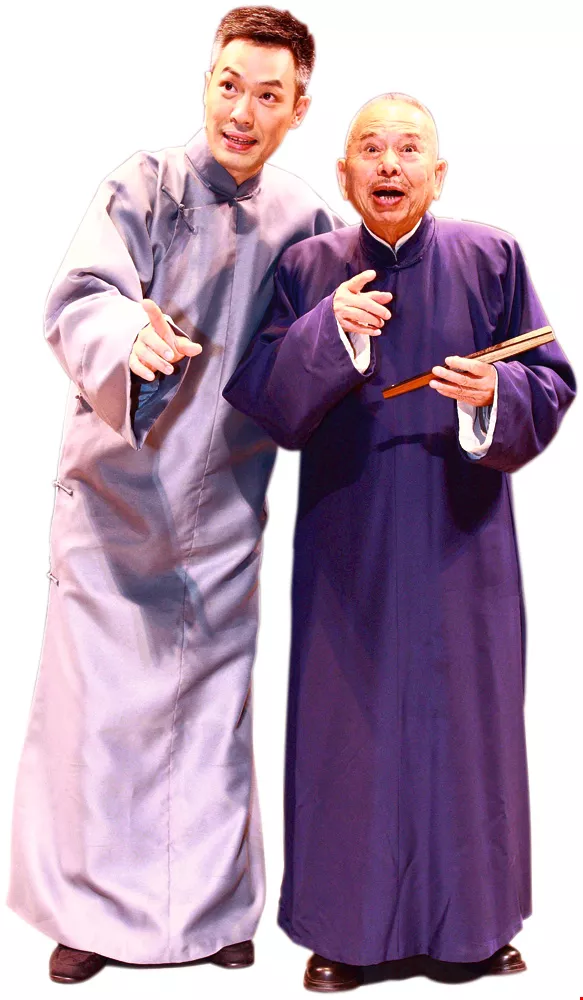
In 2013 Wu Zhaonan and his student Fan Guangyao performed Huang Tianba Toys with Diao Chan. As soon as they got up on stage they were met with thunderous applause.
If not for the rise of film and television and the decline in Peking Opera’s economic fortunes, Wu never would have moved into crosstalk.
He recalls how in 1951 Ma Jiliang, then head of the Yuanta Group, opined, “If you come from Beijing, you surely know how to banter, and you can surely perform crosstalk.” Ma twisted Wu’s arm to put on crosstalk shows at a performance hall near the Yongfu Bridge in Taipei.
“At first it was just me all by my lonesome self. I was constantly scurrying all over the stage and never stopped talking,” recalls Wu. “I brought in Chen Yi’an, Wei Longhao, and Zhou Zhiquan so that we could perform dialogues.” Wu explains that the content was based on what he could remember from the performances he had seen in Beijing’s Tianqiao. It was completely unscripted and relied on ensembles of improvisers. In time they also started to perform at a teahouse next to a nearby river embankment. What’s more, they added other narrative performance arts such as shuoshu and changdagu, as well as magic shows and other acts. Later, they would take these shows to Taipei’s Lianyuan and Red House performance halls.
Earning rave reviews, they started to record crosstalk dialogues for a Chengsheng Broadcasting radio show. The shows were aimed at selling products such as cod liver oil, and Wu and the other crosstalk performers would also make all the commercials. They’d perform a bit of crosstalk and then read a commercial. And because the show needed a beginning, Wei and Wu would always say, “Wei and Wu ascend the stage to take a bow.” In reality, explains Wu, laughing, “At the studio we never got up on stage and never took a bow.”
Beginning in the 1960s it became harder and harder to get crosstalk gigs. Wu and his wife Xu Baiheng opened a barbeque restaurant to help make ends meet.
In 1969 Wu was invited to perform in Hong Kong, where he performed Wangjian Pavilion. The show was regarded as pro-Communist by the ROC government, and he was banned from leaving Taiwan to perform. The incident soured him on politics. Later, when he heard that US airlines were allowing people, so long as they had a US visa, to pay off their tickets to America on a payment schedule after traveling, he rushed to a travel agency, basically deciding to emigrate on a whim.
After moving to the United States, Wu opened a dried beef company and performed in shows directed at the overseas Chinese community whenever an opportunity presented itself.
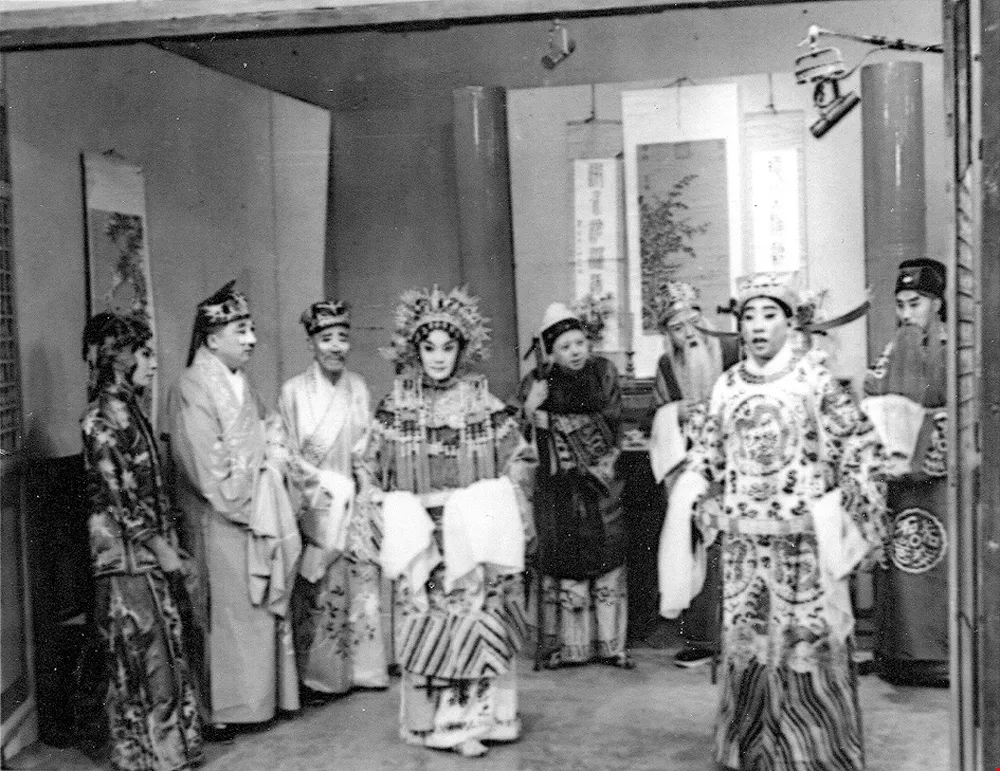
When TTV put on a production of The Prime Minister of Six Nations, Cao Junlin played Su Qin, Hu Chin played Su Qin’s wife, and Wu played his mother.
Between 1976 and 1992 Wu and Wei produced a series of 48 tapes containing 250 crosstalk dialogues. They were mostly segments from their old radio shows. A source of great enjoyment for people now in their 50s and older, they have also served as models for a great many. Performers for groups such as the Taipei Quyi Troupe, Comedians Workshop, and the Hanlin Folk Arts Storytelling Troupe, including Guo Zhijie, Feng Yigang and others, have all studied these segments before creating their own dialogues.
As early as 1979, Wu’s contributions to traditional performing arts were recognized with a Folk Art Heritage Award from the Council for Cultural Affairs. In 1999 Wu’s longtime collaborator Wei passed away, and Wu became conscious of the urgent need to start passing along the dying art of crosstalk. He took on Hou Guanqun, Lang Zuyun, Liu Zengkai, Liu Erjin, Fan Guangyao and others as students. In 2009 Wu won a Golden Melody Lifetime Contribution Award.
Although he has been famous in the Chinese-speaking realm for half a century as a result of his crosstalk performances, his friends often say: “Wu is a Peking Opera fanatic—that’s his true love!” Once you get him talking about the Peking operas he loves, he can keep going for hours.
The Guoguang Opera Company’s Ma Baoshan, who has directed Wu in rehearsals of the opera Flour Vat, points out that Wu is very articulate and has a strong and clear voice, making him particularly well suited to the rhythms of authentic Peking Opera. When performing, he quickly gains the audience’s attention.
What has impressed Ma even more is that Wu never has to look at the script when rehearsing. The lines slip fluently from his mouth because they’ve all been committed to memory over so many years of performing Peking Opera and crosstalk dialogues.
Although a wizened senior, Wu has a seriousness and commitment that offers lessons to his juniors.
Performers of clown roles have to make themselves up to look as ugly as possible. They move with exaggerated motions and walk stooped over. They often get slapped or must fall off of chairs.
Last year, when performing Flour Vat, in several scenes Wu had to crouch under a table for ten minutes at a time. In consideration of his age Ma said, “Let’s make this easier for you.” But Wu was adamant that they had to play it the right way and refused to complain about any discomfort, going under the table whenever it was required. “When it comes to faithfully representing a role, younger performers can learn a lot from him.”
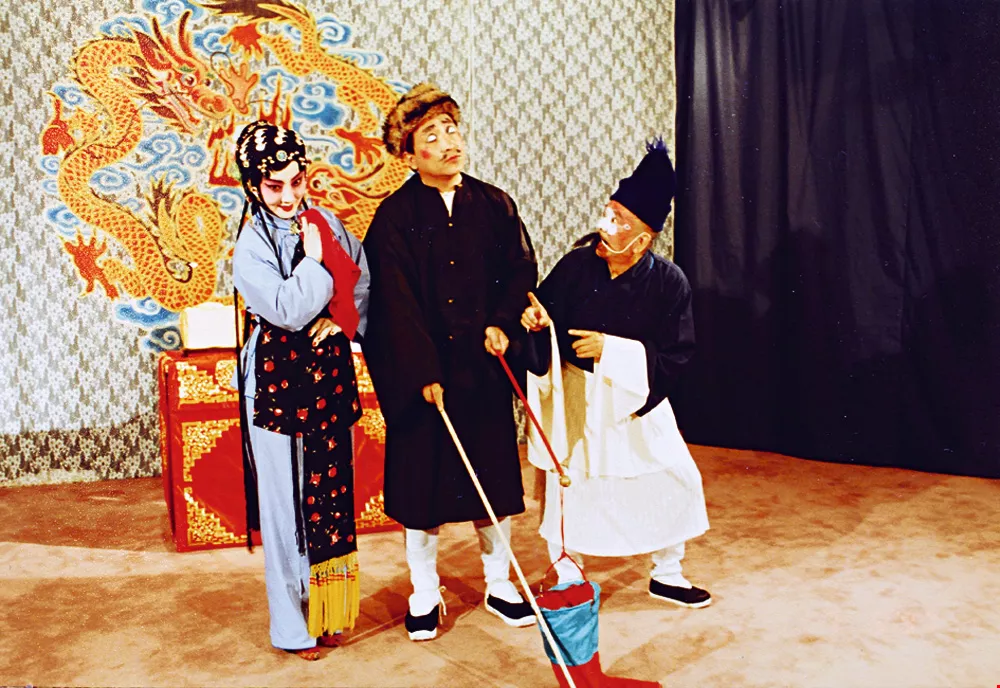
After Wu Zhaonan emigrated, he continued to perform crosstalk and Peking Opera for the overseas Chinese community in the United States. The photo shows a performance of Borrow for the New Year.
“How do you go about learning the essence of a performance art?” Wu’s response gives people a lot to ponder.
“When you’re learning a performance art, there isn’t any way around it: you’ve just got to constantly practice,” Wu explains. First of all, you have to truly like it. Secondly, you have to find a way to understand its intricacies. For instance, there’s the choreography you’ve got to master for crosstalk or a clown role. You’ve got to know all the ins and outs. You’ve got to be honest with yourself about what you can and can’t do, and then you’ve got to practice it over and over again. “The craft is effort. Practice makes perfect.”
Well up in years, his health remains good. Wu, always given to joking, stays true to form on this subject: “You can sum up health with just a few words: sleep and eat well and keep the sewage pipes, front and back, flowing smoothly.” His answer is simple and clear.
“In my life, I’ve had no enemies,” Wu says. Many old performers hang up their costumes once they get to a certain age, never to act again. “I’ve never thought about retiring. So long as people respect me enough to invite me to perform, I’ll go.”
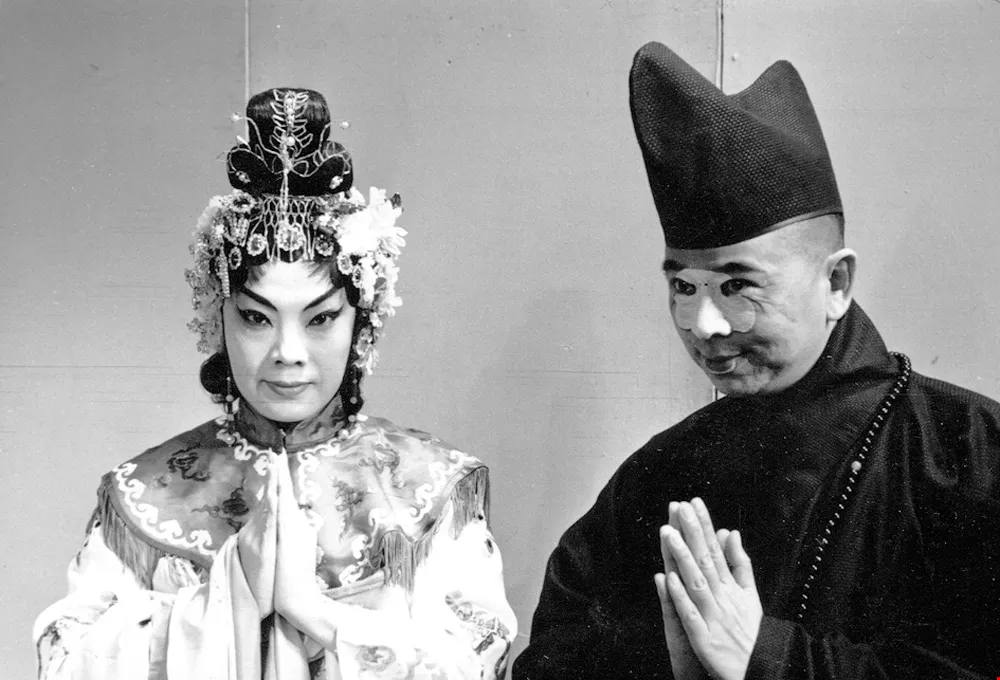
In 1967 TTV broadcast a production of Lady of Heaven Scatters Flowers with Wu Zhaonan and Dai Qixia in the leading roles.

@List.jpg?w=522&h=410&mode=crop&format=webp&quality=80)

@List.jpg?w=522&h=410&mode=crop&format=webp&quality=80)


