Telling Fortunes Online
An Ancient Art with a Modern Face
Chang Chiung-fang / photos Chin Hung-hao / tr. by Geoff Hegarty and Sophia Chen
January 2013


Life or death, riches or poverty—all is written. Many people believe that the future is somehow predestined, but few are willing to bow easily to their fate. So people are keen to discover what might be written—hoping to stay out of trouble, or turn bad luck into good.
Do you believe in fate? Would you like to discover the secrets that may be hidden in the future? In our scientific age, fortune tellers have begun integrating their ancient skills with Internet technology, creating a new style of fortune telling—one very different from the tradition.
Using the Western and Chinese zodiacs, blood groups, bazi (numerology based on the “eight characters”—four pairs of Chinese characters denoting the year, month, date and hour of birth) and onomastics (analyzing the Chinese characters in personal names), fortune telling has always been very popular in Taiwan and is a regular part of many people’s lives. Almost everyone knows at least a little about it.
A typical morning routine might include turning on the TV to catch up with the news. No matter which TV station, the format will be the same: scrolling texts fill the edges of the screen including that day’s horoscopes, lucky colors and lucky numbers.
Websites featuring tarot divination, Western astrology, or Chinese zodiac predictions are updated every day. Office workers are accustomed to checking out their favorite site every morning at the office to preview that day’s fortune for their career, romance, or finances. For many, it’s a regular start to the day.
No wonder some foreign media have called Taiwan “the island of fortune telling.” But in fact the Japanese are equally enthusiastic about fortune telling, and many visit Taiwan for just that purpose.
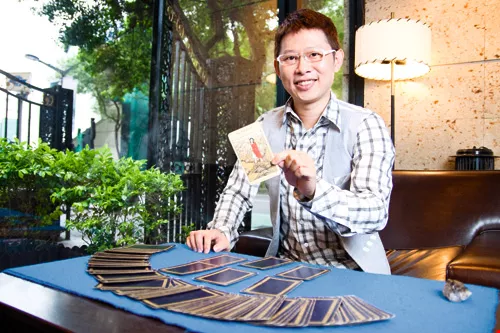
Tarot divination has become very popular among young people in recent years. But while it may look easy, in fact it’s quite difficult to master. The photos (top to bottom) show tarot masters Sky’s the Limit, Eiffel, and Xiao Wang.
Predicting the future has become a robust service industry in Taiwan. Potential revenue in the country’s fortune telling market is estimated at around NT$5 billion annually, according to a 2009 survey by Internet metrics firm NetValue. In the same year, the Taiwanese online job site 104 Job Bank published a report which notes that the category of astrology, numerology and religion ranked fourth among the Taiwanese industries considered by businesspeople to have the best future prospects.
So who is it that loves fortune telling? And why do people seem to rely on it so much?
According to a September 2012 survey into the use of fortune telling in the workplace by HR company 360d HR-JCASE, 74% of office workers had used fortune telling, 82% of them in the previous three months. The main reasons cited included career difficulties (82%), emotional distress (63%), or simply wanting to know what was going to happen in their lives in the immediate future (45%).
Sam Chang, who moved from a career in science and technology to fortune telling in 2000, notes that the business curve of fortune telling in fact runs opposite to that of the stock market. When people are feeling uncertain and perplexed, the fortune telling business booms.
Wu Chung-shu, president of the Chung-Hua Institution for Economic Research, proposes another economic measure in addition to the usual macroeconomic indicators such as the economic growth rate and Taiwan’s “economic traffic lights” system: a fortune telling index—the worse the economy becomes, the more enthusiastic people are about fortune telling. It’s a sign of uncertainty.
In fact, monitoring the numbers of people visiting fortune tellers can provide a glimpse into the “real” fortunes of the overall economy. Sam Chang recalls that during the financial tsunami of 2008, banking sector employees asking about economic prospects accounted for a significant proportion of the customers using his fortune telling service. During 2012, there was an apparent increase in the number of customers from the insurance sector.
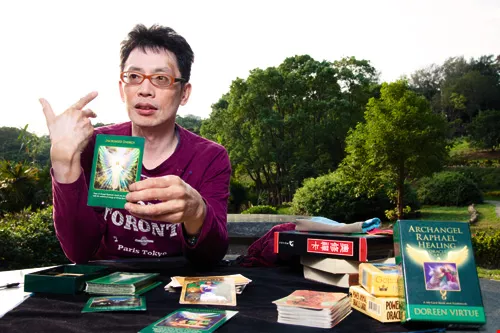
Tarot divination has become very popular among young people in recent years. But while it may look easy, in fact it’s quite difficult to master. The photos (top to bottom) show tarot masters Sky’s the Limit, Eiffel, and Xiao Wang.
Fortune telling methods include physiognomy, palmistry, astrology, divination, numerology and the analysis of Chinese characters. Among these, ziwei doushu (purple star astrology) and bazi have been used in Chinese fortune telling since ancient times. It is said that they began in the Spring and Autumn Period, and the related theories were compiled during the Han Dynasty.
In recent years, many young people have been attracted by newly introduced Western occult concepts such as horoscopes and tarot cards. And a number of professionals from science and technology have moved into fortune telling, often applying Internet technology to their new ventures to bring traditional fortune telling methods like ziwei doushu and onomastics into the 21st century. With the advantages of convenience and privacy, fortune telling has found a new lease of life on the Internet and smart phones.
Fortune telling website Click 108, which claims to be the world’s largest of its kind, was founded by Sam Chang in 2000 and currently boasts 5 million members, of whom about 3.5 million live in Taiwan. With an estimated 10 million Internet users in Taiwan, Chang believes that the domestic market for online fortune telling is almost saturated, but there is still plenty of room for growth in mainland China. Their website is available in four language versions—traditional and simplified Chinese, English and Japanese. Daily traffic estimates show about 300,000 visits, generating annual revenue of more than NT$100 million.
Chang, a math graduate from National Taiwan University (NTU) who once worked for Acer, has applied his actuarial science expertise to telling fortunes. He used Internet technology to collect a large number of individual astrological samples in order to design a set of arithmetic formulas for ziwei doushu. Through statistical analysis, the system summarizes innate personality traits into 144 categories. Based on the traditional 14 main stars of ziwei doushu, he divides human personalities into four major types: creative, leadership, supporting and cooperative. His system has given ziwei doushu a new significance for the modern era as a means of predicting personality traits.
“Ziwei doushu actually contributes significantly to human behavioral research, since it is able to predict complex personality and behavioral characteristics with an amazing degree of accuracy.”
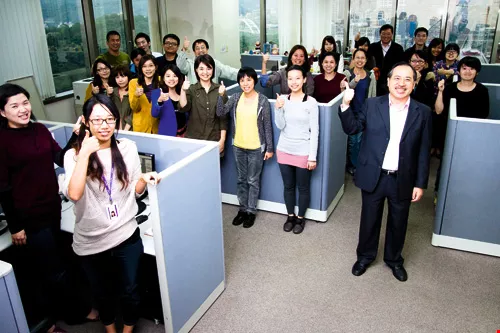
Telling fortunes has been transformed from little roadside stalls to big business. The pictures show Sam Chang and employees of Click 108 (above), and David Lin’s fortune telling service veryname.com.tw.
David Lin, an expert in onomastics and numerology, is another technology expert who has moved from science into fortune telling.
Lin’s family is an important influence, having been involved in onomastics for three generations. So it seemed a natural career move, even for someone who has master’s degrees in electrical engineering and business administration from NTU. Lin says that his study of business helps him to explore human nature, and his engineering skills mean he’s good at numbers. Numerology happens to be a combination of both.
Lin’s fortune telling website veryname.com.tw is aimed mainly at the Taiwanese market and has about 2 million members, among whom the largest demographic is 25 to 40-year-old females (the male to female ratio is about 2:3).
He notes that when members were spending lavishly during the rise of the Internet from 2004 to 2006, annual revenue peaked in nine-figure numbers. However, the market is now saturated, and spending has become more restrained.
Although traditional Chinese numerology has gone through various changes, it never moves away from its fundamental methodology of bazi, comprising the year, month, day, and hour of birth. Ziwei doushu and onomastics are inexorably tied to bazi.
In fact, Chinese onomastics is derived from the theory of bazi. Lin points out that based on the principle of the progression of the four seasons and the 24 solar terms, everyone’s bazi will become unbalanced due to particular energy flows from the elements of the Five Phases (wood, fire, earth, metal, and water). When one’s Five Phases are well balanced, one will enjoy good fortune, but when they are out of balance, one will be confronted by difficulties. “If your name can balance the Five Phases of bazi, you will enjoy a relatively trouble-free life.”
Quite a few Chinese change their names in the hope of improving their fortunes. So is there any noticeable difference after the change?
Lin cites himself as an example. His academic performance always ranked near the bottom among the 50-plus students in his classes from grades one to four. Lin’s father, a numerology expert, found this very strange. He wondered why the apparent intelligence levels of his two sons were so different. So one day his father checked the Kangxi Dictionary to count the strokes of his son’s name characters. He was shocked to find that he had previously counted the number of strokes wrongly. He quickly changed the name, and Lin’s academic performance improved dramatically. “I never really understood why my name was changed in elementary school, but I do remember that suddenly in the 5th grade I began to understand the lessons very well.”
Chinese onomastics encompasses profound knowledge. As if the complex balancing of yin and yang and the Five Phases were not enough, people are often confused by the strokes used for characters. For example, the character 梁 (liang) has a dot in the center, but 染 (ran) has none. And does the character 斌 (bin) have 11 or 12 strokes? A difference of only one stroke could lead one’s fate in an entirely different direction.
A certain Ms Chen was feeling down—the aftermath of a divorce and the fight for custody of her daughter. One day, she visited a fortune teller at the Longshan Temple in Wanhua District. The fortune teller asked for her bazi, and then told her that she was predestined for a divorce. She accepted the fortune teller’s advice to change her name, and although it had come too late for her to avoid the divorce, she felt that the change of name helped her to save money and regain control of her life. She believes it really made a difference!
Perhaps it’s a psychological effect, the feeling of starting anew with a new name. Many indeed believe that changing their name will also change their fate. Lin points out that you don’t have to actually change the name on your ID card; even if you just use your new name as a nickname, as long as you recognize it in your mind as your name, it will have an effect.
Compared to the highly skilled traditional Chinese fortune telling methods like ziwei doushu and onomastics, Western astrology (interpreting a person’s fortune based on their birth month) and tarot (describing one’s fortune through images presented on cards) seem less complex to master, so are becoming popular among young people.
To use the tarot, the 78 cards are spread out on a dark cloth, and using the left hand, three cards are chosen to represent the past, present, and future.
Miss Li was embroiled in a love affair with a married man, and was somewhat distressed about how things were going. When she sought advice from a tarot reader, she continually drew a “morality” card, so the fortune teller asked her directly: “Is your lover married?”
The card revealed that Miss Li was in a disturbed and uncertain state, both mentally and physically. The fortune teller advised her to end the relationship in order to make it through the crisis.
“I was really convinced by the tarot reading, and was able to make the difficult decision to end the relationship. My life changed completely as a result!” says Miss Li.
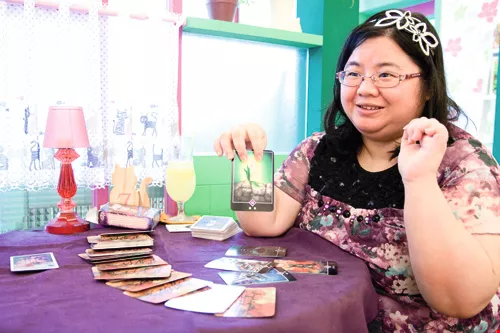
Tarot divination has become very popular among young people in recent years. But while it may look easy, in fact it’s quite difficult to master. The photos (top to bottom) show tarot masters Sky’s the Limit, Eiffel, and Xiao Wang.
Weng Zichu, a 36-year-old who calls herself “Sky’s the Limit” after an Australian racehorse, has published a number of fortune telling books including Are the Astrologers All Liars!?, Divination Symbols of the Tarot, and Fortune Telling! The Fun of Discovering Your Fate.
In 2004, Weng set up an Internet forum called Sky Cat Witch and began to communicate with visitors, mainly fellow tarot card enthusiasts. At the end of 2009, she set up a Facebook fan page called Bamboo-Cat Tarot, attracting more than 2 million visits a day—an amazing response.
Interestingly, Weng comes from a well-known fortune telling family in Keelung, but instead of carrying on the family business of bazi and onomastics, she has become more interested in Western astrology and tarot card reading.
While oriental fortune telling usually focuses on predicting the ups and downs of one’s entire lifetime, and major matters such as marriage, finance, offspring and career, Western astrology tends to focus more on details, tracking events in the next three to six months. There is another difference between East and West in judging whether particular symbols represent good or evil. The Eastern tradition, for example, tends to regard change as an ill omen, while the West believes that change brings opportunities, and is therefore auspicious.
Weng is regularly engaged in tarot divination teaching and fortune telling, but she rarely looks at herself. “Only when I feel unwell, I use divination to see what’s happening.” Her ruling planet is Mercury, so when that planet is in retrograde, she tends to feel troubled.
Mercury represents communication. Weng once experienced a series of bad events within a two-day period: Her Internet connection stopped working, her mobile phone broke down, she got writer’s block, and her toilet became bunged up. Then when she went to an Internet cafe to check her horoscope, she suddenly realized that Mercury had been in retrograde during those two days. “Once I understood the situation, I simply avoided doing anything in that period. I simply had to be patient to let the bad things go away naturally.”
As Weng puts it: “Although you can never hope to escape your destiny, by learning a little about fortune telling at least you can be mentally prepared when you encounter difficulties or disaster, so you won’t panic!”
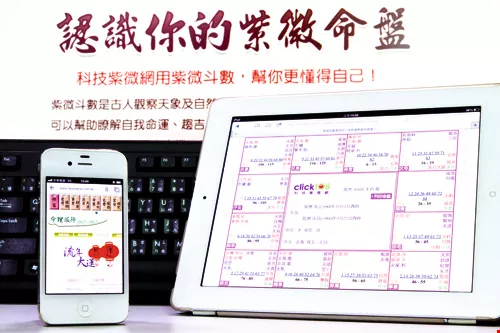
Internet technology has brought fortune telling techniques such as ziwei doushu and astrology into people’s daily lives.
Over the past 10 years, there have been significant changes: the average age of fortune tellers has fallen steadily, and many have moved from onlooker status to formally learning the skills in order to understand themselves better.
Eiffel is a graduate of the Institute of Political Science, National Sun Yat-Sen University, and a former legislator’s assistant. Once when he was feeling uncertain about how his future was unfolding, he started to study onomastics, and then went on to study Western astrology and the tarot. At age 27, he decided to enter the field of numerology and divination as a career. He used his knowledge of onomastics to figure out a new name for himself: Eiffel. “No sooner had I started using the new name when someone invited me to appear on a TV show.”
Eiffel points out that tarot is similar in many ways to the Chinese method of divination by drawing lots. The four elements of fire, sword, water and earth in the tarot are similar to the Chinese Five Phases (wood, fire, earth, metal, and water). The main difference lies in the fact that while the lots drawn in Chinese divination are referenced to written texts in the form of poems, tarot is interpreted mainly through images. And images—without the restrictions created by a text—provide broader scope for interpretation.
Eiffel used to run a fortune telling stall outside the Eslite Bookstore in Xinyi District, Taipei. Over a period of a couple of years, he not only made some extra money, but also rapidly accumulated fortune telling experience and saw much of the vicissitudes of life.
“This is one way to observe society.” Eiffel says that nine out of 10 customers are female. They usually ask about career first, and then romance. It’s obvious that the importance of a woman’s career has gained weight in recent times.
Eiffel is actually gaining a bigger name in mainland China than in Taiwan—the grass is always greener…? His page on Chinese social networking site Weibo has attracted more than 60,000 fans, so he uses this base to run his mainland venture. His customers (mainly young women aged between 20 and 30) transfer a fee to his account, and can then make an appointment to have their fortune told through online video conferencing.
In the past, fortune telling was always done face to face, but nowadays the use of social networking sites enables fortune telling across the Internet. And it’s a far-reaching business. Eiffel’s customers come from all corners, including Shanghai, Beijing and Ürümqi in China, as well as Australia and the Netherlands.
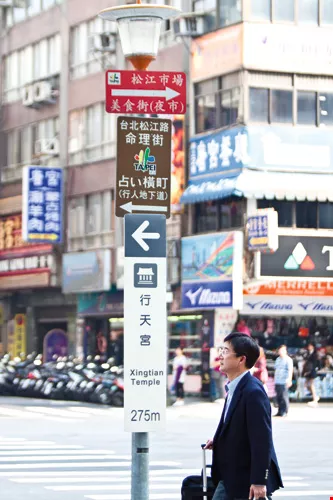
As long as people are feeling confused and hesitant, wondering which way to turn, there will always be a demand for fortune telling.
“Life is like the tarot: you never know which one you’re going to get.”
Gao Yiying (nickname Xiao Wang), who runs Osho Zen Tarot online, tells fortunes, and teaches fortune telling and meditation. In his initial experience with tarot fortune telling in 2000, his first tarot card symbolized “participation.”
After that, Gao carried tarot information and guidelines everywhere. Even when he traveled, he carried the tarot and drew cards regularly. At least until one day when he couldn’t find his Osho Zen Tarot cards! He suddenly realized that he had become too reliant on the cards. So since then, he has tried to reduce his dependence.
However, Gao’s sudden hospitalization with fulminant hepatitis again led him to experience the magic power of the tarot, leading him safely through the potentially fatal calamity. Originally he had little trust in Western medicine, to the extent of refusing Western medical treatment. However, after he drew a number of tarot cards with the indications of “acceptance” and “opening the mind to love,” he became willing to accept treatment. Despite an initial estimated treatment time of three months, he was discharged from hospital within three weeks.
“For me, tarot is a kind of spiritual counsel.” Gao is planning to create a set of his own tarot cards, having drawn cards five or six times that indicate a message of conceiving. “I need to fulfill this dream as soon as possible,” says Gao.
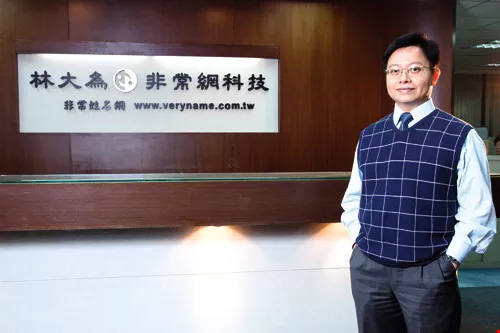
Telling fortunes has been transformed from little roadside stalls to big business. The pictures show Sam Chang and employees of Click 108 (above), and David Lin’s fortune telling service veryname.com.tw.
It’s said that all is predestined, and we are unable to control fate. Is bazi really like some sort of DNA code controlling a future from which there is no escape?
Writers Shih Chi-ching and Chen Yeh have a great deal of experience of fortune telling. They co-authored Playing Fate and Creating Fate, criticizing fortune telling methodologies. They point out in the book that there are fewer than 260,000 astrology charts in the ziwei doushu system, and about 520,000 in the bazi system. This means that with a population of 23 million, one in almost every 40-plus people in Taiwan will have the same fate. So why is it that people who are born in the same year, month and day have different destinies? Doesn’t this mean that fortune telling is nothing more than a sharing of life experiences, and a way of excusing people’s conduct?
“As genetics develops, we realize that one’s destiny isn’t determined at birth, but rather at the instant of conception. And one’s destiny is determined by genetics, not timing.”
In 2005, Kuo Cheng, a professor in National Chengchi University’s Department of Advertising, published a study entitled “Searching for the Factors and Motives that Influence Online Fortune-Telling Behavior.” The work surveys 6,000-odd Internet users, and shows that the most popular topics for online fortune telling are romance, careers, love affairs and marriage. The motivations for online fortune telling include problem solving, developing a better understanding of oneself and others, the advantages of privacy and convenience offered by the Internet, and just fun and curiosity. Respondents who are motivated by the first three items express greater satisfaction with online fortune telling, and believe it will impact their actions. Those who are just curious and looking for a bit of fun, on the other hand, generally don’t really believe in the results, so their actions tend to be less influenced.
Those who believe earnestly in fortune telling tend to retain that belief no matter what, while non-believers will always dispute its value. Fortune telling has satisfied a need in people and has contributed significantly to society since ancient times. And because of advances in science and technology, fortune telling is no longer just a simple means for making a living by itinerant fortune tellers, as in olden times. Modern fortune telling tends to be more like a consultancy comforting people’s hearts, inhabiting all corners of people’s lives.

@List.jpg?w=522&h=410&mode=crop&format=webp&quality=80)

@List.jpg?w=522&h=410&mode=crop&format=webp&quality=80)


