The AIESEC International Congress Taiwan Hosts Eminent Gathering of Global Youth
Kobe Chen / photos courtesy of AIESEC Taiwan / tr. by Geoff Hegarty and Sophia Chen
October 2014


The International Association of Students in Economic and Commercial Sciences (AIESEC) is the world’s largest international student organization, with more than 80,000 members in over 100 countries worldwide.
This year, AIESEC Taiwan celebrates its 50th anniversary, and the AIESEC International Congress has been hosted in Taiwan for the first time. Events were held in Kaohsiung in the second half of August 2014, allowing nearly 1000 young people from across the world to enjoy Taiwanese hospitality, as well as providing an opportunity for the nation’s youth to participate in such a multinational occasion.
What kind of organization is AIESEC? What challenges did AIESEC Taiwan face when bidding for the congress?
AIESEC has a long history. A group of young Europeans who experienced terrible suffering during and after World War II believed that the war had resulted from a lack of mutual trust and understanding. But if young people across the globe could communicate and encourage mutual tolerance, it might be possible to reduce conflict—and perhaps even avoid future wars completely.
Their experience led to the founding of AIESEC as a non-profit non-governmental organization in 1948. In the six decades since its beginnings, AIESEC has progressed steadily, promoting communication and peace and nurturing over a million outstanding recruits including former US president Bill Clinton, former Japanese prime minister Junichiro Koizumi, and past UN secretary-general Kofi Annan.

The 66th AIESEC International Congress was accompanied by a series of exciting activities, encouraging everyone to fall in love with Taiwan.
In the early years, AIESEC aimed mainly at organizing internships for young people with multinational companies to promote international exchange of culture and ideas. The programs included business management, language education and professional marketing, and most provided paid work and free board. Young people were able to experience life overseas in a different culture without incurring any great financial burden.
After decades of development, AIESEC currently offers 15,000 internships each year. In recent years, it has launched the Global Community Development Program to promote international volunteer exchanges, so young people can expand their horizons and experience different cultures through overseas volunteer programs of six to 12 weeks.
Both the Global Internship Program and the Global Community Development Program are operated entirely by university students. In fact, this is another aim of AIESEC—fostering leadership and enhancing young people’s international perspective.
Youth from around the globe visited various stalls at the Taiwan Nights event, exploring the joys of traditional folk crafts.
Born in 1991, Van Tsai is a graduate student at the Department of Industrial Engineering and Engineering Management, National Tsing Hua University, and was chairman of the preparatory committee for the AIESEC International Congress in Taiwan.
He joined AIESEC Taiwan when he was only 18 years old, as a way of expanding his international horizons and preparing for a future career.
“AIESEC may be a student club, but its structure is very different from ordinary student clubs,” says Tsai. When most clubs need sponsors, they contact companies in their local area. But AIESEC has contact with big enterprises at home and abroad. Students have to set their own guidelines and propose specific plans to be in a position to negotiate with these enterprises. It could be said that AIESEC is in closer contact with the realities of global society.
AIESEC members live dual lives: in one, they are ordinary college students going to class; but after class, they don smart suits and carry business cards that might read “Director of Project Management.”
AIESEC members experience the ethics and professional conduct of the workplace in real time, learning things that universities don’t teach. “Students are generally unfamiliar with the normal processes and basic knowledge needed in the workplace,” says James Chen, currently a senior life insurance consultant for Prudential Life Insurance in Taiwan, and formerly vice president of the AIESEC chapter at Chinese Culture University. Through such entrepreneurial training, students can gain a comprehensive understanding of the workplace, allowing them to rapidly adapt and integrate with a minimum of fuss.
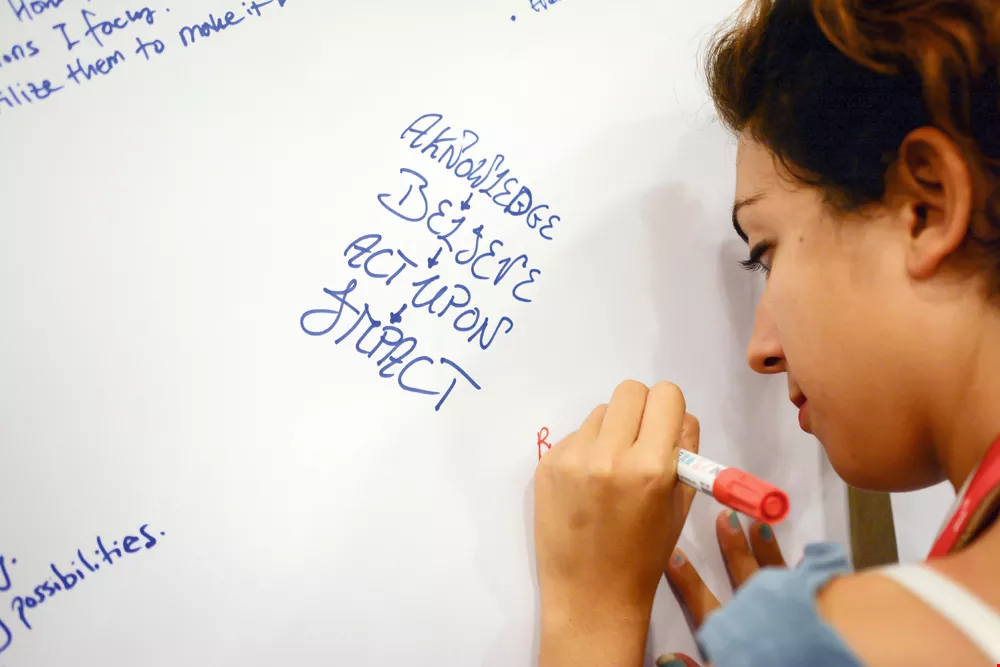
The Y2B Forum helps young people learn to turn their ideas into practical action that has an impact on society.
In addition to performing well in your own position, you also need to know how to deal with people. From this perspective, AIESEC’s vast network of personal connections is an enormous asset for its members.
Established in 1964, AIESEC Taiwan currently has 16 chapters with more than 800 members, and has nurtured many outstanding alumni over its years of activity. Despite the busy lives led by many, alumni continue in various forms of interaction with the younger generation, helping them to develop. This is in fact one of the most effective bridges between students and the business world.
“If an average student tried to make a call to a company chairman, they would more than likely be thwarted at every turn. But through AIESEC alumni, the result is often completely different.” Tsai notes his experience in preparing the AIESEC International Congress in Taiwan as an example in which they raised over NT$10 million from eight companies. Such success is largely due to the assistance and goodwill of alumni.
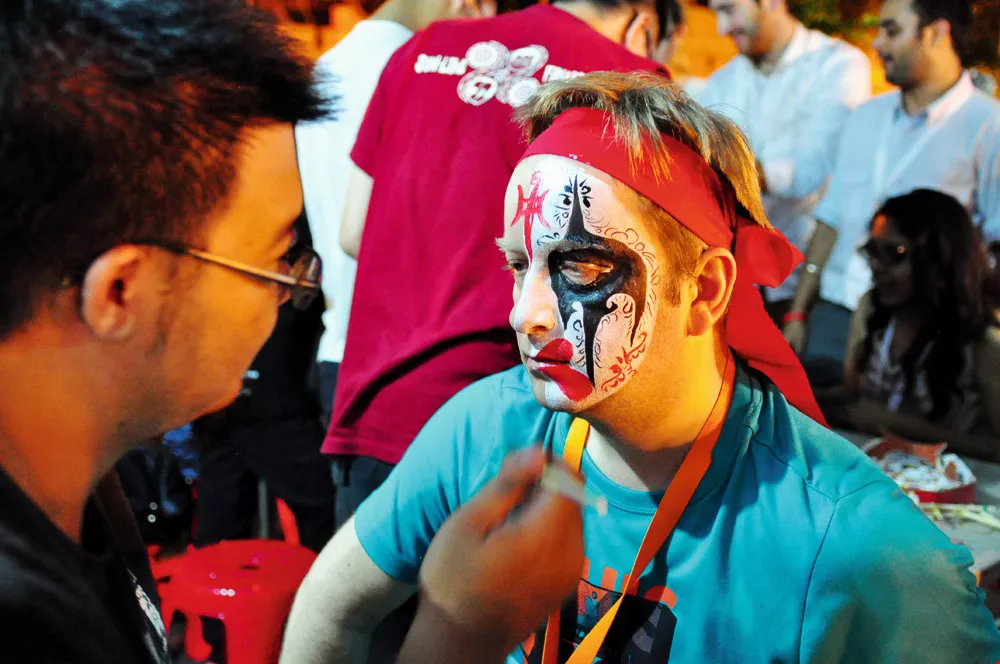
Youth from around the globe visited various stalls at the Taiwan Nights event, exploring the joys of traditional folk crafts.
This year is an exciting one. It’s not only the 50th anniversary of the organization, but also AIESEC Taiwan’s inaugural hosting of AIESEC’s International Congress.
AIESEC is like a giant multinational corporation. The congress is its global convention, at which all extensions report progress in current projects, and review the previous year’s business developments.
Gaining the opportunity to host an AIESEC International Congress is not only a great source of pride, but also a shortcut to the international community. “Usually only about five to eight Taiwanese students attend the International Congress, but this year we have 17,” says Tsai. It takes a lot of time and money to take part in overseas events, so many students can’t afford it.
Tsai, who has attended a number of AIESEC congresses, believes that only through firsthand participation can one become familiar with the realities of the business world. “Observing discussions and experiencing interpersonal relationships helps people to develop.” For these reasons, Tsai made up his mind to bring the AIESEC International Congress to Taiwan, bringing the benefits home for greater numbers of young people.
Bidding for the congressAny country that wants to host the International Congress must first submit a strategic plan. AIESEC’s International Committee reviews the applicants and selects a shortlist. Then AIESEC presidents from all participating nations vote to select the host country. A nation’s reputation is often a key factor in the process.
Taiwan began bidding for the congress in 2011. But that year Egypt, with its ancient sites and fabulous tourist resources, won a landslide victory. Taiwan gained less than 20% of the total vote.
One of the criteria for selection is experience in organizing international events, and compared to the other candidates, Taiwan’s know-how was clearly lacking to some extent.
Taiwan tried its luck again in 2012, but was quickly put out of the contest. The process was proving highly competitive.
However, at the 2012 AIESEC International Congress in Russia, countries that had failed in the selection process were allowed the privilege of delivering a short speech to the assembly. As soon as Taiwan AIESEC heard about the opportunity, they were on the ball. Virtually overnight, they put together a promotional film, paving the way for the following year’s bidding.
The film not only introduced the culture of Taiwan, but also repeatedly conveyed the passion that Taiwan felt to connect with the world. At the event, the film gained a remarkable round of applause from the members. And at the end of the conference, many members made a point of expressing their support for Taiwan’s aspiration to host the congress.
At the end of 2012, Taiwan tried to bid for the congress once again. And again, the committee raised their usual concerns. Fortunately, however, mainly because of the previous year’s efforts, a number of countries actively spoke up in support of Taiwan’s bid. They argued that Taiwan had clearly demonstrated both its determination and sincerity to host the congress, as it had bid for three consecutive years. They believed it was time to give Taiwan a chance.
So after three years of painstaking effort, Taiwan finally won the right to host the 2014 AIESEC International Congress. “We not only want to show the world that Taiwan can do it, but we also want the nation to recognize the determination of its young people,” says Tsai proudly.
Guiding the youngThis year’s 50th anniversary of AIESEC Taiwan meant that the number of activities during the congress hit a peak. More than 800 young people from 124 countries—and 300-plus alumni—took part in events.
The Global Youth Leadership Summit kicked off the congress on August 14. Fifteen speakers from a diverse range of fields enthusiastically shared their experiences with the gathered young people. Presenters included Francis Ngai, founder of Social Ventures Hong Kong, renowned film director Peter Chan, Joel Chung, founder of The News Lens, and Motherhouse creator Eriko Yamaguchi.
Yamaguchi went to Bangladesh after graduating from university, and created her own clothing brand, showing that developing countries are equally capable of producing high-quality goods. At age 27, she was selected by Business Week as one of Asia’s best young entrepreneurs.
At the summit, Yamaguchi reminded young people, “If you fear failure, and are unwilling to aim high, then it’s probably better for you not to try—because you’re simply not ready for it yet.” She believes that the world is changing quickly: starting one’s own business is becoming an increasingly difficult challenge. But if one lacks the courage even to take the first step, then how can one expect to overcome adversity in the future?
Twenty is an age of dilemma. Should one choose to work, study or start one’s own business? Each option links to a different path for your life’s future direction. So the congress aimed at helping young people to find their own direction through a process of discussion, creative exchanges and training.
The Global Village Expo was held on the congress’s opening day, allowing young people from all countries to set up a booth to introduce their nation’s culture and cuisine. A large number of Taiwanese parents took the opportunity of taking their children on a quick trip around the world—without leaving home.
The Taiwan Nights event on August 23 was a showcase for Taiwan culture, featuring the Chio-Tian Folk Drums and Art Troupe and Ten Drum Art Percussion Group, among others. Vendors from three major night markets were invited to operate stalls, allowing their young guests to taste the famous Taiwanese night-market fare.
At the closing ceremony, the famous speech from the final scene of Chaplin’s film The Great Dictator was played: “You, the people, have the power to make this life free and beautiful, to make this life a wonderful adventure.... Let us fight to free the world—to do away with national barriers—to do away with greed, with hate and intolerance... in the name of democracy, let us all unite!”
Members embraced each other amongst a chorus of cheers, and many were reluctant to leave the venue. The AIESEC International Congress ended on a high note: the mission to achieve mutual understanding and peace has passed to the next generation.


