Coffee and Mushrooms: Selling the Good Life on Hainan
Sam Ju / photos Jimmy Lin / tr. by Jonathan Barnard
September 2012


What do the world’s most common variety of coffee beans and a health food that has a potential market of more than 200 million elderly users have in common? Well, on Hainan Island anyway, Arabica coffee beans and health foods containing wild reishi mushrooms were both first produced and marketed by Taiwanese.
Taiwanese businesses have hitched their wagons to a policy train that aims to turn Hainan into an international tourist island. At a time when Hainan’s recreation economy appears strong and the Chinese market for health food products aimed at the elderly is booming, will these Taiwanese firms, however many “firsts” they notch, really find ultimate success by being at the cutting edge in Hainan?
To be sure, Hainan is a desert for consumers of coffee. So far no Starbucks or funky independent coffee shops have opened on the island. Apart from those of Fushan Coffee, based in Hainan’s Chengmai County, there are simply no name cards to be had bearing the word “coffee.”
Chengmai County is located to the southwest of Haikou. A few scattered coffee shops have opened in the county seat of Fushan in recent years. Fushan was also the first place on the island where coffee was planted.
In the 1930s, Chen Xianzhang, an overseas Chinese from Indonesia, planted some Robusta coffee trees in Fushan. Those were the first coffee trees on the island. Yet, because of Robusta’s high caffeine content and weak aroma, it has long been excluded from the ranks of high-quality coffee and is mainly used for canned or instant coffees.
Ten years ago, in the neighboring township of Dafeng, Lin Wen-ting planted some Arabica, the variety that accounts for 70% of the world’s coffee beans. Lin, a former deputy commissioner of Tainan County, had only recently arrived in Hainan and he had zero experience with coffee. Today, he is a fount of wisdom on the subject and never stops discussing it.
When Lin decided to plant coffee a decade ago, he predicted that commercialization would equal westernization and would therefore lead to the growth of coffee culture on Hainan. His dream was that coffee’s aroma would be found in every locale throughout the island.
Lin Wen-ting, former deputy commissioner of Tainan County, left the world of politics to seek his fortunes in Hainan. He has planted the island’s first Arabica coffee trees in Chengmai County.
Born in 1954, Lin was a founding member of the Democratic Progressive Party and long occupied senior party positions. In 1997 Tainan County commissioner Mark Chen selected Lin as his deputy. When they failed to regain the DPP’s nomination in 2001, Lin left the world of politics without hesitation, never to look back.
As far as Lin was concerned, by going to Hainan to invest in agriculture, he was simply moving up a business plan he had originally planned to pursue in retirement. During his time in county government he began to collect information related to agriculture on the mainland and the markets for agricultural products there. After perusing various documents, he discovered that only two places on the mainland produced coffee: Hainan and Yunnan. Moreover, he knew people from Tainan who had already invested in Hainan, and they suggested that he try investing in agriculture there. In view of the fact that the fruit market on the mainland was already saturated, and thinking that “as Chinese do business with foreigners they will gradually acquire the habit of drinking coffee,” he decided to plant coffee.
“It’s a totally different career!” his former DPP colleagues would call and tell him before he left for Hainan. “Where’d you get the gall?” They worried that this old political hand might be making a huge financial mistake by going into agriculture.
“I’ve drunk coffee since I was young, but I haven’t laid eyes on a coffee tree more than three times,” Lin would tell them honestly. Then he’d add: “But I’ve done sufficient homework.”
In 2002 Lin’s farm—Cool Sir—formally opened. As a result of having done “sufficient homework,” Lin was convinced he had picked the right location.
He had been very picky about the planting environment. He spent two months traveling throughout Hainan before he finally found the ideal volcanic soil in Chengmai, not far from Haikou. He took out a lease on 400 mu (26.7 hectares).
Next he had to pick the variety of coffee.
“Before arriving in Hainan, I already knew that no one had planted Arabica. Throughout the world, 80% of coffee drinkers were drinking coffee made from Arabica beans, but no one here had ever tried it.” Lin found it inconceivable that Hainan was so out of step with international coffee market trends.
Consequently, once the Cool Sir Farm opened, he introduced varieties of Arabica coffee trees from Brazil, India and Taiwan. On trips back to Taiwan, he would take the opportunity to go to Yunlin’s Gukeng, Taichung’s Huisun and other areas where they farmed Arabica. He’d pick the brains of the farmers, getting tips on everything from planting to roasting.
But has Lin’s dream of having “the scent of coffee waft throughout the island of Hainan” been realized?
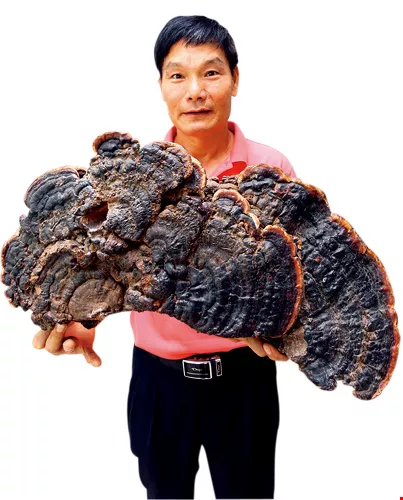
Huang Heping has given his all to researching the medicinal properties of reishi mushrooms, developing health-food products containing the mushrooms, and sharing with television audiences what he has gleaned about healthy living.
“The coffee bean industry in Hainan is still pretty weak,” explains Linus Chiang, whose U.B.C. Coffee lounges, which first opened in Hainan, are now franchised in major cities throughout mainland China. He notes that more than 80% of the Robusta in Hainan is imported from Vietnam. In other words, little more than one-tenth is grown by Hainan farmers themselves.
“What’s more, growing Arabica in Hainan is not so efficient,” says Chiang. Arabica is more suited to altitudes over 1500 meters, but the highest point in Chengmai is only about 500 meters.
“In all Hainan there are only about five Taiwanese farmers growing coffee,” says Chiang, holding up the fingers of one hand.
Lin notes that he has two basic types of clients for his Arabica beans: mainland bureaucrats who carry it away and customers in Shanghai or Beijing who buy it via mail order.
As a result of his experience in government in Taiwan, Lin has received deferential treatment from mainland bureaucrats. He was hired as a consultant at the Hainan committee of the Chinese People’s Political Consultative Conference, and, as well as using the position to give a voice to the interests of Taiwanese businesses and fight for their rights, he has provided suggestions on how Hainanese and Taiwanese businesses can cooperate.
As a consequence, Lin has tried to be a model farmer. He explains that with the current policy in Hainan of moving away from farming monocultures, he took 150 mu of old coffee fields that were damaged by a typhoon last September and planted them with pineapples instead. One the one hand he was conforming to local government policies, and on the other he was motivated by understanding the effects of climate change. Irregular blooming of the coffee trees was hurting his business.
Although there is a gap between reality and Lin’s original dream for coffee in Hainan, he is still convinced his dream wasn’t wrong. He sees himself as an ambassador of coffee, buying books related to coffee for mainland officials and hoping mainland people will follow their lead to learn more about coffee culture.
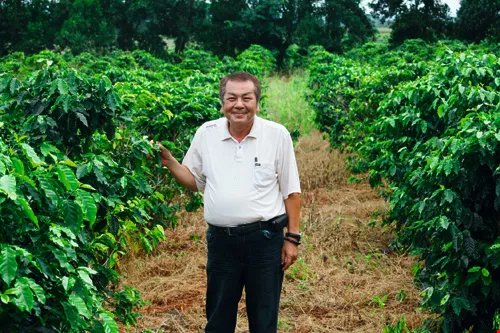
Lin Wen-ting, former deputy commissioner of Tainan County, left the world of politics to seek his fortunes in Hainan. He has planted the island’s first Arabica coffee trees in Chengmai County.
If Lin is the Taiwanese businessman in Hainan that serves as a missionary for coffee culture, then Huang Heping, 54, is an apostle of reishi mushrooms.
Correctly predicting that a flood of investment money would target Hainan’s special economic zone, Huang Heping engaged in real-estate development when he first came to Hainan in 1990. Yet, after he blindly invested money, the mainland authorities introduced new regulations in 1993, bursting the real estate bubble on Hainan. Huang, then 40, lost everything. He was so desperate that on several occasions he contemplated suicide.
In 1997, Huang Heping had occasion to drive through Hainan’s central mountains near Mt. Wuzhi. His eyes were attracted to the fallen trees in the forest on either side of the road, and to the mushrooms that were growing on them. Back then his wife was battling cancer. Wanting to gain a better understanding of the health benefits of reishi mushrooms, which are regarded as a superfood in traditional Chinese medicine, he pooled a little money from friends, which he used to hire hands from among the local Li minority people. They brought the rotting logs on which the mushrooms were growing to Haikou.
Huang read books on mushrooms and brought samples of scientifically identified mushrooms to the Chinese herbal medicine departments of various hospitals and universities, paying for tests on toxicity, medicinal properties and active ingredients. He found various reishi mushrooms with health-promoting effects.
Within three years, the wild mushrooms of Mt. Wuzhi had virtually been picked clean by Huang, and he brought his search for wild mushrooms to many mountain forests on the mainland.
In 2001 Huang established the Hainan Wannianxun Wild Lucid Ganoderma Research Institute Company in Haikou, becoming one of a small number of Taiwan firms with an actual shop front in the city. Currently, there are over 50 reishi samples in his office, some of them several hundred years old.
Wannianxun has a factory in Beijing that uses nanotechnology to extract active components from mushrooms. The reishi mushroom capsules that it produces have been officially designated as gifts for central government officials on the mainland.
Huang Heping explains that sales channels in the mainland are not well developed, and there is insufficient trust between people. Consequently, Wannianxun’s products aren’t found in other stores. They can only be purchased in the company’s own stores in Haikou and Sanya.
“In one year we produce 20–30,000 boxes of capsules,” explains Huang. “Each box sells for RMB680.” He estimates yearly business at over RMB13 million (about NT$65 million). And that doesn’t include revenue from reishi tea and other products.
With the business growing more stable, he has been gradually turning over day-to-day operations to the next generation. Apart from sharing his health secrets on television, he can be found roaming around his stores in Haikou and Sanya, freely dispensing advice on health.
Huang’s youngest daughter Huang Ziqi, who moved to Hainan when she was just eight years old, is now studying Chinese medicine at Hainan Medical College. She notes that as cities in Hainan such as Haikou and Sanya have become more developed in recent years, people in their 20s and 30s have become more concerned about their health.
“It used to be that most people would eat vitamins to protect their health, but in the last two years they’ve become clearly more receptive to the benefits of Chinese medicine.”
Ultimately, not every kind of mushroom can be safely ingested. Some are toxic. Huang Ziqi says that customers often come in with questions about reishi mushrooms they bought elsewhere. Or they ask experts at the store to provide herbal recipes. Summing up, Huang says, “Taking good care of your health is no longer the exclusive province of the elderly.”
“Only with ‘special varieties’ can you gain a stable foothold in the market,” says Huang Heping, deliberately comparing his unique experiences in the reishi business with the experiences of the Taiwanese who met success in Hainan introducing high-end fruit varieties. It’s an apt comparison.

@List.jpg?w=522&h=410&mode=crop&format=webp&quality=80)
@List.jpg?w=522&h=410&mode=crop&format=webp&quality=80)


