Confucian Cuisine: Gourmet Dishes from the Chinese Classics
Lavai Yang / photos Lan Chun-hsiao / tr. by Geoff Hegarty and Sophia Chen
September 2011


When you visit Taipei, the one thing you mustn't miss is the exquisite range of traditional Chinese food available. Taiwan cuisine is diverse and multicultural, and includes night market snacks, imported cuisines, Hakka dishes, indigenous foods, and special dishes common to communities founded by mainland Chinese military personnel who arrived in Taiwan after World War II and the subsequent Chinese civil war. By continuing the cuisines of different regions of mainland China, Taiwan has become a hub of Chinese food, blending with local Taiwanese dishes and incorporating new styles along the way.
The concept of Confucian cuisine refers to the integration of cuisine and culture: Confucian culture. Confucian cuisine comprises 15 dishes whose recipes have been handed down from the pages of gastronomic history, particularly from the sages enshrined in Confucian temples. So when people enjoy these delicious dishes, they can also enjoy showing off their knowledge of history-a new gourmet experience.
The responsibility for designing Taipei's Confucian cuisine has been given by the Taipei City Government to gourmet Zhu Zhenfan, a descendant of Zhu Xi, a Confucian scholar in the Song Dynasty. After visiting Taipei's Confucius Temple, tourists can stroll the streets of the nearby Dalongdong neighborhood to enjoy the essence of Confucian culture in sights, sounds and tastes-and a unique eating experience.
Why is Taipei's Confucian cuisine so special? Zhu points out that unlike the Confucian cuisine in Confucius' birthplace of Qufu, Shandong Province, China, which is composed of exquisite imperial-court-style dishes, Taipei's Confucian cuisine is more "user-friendly" for the public. The Taiwan dishes are named after Confucian thinkers, who in the main did not enjoy wealth and status. In fact they often suffered hardships in the struggle to keep their lives together.
Taipei's Confucian cuisine also highlights the fact that the eight major styles of Chinese cuisine that originated in mainland China gradually became blended over the last 60 years with local, more workaday, cuisines. Confucian cuisine can be offered as a series of dishes in up-market restaurants, as gourmet food for ordinary people in smaller restaurants, or as snacks in the night markets.
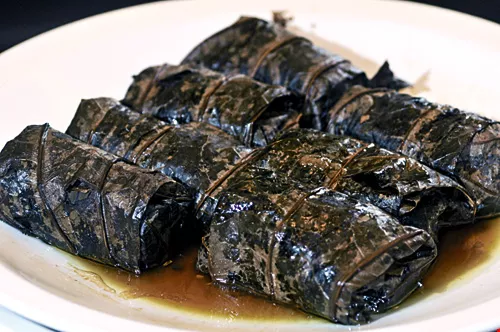
Each dish of the Confucian cuisine has its own story from ancient Chinese classics. The Taipei City Government has given responsibility for designing the cuisine to gourmet Zhu Zhenfan (page, center). The dishes shown are (1) Wen Tianxiang Chicken (courtesy of Taipei City Department of Information and Tourism); Yang Huo Kui Tun, which is actually a name for two dishes shown here: (2) steamed pork spareribs with lotus leaves and (3) pork trotters in aspic; (4) Kaoting Shuang Jiao, which is fried red spinach with preserved and salted eggs; (5) Cang Zhen Tofu; and (6) Xin Zhong Da Niu, which is pan-fried steak with oyster sauce.
Each dish of Confucian cuisine has a tale from history behind it.
For example, the first dish, Wen Tian-xiang Chicken, has the delicious flavors of the popular Taiwanese dish Three Cup Chicken. Wen Tianxiang (1236-1283), one of the three great heroes of the Song dynasty, is enshrined in the east wing of the Confucius Temple in Taipei. According to legend, when he was imprisoned in a dungeon, an old lady often visited him, and through the assistance of prison guards brought him Three Cup Chicken, made with chicken, water, rice wine and cooking oil cooked in a ceramic pot. After Wen was executed, the prison guards cooked the same dish as an offering on the anniversary of his death because of their admiration for his spirit of justice. The story spread and has carried on to this day.
Three Cup Chicken is now a common Taiwanese dish, served almost everywhere. However, to enjoy its authentic flavor to the full, it must be prepared perfectly: when done well, it is a treat for the eyes as well as the senses of smell and taste. Before it is served, the chicken pieces are arranged into the shape of a whole chicken.
How is it made? First, select a young, tender, two-pound chicken, pluck it and remove the bones and viscera, then wash it and chop it into small pieces. Put these into a ceramic pot, and add one cup each of soy sauce, cooking oil, rice wine. Then add chopped ginger and scallions, cover tightly and cook gently until it boils, stirring once every 10 minutes to prevent burning. Then stew for about half an hour until the chicken meat softens and the liquid thickens. Before serving, remove the ginger and scallion pieces, add a few drops of sesame oil, and serve in the pot.
The second dish is Kaoting Shuang Jiao: fried red spinach (amaranth) with both preserved and salted eggs.
According to a story, red spinach was a favorite vegetable of Zhu Xi, known as Master Kao Ting, the only one of the 12 sages enshrined in Confucian temples who wasn't one of Confucius' personal disciples. Zhu was particularly fond of eating red spinach after a drink. The vegetable is highly nutritious, good for the blood, has a pleasant flavor, and is versatile: it can be successfully combined with a variety of other ingredients. It is said that Zhu, a philosopher and educator, could think clearly and deeply because he regularly ate red spinach.
The third dish is Yang Huo Kui Tun, a pork dish, which derives from the Spring and Autumn Period. According to the etiquette of the time, if a senior official gave a gift to a scholar, and the person wasn't home to receive it, the scholar had to go to the official's home to express his thanks. The story goes that one day Yang Huo, a senior official in the court of the state of Lu, sent pork to Confucius. Because Yang was intent on seeing Confucius, who was of the scholar class, he purposely sent the present knowing that Confucius wasn't home. However, Confucius did not want to meet Yang, so he also went to Yang's place to express his gratitude when he knew that Yang wasn't home.
In the cuisines of Jiangsu and Zhejiang, Yang Huo Kui Tun can can take the form of several different dishes, such as pork trotters in aspic, roast pork, and steamed pork spareribs with lotus leaves.
To prepare pork trotters in aspic, scrape and wash the pork shanks, rub the pork shanks evenly with nitrates, coarse salt, star anise, cinnamon and Sichuan pepper, and marinate for three days. Then soak in clean water for 10 hours, remove and wash in warm water.
Put the marinated pork shanks in a cooking pot, add scallion, ginger, Shao-xing wine, Sichuan pepper, star anise and master sauce (a soy-based sauce), and cook on a high heat until boiling, simmer over a low heat for one and half hours, stir the shanks briefly, and continue to simmer for one hour more. Remove the shanks and pour a small amount of the cooking liquid over them, using a heavy tool to press tightly on the shanks. Wait until the shanks have cooled. The result is pork trotters in aspic. Before serving, slice ?the trotters and present them on a plate with sliced ginger and Zhenjiang vinegar.
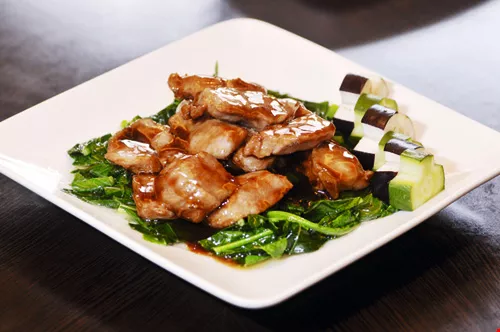
Each dish of the Confucian cuisine has its own story from ancient Chinese classics. The Taipei City Government has given responsibility for designing the cuisine to gourmet Zhu Zhenfan (page, center). The dishes shown are (1) Wen Tianxiang Chicken (courtesy of Taipei City Department of Information and Tourism); Yang Huo Kui Tun, which is actually a name for two dishes shown here: (2) steamed pork spareribs with lotus leaves and (3) pork trotters in aspic; (4) Kaoting Shuang Jiao, which is fried red spinach with preserved and salted eggs; (5) Cang Zhen Tofu; and (6) Xin Zhong Da Niu, which is pan-fried steak with oyster sauce.
The fourth dish is Qi Junzi Yu, which is steamed or fried fish. The name is an allusion to an anecdote about Zi Chan (also enshrined in the Confucius Temple). One day a live fish was sent to Zi Chan, and he asked a subordinate to release the fish into a pond. However, the official didn't follow the command and ate the fish. He later lied to Zi Chan, telling him that after he released the fish into the pond, it happily swam away. Zi Chan was pleased to hear the news and said: "Good. That fish got what it wanted!"
Dish number five is Jun Chen Chuo Zhou, a type of mixed porridge.
According to legend, near the end of the Song Dynasty, a senior official named Lu Xiufu (whose icon is located in Dacheng Hall at the Taipei Confucius Temple) escorted the last emperor of the dynasty, Zhao Bing, as he fled from his enemies. On their journey, they stopped to beg from a wealthy family in Zhangzhou, Fujian. The rich householder gave them some leftovers which he had kept to feed his cat. Lu and the emperor were extremely hungry, so they ate (and enjoyed) everything that the householder provided. Later, an imperial chef visited the household to discover what the food given to the emperor's party had been: the result was an exclusive dish called "cats' porridge," which has since become widespread.
The sixth dish is Xin Zhong Da Niu, a beef dish, which derives from a story from Mencius. During the Warring States Period, King Xuan of the state of Qi saw a bull being prepared for sacrifice to the gods. Its blood was to be used to paint a newly cast bell. The animal was greatly fearful, and the king, unable to bear to see its suffering, replaced it with a goat. Mencius believed that this benevolence was the quality that enabled Xuan to rule the state.
Cang Zhen Tofu, a tofu dish, is in seventh place. The design of this dish evolved from a joke ridiculing Zhu Xi's theory of ge wu zhi zhi: studying natural phenomena in order to acquire knowledge. One day Zhu Xi weighed soybeans, water and other ingredients preparing to make tofu, and when he was finished, he weighed the tofu. He found that the tofu was heavier than its ingredients. Since his philosophical theory was unable to account for this phenomenon, he refused to eat tofu from that day forward.
The other dishes have familiar histories. Zhuge Shuang Pin, steam buns with turnips, is believed to have been invented by Kong Ming in the Three Kingdoms period in order to feed his soldiers. Yangming Sour Fish was invented by Wang Yangming's cook during the Ming Dynasty, in Ganzhou, Jiangxi.
Fourteen exclusive restaurants have so far joined the program to promote Taipei's Confucian cuisine, offering a banquet of around 10 dishes at about NT$10-15,000. And around Dalong night market and Hami Street, 18 small eateries are transforming the once-exclusive Confucian cuisine into quite an affordable range of premium foods, with guidance from the city government, training and taste tests by master chefs and gourmet diners, and a promotion campaign guided by marketing experts.
A treat is in store for foreign tourists who may like to try these new "historical" gourmet foods when they visit the Confucius and Bao'an Temples in Taipei.
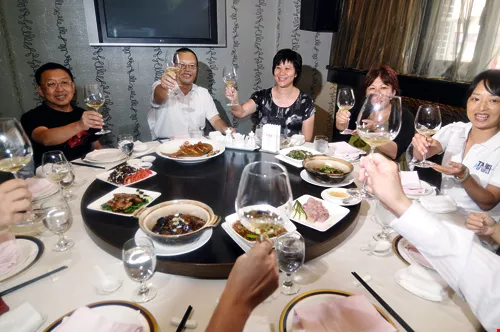
Each dish of the Confucian cuisine has its own story from ancient Chinese classics. The Taipei City Government has given responsibility for designing the cuisine to gourmet Zhu Zhenfan (page, center). The dishes shown are (1) Wen Tianxiang Chicken (courtesy of Taipei City Department of Information and Tourism); Yang Huo Kui Tun, which is actually a name for two dishes shown here: (2) steamed pork spareribs with lotus leaves and (3) pork trotters in aspic; (4) Kaoting Shuang Jiao, which is fried red spinach with preserved and salted eggs; (5) Cang Zhen Tofu; and (6) Xin Zhong Da Niu, which is pan-fried steak with oyster sauce.
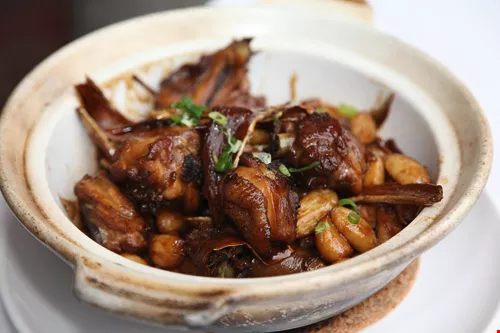
Each dish of the Confucian cuisine has its own story from ancient Chinese classics. The Taipei City Government has given responsibility for designing the cuisine to gourmet Zhu Zhenfan (page, center). The dishes shown are (1) Wen Tianxiang Chicken (courtesy of Taipei City Department of Information and Tourism); Yang Huo Kui Tun, which is actually a name for two dishes shown here: (2) steamed pork spareribs with lotus leaves and (3) pork trotters in aspic; (4) Kaoting Shuang Jiao, which is fried red spinach with preserved and salted eggs; (5) Cang Zhen Tofu; and (6) Xin Zhong Da Niu, which is pan-fried steak with oyster sauce.
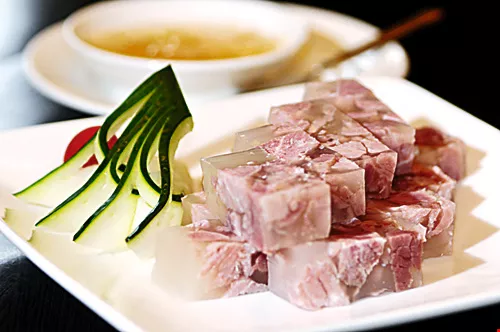
Each dish of the Confucian cuisine has its own story from ancient Chinese classics. The Taipei City Government has given responsibility for designing the cuisine to gourmet Zhu Zhenfan (page, center). The dishes shown are (1) Wen Tianxiang Chicken (courtesy of Taipei City Department of Information and Tourism); Yang Huo Kui Tun, which is actually a name for two dishes shown here: (2) steamed pork spareribs with lotus leaves and (3) pork trotters in aspic; (4) Kaoting Shuang Jiao, which is fried red spinach with preserved and salted eggs; (5) Cang Zhen Tofu; and (6) Xin Zhong Da Niu, which is pan-fried steak with oyster sauce.
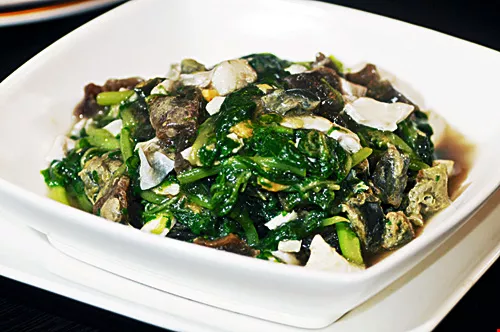
Each dish of the Confucian cuisine has its own story from ancient Chinese classics. The Taipei City Government has given responsibility for designing the cuisine to gourmet Zhu Zhenfan (page, center). The dishes shown are (1) Wen Tianxiang Chicken (courtesy of Taipei City Department of Information and Tourism); Yang Huo Kui Tun, which is actually a name for two dishes shown here: (2) steamed pork spareribs with lotus leaves and (3) pork trotters in aspic; (4) Kaoting Shuang Jiao, which is fried red spinach with preserved and salted eggs; (5) Cang Zhen Tofu; and (6) Xin Zhong Da Niu, which is pan-fried steak with oyster sauce.
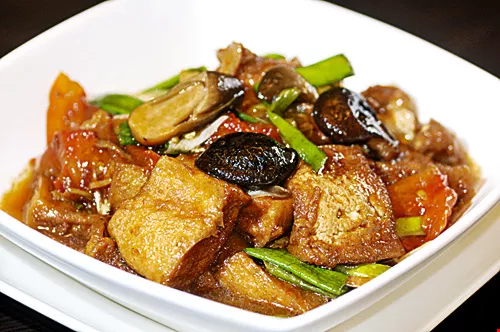
Each dish of the Confucian cuisine has its own story from ancient Chinese classics. The Taipei City Government has given responsibility for designing the cuisine to gourmet Zhu Zhenfan (page, center). The dishes shown are (1) Wen Tianxiang Chicken (courtesy of Taipei City Department of Information and Tourism); Yang Huo Kui Tun, which is actually a name for two dishes shown here: (2) steamed pork spareribs with lotus leaves and (3) pork trotters in aspic; (4) Kaoting Shuang Jiao, which is fried red spinach with preserved and salted eggs; (5) Cang Zhen Tofu; and (6) Xin Zhong Da Niu, which is pan-fried steak with oyster sauce.

@List.jpg?w=522&h=410&mode=crop&format=webp&quality=80)

@List.jpg?w=522&h=410&mode=crop&format=webp&quality=80)


