

When cold fronts arrive in winter, clothing made from far infrared bamboo charcoal fibers immediately warms its wearers. During the heat of the summer, a tee-shirt made from Flycool fabric immediately makes its wearer feel a degree or two cooler!
The creativity of Taiwanese textile manufacturers knows no limits. They've even turned coffee grounds into something wearable: clothing that keeps you dry, prevents body odor and protects against ultraviolet rays. After the clothing is discarded, it can naturally decompose, thereby avoiding problems associated with garbage disposal.
These aren't feats of magic. With constant research and development as well as refinement of new techniques, a revolution in fabrics is transforming the traditional textile sector into a high-added-value industry.
At the 2010 World Expo in Shanghai, the some 300,000 volunteers who donned green and white polo shirts were nicknamed "bok choys." Their shirts were made from interwoven Flycool and Sorona, textile yarns created respectively by the Taiwanese company Flycool and DuPont, Taiwan. The interweave represents the newest advancement in the use of Flycool fabric.
What is so special about this material?
Billy Hu, Flycool's general manager, says that the basic requirement of fabric for summer clothing is that it be comfortably dry and cool. Yet from a technical standpoint, those two objectives are hard to achieve at the same time.
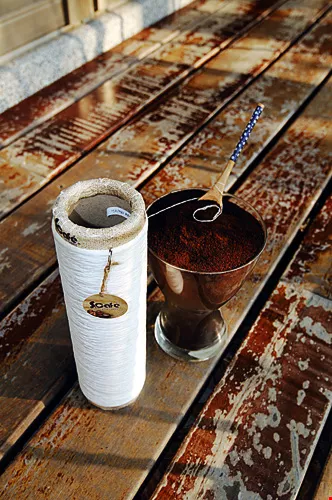
These coffee grounds will be dried to remove oils before being mashed into an extremely fine powder. Added to yarn made from recycled PET, they will end up in Singtex's S.Cafe fabrics, which boast 100% recycled content.
Comfortably dry clothing wicks the sweat away from the surface of the skin so that it can be quickly evaporated. Comfortably cool clothing allows its wearer to feel cool even when the temperature is high. The structures of the textiles used to achieve these two aims are quite different, and if you try to achieve the effects simultaneously by twisting the two kinds of yarn together, or by layering two fabrics (one for drying and one for cooling), it makes the clothing too heavy for summer use.
The key method that Flycool uses to overcome these obstacles is the addition of various compound minerals during the filament drawing process.
Generally speaking, the mineral particles that absorb heat fast, dissipate heat fast; whereas those that absorb heat slowly, dissipate heat slowly. If you add simple jade stone particles to a textile, the fabric will at first feel cool to the touch, but the apparent temperature will rise steadily over the long term. Hu spent nearly a year conducting tests before he finally chose six or seven mineral particles that were most suitable.
When selecting the combination of mineral particles, it is also important to consider crystallization, as well as the flow rate and the evenness of spread. The minerals must be ground into a powder with a consistent granularity before being spread uniformly on the surface of the material. Only then can the fabric "absorb heat slowly, but disperse heat quickly." Next, the cross-sectional structure of the fiber must be designed so that it increases dryness. Moreover, it must be a single-filament yarn so that the fabric can be light and thin.
Experiments have shown that Flycool feels 1-2°C cooler when touching the skin when the body is at rest and 3-5°C cooler after 30 minutes of physical activity in sunshine, in comparison to wearing a similar garment made of non-technical fiber. In short, wearing clothes made from Flycool makes hot weather less stifling and stuffy.
Because of the sense of coolness that comes with this fabric, you can adjust the air-conditioning setting up a degree. "By so doing, you'll save 600 grams of CO2 emissions in one hour per person. For a factory with more than 1000 workers, you can save as much as 144,000 kilograms of CO2 emissions per month," says Justin Huang, secretary-general of the Taiwan Textile Federation.

Fiber from recycled PET bottles is used in fabrics that have been turned into fashionable spring and summer apparel. These clothes were on display at the Taipei International Flower Expo early in the year.
Billy Hu started work on Flycool fiber in 2006. With government policies encouraging textile manufacturers to create products with environmental functionality, he saw the business opportunity and, judging that the future was bright, decided to throw himself into R&D. Within one year he was able to develop Flycool, after which he began working with DuPont Taiwan to create an environmental fabric from interwoven Flycool and Sorona.
In place of the petrochemical 1,3-propanediol (PDO), DuPont has created a bio PDO for Sorona, which is derived from plant starches such as tapioca. This bio PDO comprises 37% of the raw materials used to create Sorona-an amount that therefore needn't come from petrochemicals. In comparison with producing nylon, the energy consumption from producing Sorona made with bio PDO is 30% lower, and the CO2 emissions are 63% lower.
Sorona fiber is soft to the touch and offers high colorfastness and elasticity. It can hold its shape well and resists soiling and wrinkling. What's more, it is highly absorbent and wicks away sweat from the skin. When interwoven with Flycool, the resulting fabric displays the best qualities of both yarns: it's a cooling fabric that is environmentally friendly to manufacture and use. Consequently, the World Expo selected this interwoven fabric to use for its uniforms and souvenir shirts.
The two companies are currently putting great effort into researching and developing a "three-in-one" fiber that will combine the mineral particles of Flycool fabrics with the strong points of biodegradable polymers. This will allow for clothing to be decomposed by microorganisms when buried at conditions of 60°C and 50-60% humidity in landfills. It won't need to be recycled and it won't leave a carbon footprint.

A padded jacket made with S.Cafe fabric. Skiers can replace two different items of clothing with the jacket, which serves both as a parka and a wind breaker.
"With 12 plastic bottles and the grounds from three cups of coffee, you can make one piece of clothing!"
Make no mistake: S.Cafe fabric from Singtex is the first patented and authenticated fabric to be made partially from coffee grounds, which represent 2-5% of its raw material. (Recycled PET plastic bottles account for the remainder.) The material can be turned into textiles with various functions-either as fabric that wicks moisture away from the skin, dispels odor, dries quickly, cools, and provides protection against ultraviolet rays, or alternately as fabric that stores heat and maintains warmth.
"In life there are business opportunities everywhere," says Jason Chen, general manager of Singtex, who traces the origin of "wearable coffee" to a casual remark made by his wife.
In 2005, Chen and his wife came to Taipei for a concert at the Taipei Arena. While drinking some coffee before the concert, they saw an old lady ask a barista for coffee grounds to bring home to absorb odors. Witnessing the scene, his wife wondered aloud: "Can coffee grounds be turned into clothing?" That was the start of the quest that led to S.Cafe fabrics. A frequent drinker of coffee, Chen began to research the properties of different kinds of coffee beans.
Based on his knowledge of textiles, Chen thought that if he carbonized coffee grounds (by subjecting them to high-temperature processing, in which the organic matter is combusted and decomposed with only highly porous carbon remaining), then the material might be able to be used as a deodorizer like carbonized bamboo. But the carbonized coffee turned pastel fabrics darker, reducing market acceptability.
To ensure that dyed fabrics retain their intended colors, the coffee grounds used to make textiles cannot be carbonized. But if you can't carbonize them, won't that prevent them from working as deodorizers?
To find out, Chen tested different kinds of coffee beans. Eventually he discovered that dark roast beans, which are roasted until they crack for a second time, yielded the best results. That's because these dark-roasted beans are already semi-carbonized, and they have a highly porous surface like activated carbon or charcoal that can absorb foreign odors. Dark roast coffee grounds are truly a valuable natural resource.
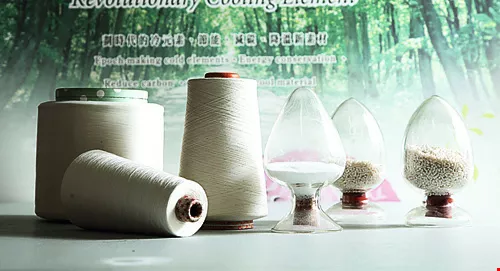
Infused with various natural mineral particles that keep them cool to the touch, Flycool fabrics are well suited for light summer clothing.
Because coffee grounds have a moisture content of 60%, you've got to dry them to remove their inner oils and clean their surface pores. Otherwise, the remaining oil will cause moisture or stickiness. After drying, the pure coffee grounds must undergo a special procedure that turns them into 400-nanometer granules so that they can be evenly spread on fabric. At this size, which represents the limit of how far they can be ground, high-powered microscopes are required to see them. They are thinner than natural silk fibers.
After eight upgrading projects, Chen had spent more than NT$20 million to overcome problems relating to stickiness, yarn breakage, low spinning efficiency, and "muddy odor," while preserving the coffee grounds' rapid absorbency, deodorization potential and UV resistance. The R&D was successfully completed at the end of 2008.
Interestingly, the earliest three generations of coffee yarns the company put on the market retained the odor of coffee by intention. In fact, Chen personally led groups of workers wearing T-shirts and sportswear made from the fabric on hikes to test the clothes. But the turbid mix of coffee and sweat proved unpleasing, and the coffee odor was later eliminated.
After S.Cafe fabrics were released, they quickly established a name for themselves in the international community. EiDER, the leading French sportswear company, was the first to make use of the fabrics, putting them in various multifunctional sweat-wicking undershirts. Within two years, Singtex was supplying S.Cafe fabrics to more than 70 international exercise and outdoor clothing brands, such as Adidas, The North Face, and Patagonia. It also won a Taiwan Excellence Award and attained recycling content certification from the German company TUV Rheinland.
Currently, Singtex is collecting coffee grounds from various convenience stores, Starbucks and Mr. Brown's Coffee, and the food manufacturers King Car and Wei Chuan. It collects 500-1000 kilos of grounds per day, producing about 3.6 million yards of fabric a year, which can be used to create 1.8 million shirts. The S.Cafe fabrics account for 15% of total company revenue.
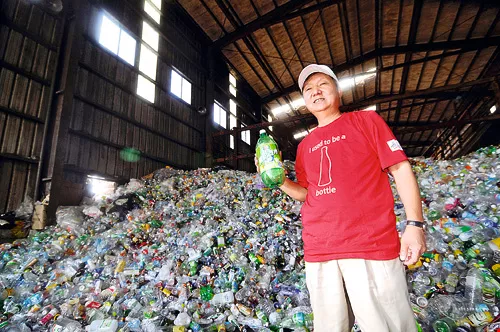
Mark Ko is president of Ecomax Textile, which recycles PET bottles to make an environmentally friendly textile fiber. Ecomax is the first company in Taiwan with this capability.
Making good use of resources by "turning garbage into gold" represents the future of the textile industry. Yet few know that the first company in Taiwan to research recycling PET plastic bottles as fabric was Ecomax Textile, a small company located in Changhua that employs only 25 people. Half of the recycled PET fabric used for soccer uniforms at the 2010 World Cup was produced by Ecomax.
Mark Ko, the second-generation president of Ecomax, was inspired by Buddhist Master Cheng Yen's call to take a hands-on approach to environmentalism. When he saw PET bottles thrown in the creeks of Changhua County, he thought: "Why can't those plastic bottles be recycled?"
Taiwan is the fourth country-after the United States, Germany and Japan-to recycle PET bottles into textiles. Ko drew from Japan's experiences in the field and asked for advice from colleagues in Taiwan's textile industry and Taiwanese academics. After two or three years of constant experimenting, he was able to overcome problems stemming from the inconsistency of the PET raw material and the high levels of impurities, as well as difficulties with shaping the fiber and keeping the yarn from splitting. Eventually in 1995, the company created a short-fiber "green" yarn, which it named Petspun.
Ecomax first used 60% recycled PET and 40% recycled fabric off-cuts for yarn until it was successfully able to create polyester yarn that wouldn't snap from 100% PET. Finally in 2000, the company was able to create a long-fiber version of recycled PET fabric, a high-value yarn with wide applications. So far it has been used for bags, jackets, vests, underwear, sleeping bags used in disaster relief efforts, hospital bedding and so forth.
The move toward green, low-carbon consumerism is already an international trend. Under the guidance of the Industrial Development Bureau of the Ministry of Economic Affairs, five Taiwan textile firms, led by DaAi Technology, have worked together to use recycled PET yarn in fashion. Aspiring to popularize a "new, low-carbon aesthetic," they are going to market the clothes under a joint brand.
James Lee, a board member at DaAi, says that fabric from recycled materials typically doesn't come in a wide range of colors, making it difficult to use them in fashion. The five textile firms are using the fibers' original colors or are dyeing the fibers prior to spinning. Then they are using tailoring and accessories to add such complimentary colors as blue, gray, black, khaki, white and green. They are focused on creating elegant and simple but nevertheless up-to-date styles.
In anticipation of clothing that is expected to be released at the end of the year, they established a process for standardizing production. And they have also adopted production process traceability and trademark certification. In the days ahead, when consumers are purchasing the brand's leisure wear, woven or knitted clothing, or bags, they can look at a product's matrix barcode to determine how many plastic bottles were used to create it and from what recycling center they came. This adds educational content to recycled textiles.
Future trendsAccording to Council of Economic Planning and Development data, about 70% of the international market's demand for functional clothing is met by Taiwanese manufacturers.
The French sportswear brand Salomon and the Canadian yoga clothing brand Lululemon Athletica purchase more than 80% of their fabric from Taiwanese manufacturers. And every year one of the world's largest clothing companies, the US conglomerate VF, with more than 20 brands under its corporate banner, including The North Face, places orders in Taiwan worth US$130 million.
Responding to global climate change, the textile industry has invested large amounts in R&D of specialized fabrics with a wide range of uses. The industry here anticipates making inroads into the market for protective fabric, including textiles used for military clothing and equipment. Clothing that falls into this category includes the protective garb worn by American football players, by medical personnel during surgery, or by workers needing protection from chemical, nuclear or biological hazards.
Chiu Sheng-fu, director of the Department of Industry Information and Services at the Taiwan Textile Research Institute, explains that R&D on fabrics will increasingly take into account environmental impact. For instance, "recycling" will progress a step farther toward becoming "reuse of a product in a life cycle." This emphasis will start at design, with the use of materials that can naturally decompose or be 100% recycled.
There are no sunset industries-only industries that aren't striving hard enough to stay current. The Taiwan textile industry has long cast off its old image as a heavy polluter and accepted greater social responsibility. It is moving toward an ecologically benign "cradle to cradle" approach that stresses the continual reuse of resources in a sustainable manner. For these efforts, it deserves more support and encouragement.

@List.jpg?w=522&h=410&mode=crop&format=webp&quality=80)


