The Little-Known Role of Male Caregivers
Sam Ju / photos Chuang Kung-ju / tr. by Jonathan Barnard
October 2014


Lin Ruiyi takes care of his mother, who has dementia. Lan Dafeng looks after his mentally disabled daughter. And Chen Xian takes care of his wife, who is paralyzed from a stroke. Caregivers aren’t exclusively one gender. Mothers, daughters, daughters-in-law, fathers, husbands, sons… all can become the sole support for a person with a serious illness or disability.
With a rapidly aging population and growing ranks of dementia patients, the load on caregivers is growing only heavier. Who can say what emotional toll it takes on them? And that’s all the more so for the men, who typically aren’t as good at expressing their feelings.
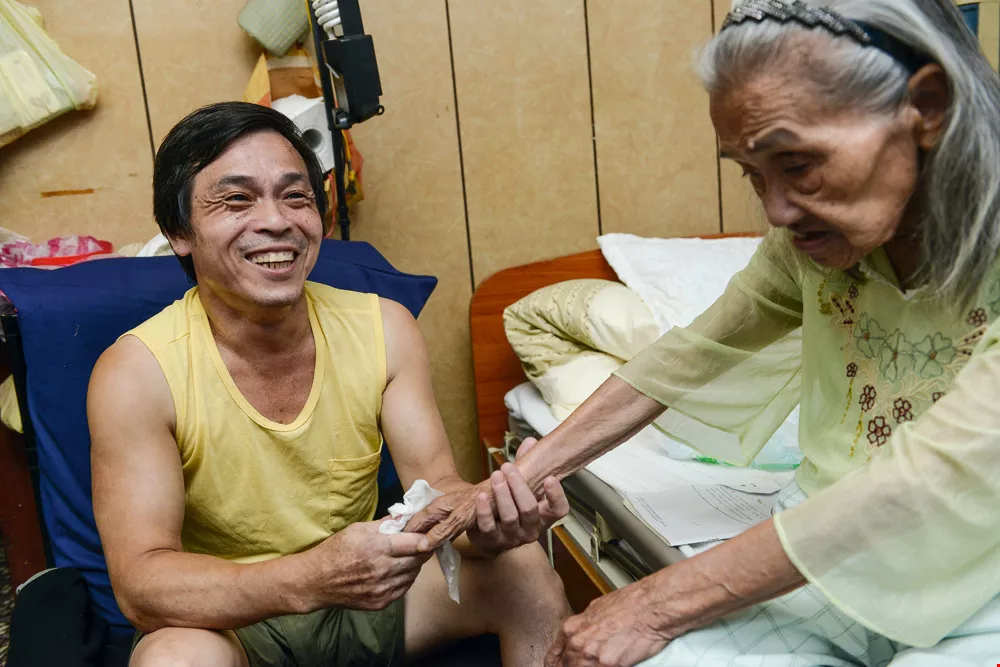
Lin Ruiyi (left), 56, is unmarried, and his siblings have used his lack of a family as a convenient excuse to evade any responsibility for their 88-year-old mother (right), who has dementia.
For many young men, leaving the military represents a new beginning, the moment when they launch their careers. But for Lin Ruiyi, now aged 56, leaving the military in 1981 meant something else entirely: taking on duties as a caregiver.
That year Lin’s father was 58, and his mother was 55. An injury at work left his father blind in both eyes. He became the first person in the family to need a caregiver.
Of the eight siblings, Lin was fifth. “My eldest brother and two sisters were already married, and the next oldest brother just didn’t care,” Lin recalls. “So it was left up to me.” Fortunately, he still had his able-bodied mother to help. During the day, when Lin left for his job of repairing factory generators, his mother would take care of his father.
But in 1986, his father had another stroke that left him paralyzed and bedridden. Lin would get up early to give his father a sponge bath and change his clothes, and after his mother made breakfast, it fell to Lin Ruiyi to feed him.
Four years later Lin’s mother, then 64, had grown absentminded. The situation was far more serious than the mild dementia that the doctor had originally diagnosed. What’s more, she had become completely incontinent. Consequently, in addition to supporting his paralyzed father, Lin had to take care of his senile mother too.
Lin’s work sometimes took him on trips out of town to repair generators. With his siblings unable or unwilling to help out, he had his hands full caring for his elderly parents. In 1992, to be able to spend more time at home, he quit his job and began to work only occasionally as a freelancer.
In 1996, he once went to a factory out of town to repair its equipment, and asked his brothers and sisters to help out in his absence. They temporarily sent his parents to a nursing home, where his father’s condition suddenly took a sharp turn for the worse. He passed away there, and his death left Lin Ruiyi with a deep mistrust of institutional care.
After his father died, Lin didn’t return to regular work. Although his mother’s condition would vary from one day to the next, her dementia was gradually worsening. Three years ago it entered an advanced stage. She could no longer recognize people. What’s more, she was diagnosed with small intestinal ischemia, for which she received a colostomy. Ever since the operation, she has required even more help with cleansing after defecation.
Lin’s 88-year-old mother can now only speak in monosyllables such as “hey” and “good.” Normally she just sleeps in bed, though sometimes, with the support of her son, she can sit at the edge of the bed. There’s a sofa chair next to the bed, which is where Lin rests. For the last decade he’s hardly slept anywhere else.
He has five alarms on his watch that are set to ring at eight, ten and 12 in the morning, as well as ten at night and in the wee hours. These are to remind him to feed his mother several small meals, give her medicine to clear her phlegm, and clean her colostomy bag. With his time so fragmented, he says he gets his sleep “on an installment plan.”
The household depends on NT$30,000 of support from Lin’s uncle. As no other family member helps him financially, his only breathers are three four-hour stints each week when he hires a home nursing aid. He uses those hours to catch up on sleep, go shopping or clear his head outside.
Because Lin Ruiyi is single and has no family of his own, his siblings maintain that it is only right that he should take on the caregiving duties. One incident that typifies an attitude that really ticks him off occured after his younger brother got divorced and returned home to live. The two of them got into an argument and Lin’s brother called the police on him. Much to Lin’s surprise, the first thing the responding officer did on arriving was to reprimand Lin, saying, “Don’t think it’s such a big deal that you care for your parents!”
Having taken care of his parents for more than 30 years, Lin says that he stays by his mother’s side because “it would feel wrong to leave her.”

Chen Xian’s wife (front) had a stroke 15 years ago. She suffered brain damage and is still partially paralyzed. Although her husband has the help of two daughters and a foreign domestic, her condition still places a heavy burden on him.
Like Lin, a reluctance to leave family members alone is one of the main reasons male caregivers say they are willing to leave the workforce. For 17 years Lan Dafeng, 53, has been a caregiver to his daughter, who has a mental age of four. For him, self-blame played a role in the decision.
Lan has three daughters. The oldest two are twins, and there is a two-year gap between them and the youngest.
The twins were born premature and underweight, and were immediately put into a neonatal intensive care unit. Although they left the hospital without any serious health issues, they had to be carefully monitored until they were three. Consequently, Lan’s attention was focused on them.
When the twins were two, Little Mei was born. When Lan and his wife saw that she weighed over three kilos, they heaved a sigh of relief, thinking that their three children would grow up hale and hearty. But at ten months Little Mei contracted a fever that wouldn’t break. After two weeks, it worsened to cerebral palsy. Fate had played another cruel joke on Lan’s family. Lan blamed himself.
Lan had a job repairing airplane parts at Taipei Songshan Airport. He explained the family crisis to his boss, who was understanding. Although Lan was forced to scurry back and forth between the hospital and his workplace, he managed to get his work done. His wife, meanwhile, quit her job as a typist and became a full-time mom.
Little Mei grew day by day, but her mental faculties stayed at a four-year-old’s level. She was also hyperactive and highly uncoordinated. In 2008 Lan left his job and threw himself entirely into caregiving.
During the day Little Mei attends a special education school, and then when she comes home she stays close to her parents. She stands 150 centimeters tall and weighs 50 kilos. She frequently bumps into things. Lan and his wife have to take turns watching her to prevent accidents.
Little Mei has limited language skills, and is usually unable to string together complete sentences. She typically speaks in single words, such as “Papa” or “yummy.” Recently, she was able to put together a few longer constructions: “Mama cooks well” and “Happy Father’s Day, Pappa.” The sentences pleased Lan Dafeng to no end, no matter how garbled they sounded.
The twins are studying at nursing school, and they say that in the future they will be able to care for Little Mei. What’s the next step for her? “I can’t see her future,” says Lan, with a tone that sounds somewhat sorrowful.
When a beloved wife collapses…Husbands and wives marry for a lifetime, and what they fear most is that something will happen to their spouse. As far as 76-year-old Chen Xian, a resident of Taipei’s Wenshan District, is concerned, his life was completely thrown upside down the moment his wife had a stroke 16 years ago.
Chen’s two daughters were studying in Britain, and Chen had to take on all the caregiving duties. He didn’t understand why his wife, who didn’t even like to eat fatty meat, would suddenly suffer a stroke.
Two years older than her, Chen previously had no experience in caring for someone with a serious illness. Back then, he was still working at a Zhongli post office and wasn’t able to spend much time with his wife in the hospital. And so when she was released, he first arranged to have her stay at a nursing facility in a hospital in their neighborhood.
Chen Xian knew that his wife was picky and worried that she wouldn’t like the food there, so he would often prepare some food himself, ask for time off from the post office, and then deliver it to his wife in Taipei. After half a year, he brought his wife home from the hospital, applied for early retirement, and began spending his days helping his wife recover.
His wife’s right side was paralyzed, and her language and mental abilities had clearly slipped. She could no longer manage things for herself. Fortunately, their two daughters had finished their studies and returned to Taiwan. With the family reunited, things were easier.
For instance, Chen couldn’t help but feel embarrassed when helping his wife with certain more private tasks, such as giving her a bath or sponge bathing her. Their daughters were naturally more comfortable with those duties.
When care is provided day after day, the relationship between caregiver and the family member being cared for is bound to become rocky at times. Chen says that since her stroke, his wife acts childish and stubborn at times. At those moments, he gets his daughters to play the good cops and cheekily coax their mother to behave, whereas he plays the bad cop and sternly refuses her demands. “My daughters have a tight bond with their mother,” Chen says. The young women are both parents’ biggest source of emotional support.
After so many years, the caregiving has become more routine. The family has hired a foreign domestic to help out. But when Chen sees how his wife’s recovery has been limited, and how his daughters have postponed establishing families of their own, he is filled with regrets.
Whenever he feels stressed, he takes a stroll to a mountainside temple to settle his emotions. Meanwhile, he has been participating in activities put on by the Taiwan Association of Family Caregivers, sharing his experiences with others.
Yet not every male caregiver has the support and understanding of his family like Chen does. Many more are misunderstood and unsupported. Caregiving is something that every family may one day have to confront. Society needs a better understanding of male caregiving in particular.

@List.jpg?w=522&h=410&mode=crop&format=webp&quality=80)

@List.jpg?w=522&h=410&mode=crop&format=webp&quality=80)


