

It is December 14, 2011, in the waiting area of Terminal 2 at Taoyuan International Airport. Xiangxiang, a fifth-grade girl from Taiwan, is holding on to the hands of the Fletchers, husband and wife. She circles around them, looking a little uneasy. Mrs. Fletcher tells her to look back, and expresses the hope that she won’t forget the place where she was born.
The boarding announcement comes for their flight, final destination Kansas City, Missouri. There Xiangxiang will be crowned with a new status, changing from “orphan” into an American citizen. (Under US immigration law, an orphan is defined as someone whose parents are deceased or missing, or have abandoned the child. Xiangxiang falls into the latter category.)
Together they board the plane and the new parents help Xiangxiang fasten her safety belt. They will never understand why there was no hope of finding an adoptive family in Taiwan just because the girl, as a result of her ADHD, was defined as a “special-needs” child.
Each year in Taiwan about 300–400 children are adopted by people overseas. These children have left the homes of their birth, been through temporary care in foster homes, and finally grow up in adoptive families in other lands. They know all too well that life is filled with emotional ups and down, and they have experienced everything from deep affection to callous abandonment.
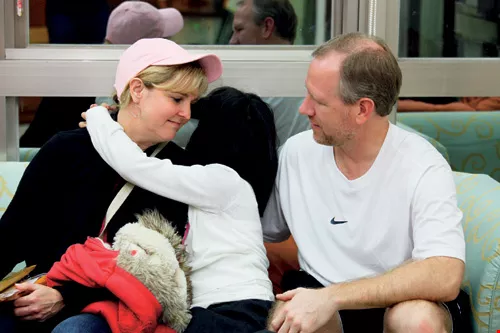
A day before leaving Taiwan, fifth-grader Xiangxiang stays close by the side of her adoptive parents from the US.
After four years of waiting and one failed attempt at a match, in the spring of 2011 five-year-old Ah Jie finally found himself on the overseas adoption track, and went to Germany to begin a new stage of his life.
His birth father had been sent to prison on drug charges and his birth mother had disappeared from home. Without his natural parents, and with his grandmother too old to look after him, at just 10 months into this world he was sent, through the auspices of the Chiayi Branch Office of the Taiwan Fund for Children and Families (TFCF), into a temporary foster home.
Foster Mom Wu Mei-hua explains that Ah Jie suffered from strabismus, and that after he completed the eye surgery they arranged for, he was diagnosed as having a speech disability, and had to go to the hospital frequently for therapy.
Ah Jie liked to stay close to Wu, accompanying her wherever she went. Lacking any sense of security, whenever strangers came to visit he would always end up taking refuge in the embrace of his foster sister.
Time passed, until finally the court issued a summons and found Ah Jie’s birth mother, who agreed to put him up for adoption. However, by then Ah Jie was already three, and no-one could be found in Taiwan who was willing to adopt him, so the only other option was to seek a chance to put him up for adoption overseas.
At first, a Swiss couple agreed to adopt Ah Jie, but the wife was struck down by a serious illness as the paperwork was still being processed, and they withdrew their application.
A few months later, the adoption agency heard that a family in Germany was looking to adopt. The couple had one son of their own, and had waited four years for the chance to adopt another child, so they were anxious to come to Taiwan to meet Ah Jie as quickly as possible.
The foster family really didn’t want to lose Ah Jie, but everyone concerned hoped that he could find a happy home in which to grow up, and soon they had taught Ah Jie to call his future parents “Daddy” and “Mommy.”
In May of 2010, though the adoption process was not yet complete, the German couple just couldn’t wait and brought their son to Taiwan so the brothers could meet. They all spent eight days together, with the Taiwanese and German families side by side taking Ah Jie to the hospital, strolling around night markets, and on a visit to a temple. Before leaving Taiwan, the German Mom prayed to the deities in a Taiwanese temple to watch over them all and ensure that Ah Jie’s adoption would go smoothly.
It is said that the gods reward sincerity; in any case 10 months later the adoptive family came again to Taiwan, this time to “take Ah Jie home.”
On this trip to Taiwan, Ah Jie’s new father wanted to express his appreciation to Ah Jie’s birth father face to face. A social worker therefore arranged for them to meet, just the two of them and a translator, before the German family left Taiwan.
Separated by the glass window of the prison visitors area, the German man prayed that Ah Jie’s father would soon get out of prison. The birth father later asked Ah Jie’s Taiwanese foster father to make sure that Ah Jie brought the family’s household registration information with him to Germany, with all their names, addresses, and telephone numbers, so that he could find them again if he came back to Taiwan as a adult.
Before Ah Jie and his German family left Taiwan, Ah Jie’s foster family bought a traditional Chinese jacket for each of them as a commemorative gift. Just recently the adoptive parents sent some pictures of Ah Jie’s life with his new family. The foster Mom was especially comforted to see how Ah Jie had grown taller and, in the room that his German parents had decorated for him in their home, he was playing very happily.
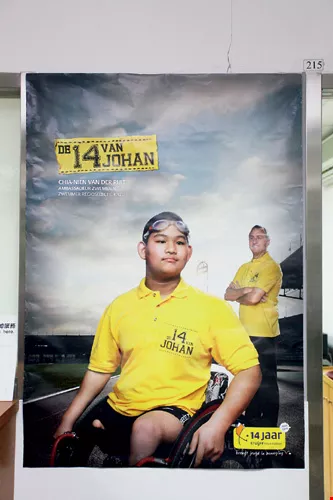
Niannian has been living with his adoptive family in the Netherlands for more than 10 years. Though born handicapped, in 2001 he was named as swimming ambassador for the Cruyff Foundation of Holland, and will participate in the 2012 London Paralympic Games.
Ah Jie was the second child to be placed abroad through the Chiayi Branch Office of the TFCF. The first was Baodi, who was adopted by a couple in the Netherlands.
Baodi’s foster father Hong Guangpu remembers very clearly the day that he, his family, and the county social worker brought the 16-month old Baodi to Taipei for the “handover.” It was Christmas Day of 2004. Before they set off, they met the birth mother at Chiayi Railway Station so she could have a chance to say goodbye. When she took Baodi into her arms for the last time, realizing that she would never raise to adulthood the baby to whom she gave birth, she burst out in tears of self-recrimination, and was finally left standing outside the ticket gate, too distraught to watch Baodi carried onto the train.
Arriving in Taipei, they were greeted by staff from the agency handling the adoption. After a quick debriefing from the Hongs about Baodi’s routine and habits, they took him away, leaving the Hongs behind, and they could only observe Baodi’s condition from a distance. Even though Hong Guangpu thought that he was fully prepared to say goodbye, it tore him up inside to see Baodi, now bereft of any familiar faces, break into wails. Mrs. Hong, unable to bear the parting scene, turned away into a corner and wept.
What Mr. Hong regretted most of all is that he didn’t even get to meet the adopting couple from Holland, so that he was unable to tell them how much he wanted them to take good care of Baodi.
In recent years, with greater attention being paid to children’s rights and adoption agencies upgrading their quality of service, there has been considerable improvement in terms of avoiding the kind of experience the Hongs had. Social worker Xu Huiping of the TFCF Chiayi branch comments that years ago, it was very rare for children to be given graduated contact with the adopting families. It was more like an ancient arranged marriage—the first meeting hooked up the two parties “till death they do part.”
In contrast, most adoption agencies these days follow these steps: Once the application process is finished, the child’s information has been relayed to the potential parents, and both parties are sure they will proceed with the adoption, first there is online visitation via Skype. This helps develop some sense of intimacy, or at least familiarity, between the child and the adopting family. More often than not, the adopting family can’t wait to show off their home and the room they have prepared for the child, so they prepare an album of photographs and send it to the intermediary agency to pass on to the child, so that he or she can get used to the environment of their soon-to-be new home.

The German family that would adopt Ah Jie (second from left, front row) came to Taiwan so they all could meet. One of the things they did together was go to the Janfusun Fancyworld theme park.
For both parties, the greatest risk of an international adoption is that there is no trial phase. Adopting parents are worried about whether the child they adopt might not have some undisclosed serious illness or behavioral problems. Might they end up with an “evil” child like the one in the film Orphan?
The more anxieties the adopting family has, the more difficult it will be for the child to find acceptance.
Renren is a young boy who in 2011, already more than five years old, was adopted out to the US. But before that, he had been rejected by another family that had expressed an interest in adopting him.
Huang Chunnü, a social worker at the Pingtung Branch Office of the TFCF, which handled Renren’s stay with a foster family prior to his placement in the US by the adoption agency, relates that when Renren was three and a half, an American couple with no children of their own agreed to adopt him. But just when everything seemed to be going smoothly, Renren was diagnosed as being mildly mentally handicapped. Just a few days before they were to have their first online contact, the American couple received the evaluation report, and immediately decided to halt the process.
Renren, still just a toddler, didn’t really understand what was going on, but he did know that the “Daddy” that “Auntie” (his social worker) had told him about was not going to come. His mood took a marked change for the worse, and for two or three days he didn’t say a word.
Huang Chunnü says that Renren had little capacity to protect himself against disappointment or shock. He showed little outward emotion, but quietly bottled things up inside. In the short run he simply swallowed the pain and “resigned himself to fate,” but ultimately he blamed himself.
But fortunately it sometimes happens that when one door closes, another opens. An intermediary agency in Taiwan heard about another American couple looking to adopt, who didn’t care in the least that Renren was classified as a special-needs child.
Organizations in Taiwan that match up adopters with adoptees usually don’t put up very long with any family that is interested only in adopting a “perfect” child. Xie Huizhen, the supervisor of social workers at the Christian Salvation Service, says that once they decide to adopt, the parents should unreservedly accept any problems the child may have.
Perhaps the most tragic cases, however, are not those who have difficulty finding adoptive parents in the first place, but those who are actually adopted but then rejected.
Lulu, who has ADHD, was adopted in May of 2010 by a couple from mainland China who had emigrated to the US. His new home also included the couple’s own son, who is one year older than Lulu.
Sadly, the interactions between Lulu and his adoptive parents did not go well, and six months later they gave up on him.
There was no physical abuse involved, says social worker Jean Wang of the Cathwel Service, but the father was rather big on parental authority, and had zero tolerance for Lulu telling lies or testing his new parents’ limits. Although a social worker in the US did an intervention to try to help, the adoptive father was determined to terminate the relationship. Following an evaluation by a US agency, Lulu was then adopted by another local family.
“The original adoptive family did not give this child enough time,” sighs Rosa Wang, Cathwel’s executive director. Considering that there is friction even between family members who have been together all their lives, shouldn’t adoptive parents also be patient?
Who am I?There is pretty much a global consensus that in-country adoption is the preferred option. There are concerns that adoption that is cross-national, cross-ethnic, or cross-cultural will cut the child off from his or her birth family as well as his or her “mother” culture, leaving the child rootless and creating the risk of an identity crisis.
In 2005, Jane Jeong Trenka, an American of Korean ancestry, published The Language of Blood, a memoir in which she criticizes cross-national adoption. She argues that cross-national adoption cuts off blood ties and distorts the memories of the adopted child. These memories, as she describes them, are like fragments of a dream, experienced as if one were floating in space-time, with some visual content, but, strangely, no language or text!
Trenka’s provocative argument has sparked a lively debate: Does cross-national adoption inevitably mean traumatic identity issues? Is there necessarily a conflict between the “language of love” and “the language of blood”? The critical factor is whether the parents are honest with the child about the child’s birth background.
Taiwanese author Xu Huijun, who along with her US-born husband adopted four children here in Taiwan, published a book in 2011 entitled A Family Like Ours: Finding Happiness Through Adoption. In it, she strongly suggests that “people who are not willing to frankly tell the child about his or her background” should think twice before adopting.
In recent years adoption agencies in Taiwan have strongly emphasized the importance of adoptive families revealing to adopted children their true origins. The point is to make it clear to everyone that “adoption is nothing to be ashamed of,” and every child has the basic right to search for his or her roots.
For adoption within Taiwan, because everyone shares typically Asian physical features, it is difficult to tell at a glance any difference between a natural and an adopted child. But that doesn’t mean that the child’s true identity should be hidden. Where the adoption involves parents of a different racial group, the lack of a genetic relationship is a no-brainer, so it should be even more of a given that the child will be told about their origins as they grow up, and that the parents will respect their choice to search for their roots.
Six years ago Cathwel began taking the initiative to invite adults who had, as children, been sent overseas for adoption, to come back to Taiwan to explore their origins. Their stories of separation from and reuniting with people with whom they have blood ties are very moving.
Cathwel’s Cecilia Chyn recalls a case from five years ago in which a 16-year-old young man named Peter, who had been sent to the US for adoption as a baby, came back to Taiwan to look for his birth mother. Because the mother, who had since married, had never told her husband that she had previously had a child out of wedlock, it was not possible for her to get to Taipei to meet Peter, so Peter agreed to go down to Tainan to meet her.
Peter was already aware that his mother, after getting married, was the sole breadwinner in her family, and that her life was very hard. Guided by a social worker, Peter met with his mom in a factory in a remote mountain area in Tainan. Meeting alone together for the first time, the emotions of more than a decade apart gushed to the surface. “Mom, I’ve never stopped thinking about you!” Hearing this, she covered her head with her arms and wept piteously, unable to speak for a long time.
“I’ve done you wrong! I’m sorry!” she finally said. Just by hearing this sentence directly from his mother, Peter was able to set down the burden of all the feelings of resentment that he had been experiencing for all those years.
There is one touching sentence from A Family Like Ours that is especially worth repeating here: “Although adoption always starts out as tragedy, it can turn into an extraordinarily happy ending.” When birth families stumble, so long as foster families can pick up the baton and pass it along to adoptive families to carry to the finish line, and the whole race is run with commitment, love, and dedication, then we have seen the best there is to be found in the human race
@List.jpg?w=522&h=410&mode=crop&format=webp&quality=80)

@List.jpg?w=522&h=410&mode=crop&format=webp&quality=80)


@List.jpg?w=522&h=410&mode=crop&format=webp&quality=80)

@List.jpg?w=522&h=410&mode=crop&format=webp&quality=80)
